
Normally, software development teams have to go through the exhausting, time-consuming process of manual testing. Yet, despite these rigorous efforts, human errors happen, and stubborn bugs invariably slip through the cracks before a product launches.
This is exactly why relying solely on manual processes is no longer enough. To truly enhance QA efficiency and coverage, AI automation solutions have emerged as the ultimate game-changer. By flawlessly executing scalable tests and comparing outcomes in real-time, these intelligent tools free your team from repetitive tasks, ensuring a seamless and successful product launch.
In this article, you can gain a deeper insight into this topic by exploring the following:
- Understanding test automation
- Advantages of employing AI in test automation
- Considerations for Test Automation with AI
- Practical applications of AI in test automation
- A 2023 comparison of AI-based test automation tools
What is Test Automation?
Automated testing is a software testing technique that uses specialized tools to execute a suite of test cases, providing faster and more accurate results than manual testing. The process of repeatedly running the same test suite is time-consuming, so test automation tools help you create and re-run test suites efficiently, reduce human intervention, and increase test ROI (return on investment).
Automated testing allows you to easily input test data into the target system, compare expected and actual results, and generate comprehensive test reports. Although it requires a certain investment of money and resources, integrating AI automation solutions into your automated testing is a worthwhile investment for organizations looking to streamline their software testing processes.
The Need for AI Automation Solutions in Testing
Leveraging automated testing stands out as the optimal approach for enhancing effectiveness, expanding test coverage, and accelerating execution speed in software testing. The significance of automated testing is underscored by several key reasons:
- Increased Accuracy: Automated tests meticulously adhere to predefined steps, minimizing the impact of human error. This precision eradicates errors attributed to tester mistakes, ensuring accurate and reliable results.
- Faster Execution: Operating autonomously, automated tests can run continuously 24/7 without human intervention. This continuous operation significantly slashes test time, expediting the overall test execution speed.
- Consistency: Automated tests consistently and uniformly execute test cases, mitigating the risk of overlooking critical issues. This uniformity boosts confidence in the overall quality of the software.
- Cost Savings: While there is an initial investment in implementation, the return on investment (ROI) from automation is most pronounced in large projects. Over time, automated testing proves to be a cost-effective solution by saving time, technology, and human resources costs.
- Extended Test Coverage: Automated test suites are versatile, allowing reuse across multiple browsers, devices, and operating systems. This eliminates the need for repetitive execution of test steps and broadens test coverage.
- Improved Test Reusability: Automated tests can be easily saved and reused, eliminating the need for testers to invest time in recreating tests. This promotes efficiency and streamlines the testing process.
- Continuous Testing: Automated tests seamlessly integrate into various stages of the development process and can be incorporated into the development pipeline. This integration ensures that tests run automatically whenever new changes are made, facilitating continuous testing.
For software businesses and professionals in the digital industry, investing in automated testing proves to be highly advantageous, significantly contributing to the efficiency of the product development process.
Levels of AI and Its Role in Automated Testing
Contemporary AI technology relies on machine learning algorithms to train models using extensive datasets. Subsequently, these trained models are employed to predict outcomes and generate desired outputs, forming the foundational principle behind most AI applications. While this simplified explanation broadly captures the essence of AI, a crucial question arises:
Can AI play a role in automatically generating and updating test cases? Can it effectively uncover bugs and contribute to enhancing code coverage? These inquiries are particularly pertinent as we find ourselves amidst the zenith of the AI hype cycle, with deep learning, in particular, fueling much of this enthusiasm.
Embracing the inevitability of AI, rather than harboring apprehensions about potential job displacement, is paramount. Instead, we should regard AI as a tool designed to streamline our work processes. Here are some strategies to accomplish that using AI automation solutions.

Increased Speed and Efficiency
One of the main benefits of using AI in software testing is the increased speed and efficiency it provides. To be more precise, AI automation solutions can perform repetitive and time-consuming tasks such as regression, functional, and performance testing much faster than human testers. This not only saves time but also reduces the risk of human error.
You can also use AI tools like ChatGPT to generate test cases in seconds by specifying acceptance criteria. Or, to support your software test automation efforts by asking us to create BDD-style test scenarios that can be included in your test automation framework, write test scripts, and debug your test code. You can also use
Improved Quality Assurance
AI-powered tools can improve the quality of software testing by identifying defects and bugs that might otherwise be missed. These tools analyze large amounts of data and provide insights that improve the overall quality of the application being tested. Additionally, AI can help identify patterns and trends in test data, improving the testing process and preventing future defects from occurring. AI can significantly improve quality assurance. Equip your QA team with the best software testing tools to ensure the highest quality.
Cost Reduction
Using AI for software testing can also reduce costs. By automating repetitive tasks, companies can reduce the need for human testers and save on labor costs. Additionally, AI-powered tools can help identify defects and bugs early in the software development lifecycle, reducing subsequent remediation costs and even improving product launches.
Advantages of Test Automation Using AI
There are many AI-powered testing tools, AI automation solutions, technologies, and bots available to improve the software testing process.
Automatic Script Generation
AI-powered test automation tools can automatically generate scripts, saving your QA team time and effort. These tools can analyze the application under test and generate test scripts covering all important features.
This not only saves you time but also ensures that all important features of your application are thoroughly tested. Popular test automation tools that use AI for automatic script generation include Testim and Katalon Studio.
Tools like ChatGPT can also be used to generate source code for manual test cases and unit tests, helping increase test coverage.
Test-case Optimization
AI automation solutions help optimize test cases by analyzing test data and identifying patterns and trends. This allows testers to focus on the most important areas of the application and reduces the number of test cases required. AI-powered test case optimization also helps identify redundant test cases that can be removed, saving time and effort. Popular AI-based test case optimization tools include Applitools and TestCraft.
Running Automated Tests
AI technology can automate test execution, reduce human intervention, and save time and effort. This allows for exploratory testing, which takes up more time for manual testing teams.
AI-powered test automation tools can automatically run test cases and provide detailed reports. These tools can also analyze the results and identify defects and bugs that need to be fixed. Popular test automation tools that use AI to run automated tests include Testim and Katalon Studio.
To maximize the benefits of AI in software testing, consider integrating dedicated test management software into your workflow.
Self-repair Function
AI-powered testing frameworks can automatically detect and fix defects, reducing the need for manual intervention. These frameworks can analyze test data and identify defects that need to be fixed. The necessary fixes are then automatically applied to ensure that the application functions correctly.
For example, some tools have an option to automatically update XPath and other locators in your web application. Popular AI-based software testing tools with self-healing capabilities include Testim and Healenium.
Read more: Evolution of AI: An Algorithm can revolutionize the World
Points to be Noted When Automating Tests Using AI
Of course, every innovation comes with its own set of hurdles, and AI automation solutions are no exception. In the context of software testing, developers and QA teams should prepare for two primary challenges:
Long Learning Curve
The learning curve for AI in software testing is steep and one of its biggest challenges. Effective use of AI-powered testing tools requires extensive training and knowledge. This can be difficult for software testers who are new to AI technology. Additionally, the complexity of AI-powered testing technology can make it difficult to integrate into current testing processes. To enable testers to effectively use AI-powered testing solutions, companies must engage in training and education. Testers have the necessary skills to effectively use AI-powered testing tools.
Difficulty in Debugging
Debugging complexity is an additional challenge with AI in software testing. Testing software with AI capabilities provides a large amount of data, which can be difficult to understand. Furthermore, the complexity of AI algorithms can make it difficult to identify the main cause of errors and issues. As a result, software testers may find it difficult to effectively resolve bugs and defects. Companies should invest in systems and procedures that allow them to efficiently examine and interpret test results produced by AI-powered testing solutions.
Application of AI in Test Automation
Creating and Updating Unit Tests
Unit tests are often used as part of continuous testing and continuous integration/continuous delivery (CI/CD) in DevOps, but they can be a real pain in the ass for small projects.
Developers typically spend a significant amount of time writing and maintaining unit tests, which is not as fun as writing application code. In these scenarios, AI automation solutions that automatically generate unit tests can be incredibly helpful. These tools are particularly valuable for organizations looking to implement robust unit testing later in the product lifecycle without slowing down their development velocity.
Advantage:
- AI-based automated unit testing is a significant advance over template-based automated unit test generation using static or dynamic analysis. Tests generated this way are actual code, not just stubs.
- AI-based unit tests can be generated very quickly, making them suitable for large existing codebases.
- Developers can set up a unit regression suite relatively quickly by simply modifying the tests.
Limitations:
- Unit tests generated by AI simply reflect the code it was built on, but they still cannot infer the intended functionality of the code. If your code does not behave as intended, the unit tests generated for that code will reflect that unintended behavior.
- This is a big negative point since the purpose of unit tests is to enforce and verify implicit or explicit contracts.
- Unit tests generated using machine learning can break existing working unit tests, and it is the developer’s responsibility to avoid this.
- Developers must write tests for complex business logic themselves.
Automated User Interface Testing
This is a domain where AI automation solutions are demonstrating notable prowess. In AI-based UI testing, these tools meticulously analyze the Document Object Model (DOM) and associated code to discern object properties. As a programming interface for HTML and XML documents, the DOM allows programs to modify document structure, style, and content. By representing documents as nodes and objects, it forms the essential foundation of the entire testing process.
Furthermore, AI-based UI testing incorporates image recognition technology to traverse applications, visually scrutinize UI objects, and examine elements for the creation of UI tests. In tandem, AI testing systems harness exploratory testing to unearth bugs and variations in the application UI, generating screenshots for QA engineers to verify. This approach also facilitates an in-depth examination of visual aspects of the System Under Test (SUT), including layout, size, and color.
Advantages:
- Automated UI tests have the potential to enhance code coverage. They exhibit resilience, accommodating small deviations in the UI without causing test suite failures, thanks to the adept handling by AI models.
Limitations:
- The landscape of modern applications encompasses a myriad of platforms, app versions, and browser iterations, posing uncertainties about the efficacy of AI-based UI automation under such diverse conditions. However, the advent of cloud testing tools that can execute tests concurrently presents an intriguing avenue for exploration in this realm.
Leveraging AI for API Testing
Automating API testing poses inherent challenges, demanding a profound understanding of APIs and the creation of tests across a multitude of scenarios to ensure comprehensive coverage. Existing API test automation tools, such as Tricentis and SoapUI, employ recording of API activity and traffic to analyze and formulate tests. However, modifying and updating tests necessitates a deep dive into the intricacies of REST calls and parameters, demanding manual intervention in updating the API test suite.
AI automation solutions strive to address this complexity by examining traffic, discerning patterns and connections among API calls, and intelligently grouping them by scenario. These tools not only utilize existing tests to comprehend relationships between APIs but also employ this knowledge to understand API changes, subsequently updating existing tests or generating new scenario-based tests.
Advantages:
- Simplified Onboarding for Novice Testers: Particularly beneficial for novice testers or those lacking programming experience, AI-driven tools streamline the initiation process. Efficient Change Management: AI automation tools significantly ease change management, handling certain API modifications autonomously.
Limitations:
- Complex Setup: API testing, in general, remains challenging to set up, and the adoption of machine learning-based functionality in this domain is limited. Many tools exhibit relatively basic functionality in this regard.
Automated Test Maintenance
AI-based tools can evaluate code changes and fix some existing tests that don’t adapt to those changes, especially if the code changes are not very complex. You no longer need to interrupt your test suite when updating things like UI elements or field names.
Some AI tools monitor running tests and try modified variants of failed tests by selecting UI elements based on the best fit. You can also verify test coverage if needed.
AI-based Test Data Generation
Test data generation is also a promising area for AI automation solutions. With machine learning, you can easily generate datasets, such as a person’s profile picture and information like age, weight, and more, which are based on a machine learning model trained using existing production datasets.
The test data generated in this way is very similar to production data and is ideal for use in software testing. The machine learning model that generates the data is called a generative adversarial network (GAN).
AI Test Automation Tools Comparison in 2023
TestSigma
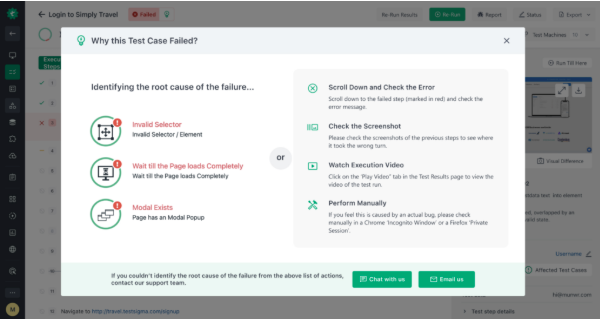
Testsigma is one of the top AI testing tools. It allows QA analysts and automation engineers to create automated tests for web, mobile, and desktop applications, and APIs. Moreover, it also has powerful auto-repair features to fix errors. This tool allows manual testers and team leaders to efficiently run tests in parallel.

Features
- Codeless test development using natural language processing.
- Creating a test is as easy as writing a simple English sentence.
- Since it is cloud-based, no installation is required.
- Supports web, mobile, desktop, and API test automation.
- Great dashboard. Intuitive intelligence and automatic remediation.
- Data-driven features for real-world test cases.
- Automatic scheduling and report customization.
- Seamless integration with all popular CICD tools.
Price
- Testsigma offers three pricing models.
- Users can sign up for a free trial or subscribe to a Pro/Enterprise plan.
Mabl
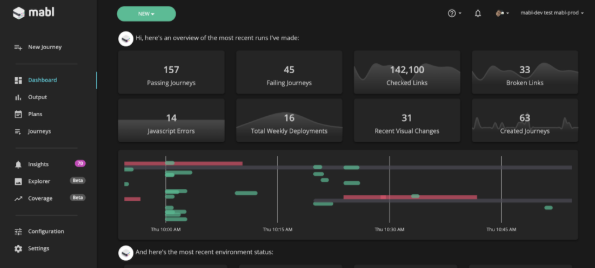
Mabl is one of the AI testing tools with a powerful and intuitive GUI interface. This tool provides low-code testing capabilities and eliminates the need for scripting. Busy teams can test faster, with end-to-end tests running from the first code to the end. Similarly, this tool enhances collaboration with clients and managers at every step.
Features:
- Low-code testing capabilities that allow developers to focus on quality.
- Intuitive intelligence and automatic remediation.
- Data-driven features for real-world test cases.
- Extensive end-to-end testing capabilities via API.
- Ability to use data to generate insights for developers.
- Dashboard for easy navigation.
Fee:
- Three plan options are available: startup, growth, and enterprise. Prices for each plan vary depending on the number of users.
Testcraft
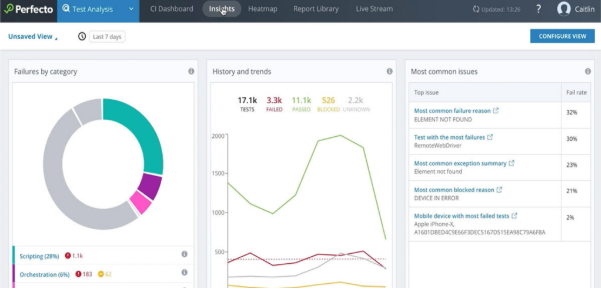
Perfecto’s TestCraft is one of the Selenium-based AI-driven test automation tools. Furthermore, it has been developed to allow both manual and automated testing. This tool is perfect for running web-based software tests at lightning speed. Additionally, it can be extended to provide the highest quality industry-based standards. Moreover, it has the best features for performing repeated tests.
Features
- Multilingual support. Developers can write scripts in multiple languages and run them on the tool.
- There is a copy-to-clipboard feature that allows users to copy and paste tests to the clipboard.
- A test idea generator to test your website using advanced GPT technology.
- Integration features to integrate with other tools.
- Available online as SaaS.
Price
- Free trial, monthly, and annual subscription options. The minimum cost per user is $29.
Testim.io
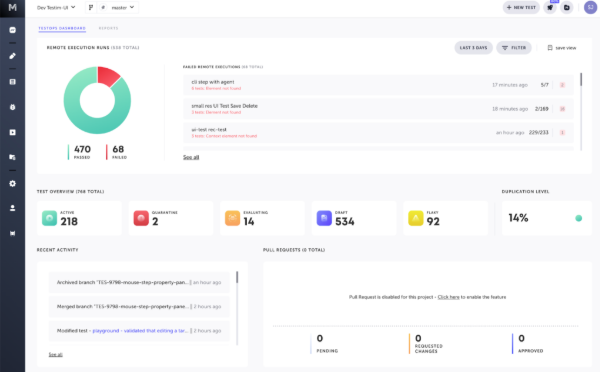
Perfecto’s TestCraft is one of the Selenium-based AI-driven test automation tools. Furthermore, it has been developed to allow both manual and automated testing. This tool is perfect for running web-based software tests at lightning speed. It can also be extended to provide the highest-quality industry-based standards. Moreover, it has the best features for performing repeated tests.
Features
- Multilingual support.
- Developers can write scripts in multiple languages and run them on the tool.
- There is a copy-to-clipboard feature that allows users to copy and paste tests to the clipboard.
- A test idea generation tool to test your website using advanced GPT technology Integration features to integrate with other tools.
- Available online as SaaS.
Price:
- There is a free plan with limited features and a subscription plan with more features.
Aqua ALM
Aqua ALM leverages natural language processing capabilities to run tests. It is one of the AI-driven test automation tools with multilingual testing capabilities. Additionally, this web-based platform offers high flexibility, complete visibility, and easy-to-use tools. This platform allows developers to reduce testing time and run more tests. Additionally, it is designed as a test management system for busy businesses. In particular, this tool is a great choice for large technology companies.

Features
- Enables centralized test management by multiple departments.
- Generate reports for test runs.
- It has the ability to detect and fix defects.
- Generate tests automatically.
- Includes budgeting and forecasting tools.
- Permissions and access control features.
Price
- There is a free trial option, after which users need to subscribe. Fees are charged per user based on the total number of users.
Summary
All in all, artificial intelligence is fundamentally reshaping testing tools and methodologies, driving a significant evolution in AI automation solutions. A survey of current tools reveals a landscape where numerous promising capabilities are being introduced, even as some functionalities continue to mature and reach their full potential.
In this context, Relipa stands out with a robust 7-year track record as a trusted partner for Japanese IT companies across information technology, blockchain, and AI. By delivering offshore development that is both cost-effective and highly efficient, we ensure seamless communication through our English-proficient developers and top-tier project managers. Our commitment to maintaining 100% Japanese-standard communication and delivery throughout the contract ensures that every project meets the highest quality benchmarks.
