
Choosing the right offshore software development company is no longer just about cutting costs. Today’s buyers are looking for reliable delivery, long-term scalability, and partners who can integrate seamlessly with their internal teams.
Vietnam has rapidly become one of the most trusted offshore destinations for global companies — not only because of its competitive pricing, but because of its proven engineering talent, mature outsourcing ecosystem, and strong track record with international clients.
If you are evaluating offshore partners in 2023 and beyond, understanding how rates work in Vietnam — and what you actually get for your investment — is critical.
Why Vietnam Is a Strategic Choice for Offshore Software Development
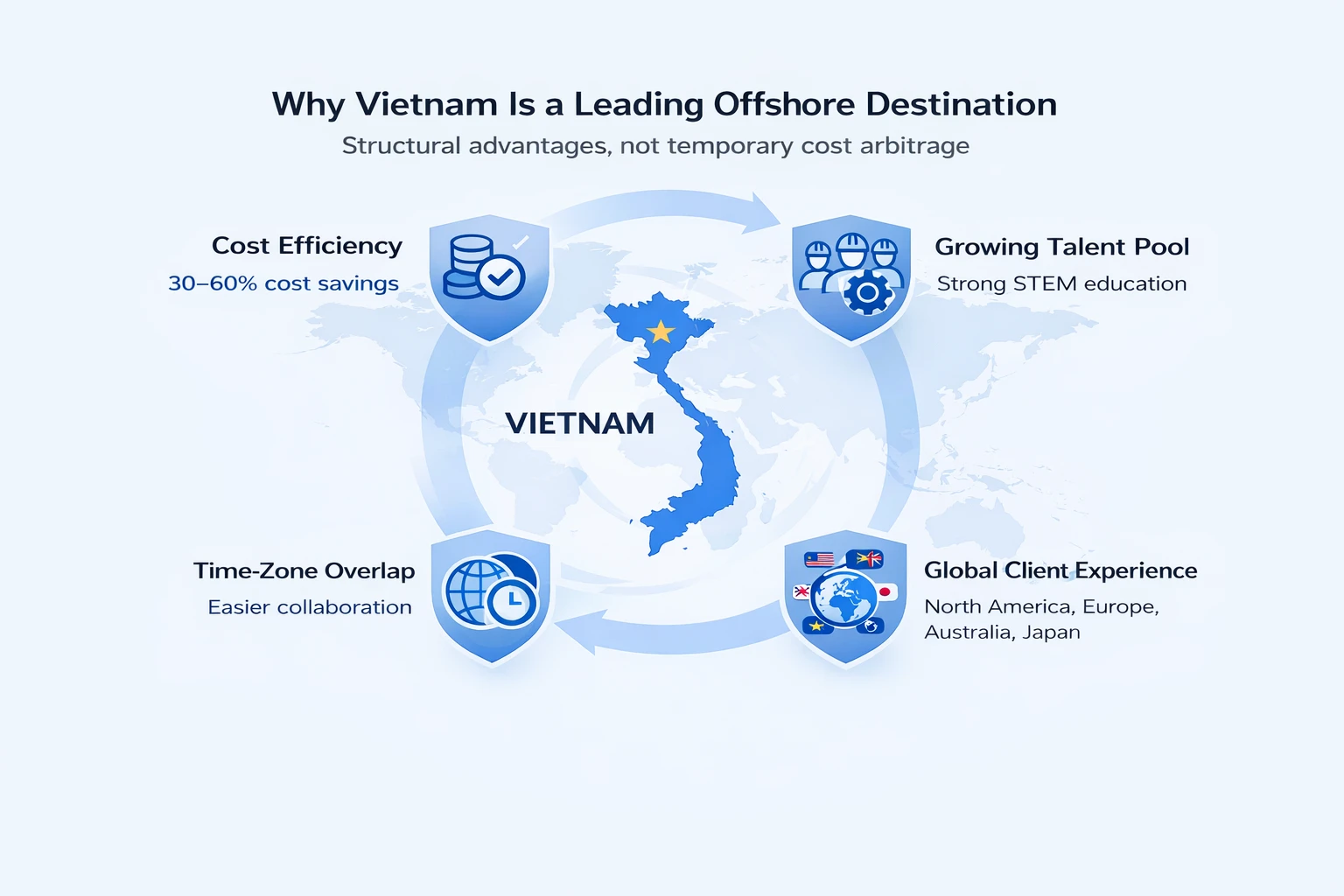
Vietnam’s position as a leading offshore destination is the result of structural advantages, not temporary cost arbitrage.
1. Cost Efficiency Without Compromising Quality
Vietnam consistently delivers 30–60% cost savings compared to Western markets, while maintaining solid engineering standards. For companies under pressure to optimize budgets without sacrificing delivery quality, this balance is difficult to ignore.
2. A Deep and Growing Engineering Talent Pool
Vietnam’s IT workforce has expanded rapidly over the past decade, supported by strong STEM education and government investment in the ICT sector. This means offshore software development companies in Vietnam can scale teams quickly as your product grows.
3. Strong Experience with Global Clients
Vietnamese offshore teams regularly work with clients from North America, Europe, Australia, and Japan. As a result, most established offshore software development companies already operate with Agile/Scrum, international coding standards, and remote collaboration best practices.
4. Practical Time-Zone and Communication Advantages
Vietnam offers workable time overlaps with Asia-Pacific and partial overlap with Europe, making real-time collaboration easier than with many other offshore locations.
Understanding Software Development Salaries in Vietnam
To properly evaluate an offshore software development company, it is important to understand the salary structure that underpins development rates in Vietnam. These figures help explain why offshore pricing remains competitive while still being sustainable for long-term delivery.
In Vietnam, software engineer salaries vary by experience level, responsibility, and specialization. Typical monthly salary ranges include:
- Junior software engineers: ~$350–$600
- Mid-level engineers: ~$1,000–$1,200
- Senior engineers: ~$1,500+
- Technical leads and managers: $2,000+
Compared to Western markets—where annual software engineer salaries often exceed USD 80,000—Vietnam’s salary structure reflects differences in cost of living and economic conditions rather than technical capability. This enables offshore software development companies in Vietnam to build stable teams, invest in training, and retain talent while still offering competitive pricing to international clients.
For buyers, these benchmarks provide useful context: lower offshore rates are not driven by short-term labor arbitrage, but by structural advantages that support scalable, long-term partnerships.
Typical Offshore Software Development Company Rates in Vietnam
When global buyers evaluate an offshore software development company, hourly rates are often the first comparison point. In Vietnam, these rates remain competitive while still supporting stable delivery and long-term team retention.
Based on prevailing market benchmarks, offshore software development companies in Vietnam typically operate within the following hourly ranges:
- Junior developers: $18–25/hour
- Mid-level developers: $25–35/hour
- Senior developers: $35–50/hour
These ranges reflect differences in experience, technical responsibility, and problem-solving capability rather than simple coding capacity. Junior developers are usually suitable for well-defined tasks under supervision, while mid-level engineers handle core feature development and system components. Senior developers, who command higher rates, often contribute architectural decisions, technical leadership, and risk mitigation—areas that significantly influence overall project success.
For buyers, the key takeaway is that total project cost is not determined by hourly rate alone. A slightly higher rate from a mature offshore software development company often translates into better productivity, fewer defects, and reduced long-term maintenance costs. As a result, many companies find that balanced team compositions—combining senior oversight with mid-level execution—deliver the best return on investment.
These rate benchmarks also highlight why Vietnam remains attractive for offshore development: companies can access experienced engineering talent at a fraction of Western costs, without compromising delivery reliability or technical standards.
What Actually Drives Offshore Development Costs?
When comparing offshore software development companies, smart buyers look beyond headline pricing.
Experience and Specialization
A senior engineer who delivers clean architecture and reduces rework can be far more cost-effective than a cheaper, inexperienced developer.
Location and Talent Competition
Companies based in major tech hubs like Ho Chi Minh City or Hanoi may charge slightly higher rates — but often provide stronger talent pipelines and project management maturity.
Engagement Model
- Dedicated teams offer stability and long-term efficiency
- Time & materials provide flexibility for evolving requirements
- Fixed-price works best for clearly defined scopes
The best offshore software development companies will recommend the model that fits your business goals — not just what benefits them.
Currency and Contract Stability
Professional offshore vendors structure contracts to minimize currency risk for clients, ensuring predictable costs over long-term engagements.
Why Vietnam Continues to Win Offshore Projects
Vietnam’s offshore software development market has evolved beyond simple staff augmentation. Today, many companies offer end-to-end services covering product design, development, testing, deployment, and maintenance.
Vietnam’s offshore software development ecosystem has matured significantly. Today, it offers:
- A young, skilled, and motivated engineering workforce
- Competitive rates backed by sustainable economics
- Strong alignment with international delivery standards
- Increasing specialization in enterprise, SaaS, AI, and cloud solutions
For companies seeking a reliable offshore software development company, Vietnam is no longer an “emerging option” — it is a proven strategic choice.
How to Choose the Right Offshore Software Development Company
If you’re actively evaluating offshore partners, follow a disciplined selection process:
- Define your technical and business goals clearly
- Shortlist vendors with proven domain experience
- Review real case studies, not just marketing claims
- Assess communication quality and responsiveness early
- Ensure contracts, SLAs, and IP protection are explicit
Cost matters — but predictability, trust, and delivery consistency matter more.
Final Thoughts
If your goal is to scale software development efficiently, reduce delivery risk, and build a long-term technology capability, partnering with the right offshore software development company in Vietnam can be a decisive advantage.
The key is not choosing the cheapest vendor — but choosing a partner that understands your business, communicates clearly, and delivers consistently.
Relipa Software
Relipa Co., Ltd. is a Vietnam-based software development company established in April 2016. After two years of growth, our Japanese branch – Relipa Japan – was officially founded in July 2018.
We provide services in MVP development, web and mobile application development, and blockchain solutions. With a team of over 100 professional IT engineers and experienced project managers, Relipa has become a reliable partner for many enterprises and has successfully delivered more than 500 projects for startups and businesses worldwide.
