8 Major Benefits Of IT Outsourcing In Vietnam
If you want to have groundbreaking growth for your IT infrastructure, a Vietnam IT outsourcing service is an ideal one. Many young and talented engineers and human resources with high IT literacy have been nurtured, and it is possible to outsource a wide range of IT operations at a reasonable price. Tech giants such as Apple and Samsung also highly value Vietnam’s potential and future prospects in the IT field.
Tech-savvy and diligent engineers who are experts in various fields such as Artificial Intelligence, Blockchain, and Web/App/System Development can provide a qualified service at a preferred price compared to European countries. Tech titans also highly valued Vietnam’s potential and future prospects in the IT field.
Therefore, in this article, we will explain the meaning and types of IT outsourcing and the top 8 significant advantages of using IT outsourcing in Vietnam.
What is IT Outsourcing?
IT outsourcing refers to the practice of delegating IT-related activities to a specialized company, also known as “ITO (Information Technology Outsourcing).”
The spectrums and varieties of services offered encompass system development, software development, server management, security measures, and operating system upkeep. In the rapidly evolving IT landscape, substantial time and financial investments are required to establish and train an in-house IT workforce for such purposes. Additionally, excessive resource allocation to IT operations may divert attention from core business functions, leading to misplaced priorities. Consequently, outsourcing IT operations not only enables cost savings but also enhances operational effectiveness and competitiveness.
The IT Field is the Area Where Outsourcing is Most Utilized
Originally, outsourcing itself has been done in various industries, so it is not uncommon.
It is prevalent to use outsourcing services in various industries. For instance, in the construction domain, construction firms and builders often subcontract equipment and interior tasks that surpass their capabilities, relying on subcontractors to accomplish the work. Similarly, within the fashion industry, it is customary to outsource dyeing and sewing responsibilities to specialized small or medium-sized entities. However, in many of these instances, outsourcing pertains to peripheral tasks that are ancillary to their primary operations and deemed essential for successful execution.
However, in the case of IT outsourcing, eligibility extends to all companies utilizing personal computers, the Internet, cloud computing, and similar technologies, regardless of the industry they operate in. It encompasses not only the construction and fashion sectors mentioned earlier, but also manufacturing industries like food, steel, and chemicals, distribution sectors including supermarkets, convenience stores, and department stores, logistics industries encompassing warehouses and transportation, government institutions such as national and local administrations, medical facilities, trading companies, agricultural and forestry enterprises, water-related entities, a broad array of infrastructure-related domains like fuel and communications, and even entertainment industries.
Currently, the need for DX (Digital Transformation) is being strongly called out in all industries around the world. We aim to gain a competitive edge by effectively utilizing the power of digital technology to improve operational efficiency and transform our business model to improve our products and services to an unprecedented level. But DX is easier said than done. The urgency to embark on digital transformation (DX) arises from the understanding that failure to do so promptly jeopardizes meeting customer demands and puts the future at risk. Conversely, numerous instances exist where organizations possess the concept of DX but lack the knowledge and know-how to implement it effectively. In light of this, it is not an overstatement to assert that the attainment of DX would be unattainable without the support of IT companies equipped with profound expertise and extensive experience.
Types of IT Outsourcing
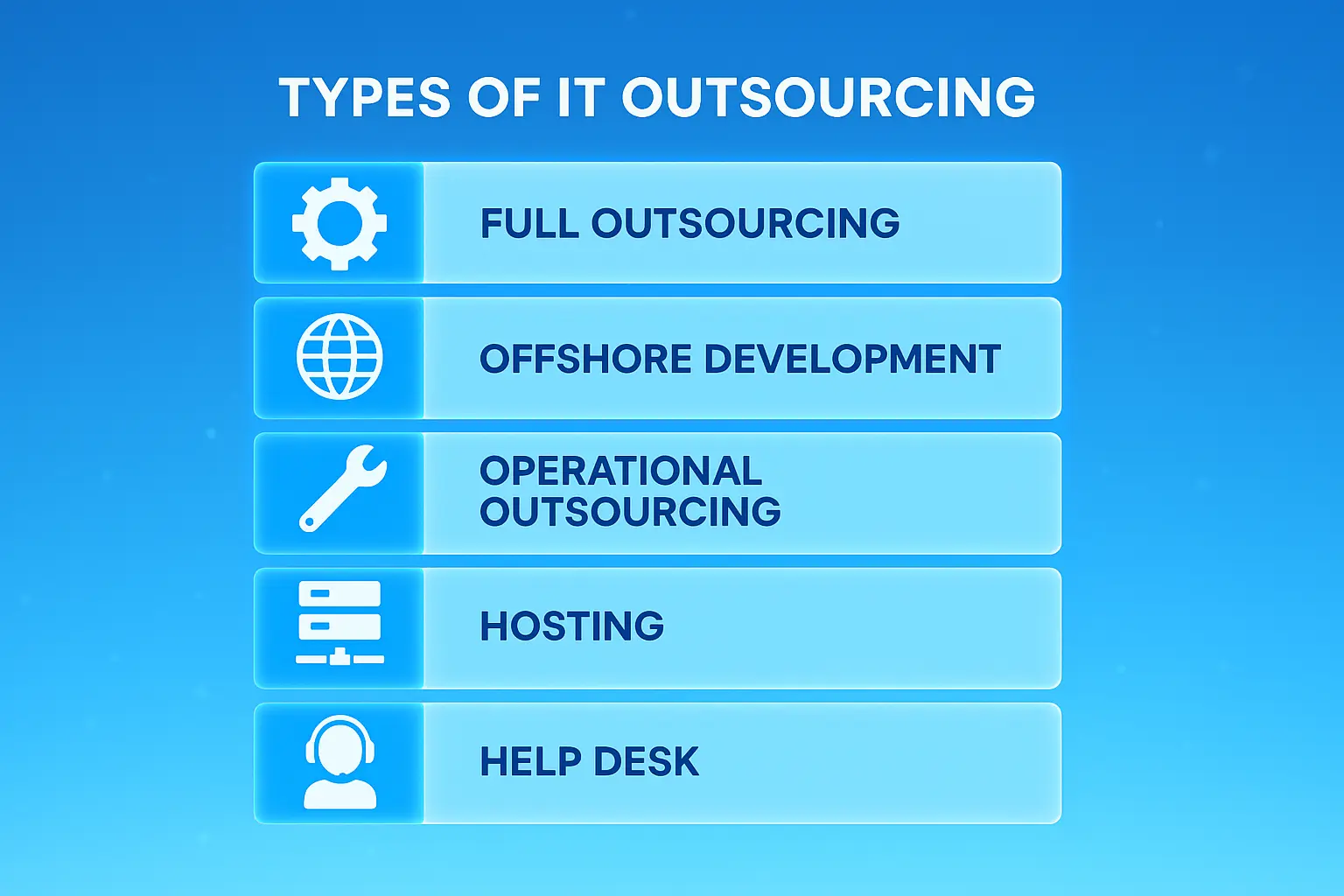
There are many types of IT outsourcing.
Specifically:
- Full outsourcing
- Offshore development
- Operational outsourcing
- Hosting
- Help desk
Let’s talk about each.
Full Outsourcing
“Full outsourcing” is outsourcing the entire IT system.
After fully understanding the current situation of the client company, the needs of the system, the purpose of the introduction, etc., IT outsourcing companies are responsible for the total work from planning, design, development, testing, operation, and maintenance.
This format is often used when there are no IT human resources in the company, or when it is impossible to develop and operate on your own because there are very few people. In some cases, after the initial planning is done by the ordering party themselves, there are cases where further work is outsourced.
Offshore Development
“Offshore development” is a type of full outsourcing, and is a method of outsourcing development work, operation, and maintenance to IT companies mainly in Vietnam and other Southeast Asian countries.
In recent years, countries in Southeast Asia, such as India and China, have become conspicuous where the number of excellent engineers with abundant development experience is increasing rapidly. However, due to the remarkable rise in labor costs in these two countries, the advantage of offshore development, which is cheap, is fading. Therefore, Vietnam is attracting worldwide attention. The reason is that there are many high-level IT educational institutions in the country, and the country is focusing on training engineers, so the number of IT companies with excellent development capabilities is increasing.
Not only is the price level high, but development costs in European countries are skyrocketing due to the shortage of IT human resources, and the need for offshore development that can be developed at less than half the price is increasing.
Operational Outsourcing
“Operational outsourcing” is to outsource only the operational part of the IT system. There are many cases in which core systems and business systems have been developed and introduced, but cannot be fully used by in-house personnel alone. Furthermore, in recent years, cyberattacks have become more sophisticated and malicious, so security-related measures cannot be ignored. Therefore, if you can entrust the operation and maintenance, including system updates, to a professional company, you will be freed from anxiety and risk.
Hosting
“Hosting” means renting an external server. If you build your own server, you will need a lot of money and manpower for operation and management. Once the storage reaches capacity, you should consider adding more.
If you can rent a vendor’s server there, you can increase the amount of data as much as you want, and you can save the hassle of management, updates, and maintenance.
HelpDesk
The “Help Desk” handles inquiries from users on how to use IT systems and equipment on behalf of the ordering company, and responds to questions about how to use the system and equipment, and how to solve problems for employees of the ordering company.
Sometimes we respond directly by phone, and sometimes we use emails and chats. A call center is also a type of help desk. In addition, there are cases where the employee of the ordering company handles the work during the daytime, and outsourcing is done only at night and on holidays.
Read more: Top 5 Recommended Blockchain Development Companies in Vietnam! How to Have a Successful Partnership?
8 Big Benefits of Using IT Outsourcing in Vietnam
Explain 8 benefits of IT outsourcing. Above all, this article will introduce in detail the advantages that can be obtained by using offshore development in Vietnam, so please refer to it.
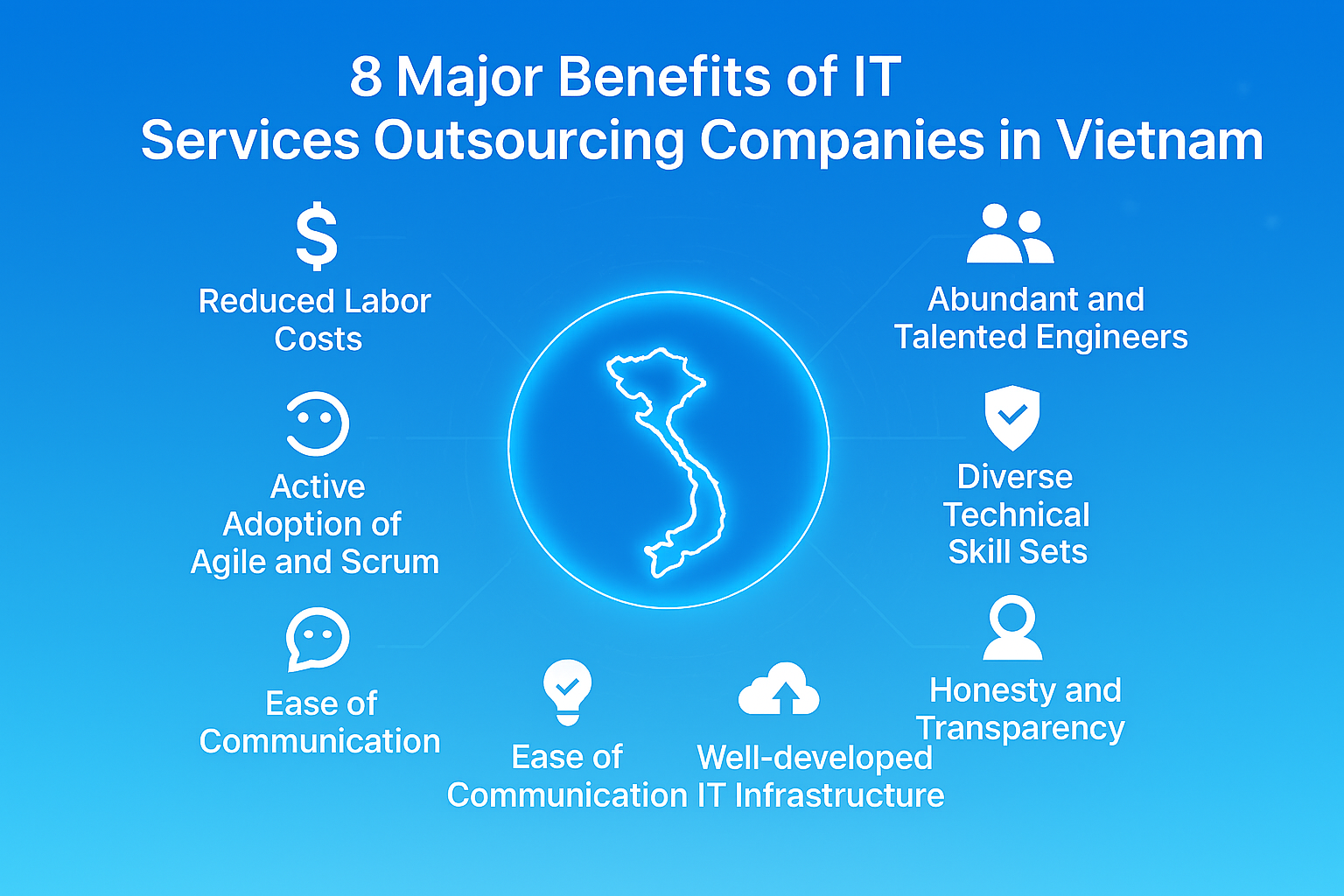
Specific benefits include:
- Reduced labor costs
- Diverse and Abundant Excellent Engineers
- Well-developed IT infrastructure
- Diverse technical skill set
- Political stability
- Ease of communication
- Active use of Agile and Scrum
- Honesty and transparency
1. Reduced Labor Costs

The hourly rate for IT engineers in Vietnam is approximately 20-30% compared to European countries, and this cost advantage also extends to IT outsourcing. In practical terms, the expenses for development that would amount to 1 million USD in Europe can be significantly reduced to 200,000 to 300,000 USD in Vietnam.
The calculation of IT outsourcing costs typically involves multiplying or adding the number of engineers and project managers who act as intermediaries between the client and the outsourced company, the unit price, and the development duration (with some exceptions). It is not uncommon for the development of core systems and software to span several months to a year or even longer, with costs ranging from millions to tens of millions of USD. With the hourly rate being around 20-30% cheaper compared to Europe, the cost reduction effect can be deemed exceptionally high.
2. Abundant Talented Engineers

Vietnam has a large number of very high-level information technology universities, such as Hanoi University of Technology and Ho Chi Minh City University of Technology. Students can interact with world-famous IT universities, receive direct lectures from engineers at top-class companies in the industry, and learn about cutting-edge technologies such as software development, AI, and IoT through internships at companies. As a result, many excellent engineers have been produced.
An important aspect to highlight is the age distribution in Vietnam. Approximately 70% of the population is under the age of 35, and individuals between the ages of 15 and 35 make up around 45% of the total population. According to United Nations data from 2020, the average age in Vietnam is about 32 years old, indicating a remarkably youthful demographic. In comparison, Japan’s average age is around 48 years old, illustrating the significant contrast in the proportion of young people between the two countries.
Considering these circumstances, it is evident that Vietnam will continue to nurture a substantial pool of young and talented engineers who will contribute to the growth of the Vietnamese economy. Furthermore, alongside the youthful population, there is also a considerable number of experienced and skilled engineers, garnering attention from around the world due to their exceptional development capabilities.
3. Well-developed IT Infrastructure
The Vietnamese government has established ambitious goals for the digital economy, aiming for a 20% contribution to GDP by 2025 and 30% by 2030. To achieve these targets, the government has implemented policies supporting various sectors such as Fintech, e-commerce, and educational technology, as well as emerging technologies like AI and blockchain, encompassing the realm of Web 3.0. The pace of digitization in Vietnam is truly impressive, and the increasing influx of foreign investments in these digital fields serves as evidence of this progress.
Notably, IT companies engaged in system development are experiencing remarkable success. Vietnam boasts a sophisticated IT infrastructure comparable to that of developed nations, and its proactive approach to addressing diverse development needs has earned significant international recognition. Consequently, leveraging offshore development in Vietnam holds tremendous potential, allowing businesses to anticipate or even surpass their anticipated outcomes.
4. Diverse Technical Skill Sets

Vietnamese engineers have diverse skill sets.
Developing cutting-edge products, including core systems, business systems, games, blockchain applications, and the metaverse, requires proficient programming skills. In Vietnam, there is a wide range of capabilities to address diverse development needs. These include expertise in logical thinking to translate client intentions into ideal user interfaces (UI) and user experiences (UX), as well as strong design proficiency and know-how to attract customers effectively. With these skill sets in place, Vietnam is capable of delivering comprehensive solutions and meeting the demands of various development projects.
With regard to TopDev’s Vietnam IT market report 2020, Vietnam has about 400.000 qualified engineers, including back-end, front-end, full-stack, etc., and approximately 50.000 graduated IT bachelors from over 150 universities and colleges.
- Vietnam ranks 29th in terms of Skillvalue Worldwide in the Developer Skills Chart Of Skill Value Report in 2018.
- Top 06 worldwide in Developer Skills Charts Of Topcoder Report in 2016.
- Ranked 23rd worldwide in Developer Skills Charts of Hackerrank’s Report in 2016.
5. Political Stability
Vietnam has long been under the one-party dictatorship of the Communist Party of Vietnam, and it can be said that it has the advantage of being quite stable politically.
From a geopolitical point of view, there are no conflicts or strong conflicts with any country, and it tends to be peaceful and calm. Therefore, it is safe to assume that the risk of a sudden political change that makes business transactions unsustainable is low.
6. Ease of Communication
By virtue of the policy published by Vietnam’s Ministry of Education, most of Vietnam’s high school students who obtain IELTS/TOEFL/TOEIC certificates can have a better place when jostling with their peers to grasp a chance to enter top-notch universities. Hence, the English level of Vietnamese students is good enough to collaborate and communicate with English-speaking countries. So you don’t need to worry about communication problems.
7. Active Adoption of Agile and Scrum
Offshore development in Vietnam is mainly a “laboratory type” that actively adopts Agile and Scrum. The laboratory type is a method in which a dedicated team is formed by the company that orders the development, and the required work is carried out with a high degree of flexibility for a set period of time. You can change the specifications as many times as you like if any problems or aspects differ from your ideal.
The goal is not the finished product. It is a rule to pay remuneration for specific work or actions. Therefore, one of our greatest strengths is that we can flexibly change the direction of development while looking at the state of testing, user reactions, and feedback.
There are almost no cases where the development of a system or application goes smoothly without any problems. There are many things to fix, and it’s not uncommon for rivals to get ahead of us in the middle of development. Therefore, it is often difficult to respond realistically unless it is Agile or Scrum.
8. Honesty and Transparency
Vietnamese people are very serious and sincere. Therefore, it will be easy to trust as a business partner.
Points to be Noted When Considering IT Outsourcing
Finally, let’s discuss what you should keep in mind when considering IT outsourcing.
Read more: What is Offshore Development? How to Succeed in Offshore Development?
Check the IT Outsourcing Company’s Achievements
When engaging with IT outsourcing partners, it is crucial to recognize that developers come in various sizes, specialize in different areas, and offer diverse expertise. Selecting the appropriate subcontractor becomes paramount as it directly impacts the success of your project.
To ensure a successful partnership, it is essential to conduct a thorough evaluation of potential candidates. Gathering detailed information regarding their previous development projects, accomplishments, and processes is crucial. If feasible, opting for a company that possesses experience in developing similar systems within your industry can be advantageous. Such a company is more likely to understand your intentions and align with your philosophies, fostering a smoother collaboration.
By diligently assessing these factors and choosing the right IT outsourcing partner, you enhance the prospects of project success and establish a strong foundation for productive cooperation.
Check the Personality of the Person in Charge
Whether or not the project goes well depends heavily on human relationships in the end. In addition to the knowledge and experience of the person in charge, personality is also important.
The point is whether they listen carefully to what we have to say and understand the background and purpose of the development decision and whether there is a side that prioritizes their own convenience and imposes it on them.
Get Multiple Quotes
If you are outsourcing for the first time, there is a risk that you will be asked for a high reward because you do not know what you are doing. It’s not always the case that the cheaper the better, but don’t narrow it down to just one company from the beginning, and if possible, get quotes from at least three companies. Among them, it is recommended to comprehensively consider the budget and other factors when deciding on an outsourcing destination.
Before finalizing the contract, it is crucial to clarify and define the scope of the warranty for the outsourced work. Here are the key points to consider:
- Lab Type Offshore Development: In this scenario, the project duration and the associated remuneration are predetermined and fixed. If you request a specification change within the agreed-upon period, no additional costs will be incurred. It is important to ensure that any changes fall within the fixed period. However, if there is a need for additional work beyond the agreed-upon timeframe, it is essential to inquire about the associated costs in advance. It is worth noting that even without any additional requests, you will receive compensation as agreed.
- Project-based Contract Type: In contrast to the lab type, this contract type focuses on completing and delivering the product within a specific delivery date. Changing the specifications during this type of contract is generally challenging. However, there may be instances where policy changes become necessary. In such cases, it is crucial to inquire well in advance about the potential additional costs associated with these changes.
Additionally, it is important to confirm whether post-release maintenance and troubleshooting services are provided and what their scope and cost will be. Clarify whether your subscription entails a fixed monthly fee or if charges are incurred based on actual usage or support requests.
By addressing these aspects and gaining a clear understanding of the warranty scope, post-release support, and associated costs, you can ensure a solid foundation for the outsourcing contract.
If you have a project in mind, contact Relipa.
We have many achievements as an IT outsourcing destination for Japanese companies, from the development of web systems, business systems, and various applications, to blockchain development to cloud migration.
“I want to make a system like this”, “I’m worried about the cost,” “How long will it take?” Please feel free to contact us.
Summary
Vietnamese companies are recommended for IT outsourcing. There are many benefits for Japanese companies, such as:
- Many excellent engineers
- Remarkably low-cost
- Well-developed IT infrastructure
- Many staff and engineers are proficient in English
- Honest and sincere personalities
Relipa is a reputable offshore development company catering specifically to the European market. With a considerable number of full-stack developers and proficient English engineers, Relipa possesses excellent adaptability and development capabilities. The company stays abreast of the latest technologies and is well-equipped to address diverse development requirements from its clients. If you have any development orders or inquiries, do not hesitate to contact Relipa.