

Over the past two years, enterprise discussions about artificial intelligence have evolved dramatically.
Not long ago, the primary question in boardrooms was whether AI would create meaningful business impact. Today, that debate is largely settled. From customer service and software engineering to operations, supply chain management, and knowledge work, organizations around the world are actively experimenting with AI technologies and increasing their investments.
The challenge now is different.
Enterprise leaders are no longer asking whether they should invest in AI. They are asking how to generate measurable business value from those investments.
This shift explains why demand for AI software development services continues to grow. While many organizations understand AI’s potential, they often struggle to move from proofs of concept and isolated pilots to scalable, enterprise-wide outcomes.
From our experience working with enterprises across industries, the organizations creating lasting value with AI are not necessarily those deploying the most AI tools. They are the ones that successfully combine technology, workforce transformation, business process redesign, and expert execution.
The real opportunity is not simply adopting AI.
The opportunity is turning AI into a business capability.
Why Enterprises Are Turning to AI Software Development Services Faster Than Ever
The urgency surrounding AI adoption continues to increase.
Executives face growing pressure to improve productivity, streamline operations, enhance customer experiences, and unlock new revenue opportunities. Artificial intelligence offers solutions to all these challenges, but implementation remains difficult.
Many organizations underestimate the complexity involved in enterprise AI deployment.
Successful initiatives require expertise in multiple domains simultaneously, including machine learning, cloud infrastructure, data engineering, AI governance, cybersecurity, application modernization, integration architecture, and change management.
Even for large organizations, assembling this capability internally can take considerable time.
As a result, many enterprises are increasingly investing in AI software development services to accelerate implementation and reduce execution risk.
Rather than spending months building internal teams, organizations can immediately access experienced AI specialists, proven frameworks, and delivery methodologies that have already been validated across multiple projects.
This approach allows business leaders to focus on strategic outcomes rather than talent acquisition challenges.
AI Adoption Is Nearly Universal, but Value Creation Remains Challenging
Recent enterprise AI research reveals an interesting contradiction.
While investment in AI continues to rise across industries, many organizations still struggle to achieve widespread and sustained business value from their initiatives.
The issue is not AI adoption itself.
Many organizations have already deployed AI tools, experimented with automation, and launched pilot projects. However, creating enterprise-wide impact requires much more than deploying technology.
This is where AI software development services play a critical role.
Technology alone rarely transforms a business.
Organizations need the ability to integrate AI into existing workflows, connect it to operational systems, redesign business processes, and ensure adoption across departments.
Without this broader transformation, AI initiatives often remain limited to isolated use cases rather than becoming drivers of organizational growth.
The gap between AI deployment and AI value realization is now one of the most important challenges facing enterprise leaders.
The Difference Between Using AI and Running on AI
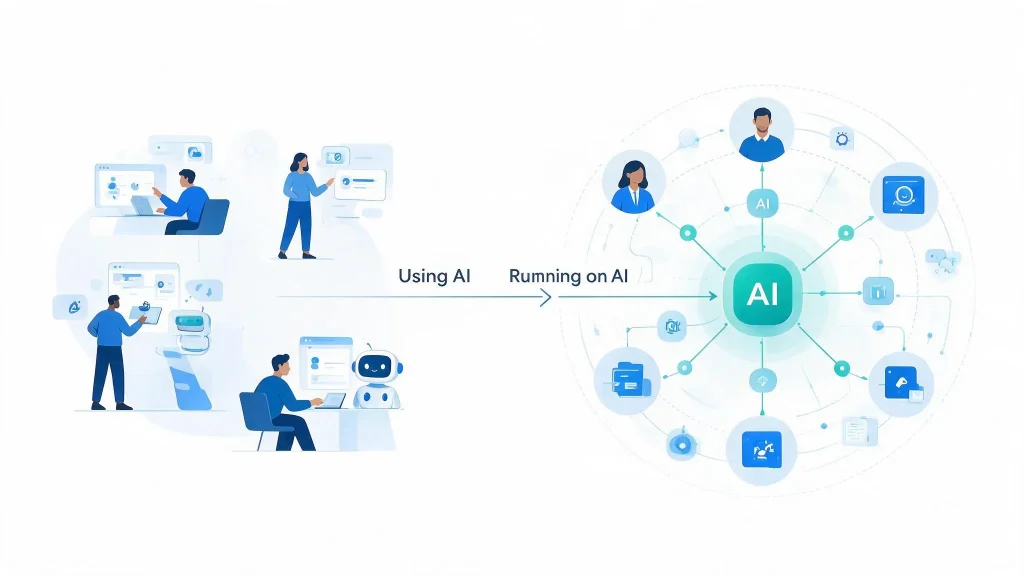
Many companies are currently using AI.
Far fewer are truly operating with AI as a core business capability.
This distinction matters.
Using AI typically means adding AI-powered tools to existing workflows. Employees may leverage copilots, automation platforms, chatbots, or intelligent assistants to improve productivity.
These improvements are valuable, but they often generate only incremental gains.
Running on AI is fundamentally different.
It involves redesigning business operations, decision-making processes, and workflows around AI capabilities. Organizations begin treating AI as an operating layer rather than a standalone tool.
This requires changes across technology, governance, talent, and organizational structures.
The most successful enterprises recognize that AI is not merely a software project. It is a business transformation initiative.
Leading providers of AI software development services help organizations make this transition by connecting AI technologies to broader business objectives rather than focusing exclusively on individual applications.
Why Productivity Gains Alone Are Not Enough
Many organizations initially evaluate AI through the lens of productivity.
This is understandable. AI can automate repetitive tasks, improve content generation, accelerate development cycles, and enhance knowledge discovery.
However, productivity improvements alone rarely justify large-scale transformation initiatives.
The organizations generating the greatest returns from AI focus on broader outcomes.
They use AI to improve customer experiences, accelerate product innovation, reduce operational friction, strengthen decision-making, and create entirely new business models.
These outcomes require more sophisticated implementations than simple tool deployment.
They often involve custom AI applications, integration with enterprise systems, intelligent workflow automation, and advanced analytics capabilities.
This is another reason enterprises increasingly rely on AI software development services. External experts can help identify high-value opportunities and build solutions aligned with strategic business objectives.
Instead of simply automating existing processes, organizations can redesign how value is created.
The Emerging Role of Agentic AI
One of the most important developments in enterprise AI is the rise of agentic AI.
Unlike traditional AI systems that respond to prompts, agentic AI can perform actions, execute workflows, coordinate tasks, and operate with greater autonomy.
These technologies are beginning to reshape how organizations approach work.
AI agents can support customer service, software engineering, operations management, supply chain monitoring, and numerous other business functions.
However, deploying agentic AI effectively requires strong technical foundations.
Organizations must ensure that AI systems can access accurate data, interact with enterprise platforms securely, and operate within governance frameworks that support accountability and compliance.
This level of implementation often exceeds the capabilities of general AI tools.
It requires specialized expertise that many enterprises obtain through AI software development services, particularly when deploying AI agents across multiple departments or business units.
The Talent Challenge Behind AI Transformation
Technology is only one side of AI transformation.
The workforce is equally important.
Many executives expect AI to significantly reshape roles and responsibilities over the coming years. At the same time, employees are already experiencing changes in how work is performed.
This creates new challenges for leadership teams.
Organizations must address skills gaps, workforce readiness, change management, and organizational alignment while continuing to execute business priorities.
Middle management often becomes a particular pressure point because managers are expected to translate strategic AI initiatives into operational reality.
Unfortunately, many companies lack sufficient AI expertise at precisely this level.
As demand for AI talent continues to grow, many organizations use AI software development services to supplement internal capabilities while simultaneously developing long-term workforce strategies.
This hybrid approach often provides the best balance between immediate execution and sustainable knowledge development.
Building Enterprise AI Without Expanding Internal Teams
One of the biggest advantages of partnering with an AI development provider is the ability to scale innovation without dramatically increasing organizational complexity.
Many enterprises already face pressure to control headcount while maintaining aggressive digital transformation goals.
Growing internal AI departments can be expensive, time-consuming, and difficult to sustain.
By leveraging AI software development services, enterprises gain access to specialized expertise only when needed.
Organizations can:
- Accelerate AI development initiatives
- Access scarce technical skills
- Reduce recruitment pressures
- Improve speed-to-market
- Scale projects more flexibly
- Minimize operational risk
This model allows leaders to pursue ambitious AI strategies while maintaining financial discipline.
For many organizations, the ability to move quickly without expanding permanent teams represents a significant competitive advantage.
How to Choose the Right AI Software Development Services Partner
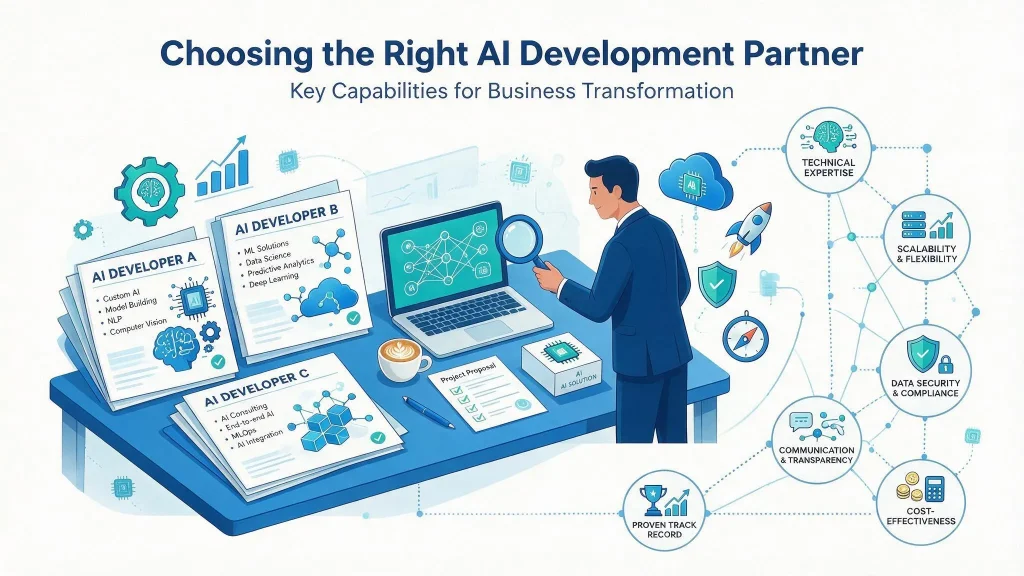
As AI adoption matures, selecting the right implementation partner becomes increasingly important.
The best providers offer far more than technical development capabilities.
They help organizations identify high-impact use cases, establish governance frameworks, modernize existing systems, and integrate AI into broader transformation strategies.
When evaluating AI software development services, enterprise leaders should consider several factors.
Technical expertise remains essential, but so does business understanding. A strong partner should be capable of translating AI capabilities into measurable outcomes rather than simply deploying technology.
Organizations should also assess industry experience, cloud capabilities, security practices, governance maturity, scalability, and delivery methodologies.
Most importantly, enterprises should look for partners who understand transformation.
AI success is not determined solely by model accuracy. It depends on how effectively technology, processes, people, and strategy work together.
Why the Future Belongs to Organizations That Reinvent
The next phase of AI adoption will not be defined by experimentation.
It will be defined by execution.
Most enterprises now recognize the value of AI. Many have already launched initiatives and expanded investment.
The organizations that pull ahead will be those that move beyond pilots and begin transforming how work is performed across the enterprise.
This requires more than buying AI tools.
It requires redesigning workflows, modernizing applications, building governance structures, and developing workforce capabilities.
Most importantly, it requires the ability to turn AI investments into measurable outcomes.
This is where AI software development services become a strategic enabler.
By combining technical expertise with business transformation knowledge, enterprises can accelerate value realization while reducing implementation risk.
Conclusion
AI investment is no longer the differentiator.
Enterprise commitment to AI is already widespread. The real differentiator is an organization’s ability to translate that investment into productivity gains, operational improvements, customer value, and sustainable growth.
Organizations that treat AI as a transformation initiative rather than a technology experiment will be best positioned for long-term success.
For many enterprises, achieving that goal requires more than internal resources alone. It requires access to expertise, proven methodologies, and scalable implementation capabilities.
That is why AI software development services have become a critical component of modern enterprise transformation strategies.
The future will not belong to the organizations that deploy AI the fastest.
It will belong to those that successfully reinvent how their businesses operate through AI.
Relipa
Relipa is a Vietnam-based software development company established in April 2016. After two years of growth, our Japanese branch – Relipa Japan – was officially founded in July 2018.
We provide services in MVP development, web and mobile application development, and blockchain solutions. With a team of over 100 professional IT engineers and experienced project managers, Relipa has become a reliable partner for many enterprises and has successfully delivered more than 500 projects for startups and businesses worldwide.
