
Few technology initiatives create as much tension within enterprises as application modernization.
On one hand, business leaders understand that legacy applications can slow innovation, increase maintenance costs, create security concerns, and limit organizational agility. On the other hand, these same applications often support critical business functions such as customer operations, supply chain management, financial reporting, manufacturing processes, and enterprise data management.
This creates a difficult situation for CEOs, COOs, and CTOs.
The organization needs modernization to remain competitive, yet even minor disruptions can affect revenue, customer experience, regulatory compliance, and operational performance.
As a result, many modernization initiatives are delayed not because leaders disagree with the need for transformation, but because they fear the business risks associated with change.
This is why demand for application modernization services continues to grow. Rather than viewing modernization as a purely technology-driven exercise, enterprises are increasingly treating it as a managed business transformation process delivered through experienced service partners.
The focus is no longer simply on upgrading applications.
The focus is on modernizing business-critical systems while protecting day-to-day operations.
Why Modernizing Critical Applications Has Become a Business Priority
Many enterprise applications have supported organizations for years, sometimes even decades.
These systems often contain valuable business logic, deep operational knowledge, and integrations that connect multiple departments. While they continue to perform essential functions, they were rarely designed to support today’s requirements.
Modern businesses demand:
- Faster product delivery
- Cloud integration
- Real-time data accessibility
- Enhanced customer experiences
- Improved cybersecurity
- Better scalability
Legacy applications frequently struggle to meet these expectations.
Over time, organizations reach a point where maintaining existing systems becomes more expensive than transforming them.
However, the challenge is that mission-critical applications cannot simply be switched off and rebuilt.
Every modernization decision must balance innovation with operational continuity.
This is where application modernization services provide value by helping organizations evolve systems without jeopardizing business performance.
Why Enterprises Are Increasingly Choosing Modernization Partners
Historically, many organizations attempted modernization using internal resources.
While internal teams possess valuable business knowledge, large-scale modernization projects often introduce challenges that extend beyond everyday technology operations.
Modernization programs require expertise across multiple disciplines:
- Legacy systems
- Cloud platforms
- Enterprise integration
- Security and compliance
- Data migration
- DevOps and automation
- Application architecture
- Program governance
Finding all of these capabilities within a single internal team is difficult.
More importantly, enterprise IT teams are usually responsible for maintaining ongoing operations while simultaneously supporting transformation initiatives.
This dual responsibility can create delays, competing priorities, and execution risks.
As a result, many enterprises turn to providers of application modernization services to supplement internal capabilities and accelerate delivery.
External specialists bring dedicated resources, proven methodologies, and cross-industry experience that help reduce modernization risks while allowing internal teams to remain focused on core business activities.
Modernization Is No Longer Just a Technology Project
One of the biggest misconceptions about modernization is that it is primarily a technical challenge.
In reality, most modernization failures stem from operational disruptions, organizational misalignment, and execution risks rather than technology problems.
Successful enterprises recognize that modernization affects:
- Employees
- Customers
- Business processes
- Revenue streams
- Compliance obligations
- Operational workflows
Because of this, modern application modernization services focus heavily on service delivery and risk management.
The objective is not simply to deliver a new application environment.
The objective is to ensure that modernization supports business goals while minimizing disruption throughout the transition.
This shift in thinking has fundamentally changed how modernization projects are planned and executed.
The Business Continuity Challenge
For enterprise leaders, business continuity is often the most important consideration during modernization.
A customer-facing platform that experiences downtime can impact revenue. A supply chain application disruption can affect production schedules. A financial system outage can create reporting and compliance issues.
These risks become even more significant when organizations operate across multiple business units, regions, or markets.
Consequently, executives frequently ask: “How can we modernize critical applications without affecting business operations?”
This question is at the heart of modern service delivery models.
Leading providers of application modernization services build their engagements around continuity planning, phased execution, governance frameworks, and operational safeguards.
The goal is to ensure that modernization happens alongside ongoing business activities rather than interrupting them.
What Enterprises Expect from Application Modernization Services
Today’s enterprise buyers are not simply purchasing development resources.
They are looking for strategic partners capable of managing complexity and minimizing risk.
When evaluating modernization providers, organizations typically expect support across several areas.
First, they expect visibility.
Leaders need a clear understanding of application dependencies, modernization scope, delivery timelines, and potential business impacts.
Second, they expect predictable execution.
Modernization initiatives often involve multiple stakeholders, systems, and business units. Structured delivery processes become critical for maintaining alignment and reducing uncertainty.
Third, they expect governance.
Without clear reporting, escalation procedures, and decision-making frameworks, modernization efforts can quickly lose momentum.
Most importantly, enterprises expect measurable business outcomes rather than technical activity alone.
This is what differentiates mature application modernization services from traditional development engagements.
The Role of Dedicated Modernization Teams
A key reason enterprises choose specialized modernization partners is access to dedicated teams.
Unlike project-based staffing models, dedicated modernization teams provide continuity throughout the transformation lifecycle.
These teams often include:
- Solution architects
- Cloud specialists
- Migration experts
- Security consultants
- DevOps engineers
- Quality assurance professionals
- Project managers
Because they focus exclusively on modernization initiatives, these teams develop a deeper understanding of business requirements and application environments.
This continuity reduces knowledge gaps, improves decision-making, and accelerates delivery.
For enterprise leaders, dedicated modernization teams provide greater confidence that projects will remain aligned with strategic objectives from start to finish.
Reducing Risk Through Structured Service Delivery
Modernization projects succeed when risk is managed proactively rather than reactively.
This is why leading application modernization services providers rely on structured delivery frameworks.
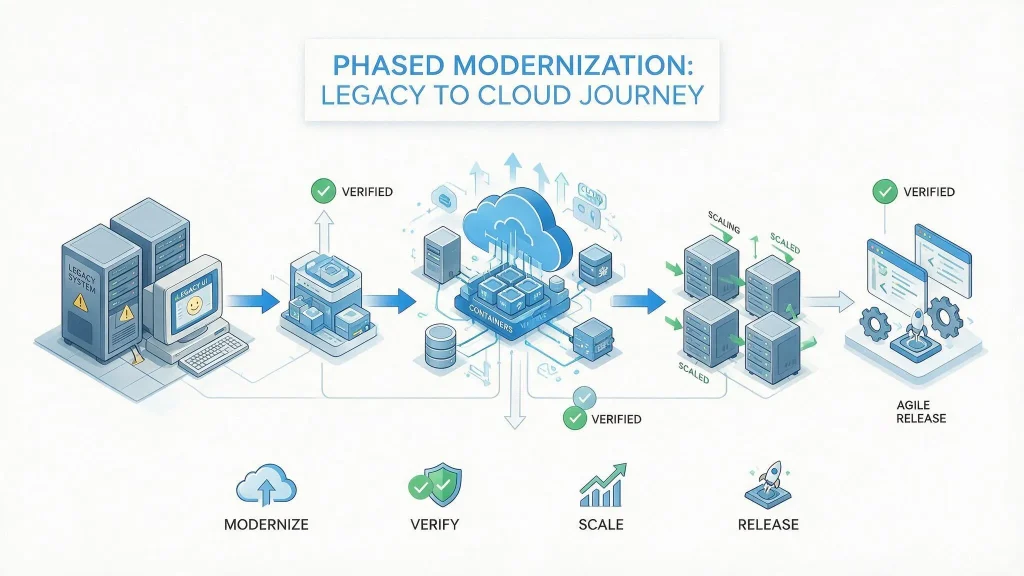
Instead of attempting large-scale changes all at once, modernization is typically delivered through controlled phases.
Each phase includes:
- Assessment
- Validation
- Testing
- Deployment
- Performance monitoring
This incremental approach allows organizations to verify outcomes before expanding modernization efforts further.
More importantly, it creates opportunities to identify potential issues before they affect critical business operations.
From a business perspective, this method often proves far more effective than attempting a complete transformation in a single initiative.
Why Outsourcing Accelerates Modernization Outcomes
One of the main reasons organizations pursue outsourcing partnerships is speed.
Building a modernization capability internally requires recruiting specialists, implementing processes, establishing governance models, and coordinating resources across departments.
These activities consume time before transformation work can even begin.
By contrast, experienced providers of application modernization services have established frameworks, skilled personnel, and delivery models already in place.
Organizations can move directly into assessment and execution rather than spending months building internal capabilities.
This acceleration creates several benefits:
- Faster time-to-value
- Reduced opportunity costs
- Improved project predictability
- Earlier realization of business benefits
In highly competitive markets, these advantages can significantly influence modernization ROI.
Governance: The Foundation of Successful Modernization
One area often overlooked by organizations is governance.
Technology alone does not guarantee modernization success.
Effective governance helps ensure that business priorities remain aligned with technical execution throughout the engagement.
Strong application modernization services providers establish governance practices that include:
- Executive steering committees
- Progress reporting
- Risk tracking
- Change management controls
- Stakeholder communication plans
These structures create transparency and accountability while helping organizations maintain momentum.
For enterprise leaders, governance provides confidence that modernization initiatives remain aligned with broader business goals.
Building Long-Term Transformation Capabilities
Modernization is rarely a one-time event.
As technologies evolve and business needs change, organizations must continue adapting their application portfolios.
This reality has influenced how enterprises select modernization partners.
Organizations increasingly seek providers capable of supporting long-term transformation rather than delivering isolated projects.
The most effective application modernization services engagements help enterprises build sustainable modernization capabilities through:
- Knowledge transfer
- Process improvement
- Cloud operating models
- Application portfolio governance
- Continuous optimization
This approach creates lasting value beyond the initial modernization effort.
How to Choose the Right Application Modernization Services Partner
Selecting a modernization partner requires more than evaluating technical expertise.
Enterprise leaders should assess several critical capabilities.
Industry experience remains important because modernization challenges often vary between sectors.
Delivery maturity is equally important. Providers should demonstrate structured methodologies and successful modernization outcomes across multiple projects.
Organizations should also evaluate:
- Governance practices
- Security capabilities
- Resource scalability
- Communication processes
- Cloud expertise
- Change management experience
Ultimately, the right partner should operate as an extension of the enterprise rather than simply a service vendor.
The goal is to build a relationship focused on business outcomes, operational continuity, and long-term growth.
Modernization Without Disruption Is the New Success Metric
The conversation around modernization has evolved.
Enterprise leaders no longer evaluate modernization projects solely based on technology upgrades. Instead, they measure success through business outcomes, operational continuity, speed of execution, and risk reduction.
This shift has elevated the role of application modernization services.
Rather than focusing exclusively on technical transformation, modern service providers help organizations navigate change while protecting critical business operations.
For enterprises facing growing pressure to modernize legacy applications, the challenge is not deciding whether modernization is necessary.
The challenge is finding the safest, fastest, and most effective path forward.
Organizations that combine clear business objectives with experienced modernization partners are best positioned to achieve that goal.
In today’s digital economy, modernization is no longer just about updating applications. It is about enabling transformation while keeping the business running smoothly.
Relipa
Relipa is a Vietnam-based software development company established in April 2016. After two years of growth, our Japanese branch – Relipa Japan – was officially founded in July 2018.
We provide services in MVP development, web and mobile application development, and blockchain solutions. With a team of over 100 professional IT engineers and experienced project managers, Relipa has become a reliable partner for many enterprises and has successfully delivered more than 500 projects for startups and businesses worldwide.
