

Artificial intelligence has become a strategic priority across the healthcare industry.
Hospital networks are exploring predictive care models. Clinics are evaluating intelligent scheduling and patient engagement solutions. Healthtech companies are embedding AI into digital products to improve outcomes, automate workflows, and create new revenue opportunities.
The enthusiasm is understandable. AI promises to help healthcare organizations operate more efficiently while delivering better experiences for both patients and providers.
Yet the reality on the ground is often far more complicated.
Many healthcare organizations successfully launch AI pilots but struggle to scale them. Projects that appear promising during the proof-of-concept stage frequently encounter roadblocks when they move into production. Leaders may assume these challenges stem from the AI technology itself.
In many cases, they do not.
The real issue is that healthcare data environments were never designed with enterprise AI in mind.
This is where an AI development agency in healthcare can play a critical role. The conversation is no longer simply about building AI models. It is about preparing fragmented healthcare ecosystems so AI can generate meaningful business and clinical value.
Before investing in new algorithms, healthcare leaders should ask a more fundamental question: “Is our data foundation ready for AI?”
The Healthcare AI Challenge Is Rarely an AI Problem
AI receives most of the attention in transformation discussions, but successful healthcare AI initiatives typically depend on something much less visible: data infrastructure.
Most healthcare organizations already have access to enormous amounts of information. Electronic health records, imaging systems, laboratory platforms, patient portals, billing applications, telehealth solutions, wearable devices, and operational systems continuously generate data.
The problem is not a lack of information.
The problem is that information is rarely organized in a way that supports AI at scale.
Healthcare leaders are often surprised by how much effort is required before an AI initiative can even begin. Data must be identified, validated, standardized, integrated, secured, and governed.
We’ve seen organizations spend far more time preparing data than building models.
That may sound disappointing, but it reflects a reality many successful healthcare organizations have learned: AI outcomes are directly linked to data readiness.
An advanced AI model built on fragmented data will rarely outperform a modest model built on trusted, accessible, and well-governed information.
Why Healthcare Data Rarely Lives in One Place
Few healthcare organizations operate within a clean, unified technology environment.
Most healthcare ecosystems have evolved over many years, sometimes decades.
A hospital may use one platform for patient records, another for imaging, another for laboratory operations, and several more for scheduling, billing, and financial management. Clinics within the same network may rely on different systems altogether. Mergers and acquisitions often add even more complexity.
Over time, this creates an environment where critical patient information is distributed across multiple applications.
The consequences are not always obvious until organizations attempt to implement AI.
A predictive care model may require data from clinical records, laboratory systems, and operational databases. If those systems are disconnected, obtaining a complete picture becomes far more difficult.
What appears to be an AI initiative quickly becomes an integration initiative.
This is why data fragmentation remains one of the biggest barriers to healthcare AI adoption.
Before organizations can generate intelligent insights, they must first create a unified view of the information they already possess.
Good AI Starts with Trustworthy Data

Healthcare organizations often focus on selecting AI platforms, evaluating vendors, or identifying use cases.
All of those activities are important.
However, none of them matter if the underlying data cannot be trusted.
Consider a common example.
An organization wants to use AI to identify patients at risk of readmission. The model relies on historical patient information, treatment histories, diagnoses, and follow-up care data.
If patient records contain inconsistencies, missing fields, duplicate entries, or conflicting information, prediction quality deteriorates rapidly.
The issue is not the algorithm.
The issue is the data.
Common healthcare data challenges include:
- Duplicate patient records
- Inconsistent coding practices
- Missing clinical information
- Unstructured documentation
- Legacy data formats
- Data entry inconsistencies
These problems often remain hidden until organizations begin preparing for AI.
Healthcare leaders who achieve long-term AI success typically invest heavily in data quality programs before pursuing large-scale AI deployment.
In reality, data quality initiatives are often among the most important AI investments an organization can make.
Interoperability Is No Longer Optional
Healthcare AI depends on context.
The more complete the picture, the more valuable the insights.
That is why interoperability has become such a critical component of AI readiness.
A healthcare organization cannot fully leverage AI if key systems remain isolated from one another.
Clinical teams need information that extends beyond individual applications. Operational leaders need visibility across departments. AI systems require access to data flows that reflect the complete patient journey.
Modern healthcare organizations are increasingly building interoperability frameworks that allow information to move securely and consistently between systems.
The objective is not simply technical integration.
The objective is creating an environment where information becomes usable across the entire organization.
When interoperability improves, AI becomes capable of supporting broader use cases, including predictive analytics, capacity planning, care coordination, and population health management.
Without interoperability, most AI initiatives remain limited in scope.
Why Governance Matters as Much as Technology
Healthcare organizations operate in one of the most heavily regulated industries in the world.
Any discussion about AI must therefore include governance.
The most successful healthcare organizations do not treat governance as a compliance requirement added after deployment. Instead, they build governance directly into their AI readiness strategies.
Several questions must be addressed early:
- Who owns patient data?
- Who can access specific information?
- How is consent managed?
- How are data quality standards enforced?
- How are AI decisions monitored and reviewed?
- How are security and privacy controls maintained?
Strong governance creates trust among clinicians, patients, executives, regulators, and technology teams.
Without trust, AI adoption becomes difficult regardless of technical sophistication.
Healthcare organizations often find that governance frameworks become one of the most valuable outcomes of working with an AI development agency in healthcare, particularly during large-scale transformation initiatives.
Building an AI-Ready Data Architecture
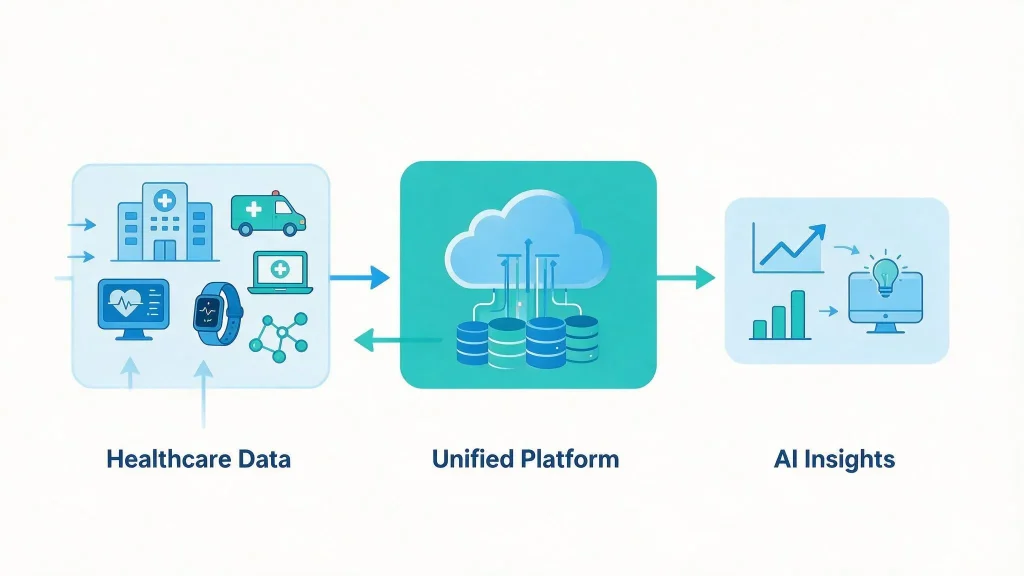
Once organizations address fragmentation, interoperability, and governance challenges, attention shifts toward architecture.
The goal is not merely to store information.
The goal is to create an environment where information can be transformed into intelligence.
- An AI-ready architecture typically supports:
- Unified data access
- Scalable storage capabilities
- Analytics workloads
- Real-time data processing
- Secure integration across systems
- Future AI model deployment
Importantly, flexibility matters.
Healthcare organizations rarely stand still. New systems are introduced, regulations evolve, and business priorities change.
The most successful architectures are designed to accommodate continuous evolution rather than fixed requirements.
Healthcare leaders should think of AI readiness not as a one-time project but as an ongoing capability.
Different Healthcare Organizations Start in Different Places
A common mistake in healthcare transformation is assuming every organization follows the same path.
The reality is far more varied.
Large hospital networks often struggle with highly complex legacy environments and decades of accumulated technology decisions.
Specialized clinics may face resource constraints that limit modernization efforts.
Healthtech companies frequently possess more modern platforms but require scalable infrastructure capable of supporting aggressive growth.
Each organization faces different challenges.
As a result, there is no universal AI roadmap.
An effective AI readiness strategy should reflect an organization’s unique environment, maturity level, operational priorities, and long-term objectives.
This is one reason many healthcare leaders prefer working with an AI development agency in healthcare that understands both technology and healthcare operations rather than applying generic AI implementation frameworks.
Why Many Healthcare Organizations Don’t Build Everything Themselves
Preparing healthcare systems for AI requires expertise across multiple disciplines.
Organizations need professionals who understand:
- Healthcare technology ecosystems
- Data engineering
- Cloud architecture
- Security and compliance
- Interoperability standards
- Analytics platforms
- AI implementation
Even organizations with strong internal technology teams often struggle to dedicate sufficient resources to these initiatives.
Internal teams are already responsible for maintaining existing systems, supporting users, managing security, and delivering ongoing projects.
Adding large-scale AI readiness efforts can create significant pressure.
For this reason, many healthcare organizations partner with an AI development agency in healthcare not because they lack capability, but because they need additional capacity and specialized expertise to accelerate progress while minimizing operational disruption.
The right partner helps organizations move faster while avoiding many of the common mistakes that delay AI programs.
Success Is Measured Long Before the AI Model Goes Live
Organizations sometimes define AI success too narrowly.
They focus on whether a model has been deployed or whether a proof of concept has been completed.
These milestones matter, but they are not the ultimate objective.
True success is measured through business and clinical outcomes.
For example:
- Can clinicians access more reliable information?
- Are operational workflows becoming more efficient?
- Has decision-making improved?
- Are patient experiences improving?
- Is reporting becoming more accurate?
- Can data be trusted across the organization?
Interestingly, many of these improvements occur before advanced AI applications are fully deployed.
Organizations often discover that strengthening their data foundation generates significant business value on its own.
This is one reason why AI readiness should be viewed as a transformation initiative rather than a technology project.
The benefits extend well beyond AI.
Healthcare AI Is Ultimately a Data Transformation Journey

AI will continue to reshape healthcare over the coming years.
Predictive care models, intelligent clinical support systems, automation platforms, and personalized patient experiences will become increasingly common.
However, the organizations that benefit most will not necessarily be those investing in the largest number of AI tools.
They will be the organizations that have prepared their foundations.
Fragmented systems, inconsistent information, weak governance, and limited interoperability create constraints that no AI model can overcome.
Healthcare leaders who understand this reality approach AI differently.
They start by building reliable, accessible, and well-governed data ecosystems. They focus on interoperability before intelligence. They strengthen the foundation before scaling innovation.
That is why the role of an AI development agency in healthcare extends far beyond application development.
The most valuable partners help healthcare organizations create the conditions necessary for sustainable AI success.
Because in healthcare, AI readiness is not primarily an algorithm challenge.
It is a data transformation challenge.
Relipa
Relipa is a Vietnam-based software development company established in April 2016. After two years of growth, our Japanese branch – Relipa Japan – was officially founded in July 2018.
We provide services in MVP development, web and mobile application development, and blockchain solutions. With a team of over 100 professional IT engineers and experienced project managers, Relipa has become a reliable partner for many enterprises and has successfully delivered more than 500 projects for startups and businesses worldwide.
