

When business leaders discuss digital transformation, software usually dominates the conversation.
Teams evaluate new platforms. Executives explore AI opportunities. Technology roadmaps focus on cloud migration, automation, and modernization initiatives.
Yet many organizations continue to experience the same operational frustrations even after significant technology investments.
Approvals still take too long.
Teams still rely on spreadsheets.
Employees still re-enter the same information across multiple systems.
Decision-makers still struggle to obtain accurate real-time insights.
In these situations, the problem is rarely a lack of technology.
More often, the problem is that technology has evolved separately from the way the business actually operates.
Over time, companies build processes around software limitations. Employees create workarounds. Departments introduce additional tools to solve isolated issues. New systems are added without fully addressing underlying workflow challenges.
Eventually, operational complexity becomes part of daily life.
This is where strategic software & application development creates the greatest business impact.
The objective is not simply to build another application.
The objective is to understand where work gets stuck and create technology that removes friction from critical business processes.
The organizations seeing the strongest results from digital transformation are not necessarily those using the most software. They are the ones using software to improve how work gets done.
The Cost of Bottlenecks Is Usually Hidden
Operational bottlenecks rarely appear as obvious business problems.
They are rarely discussed during quarterly reviews. They seldom appear as individual line items in financial reports.
Instead, they quietly accumulate costs over time.
Consider a simple scenario.
A customer order enters the organization. Information is entered into one system, transferred manually into another, approved through a series of emails, and reviewed by multiple departments before processing begins.
Each step only adds a few minutes.
Each individual delay seems insignificant.
Yet when that process occurs thousands of times per month, the impact becomes substantial.
We’ve seen organizations hire additional staff to manage complexity that could have been eliminated through better workflow design. We’ve seen employees spend hours creating reports because information was trapped across multiple systems. We’ve seen managers waiting days for approvals because no one had real-time visibility into where work was stalled.
The challenge is that most businesses learn to live with these inefficiencies.
People adapt.
Workarounds emerge.
The process continues functioning, but not efficiently.
The longer these bottlenecks remain unaddressed, the more difficult they become to identify because they start feeling normal.
Why Traditional Software Investments Sometimes Fail
Many organizations respond to operational challenges by purchasing new tools.
It’s a logical decision.
If reporting is difficult, buy a reporting platform.
If collaboration is inefficient, deploy a collaboration tool.
If customer service struggles, implement a CRM.
Sometimes these investments solve the problem.
Sometimes they create new ones.
The issue is that software purchased to address a specific challenge often focuses on a department rather than an end-to-end process.
As more tools are introduced, the technology landscape becomes increasingly fragmented.
Departments optimize their own workflows while broader business processes remain disconnected.
The result is a growing collection of systems that perform individual tasks effectively but fail to work together efficiently.
This is one reason business leaders increasingly invest in process-centric software & application development rather than simply acquiring additional technologies.
The focus shifts from software functionality to business outcomes.
The Difference Between Technology-Centric and Process-Centric Development
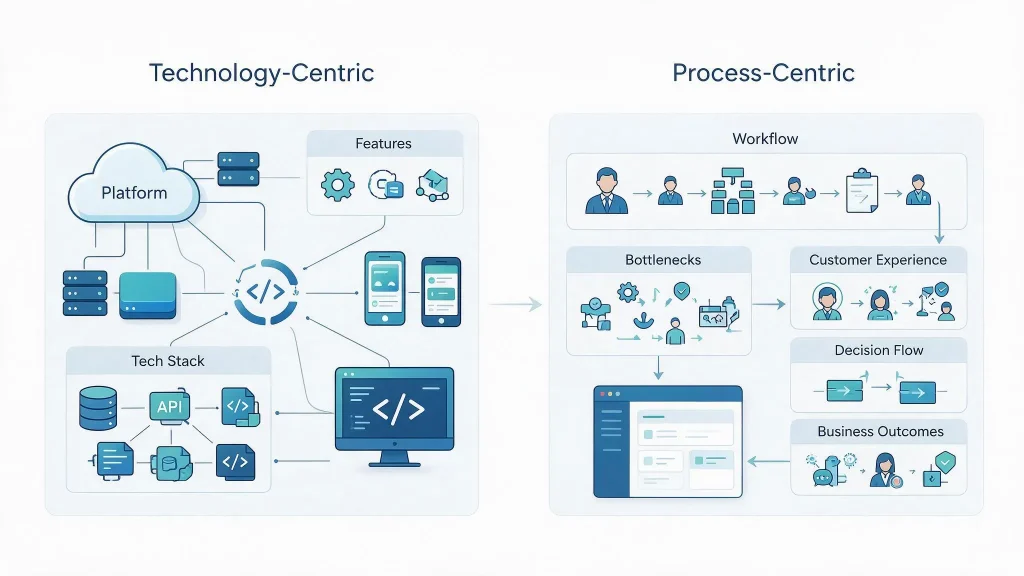
Many software projects start with a technology discussion.
Organizations ask questions such as:
- Which platform should we use?
- What features do we need?
- What technology stack is most suitable?
These are important questions, but they are rarely the first questions that should be asked.
The more important discussion often begins with understanding how work moves through the organization.
- Where do delays occur?
- Which activities require excessive manual effort?
- What decisions take too long?
- Which processes frustrate employees or customers?
Technology-centric development focuses on software.
Process-centric development focuses on outcomes.
The difference may seem subtle, but it has a significant impact on project success.
Organizations that begin by understanding workflows usually create applications that generate measurable business improvements rather than simply introducing additional technology.
Start by Identifying Where Work Slows Down
Before investing in any application, organizations should understand where operational friction exists.
In many cases, the warning signs are already visible.
Employees maintain spreadsheets alongside enterprise systems.
Teams re-enter data manually.
Reporting takes days instead of minutes.
Approvals move through endless email chains.
Information exists in multiple places but nowhere with complete accuracy.
These symptoms indicate opportunities for improvement.
The goal is not necessarily to automate everything.
The goal is to identify the activities that consume disproportionate amounts of time, effort, and attention.
Once these processes are understood, technology investments become easier to prioritize.
The conversation shifts from building software to solving business problems.
When Manual Processes Become a Growth Problem
One of the most common bottlenecks involves manual work.
Many organizations continue relying on employee effort to perform repetitive administrative tasks.
Examples include:
- Invoice processing
- Employee onboarding
- Contract approvals
- Request management
- Compliance reporting
- Data reconciliation
These activities may have been manageable when the organization was smaller.
As transaction volumes increase, however, manual processes become increasingly expensive.
Employees spend less time creating value and more time moving information.
Errors become more frequent.
Processing times increase.
At this point, software becomes more than a convenience.
It becomes a growth enabler.
Well-designed applications allow organizations to automate routine activities while providing greater visibility into business operations.
When Data Lives Everywhere, Visibility Lives Nowhere
One of the most frequent challenges we encounter is data fragmentation.
Most enterprises have accumulated technology investments over many years.
Sales uses one platform.
Operations relies on another.
Finance maintains separate systems.
Customer service depends on entirely different tools.
Individually, these systems may work well.
Collectively, they often create visibility challenges.
When executives ask straightforward questions about performance, teams may spend hours gathering information from different sources.
Reports are manually assembled.
Data must be reconciled.
Conflicting numbers create confusion.
The organization does not suffer from a lack of information.
It suffers from a lack of connected information.
Strategic software & application development often addresses this challenge by creating applications that connect systems, streamline information flows, and provide meaningful visibility across departments.
The result is faster decision-making and greater operational confidence.
Why Approval Processes Become Bottlenecks

Many growing organizations discover that success introduces complexity.
As companies expand, governance becomes more important.
Additional reviews are introduced.
Approvals require more stakeholders.
Compliance requirements increase.
While these controls are necessary, they often slow execution significantly.
A simple purchasing request may require multiple approvals.
Product changes can sit in queues waiting for authorization.
Contracts move slowly between departments.
Eventually, employees spend more time tracking progress than completing work.
Applications built around approval workflows can dramatically improve efficiency.
Rather than relying on emails, spreadsheets, and manual follow-ups, organizations gain transparency into where decisions are pending and what actions are required.
The result is faster execution without sacrificing governance.
The Customer Experience Is Often an Internal Process Problem
Many customer experience challenges originate inside the organization.
Customers may only see symptoms.
A delayed response.
An inaccurate update.
A slow onboarding process.
An unresolved support request.
Behind those symptoms is often an operational bottleneck.
Information may be trapped within separate systems. Departments may be working from different datasets. Employees may lack visibility into the complete customer journey.
When organizations improve internal workflows, customer experiences often improve naturally.
This is why some of the most successful customer experience initiatives begin with operational process analysis rather than customer-facing technologies.
Improving how work flows internally frequently produces measurable external benefits.
Growth Magnifies Existing Inefficiencies
Growth rarely creates new problems.
More often, it exposes existing ones.
Processes that worked well at a smaller scale begin to struggle under increased volume.
Manual workflows become difficult to manage.
Communication channels become more complex.
Information becomes harder to track.
Organizations often respond by hiring more people.
While additional resources may help temporarily, they don’t necessarily solve the underlying issue.
In many cases, the process itself requires redesign.
Business process-centric applications help organizations scale operations without increasing complexity at the same pace.
They create consistency, automation, and visibility that support sustainable growth.
Why Custom Applications Often Deliver Greater Impact
Off-the-shelf software plays an important role in most organizations.
Many business functions are well served by commercial platforms.
However, competitive advantage rarely comes from standard processes.
It comes from the unique ways organizations create value.
At a certain stage of growth, enterprises often discover that generic software no longer aligns with how the business operates.
Employees continue relying on workarounds.
Manual tasks persist.
Critical workflows span multiple systems.
This is where custom applications can create significant value.
Instead of forcing business processes to adapt to software limitations, organizations build software that supports the way they actually work.
The result is often greater efficiency, improved flexibility, and stronger long-term scalability.
Prioritizing the Right Software Investments

Not every operational challenge requires a custom solution.
Successful organizations focus on opportunities that offer the greatest potential return.
Three questions can help prioritize investments:
- Which bottlenecks have the biggest business impact?
- Which inefficiencies occur most frequently?
- Which problems will become worse as the organization grows?
The answers often reveal where software investments are most likely to generate meaningful value.
The goal is not building more applications.
The goal is removing the barriers that slow business performance.
Why Many Enterprises Partner with Development Specialists
Building process-centric applications requires more than technical expertise.
It requires understanding operations, workflows, organizational challenges, and business objectives.
Internal teams often understand the business exceptionally well but may not have sufficient capacity to execute major transformation initiatives while maintaining day-to-day operations.
This is where experienced providers of software & application development services create value.
The best partners do more than develop applications.
They help organizations:
- Analyze processes
- Identify bottlenecks
- Prioritize opportunities
- Design scalable solutions
- Integrate systems
- Measure business outcomes
Most importantly, they help keep the focus on operational improvement rather than technology alone.
Measure Outcomes, Not Features
Many software projects are evaluated using technical metrics.
How many features were delivered?
How many releases were completed?
How many integrations were implemented?
While these measures have value, they rarely tell the full story.
The most successful organizations evaluate projects through business outcomes.
For example:
- Did processing times decrease?
- Did productivity improve?
- Were operational costs reduced?
- Did decision-making become faster?
- Did customer satisfaction improve?
- Did revenue opportunities increase?
Ultimately, the purpose of software & application development is not to create applications.
It is to create measurable business value.
Start with the Workflow, Not the Technology
When organizations begin a software initiative, it is tempting to focus on features, platforms, and tools.
The more valuable conversation typically starts elsewhere.
Where does work slow down?
Where do employees lose time?
Where do customers experience friction?
Where does complexity prevent growth?
Answering those questions often reveals opportunities that technology alone cannot identify.
The organizations generating the strongest returns from software investments are not necessarily those building the most sophisticated applications.
They are the ones using software to remove obstacles that stand between their people and meaningful business outcomes.
In the end, the best application is not the one with the most features.
It is the one that quietly removes friction and allows the business to move faster, scale more effectively, and serve customers better.
Relipa
Relipa is a Vietnam-based software development company established in April 2016. After two years of growth, our Japanese branch – Relipa Japan – was officially founded in July 2018.
We provide services in MVP development, web and mobile application development, and blockchain solutions. With a team of over 100 professional IT engineers and experienced project managers, Relipa has become a reliable partner for many enterprises and has successfully delivered more than 500 projects for startups and businesses worldwide.
