
As enterprises move beyond initial experimentation with blockchain technologies, the conversation is increasingly shifting from “what is blockchain?” to “how can we apply it to create measurable business value?” At the center of this transition lies one of the most important innovations in the blockchain ecosystem: smart contracts.
For decision-makers such as CEOs, CTOs, and COOs, smart contracts represent far more than a technical concept. They offer a fundamentally new way to automate processes, enforce agreements, and reduce operational inefficiencies without relying on intermediaries.
From our experience delivering blockchain development services, organizations that successfully adopt smart contracts are those that treat them not simply as code, but as a core component of digital transformation strategy. Understanding how smart contracts work—and how they can be implemented effectively—is therefore essential for enterprises looking to scale blockchain initiatives.
What Are Smart Contracts?

A smart contract is a self-executing program stored on a blockchain that automatically enforces the terms of an agreement when predefined conditions are met. Unlike traditional contracts, which rely on legal enforcement and manual execution, smart contracts operate independently and execute with precision.
At a basic level, smart contracts follow a simple logic: “if this condition is met, then perform this action.” However, their real power emerges when applied to complex business scenarios involving multiple parties, transactions, and dependencies.
From a business standpoint, smart contracts enable a shift from trust-based processes to trustless systems, where outcomes are determined by transparent and verifiable code rather than external enforcement. This significantly reduces the potential for disputes, delays, and human error.
Why Smart Contracts Matter for Enterprises
For many organizations, operational inefficiencies stem from processes that involve manual approvals, intermediaries, and fragmented systems. Smart contracts address these challenges by introducing automation, transparency, and consistency into business workflows.
In financial transactions, for example, smart contracts can automatically release payments when predefined conditions are fulfilled, eliminating the need for intermediaries and reducing settlement times. In supply chain systems, they can trigger updates and validations as goods move through different stages, improving visibility and reducing the risk of fraud.
The key advantage is not just automation, but reliable automation. Because smart contracts run on blockchain networks, their execution is immutable and cannot be altered once deployed. This creates a level of trust and accountability that is difficult to achieve with traditional systems.
For enterprises, this translates into:
- Reduced operational costs
- Faster transaction processing
- Improved transparency and compliance
- Lower risk of disputes
How Smart Contracts Work in Practice
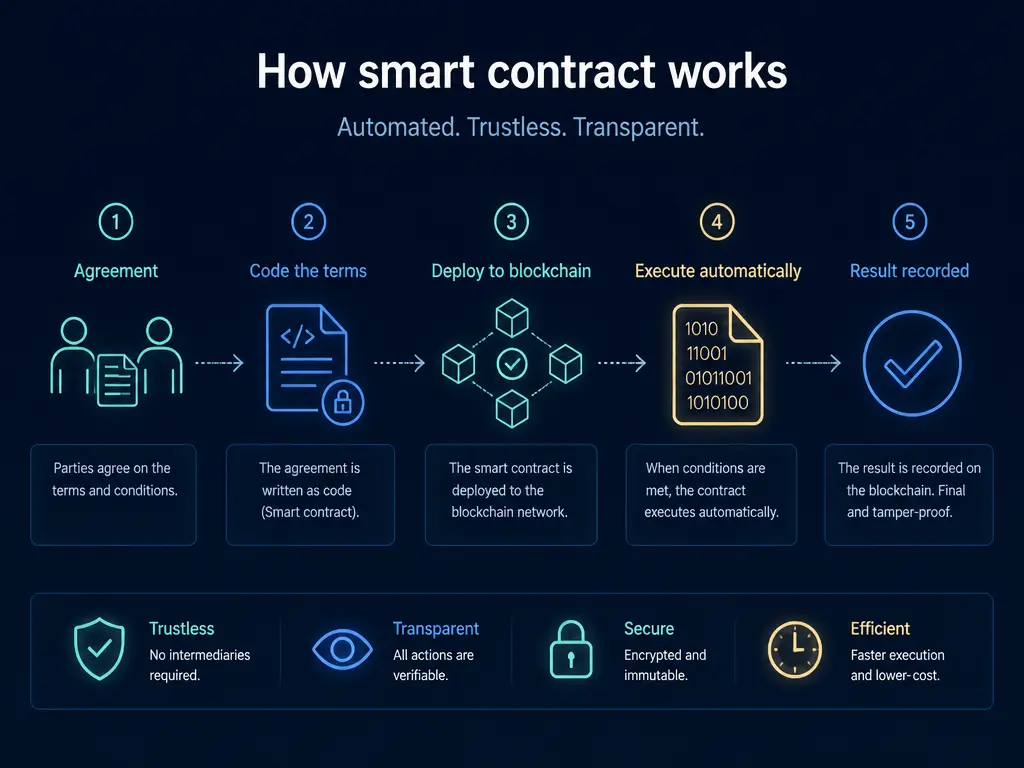
To understand how smart contracts deliver business value, it is important to look at how they operate within a blockchain environment.
Smart contracts are written using specific programming languages (such as Solidity for Ethereum) and deployed onto a blockchain. Once deployed, they are assigned a unique address and become accessible to users and other systems.
When a predefined condition is met—for example, receiving a payment or verifying a transaction—the contract automatically executes the relevant action. This could involve transferring assets, updating records, or triggering another process.
One of the defining features of smart contracts is that they operate in a decentralized environment. There is no central authority controlling execution. Instead, the blockchain network ensures that all participants agree on the outcome, creating a secure and transparent execution process.
For enterprise applications, this means that smart contracts can serve as the central logic layer connecting multiple systems, stakeholders, and data sources.
Key Benefits of Smart Contracts for Enterprise Use
While the technical characteristics of smart contracts are important, their real value lies in how they improve business operations.
Automation and Efficiency
Smart contracts eliminate the need for manual intervention in repetitive processes. Tasks that previously required human oversight—such as verifying conditions, initiating payments, or updating records—can now be executed automatically. This not only reduces workload but also minimizes errors and delays.
Cost Reduction
By removing intermediaries and streamlining processes, smart contracts can significantly reduce operational costs. For industries where transaction fees, administrative overhead, or reconciliation processes are substantial, these savings can have a direct impact on profitability.
Transparency and Trust
All transactions and contract logic are recorded on the blockchain and can be verified by authorized participants. This level of transparency builds trust among stakeholders and simplifies auditing and compliance processes.
Security and Reliability
Once deployed, smart contracts cannot be altered, which reduces the risk of tampering. Additionally, blockchain networks use cryptographic mechanisms to ensure the security of transactions and data.
Faster Execution
Traditional processes that take days or even weeks—such as contract settlement or cross-border payments—can be completed in minutes or seconds using smart contracts.
Enterprise Use Cases of Smart Contracts
Smart contracts are already being applied across a variety of industries, demonstrating their versatility and impact.
In the financial sector, they are used for automated lending, payments, and asset management, reducing reliance on intermediaries and improving transaction speed. In supply chain management, smart contracts enhance traceability by recording every step of a product’s journey, ensuring transparency and accountability.
Within insurance, smart contracts enable automated claims processing, where payouts are triggered automatically based on verified events. This reduces administrative overhead and improves customer satisfaction.
In real estate, smart contracts can streamline property transactions by automating ownership transfers and payment processes. Similarly, in digital platforms, they are used to manage user access, subscriptions, and digital rights.
These examples illustrate that smart contracts are not limited to a single use case—they serve as a universal mechanism for automating agreements and transactions across industries.
Challenges in Implementing Smart Contracts
Despite their benefits, implementing smart contracts at an enterprise level is not without challenges. Many of these challenges arise from the gap between theoretical potential and real-world execution.
One of the most common challenges is complexity in design and development. Smart contracts must be carefully written and tested, as errors can lead to significant financial and operational risks. Unlike traditional software, deployed smart contracts cannot be easily modified, making accuracy critical from the outset.
Another challenge is integration with existing systems. Enterprises often operate on legacy infrastructure that was not designed for blockchain technologies. Integrating smart contracts into these environments requires careful planning and architectural design.
Security is also a major concern. While blockchain itself is secure, vulnerabilities in smart contract code can be exploited if not properly audited. This makes security testing and validation an essential part of the development process.
Finally, scalability and cost considerations must be addressed. Without proper optimization, transaction costs and performance limitations can impact system efficiency.
How Blockchain Development Services Enable Successful Implementation
Given these challenges, enterprises increasingly rely on specialized blockchain development services to guide their implementation journey.
A structured approach begins with identifying the most valuable use cases based on business objectives. Rather than applying blockchain indiscriminately, organizations need to focus on areas where smart contracts can deliver measurable improvements.
Once use cases are defined, the next step involves selecting the appropriate blockchain platform and designing the architecture. Factors such as scalability, cost, security, and integration requirements must be carefully considered.
Development involves creating and testing smart contracts, ensuring they operate correctly under different scenarios. This is followed by rigorous auditing to identify and eliminate potential vulnerabilities.
Integration is another critical phase, where smart contracts are connected with existing systems, APIs, and databases. This ensures seamless operation within the enterprise environment.
Finally, continuous monitoring and optimization are necessary to ensure long-term performance and scalability.
Through this end-to-end approach, blockchain development services help enterprises reduce risk, accelerate deployment, and maximize ROI.
Why Enterprises Choose Outsourcing for Blockchain Development
Building in-house blockchain capabilities is often challenging due to the specialized skills required and the rapidly evolving nature of the technology. As a result, many enterprises choose to outsource their blockchain initiatives.
Outsourcing provides access to experienced professionals who have already delivered similar projects and understand best practices. It also allows organizations to scale resources based on project needs without long-term commitments.
From a cost perspective, outsourcing avoids the overhead associated with hiring and training internal teams. It also reduces the risk of costly mistakes by leveraging proven methodologies.
Most importantly, outsourcing enables enterprises to focus on their core business objectives while relying on experts to handle the technical complexities of blockchain development.
Our Approach to Blockchain Development Services
At the core of our approach is a commitment to delivering solutions that create real business value. We do not view smart contracts as standalone components, but as part of a larger ecosystem that includes strategy, architecture, and implementation.
We begin by working closely with stakeholders to understand their goals and identify opportunities where smart contracts can deliver tangible benefits. From there, we design scalable architectures that align with both technical requirements and business objectives.
Our development process emphasizes quality, security, and performance. Every smart contract is thoroughly tested and audited to ensure reliability. We also focus on seamless integration, ensuring that new systems work harmoniously with existing infrastructure.
Beyond implementation, we provide ongoing support and optimization to ensure that solutions continue to perform effectively as business needs evolve.
Conclusion: From Concept to Competitive Advantage
Smart contracts are no longer an emerging concept—they are a foundational element of enterprise blockchain strategy. By enabling automation, transparency, and efficiency, they offer a powerful way to streamline operations and create new opportunities for innovation.
However, realizing this potential requires more than just technical implementation. It requires a strategic approach that aligns technology with business goals and ensures scalability from the outset.
With the support of experienced blockchain development services, enterprises can move beyond experimentation and build solutions that deliver lasting value.
For decision-makers, the opportunity is clear: smart contracts are not just a tool—they are a pathway to more efficient, secure, and future-ready business operations.
Relipa Software
Relipa Co., Ltd. is a Vietnam-based software development company established in April 2016. After two years of growth, our Japanese branch – Relipa Japan – was officially founded in July 2018.
We provide services in MVP development, web and mobile application development, and blockchain solutions. With a team of over 100 professional IT engineers and experienced project managers, Relipa has become a reliable partner for many enterprises and has successfully delivered more than 500 projects for startups and businesses worldwide.
