
AI development services are rapidly becoming a critical driver of innovation in modern healthcare systems. Artificial intelligence has transitioned from a promising innovation to a practical necessity across industries — especially in healthcare. As global healthcare systems confront workforce shortages, rising operational costs, and increasing demand for digital transformation, organizations are increasingly investing in AI development services to build intelligent systems that integrate seamlessly into clinical workflows.
Symptera – AI Medical Assistant is a flagship case study that illustrates how Relipa’s research and development (R&D) team delivers advanced AI development services to solve real-world healthcare challenges. This article provides an in-depth overview of the Symptera project, highlights its technical architecture, and emphasizes the R&D capabilities demonstrated by Relipa in building a structured, scalable AI solution for the healthcare and Kaigo (eldercare) sectors.
I.Project Overview: What is Symptera?
Platform Name: Symptera (AI Medical Assistant)
Industry: AI Healthcare / Digital Health
Model Purpose: AI-powered symptom assessment and care guidance
Symptera is an AI-driven platform designed to help users input symptoms and receive structured medical insights. Rather than offering generic responses, it delivers:
- Condition likelihood analysis
- Urgency assessment
- Recommended next steps (self-monitoring, clinic visit, emergency care)
- Suggested clinical pathways or departments
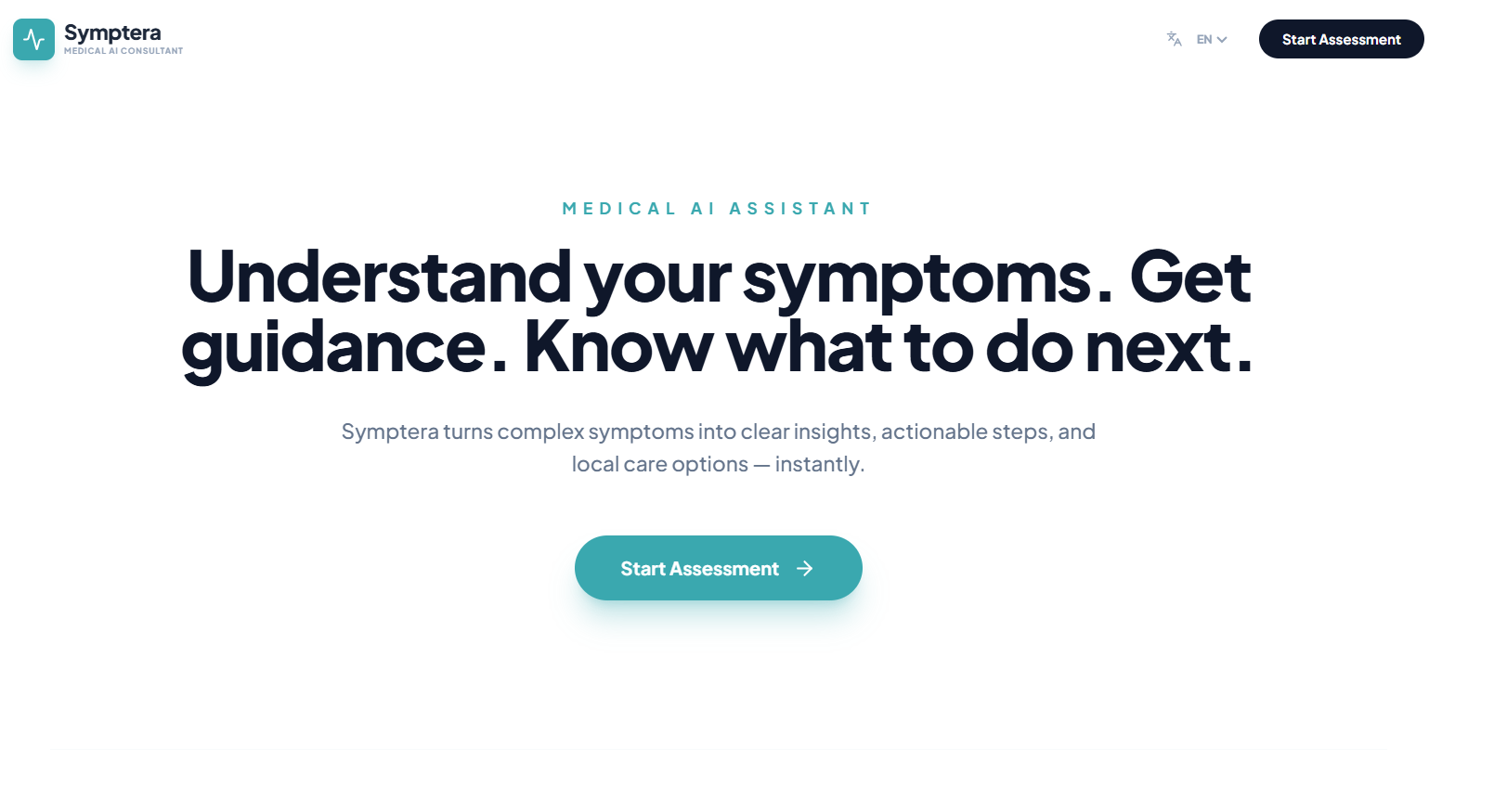
Symptera Medical AI Consultant
What distinguishes Symptera from traditional health chatbots is its design philosophy: it mirrors a clinical workflow rather than providing open-ended conversation. This means structured logic, consistent data handling, and outputs that can support real-world healthcare workflows.
Currently, Symptera is in Phase 1 of development, focusing on validating core diagnostic logic, workflow accuracy, and real-world usability. During this initial stage, Relipa Co., Ltd. is offering a limited trial version to selected healthcare partners and early users for evaluation and feedback. This pilot phase allows continuous refinement of medical logic, user experience, and enterprise integration capabilities before broader deployment.
To explore the trial version or request early access, please visit: https://sc.relipasoft.com/
II. AI Development Services Behind Relipa’s Engineering Capability
At Relipa, AI development services and research capabilities are not positioned as experimental innovation. Instead, they are engineered as production-oriented systems designed for real-world deployment. Through structured AI development services, Relipa’s R&D team combines data scientists, machine learning engineers, backend architects, and system designers to transform complex healthcare challenges into scalable AI platforms. It is engineered as a disciplined, production-oriented capability built around real-world deployment. The company’s AI R&D team combines data scientists, machine learning engineers, backend architects, and domain-oriented system designers who work collaboratively to transform complex healthcare challenges into structured AI systems.
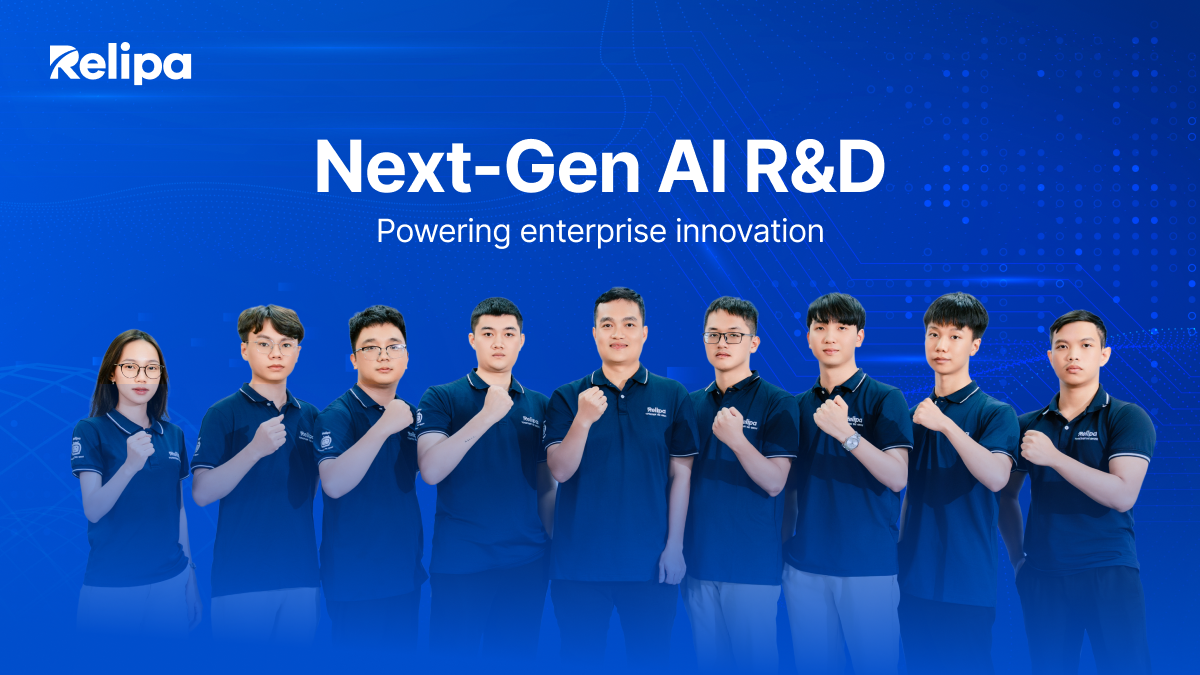
With experience serving the Japanese market — one of the most demanding environments in terms of precision, process standardization, and data governance — Relipa’s engineering approach emphasizes reliability, workflow alignment, and long-term scalability. Rather than building conversational AI for demonstration purposes, the team focuses on constructing decision-support systems that can operate inside regulated healthcare ecosystems.
A representative internal case reflecting this capability is the development of a structured AI-powered medical assistant platform designed for healthcare and Kaigo (eldercare) environments. While not positioned here as a product launch, the project serves as technical evidence of Relipa’s end-to-end AI R&D strength.
III. Engineering AI for Real Clinical Workflows
One of the most significant differentiators of Relipa’s AI team is its workflow-first design philosophy, a core principle applied throughout its AI development services for healthcare systems. In healthcare environments, intelligence cannot operate in isolation; it must follow established clinical logic and align with how healthcare professionals actually work. While free-form AI responses may appear technically sophisticated, they provide limited operational value if they cannot integrate seamlessly into intake procedures, documentation systems, or care coordination processes used in real medical environments.
Relipa’s R&D engineers address this challenge by designing structured workflow engines that replicate real clinical reasoning steps. As part of Relipa’s AI development services, the architecture goes beyond basic conversational AI by incorporating controlled processing pipelines that guide each stage of the interaction. These pipelines manage symptom intake, generate structured clinical summaries, analyze potential medical conditions, classify urgency levels, and recommend appropriate care pathways. By organizing AI interactions into defined operational stages, the system ensures that outputs remain consistent, interpretable, and aligned with real medical decision-making frameworks.
This architecture not only improves reliability but also enables healthcare organizations to transform raw symptom conversations into structured, actionable data. Such data can then be integrated into hospital information systems, care coordination platforms, or clinical documentation workflows. Through advanced AI development services, AI becomes part of the operational infrastructure rather than simply functioning as a conversational interface.
IV. Multidisciplinary AI Expertise
Healthcare AI is inherently interdisciplinary, demanding the coordinated integration of multiple advanced technologies rather than isolated model development. Developing intelligent healthcare systems requires far more than training a machine learning model. It involves combining several specialized domains, including Natural Language Processing (NLP) for interpreting unstructured symptom descriptions, Speech-to-Text technologies that improve accessibility in eldercare environments, robust backend architectures designed to manage structured medical datasets, and security frameworks aligned with strict enterprise governance and healthcare data protection standards.
Relipa’s AI R&D team operates seamlessly across these domains, bringing together machine learning engineers, system architects, backend developers, and AI specialists who collaborate closely throughout the development process. This multidisciplinary approach reflects the depth of Relipa’s AI development services, ensuring that each layer of the system—from NLP processing and symptom classification to workflow orchestration and data management—functions cohesively within a scalable and secure infrastructure.
Through this collaborative engineering model, AI components are not treated as isolated experimental features. Instead, they are developed as integrated modules within a broader software architecture designed for long-term reliability and operational deployment. This allows solutions built through AI development services to move beyond experimental prototypes and become fully embedded within real healthcare operations.
Another critical capability demonstrated by Relipa’s AI R&D team is the platform’s multilingual design architecture. The system supports English, Japanese, and Vietnamese, enabling the technology to operate effectively in international healthcare environments, particularly within Japan’s healthcare and Kaigo sectors.
However, multilingual AI in healthcare involves far more than direct translation. It requires adapting linguistic structures, understanding contextual nuances in symptom descriptions, and designing culturally aware interaction models that reflect how patients communicate health concerns in different languages. Medical terminology, symptom descriptions, and conversational patterns often vary significantly across cultures and languages, requiring careful engineering at both the NLP and workflow design levels.
By addressing these complexities through advanced AI development services, Relipa ensures that its AI systems remain both technically robust and globally adaptable. This capability positions the company to build scalable AI platforms that can operate across diverse healthcare environments while maintaining consistent performance, reliability, and usability.
V. Roadmap & Future Integration Scalability
Building on the validated clinical workflows of Phase 1, Phase 2 will elevate Symptera into a fully enterprise-integrated healthcare AI platform. The roadmap focuses on seamless EHR/HIS connectivity for automated clinical documentation, enhanced clinical decision-support models with expanded condition databases and risk stratification logic, and the introduction of an enterprise dashboard providing operational analytics, urgency tracking, and configurable workflows. At the infrastructure level, security and compliance will be strengthened through advanced encryption, role-based access control, and comprehensive audit logging.
The Role of AI Development Services in Healthcare Innovation
Modern healthcare organizations require more than isolated AI tools. They need comprehensive AI development services capable of integrating artificial intelligence into clinical workflows, enterprise systems, and data infrastructure. Through specialized AI development services, companies can build scalable platforms that automate symptom intake, support clinical decision-making, and generate structured medical data for long-term analysis.
The Symptera case study demonstrates how professional AI development services can transform healthcare operations by embedding AI into real workflows rather than treating it as a standalone digital interface.
Conclusion
Relipa’s AI R&D capability in healthcare is defined by structured engineering discipline, workflow-oriented system design, multilingual adaptability, and enterprise-grade deployment architecture.
The development of a structured AI-powered medical assistant platform stands as technical evidence of this capability. It demonstrates how Relipa translates artificial intelligence from theoretical models into operational systems aligned with complex healthcare environments.
For organizations seeking AI partners who understand not only algorithms but also architecture, governance, and real-world deployment challenges, Relipa represents a proven and forward-looking engineering team ready to deliver scalable healthcare intelligence solutions.
Relipa Software
