
In the digital transformation of healthcare, the key question is no longer whether to adopt AI, but how deeply AI can integrate into real operational systems and deliver sustainable value.
Symptera – an AI Medical Assistant developed by Relipa Co., Ltd. – is the result of comprehensive AI development services tailored specifically for the Health Care and Kaigo sectors. Through specialized AI development services, Relipa designed Symptera not simply as a chatbot, but as an intelligent system capable of integrating directly into clinical workflows and enterprise healthcare management platforms.
Rather than functioning as a standalone tool, Symptera is built to operate as part of the healthcare infrastructure, enabling organizations to apply AI in real operational environments. This reflects a key principle of modern AI development services: artificial intelligence must support real workflows and decision-making processes rather than exist as an isolated digital application.
In many healthcare organizations, digital tools are often deployed as independent applications that address only a small portion of operational challenges. While these tools may provide temporary improvements, they rarely transform how healthcare organizations operate at scale. Symptera was therefore designed with a fundamentally different philosophy: AI should function as an operational layer within healthcare infrastructure, supporting both frontline staff and organizational leadership.
This distinction is critical. AI only creates long-term enterprise value when it becomes deeply integrated into operational systems.
By combining advanced artificial intelligence with structured system architecture, Symptera demonstrates how professional AI development services can help healthcare and Kaigo providers streamline intake processes, accelerate decision-making, and generate structured data that supports both daily operations and long-term strategic planning.
Overview of Symptera
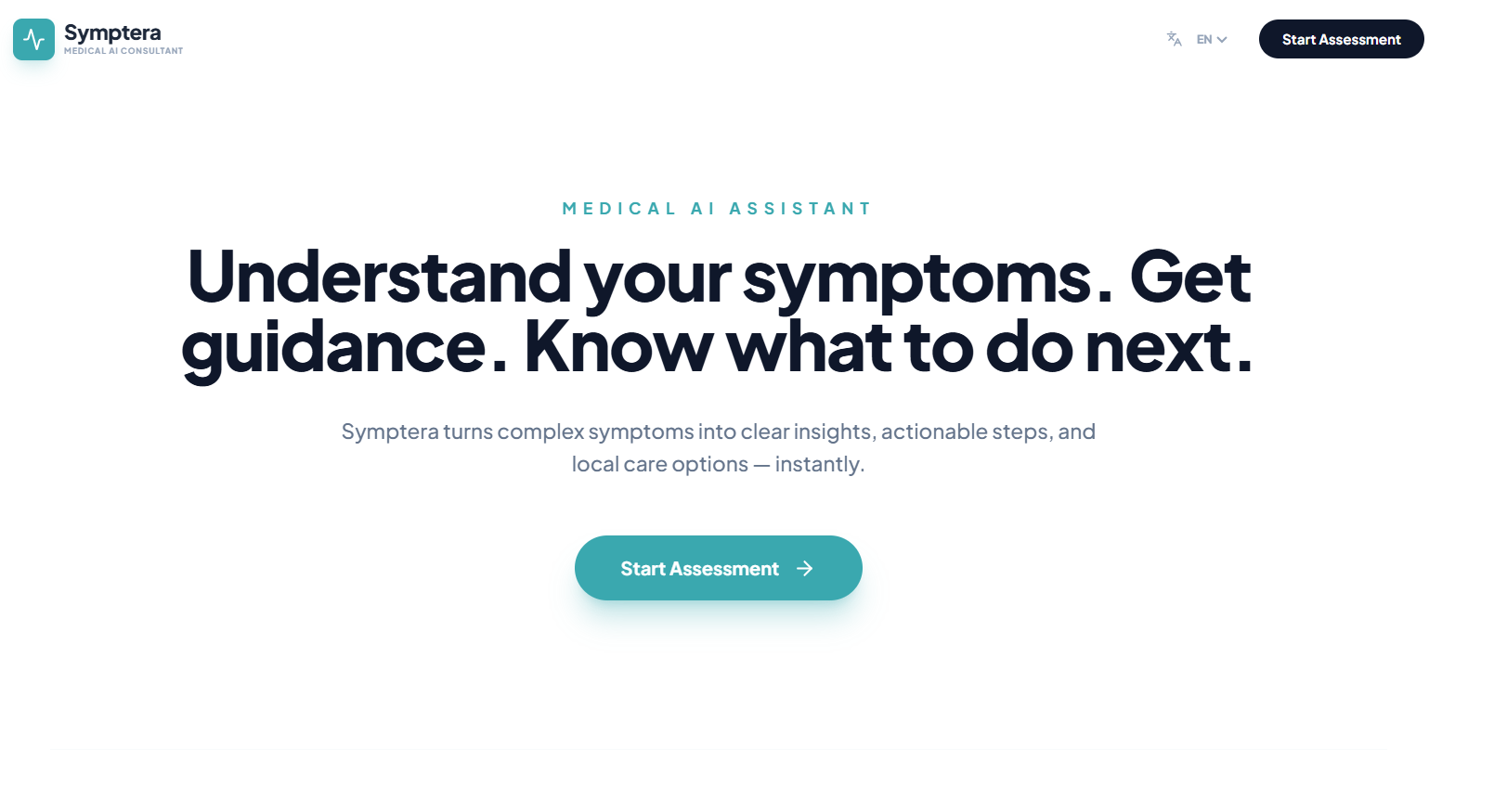
Symptera is an AI-powered platform designed to support symptom assessment and patient care navigation. The system allows users to input symptoms via text or voice, after which it performs structured analysis to provide:
-
Possible medical conditions
-
Urgency assessment
-
Recommended actions (self-monitoring, clinic visit, or emergency care)
-
Suggested medical department or specialty
These capabilities help healthcare providers guide patients toward appropriate care pathways more quickly while maintaining consistency in initial clinical assessments.
The platform currently supports English, Japanese, and Vietnamese, making it particularly suitable for Japan’s multilingual healthcare environment where both domestic and international patients require accessible digital services.
Unlike conventional medical chatbots, Symptera is built on a structured clinical workflow architecture. Its operational pipeline includes:
Intake → Clinical Memo → Possible Conditions → Urgency Assessment → Care Pathway → Navigation Support
Each stage replicates the logical reasoning process used by healthcare professionals during an initial patient evaluation. By structuring the workflow in this way, Symptera ensures that information is captured consistently and processed in a way that supports real clinical decision-making.
This structured architecture is the result of advanced AI development services focused on real-world healthcare integration rather than experimental prototypes.
A live web demo is currently available for enterprise presentations, allowing healthcare organizations to evaluate how AI-powered systems can integrate with existing digital infrastructure.
Read more: What Is Medical AI? Explained by AI Development Companies
Market Context: Why System Integration Matters
Healthcare and Kaigo providers in Japan are currently facing several structural challenges. Workforce shortages, rising operational costs, and the growing demand for elderly care services are placing significant pressure on healthcare organizations. According to the World Health Organization’s overview of artificial intelligence in healthcare, AI technologies are increasingly used to support clinical decision-making, improve operational efficiency, and enhance patient care delivery when integrated into healthcare systems.
Japan’s aging population continues to increase demand for healthcare and long-term care services, while the supply of trained medical staff grows much more slowly. This imbalance requires healthcare providers to find new ways to increase efficiency while maintaining high-quality care standards.Many administrative processes—especially symptom intake and documentation—are still handled manually. These processes are often time-consuming, inconsistent, and difficult to standardize across multiple facilities.In this environment, isolated digital tools are no longer sufficient. Healthcare organizations require integrated systems built through advanced AI development services that can support operational workflows and data-driven decision-making.
Modern healthcare systems increasingly require solutions capable of:
-
Standardizing initial clinical assessments
-
Generating structured healthcare data
-
Integrating with internal hospital management systems
-
Supporting operational and managerial decision-making
Through specialized AI development services, Symptera was designed to address these challenges holistically. Rather than functioning as a standalone digital tool, the platform acts as a core infrastructure layer within healthcare organizations.By embedding symptom assessment directly into operational workflows, the platform helps healthcare providers streamline intake procedures while generating valuable clinical data. This approach highlights how enterprise-level AI development services can transform healthcare operations beyond simple automation.
Short-Term Business Value: Operational Efficiency and Cost Optimization
Reduced Intake Time
Symptera leverages Natural Language Processing (NLP) and Speech-to-Text technologies developed through advanced AI development services to automatically collect and structure symptom information.Instead of requiring healthcare staff to manually gather detailed patient information, the system dynamically asks follow-up questions based on the user’s responses. This adaptive questioning process enables the platform to efficiently capture clinically relevant data.
Once the interaction is complete, the system generates a structured Clinical Memo summarizing each patient case.By automating these processes through intelligent AI development services, Symptera significantly reduces documentation time and minimizes inconsistencies in patient data entry. In Kaigo environments where caregiver resources are limited, this efficiency improvement allows staff to focus more on direct patient care.
Reduced Administrative Workload
Administrative tasks often consume a large portion of healthcare staff time.
By automating symptom collection and structuring patient information, Symptera reduces the burden of manual paperwork and repetitive documentation processes. Healthcare professionals can therefore dedicate more time to direct patient care and clinical decision-making.
This shift improves productivity while also enhancing overall patient experience.
Standardized Case Handling
Variability in symptom evaluation is one of the major operational challenges in healthcare systems.Different staff members may interpret patient symptoms differently depending on their experience levels. These inconsistencies can lead to variability in triage decisions and care pathways.Symptera addresses this issue by implementing a structured workflow powered by advanced AI development services. Each patient case is evaluated according to a consistent analytical framework.This standardization improves reliability, reduces the risk of oversight, and ensures higher operational quality across healthcare organizations.
Long-Term Value: A Data Foundation for Strategic Management
While Symptera delivers immediate operational improvements, its long-term strategic value lies in the structured data it generates.
Each case processed by the platform becomes structured clinical data. Over time, this data forms a valuable asset that healthcare organizations can use for management, planning, and operational optimization.
Standardization Across Multiple Facilities
Healthcare organizations operating multiple clinics or care centers often struggle to maintain consistent intake procedures.
Symptera introduces a standardized digital framework that can be implemented across multiple locations. This ensures consistent symptom assessment, documentation standards, and clinical workflows across the organization.
Advanced Analytics and Reporting
One of the most valuable outcomes of implementing solutions built through professional AI development services is the ability to generate structured, analyzable healthcare data. In traditional healthcare environments, patient information is often recorded manually and stored in fragmented formats, making it difficult to analyze trends or extract operational insights.
By contrast, Symptera collects and organizes symptom data through structured workflows powered by advanced AI development services. Every interaction processed by the platform becomes standardized clinical information that can be aggregated and analyzed at scale.
With access to structured data, healthcare organizations can perform deeper operational analysis, including:
-
Identifying emerging health trends across patient populations
-
Monitoring operational performance across multiple facilities
-
Evaluating service quality and care pathway efficiency
-
Detecting workflow inefficiencies and process bottlenecks
These insights enable healthcare leadership teams to transition from fragmented reporting systems toward fully data-driven management strategies. Instead of relying solely on manual observations or periodic reports, organizations can use real-time data generated through AI development services to support faster and more accurate decision-making.
Over time, this analytical capability becomes a strategic asset, helping healthcare providers continuously refine operational processes and improve the quality of care delivered to patients.
Competitive Differentiation
In today’s healthcare landscape, technological capability is increasingly becoming a key factor in organizational competitiveness. Healthcare providers that integrate AI technologies directly into their operational workflows are better positioned to respond to market challenges and evolving patient needs.
Solutions developed through advanced AI development services do more than introduce new digital tools. They create intelligent operational systems that support scalability, reliability, and long-term organizational resilience.
For healthcare and Kaigo providers in Japan, this capability is particularly important. The country’s aging population continues to increase demand for healthcare services, while workforce shortages create significant operational pressure.
Organizations that adopt AI-powered platforms like Symptera gain the ability to improve intake efficiency, standardize care processes, and enhance service quality. Through well-designed AI development services, healthcare providers can implement digital systems that strengthen operational performance while also improving patient experiences.
As competition within Japan’s healthcare and Kaigo sectors continues to intensify, the adoption of integrated AI solutions will increasingly become a differentiating factor between organizations that successfully modernize their operations and those that struggle to keep pace with industry transformation.
Integration and System Expansion Capabilities
A defining characteristic of enterprise-grade solutions built through AI development services is their ability to integrate seamlessly with existing operational infrastructure. Symptera was designed with this principle in mind.
Rather than operating as an isolated application, the platform is built to function as part of a broader healthcare system architecture. Its modular design enables organizations to integrate AI-driven symptom assessment directly into their clinical workflows, hospital management systems, and operational processes.
Through scalable AI development services, Symptera can be expanded to support a wide range of automation and decision-support capabilities.
Workflow Automation
Once integrated into an organization’s healthcare infrastructure, Symptera can automate several operational processes that traditionally require manual coordination.
Depending on the organization’s existing systems, the platform can support automation such as:
-
Appointment scheduling based on urgency levels identified during symptom assessment
-
Staff assignment aligned with internal operational workflows
-
Intelligent suggestions for appropriate medical tests or examinations
-
Automatic transfer of structured patient data to physicians or medical staff
In this model, symptom assessment data generated through AI development services becomes the trigger for downstream operational processes. This reduces administrative delays and ensures that patient information flows efficiently through the healthcare system.
By connecting symptom analysis directly with operational workflows, the platform demonstrates how well-designed AI development services can transform healthcare processes from fragmented manual steps into coordinated digital operations.
Predictive and Resource Management Support
As structured data accumulates within the system, the capabilities of AI-powered healthcare platforms expand beyond operational automation.
When integrated into enterprise management systems, data generated by Symptera can support predictive analytics and resource planning initiatives. These capabilities include:
-
Workforce demand forecasting based on patient intake trends
-
Analysis of operational load across departments or facilities
-
Detection of potential risks within care workflows
-
Strategic planning for resource allocation and capacity management
Through advanced AI development services, healthcare organizations can transform routine operational data into predictive insights that support long-term planning.
At this stage, artificial intelligence evolves from a simple patient interaction tool into a decision-support system for healthcare leadership, helping organizations anticipate challenges and allocate resources more effectively.
Internal Training Infrastructure
Another long-term advantage of implementing solutions built through professional AI development services is the creation of a valuable training resource.
Each real-world case processed by Symptera becomes part of a growing dataset that reflects authentic patient interactions and clinical evaluation scenarios. These structured cases can be used as training materials for healthcare staff.
Organizations can leverage this dataset to:
-
Standardize symptom evaluation practices
-
Improve staff diagnostic awareness during initial patient intake
-
Support the training and onboarding of new healthcare professionals
By analyzing real operational cases, healthcare organizations can develop more consistent and effective training frameworks. Over time, the platform evolves beyond a digital operational tool and becomes part of a continuous learning infrastructure for healthcare teams.
This capability highlights the broader value of enterprise AI development services, which enable organizations not only to automate tasks but also to build knowledge systems that strengthen workforce competency and institutional expertise.
Conclusion
Symptera is more than a symptom assessment platform. Its real value lies in its ability to:
-
Standardize clinical workflows
-
Generate structured enterprise-ready data
-
Integrate deeply into operational systems
-
Support both operational management and strategic decision-making
By leveraging specialized AI development services, Symptera demonstrates how healthcare AI can evolve beyond experimental tools into scalable, integration-ready operational infrastructure.
As healthcare and Kaigo providers accelerate digital transformation, organizations that adopt deeply integrated AI systems will gain sustainable competitive advantages. Symptera was designed precisely to support that transformation.
