
In today’s digital-first landscape, enterprises are under constant pressure to operate faster, smarter, and more efficiently. As organizations scale, the complexity of their internal processes increases—often resulting in fragmented systems, manual bottlenecks, and inconsistent performance. These inefficiencies not only slow down operations but also create barriers to innovation and growth. This is where workflow automation becomes a critical enabler of modern business success.
Workflow automation is no longer just about reducing manual work or digitizing repetitive tasks. It represents a fundamental shift in how businesses design, execute, and optimize their operations. By leveraging intelligent technologies such as artificial intelligence and machine learning, organizations can move beyond static, rule-based systems toward adaptive workflows that continuously learn, improve, and respond to real-time conditions.
This transformation is typically driven by an experienced AI software development company, which combines expertise in AI, system architecture, and enterprise workflow design. A capable AI software development company does not simply automate isolated processes—it builds interconnected automation ecosystems that enable seamless data flow, intelligent decision-making, and scalable performance across the organization.
In this article, we explore how workflow automation works, why it matters in today’s competitive landscape, and how partnering with an AI software development company can help enterprises unlock long-term operational excellence and sustainable growth.
What is Workflow Automation?
Workflow automation refers to the use of technology to execute business processes automatically, minimizing or eliminating the need for manual intervention. Instead of relying on human input at every stage, automated workflows use predefined rules, triggers, or AI-driven logic to manage data processing, decision-making, and task execution.
A typical workflow automation process includes:
Capturing data from multiple sources such as applications, users, or external systems
Automatically validating, cleaning, and processing data
Triggering actions based on predefined conditions or real-time events
Routing tasks to appropriate systems, departments, or stakeholders
Monitoring performance and continuously optimizing workflows
While this structure may seem straightforward, modern workflow automation systems are highly dynamic and interconnected. They operate across multiple platforms and handle large volumes of data in real time. In traditional environments, these processes are often manual and disconnected, leading to inefficiencies and delays.
A modern AI software development company transforms this model by introducing intelligent automation capabilities. Instead of static workflows, systems become adaptive and context-aware. By integrating technologies such as machine learning, natural language processing, and predictive analytics, an AI software development company enables workflows that can adjust to changing conditions, learn from historical data, and continuously improve performance.
As a result, workflow automation evolves from a simple operational tool into a strategic capability that supports scalability, agility, and innovation.To better understand how automation is reshaping enterprise operations, you can explore insights from IBM’s workflow automation guide.
Why Workflow Automation Matters
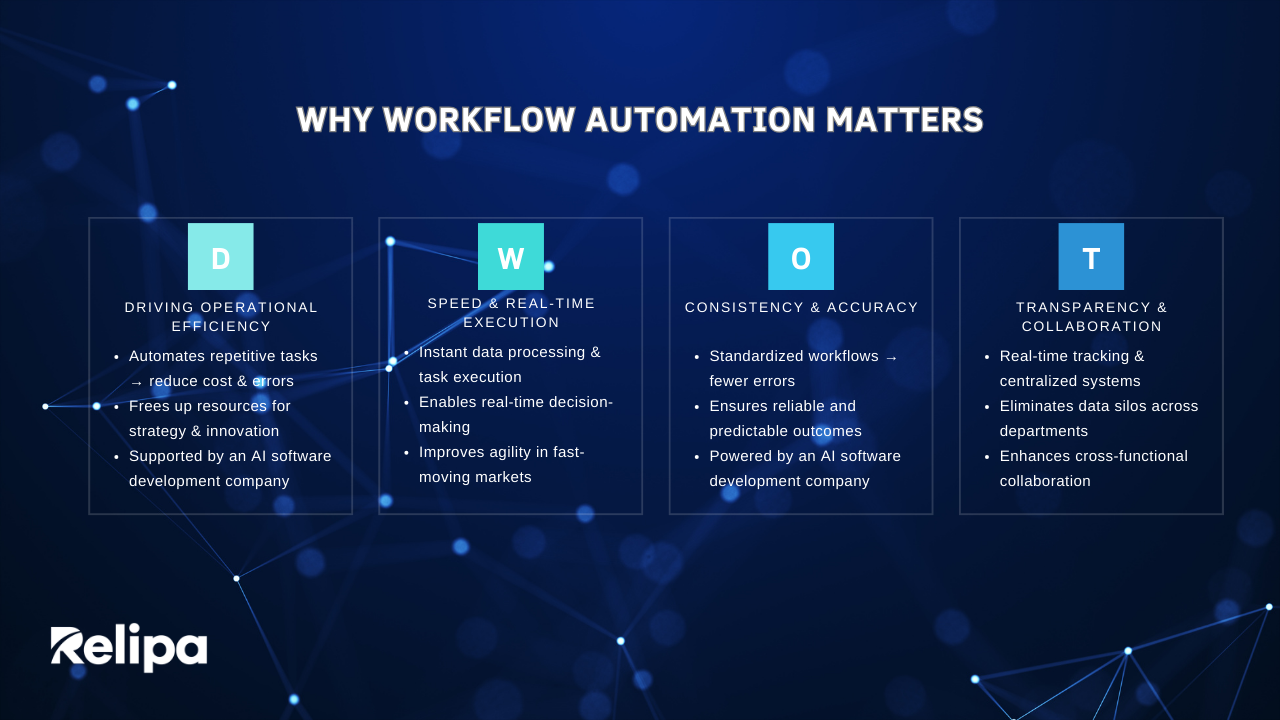
Driving Operational Efficiency
Workflow automation plays a central role in improving operational efficiency and enabling business growth. As organizations expand, manual processes become increasingly difficult to manage, leading to delays, errors, and rising costs.An AI software development company helps enterprises eliminate these inefficiencies by automating repetitive and time-consuming tasks. This allows teams to focus on higher-value activities such as strategy, innovation, and customer engagement.
Speed and Real-Time Execution
One of the most significant advantages of workflow automation is speed. Automated systems can process data and execute tasks instantly, enabling real-time operations.An AI software development company ensures that workflows are designed to respond quickly to changes, helping businesses maintain agility and competitiveness in fast-moving markets.
Consistency and Accuracy
Another critical benefit is consistency. Manual workflows often vary depending on individual execution, leading to inconsistencies and errors.By implementing standardized automation solutions, an AI software development company ensures uniformity across processes, reducing risks and improving reliability.
Transparency and Collaboration
Workflow automation also enhances transparency. With centralized systems and real-time tracking, organizations gain better visibility into their operations.An AI software development company enables businesses to create unified data flows, eliminating silos and improving cross-functional collaboration.
The Role of AI in Workflow Automation
Artificial intelligence significantly enhances workflow automation by introducing intelligence, adaptability, and predictive capabilities. Instead of relying solely on predefined rules, AI enables workflows to evolve based on data and experience.
An AI software development company integrates AI into workflow automation through several advanced capabilities:
Intelligent automation that dynamically adjusts workflows based on real-time data
Natural language processing to interpret unstructured inputs such as emails, documents, and user interactions
Machine learning models that identify patterns, trends, and anomalies
These capabilities allow workflows to operate more efficiently and with greater autonomy. For example, instead of manually categorizing incoming requests, AI systems can automatically classify and route them based on context and priority.
Predictive automation is another major advantage. An AI software development company enables systems to anticipate potential issues and take proactive actions. This could include detecting anomalies in financial transactions, predicting equipment failures, or identifying customer churn risks before they occur.
In addition, AI enables continuous optimization. Workflow systems developed by an AI software development company can analyze performance data over time, identify inefficiencies, and refine processes automatically. This creates a self-improving system that becomes more efficient and effective with each iteration.
Core Components of Workflow Automation Systems
A robust workflow automation system consists of multiple interconnected components that work together to ensure seamless execution.
Key components include:
Data Input Layer: Collects data from various sources such as enterprise systems, APIs, and user interactions
Processing Engine: Cleans, validates, and transforms data into a usable format
Automation Engine: Executes workflows based on rules or AI-driven logic
Integration Layer: Connects different systems and ensures smooth data exchange
Monitoring and Analytics: Tracks performance and provides insights for optimization
An experienced AI software development company ensures that these components are properly designed and integrated. This creates a unified system where data flows efficiently and actions are executed accurately.
How an AI Software Development Company Implements Workflow Automation
Implementing workflow automation requires a strategic approach that aligns technology with business objectives. A professional AI software development company follows a structured methodology to ensure successful deployment and long-term value.
This process typically includes:
Evaluating existing workflows and identifying inefficiencies
Defining automation goals and measurable success metrics
Designing scalable and flexible system architecture
Developing and integrating AI-powered automation solutions
Monitoring performance and continuously optimizing workflows
During the assessment phase, an AI software development company conducts a detailed analysis of current operations to identify bottlenecks and opportunities for improvement. This ensures that automation efforts are focused on areas that deliver the highest impact.
In the design phase, the AI software development company creates a robust architecture that supports scalability, security, and integration. This foundation is critical for ensuring long-term success.
The development phase involves building automation logic, training AI models, and integrating systems. Here, the technical expertise of an AI software development company ensures that workflows operate seamlessly across platforms.
After deployment, continuous monitoring and optimization ensure that workflows remain efficient and adaptable. A forward-thinking AI software development company treats automation as an ongoing process that evolves with business needs.
Real-World Use Cases
Workflow automation powered by AI is transforming industries by enabling smarter and more efficient operations.
In healthcare, automated workflows streamline patient data management, appointment scheduling, and clinical processes. An AI software development company can build systems that improve both operational efficiency and patient outcomes.
In e-commerce, workflow automation manages order processing, inventory tracking, and customer interactions. By leveraging AI, an AI software development company enables personalized and seamless shopping experiences.
In finance, automation is used for fraud detection, compliance management, and transaction processing. These applications require high levels of accuracy and security, which an AI software development company can deliver.
Benefits of Workflow Automation
Workflow automation delivers far more than simple efficiency gains—it creates a foundation for sustainable, scalable, and data-driven business operations. As enterprises continue to grow and digitize, the ability to automate complex workflows becomes a key competitive advantage.
At its core, workflow automation significantly reduces operational costs by eliminating repetitive, manual tasks that consume time and resources. Instead of relying on human intervention for routine processes, businesses can leverage systems designed by an AI software development company to execute tasks automatically with speed and precision.Beyond cost reduction, workflow automation drives a substantial increase in efficiency. Processes that once took hours or days can now be completed in real time, enabling faster execution across departments. An experienced AI software development company ensures that these workflows are not only automated but also optimized for performance, allowing organizations to respond quickly to market demands.
Accuracy is another critical benefit. Manual processes are inherently prone to errors, especially when dealing with large volumes of data. Workflow automation minimizes these risks by enforcing standardized processes and validation mechanisms. By partnering with an AI software development company, businesses can ensure consistent and reliable outcomes across operations.Scalability is equally important. As organizations expand, their operational complexity increases. Workflow automation provides the infrastructure needed to scale efficiently without proportional increases in cost or effort. A capable AI software development company designs systems that can handle growing workloads while maintaining performance and stability.
Ultimately, workflow automation transforms operations from fragmented and reactive to streamlined and proactive. With the support of an AI software development company, businesses can unlock long-term value, improve productivity, and build a strong foundation for digital growth.
Challenges in Workflow Automation
Despite its significant advantages, implementing workflow automation is not without challenges. Organizations often encounter technical, operational, and cultural barriers that must be addressed to ensure successful adoption.One of the most common challenges is integrating automation with legacy systems. Many enterprises rely on outdated infrastructure that was not designed to support modern automation technologies. An experienced AI software development company plays a crucial role in bridging this gap by designing flexible integration layers that allow new systems to work seamlessly with existing ones.
Data quality and consistency also present major challenges. Workflow automation relies heavily on accurate and well-structured data. Inconsistent or incomplete data can lead to incorrect outputs and reduced system effectiveness. An AI software development company addresses this issue by implementing robust data governance frameworks, ensuring that data is clean, standardized, and reliable.Another critical challenge is organizational change. Automation often requires shifts in workflows, roles, and responsibilities, which can lead to resistance from employees. Without proper change management, even the most advanced systems may fail to deliver expected results. A skilled AI software development company supports this transition by aligning technology with business processes and providing strategies to improve user adoption.
Security and compliance are also key considerations, particularly in industries such as finance and healthcare. Workflow automation systems must be designed to protect sensitive data and comply with regulatory requirements. An AI software development company ensures that security measures such as encryption, access control, and audit trails are built into the system from the ground up.
By addressing these challenges proactively, organizations can fully realize the benefits of workflow automation. Partnering with an AI software development company ensures that both technical and organizational complexities are managed effectively.
Future Trends in Workflow Automation
Workflow automation is evolving rapidly, driven by advancements in artificial intelligence, cloud computing, and enterprise software architecture. Organizations that stay ahead of these trends are better positioned to maintain competitiveness and drive innovation.
One of the most significant trends is hyperautomation, which combines AI, robotic process automation (RPA), and advanced analytics to automate end-to-end business processes. An innovative AI software development company enables enterprises to move beyond isolated automation and create fully integrated, intelligent systems.
Another key trend is the shift toward real-time, event-driven automation. Instead of relying on scheduled processes, modern systems respond instantly to events and data changes. This allows businesses to operate with greater agility and responsiveness. An AI software development company plays a critical role in designing architectures that support real-time execution.
AI-first workflow design is also gaining traction. Rather than adding AI capabilities to existing systems, organizations are building workflows around AI from the beginning. This approach enables deeper integration, better performance, and more advanced capabilities. A forward-thinking AI software development company helps businesses adopt this model effectively.
Given these trends, organizations should consider investing in workflow automation when they encounter clear operational limitations. Common indicators include:
A high volume of repetitive and manual tasks
Slow processing times and delayed decision-making
Difficulty scaling operations as the business grows
In such situations, an AI software development company can redesign workflows, implement intelligent automation, and create systems that support long-term scalability and efficiency.
Conclusion
Workflow automation has become a fundamental pillar of modern enterprise operations. It enables organizations to streamline processes, reduce costs, and improve overall efficiency while supporting innovation and growth.
However, the true value of workflow automation lies in its evolution toward intelligent systems. By working with an AI software development company, businesses can go beyond basic automation and build adaptive workflows that learn, optimize, and continuously improve over time.
An experienced AI software development company not only provides the technical expertise needed to implement automation but also serves as a strategic partner in driving digital transformation. From system design to long-term optimization, their role is essential in ensuring that automation delivers measurable business value.
As the business landscape continues to evolve, workflow automation will play an increasingly important role in shaping how organizations operate, compete, and grow. Enterprises that invest in automation today—especially in collaboration with a trusted AI software development company—will be better equipped to lead in a data-driven future.
Relipa Software
Relipa Co., Ltd. is a Vietnam-based software development company established in April 2016. After two years of growth, our Japanese branch – Relipa Japan – was officially founded in July 2018.
We provide services in MVP development, web and mobile application development, and blockchain solutions. With a team of over 100 professional IT engineers and experienced project managers, Relipa has become a reliable partner for many enterprises and has successfully delivered more than 500 projects for startups and businesses worldwide.
