

Artificial intelligence has rapidly become one of the most discussed topics in enterprise technology. Boards are approving AI budgets, executives are exploring new use cases, and technology leaders are under increasing pressure to deliver AI-driven innovation.
Yet despite growing investment, many organizations face a common problem.
They know they need an AI strategy, but they are not always sure where to invest first.
Should they build an AI-powered customer service platform? Implement predictive analytics? Deploy AI copilots for employees? Invest in process automation? Explore generative AI applications?
The challenge is not a shortage of AI opportunities.
The challenge is identifying which AI investment will generate the greatest business value.
This is where AI application development services have become increasingly important. Rather than focusing on AI technology for its own sake, enterprises are seeking partners who can help align AI initiatives with business priorities, operational goals, and measurable outcomes.
From our experience supporting organizations across industries, the most successful AI projects do not begin with technology. They begin with a business objective.
The organizations achieving meaningful results are the ones asking: “Which AI solution will create the greatest impact for our business?”
Instead of: “What can AI do?”
Why Many AI Projects Fail to Deliver Expected Value
Enterprise enthusiasm for AI remains exceptionally high.
However, many organizations still struggle to achieve widespread business value from AI initiatives.
A common reason is that AI projects are often selected based on technology trends rather than business challenges.
An enterprise may deploy a chatbot because competitors are doing the same. Another may implement a generative AI assistant because it appears innovative.
Yet if these solutions fail to solve meaningful business problems, adoption remains low and ROI becomes difficult to justify.
The issue is not AI itself.
The issue is poor alignment between technology investments and strategic goals.
This is why modern AI application development services emphasize business outcomes before solution development.
The objective is not merely deploying AI.
The objective is creating measurable value.
Start with Business Objectives, Not AI Capabilities
One of the biggest mistakes enterprises make is approaching AI from a technology-first perspective.
Instead, organizations should begin by identifying core business priorities.
For example:
- Is the business trying to reduce operational costs?
- Improve customer experience?
- Increase employee productivity?
- Accelerate decision-making?
- Enhance forecasting accuracy?
- Scale operations efficiently?
Different goals require different AI solutions.
A manufacturing company focused on reducing downtime may benefit more from predictive maintenance than generative AI.
A financial institution seeking better risk management may prioritize predictive analytics.
A customer-centric business may focus on AI-powered engagement platforms.
Successful AI application development services engagements begin by identifying these priorities and mapping them to realistic AI opportunities.
This approach ensures that investments remain linked to business outcomes rather than technology trends.
Scenario 1: Reducing Operational Costs Through AI Automation
For many organizations, cost optimization remains one of the most compelling AI use cases.
Operational processes often contain repetitive tasks that consume significant employee time and resources.
Examples include:
- Data processing
- Document management
- Customer inquiries
- Workflow approvals
- Reporting activities
AI-powered automation can streamline these processes, reducing manual effort while improving consistency and speed.
In this scenario, the value of AI is relatively straightforward to measure.
Organizations can track:
- Labor savings
- Reduced processing times
- Lower error rates
- Improved operational efficiency
Many enterprises begin their AI journey here because the ROI is often visible relatively quickly.
Leading AI application development services providers frequently identify automation opportunities as a practical starting point for organizations seeking measurable returns.
Scenario 2: Improving Customer Experience
Customer expectations continue to increase.
Organizations are expected to deliver personalized, responsive, and seamless interactions across channels.
AI can play a significant role in achieving these objectives.
Applications may include:
- Intelligent customer support
- Recommendation engines
- Personalized content delivery
- Sentiment analysis
- Customer journey optimization
Unlike cost-reduction initiatives, customer experience investments often focus on growth rather than efficiency.
The benefits may appear through:
- Increased customer retention
- Higher conversion rates
- Improved satisfaction scores
- Greater customer lifetime value
When evaluating AI application development services, organizations should consider how AI can strengthen relationships with customers rather than simply automate interactions.
The most effective customer-focused AI solutions enhance experiences without sacrificing personalization.
Scenario 3: Accelerating Data-Driven Decision-Making
Many organizations possess large volumes of data but struggle to convert information into actionable insights.
Executives frequently face challenges associated with:
- Forecasting
- Planning
- Risk assessment
- Resource allocation
- Market analysis
AI-powered analytics solutions help organizations move from reactive decision-making to predictive decision-making.
Rather than relying solely on historical reporting, leaders gain access to forecasts, trend identification, and proactive recommendations.
This creates significant advantages in areas such as:
- Supply chain optimization
- Financial planning
- Demand forecasting
- Inventory management
- Operational performance
For enterprises seeking faster and more informed decision-making, AI application development services often focus on building intelligent analytics platforms capable of supporting strategic planning.
Scenario 4: Increasing Employee Productivity
One of the fastest-growing AI investment areas involves workforce productivity.
Employees increasingly spend time searching for information, generating reports, responding to inquiries, and navigating complex internal systems.
AI-powered assistants and enterprise copilots can reduce these inefficiencies.
Examples include:
- Knowledge management assistants
- Internal AI search solutions
- Productivity copilots
- Automated reporting tools
- Intelligent workflow assistants
The goal is not replacing employees.
The goal is enabling employees to focus more time on high-value activities.
Organizations implementing these solutions frequently report improvements in both productivity and employee satisfaction.
As demand grows, AI application development services increasingly include custom AI assistants tailored to specific roles, departments, and business functions.
Scenario 5: Creating New Revenue Opportunities
Not every AI investment focuses on efficiency.
Some organizations use AI to drive innovation and create entirely new revenue streams.
These initiatives may involve:
- AI-powered products
- Intelligent platforms
- Data monetization opportunities
- Predictive services
- Industry-specific AI solutions
In this scenario, AI becomes a market differentiator rather than an operational tool.
The objective is competitive advantage.
Organizations pursuing growth-focused initiatives often require more customized solutions, making AI application development services especially valuable.
Off-the-shelf AI tools rarely provide sufficient differentiation for revenue-generating innovations.
Custom development enables businesses to create unique capabilities aligned with market needs.
How to Prioritize AI Investments

One of the most important executive decisions is determining where to invest first.
Not every AI opportunity deserves immediate attention.
Successful organizations evaluate potential projects across three criteria:
- Business Impact: How significantly will the solution affect revenue, efficiency, productivity, or customer experience?
- Implementation Complexity: How difficult is the project to deploy, integrate, and manage?
- Time-to-Value: How quickly can measurable benefits be realized?
The most attractive AI initiatives typically combine high impact, manageable complexity, and a reasonable implementation timeline.
Experienced providers of AI application development services help organizations evaluate opportunities objectively and develop realistic implementation roadmaps.
This reduces the risk of investing heavily in initiatives that fail to generate meaningful returns.
Build, Buy, or Partner?
As enterprises identify AI opportunities, another question emerges:
Should the organization build solutions internally, buy existing platforms, or partner with an AI development provider?
Internal development offers control but requires specialized talent that can be difficult to recruit and retain.
Commercial AI platforms provide speed but may not address unique business requirements.
For many enterprises, partnering with experienced providers of AI application development services offers a balanced approach.
Organizations gain access to:
- AI expertise
- Data engineering capabilities
- Cloud architecture support
- Business analysis resources
- Proven implementation frameworks
This reduces execution risk while accelerating time-to-market.
Rather than spending months building AI teams, organizations can focus on realizing business outcomes.
What to Look for in an AI Application Development Services Partner
Choosing the right partner is often just as important as selecting the right AI use case.
The best providers offer more than technical expertise.
They help organizations connect business objectives to practical AI solutions.
When evaluating providers, enterprise leaders should consider:
AI and machine learning expertise
- Industry knowledge
- Cloud and data capabilities
- Governance and security practices
- Integration experience
- Scalability of delivery teams
- Ability to measure business outcomes
A strong partner should be capable of translating AI possibilities into measurable business results.
Ultimately, successful AI adoption is not about technology alone.
It is about transformation.
Measuring Success: From AI Adoption to AI Value
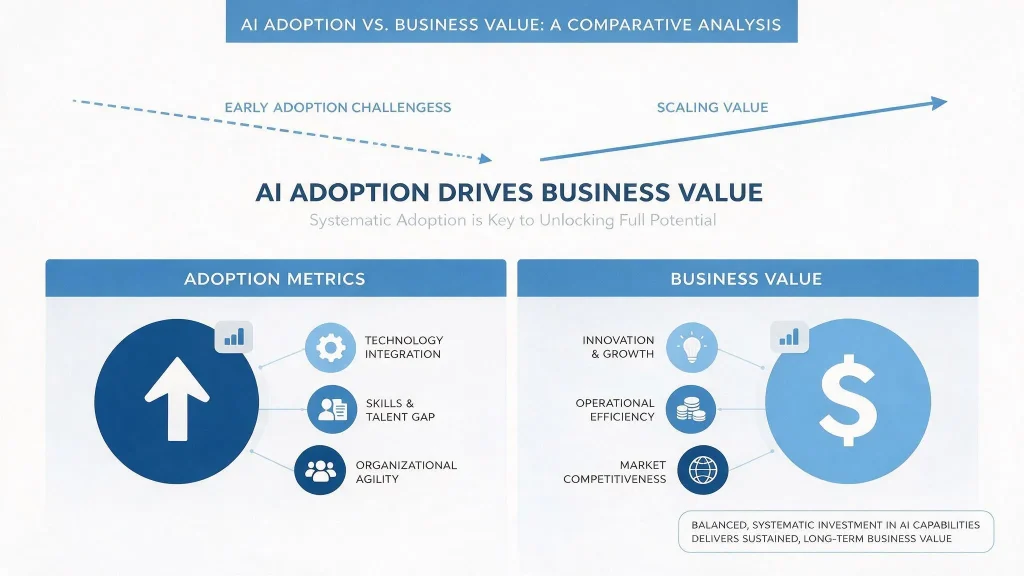
One of the most common mistakes organizations make is measuring the wrong outcomes.
AI success is not determined by:
- Number of models deployed
- Number of users onboarded
- Number of AI features launched
Instead, success should be measured through business value.
Examples include:
- Revenue growth
- Cost reduction
- Productivity improvements
- Customer satisfaction gains
- Faster decision-making
- Reduced operational risks
The most effective AI application development services focus on these metrics from the beginning.
This ensures that AI remains aligned with enterprise priorities throughout the project lifecycle.
The Best AI Investment Is the One That Solves a Business Problem
The AI landscape continues to evolve rapidly.
New technologies, platforms, and capabilities emerge almost every month. While this creates exciting opportunities, it also creates uncertainty for enterprise leaders attempting to prioritize investments.
The solution is not chasing every new AI trend.
The solution is aligning AI initiatives with business goals.
Whether the objective is reducing costs, improving customer experience, accelerating decisions, increasing productivity, or creating new revenue streams, the right AI strategy begins with understanding the desired outcome.
This is where AI application development services create the greatest value.
By combining technical expertise with strategic business understanding, organizations can identify the AI opportunities most likely to deliver measurable results.
The question is not: “Which AI technology should we invest in?”
The better question is: “Which AI investment will create the greatest business value for our organization?”
The enterprises that answer that question successfully will be the ones that turn AI from an innovation initiative into a true competitive advantage.
Relipa
Relipa is a Vietnam-based software development company established in April 2016. After two years of growth, our Japanese branch – Relipa Japan – was officially founded in July 2018.
We provide services in MVP development, web and mobile application development, and blockchain solutions. With a team of over 100 professional IT engineers and experienced project managers, Relipa has become a reliable partner for many enterprises and has successfully delivered more than 500 projects for startups and businesses worldwide.
