

Most organizations don’t start by planning to build a long-term development team.
In the early stages of a product, the typical approach is straightforward. A business identifies an opportunity, defines a scope, allocates a budget, and brings in external resources to build the first version. For many companies, project-based outsourcing or freelance support works perfectly well at this stage.
The situation changes when the product succeeds.
Customers begin using it. New requirements emerge. Market expectations evolve. Competitors release new features. Internal stakeholders request integrations, automation, analytics, or entirely new capabilities.
Before long, the organization realizes that software development is no longer a temporary initiative. It has become a continuous business function.
This is the point at which many CTOs, CIOs, and product leaders begin questioning whether their current delivery model is still the right fit.
Should they continue managing a series of outsourced projects and freelance engagements? Or is it time to invest in dedicated development team services that can support the product over the long term?
The answer depends less on technology and more on how important software has become to the future of the business.
Why Project-Based Outsourcing Still Has a Place
Let’s start with an important reality: project-based outsourcing is not inherently flawed.
In fact, it remains one of the most effective delivery models for specific situations.
When a company needs a corporate website, a proof of concept, a mobile application, or a clearly defined internal system, a project engagement offers simplicity and predictability. The scope is established, timelines are agreed upon, and success criteria are usually easy to measure.
For organizations with fixed requirements and limited long-term development needs, this model can be both cost-effective and practical.
The problem is that many software products no longer fit into this category.
What initially appears to be a project often evolves into a product with an ongoing roadmap. Features need to be improved. Technical debt must be managed. Security standards change. User expectations continue to rise.
Eventually, the product becomes a living asset that requires continuous investment.
That is where project-based delivery can begin to show its limitations.
When Product Development Outgrows the Project Model
One of the most common patterns we encounter is organizations managing a strategic product through a series of disconnected development projects.
At first, the model appears efficient.
A team is hired to build Version 1.0. Once that engagement ends, another team is brought in for enhancements. A different vendor may later handle integrations or modernization work.
Each individual project can be successful on its own.
The issue emerges over time.
Institutional knowledge becomes fragmented across multiple vendors and contributors. Architectural decisions made months earlier may no longer be understood. New teams spend significant time rediscovering product context before delivering meaningful value.
As products become more complex, the cost of repeatedly transferring knowledge starts to outweigh the perceived savings of short-term engagements.
This is often the turning point that leads enterprises to explore dedicated development team services.
Rather than rebuilding context every few months, organizations begin investing in continuity.
What Dedicated Development Team Services Actually Mean
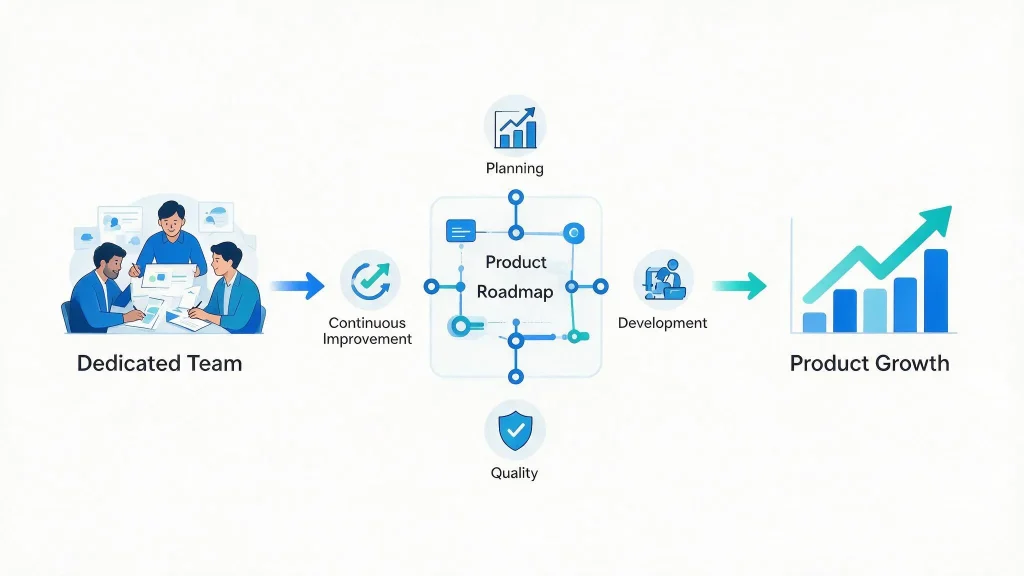
Many executives assume a dedicated team is simply another outsourcing model.
In reality, it operates much closer to an extension of an internal engineering organization.
Instead of engaging a vendor to deliver a pre-defined scope of work, companies gain access to a team that works exclusively on their product, priorities, and business objectives.
The team becomes embedded in daily operations.
They contribute to sprint planning, backlog prioritization, architecture discussions, product strategy meetings, code reviews, and release planning. Over time, they build the same level of understanding that internal employees typically develop.
This creates an important difference.
Project vendors are measured by deliverables.
Dedicated teams are measured by the success of the product.
That distinction fundamentally changes how they approach decisions, quality, and long-term planning.
Why More CTOs Are Moving Toward Dedicated Teams
The technology talent market has become increasingly competitive.
Recruiting experienced developers, architects, DevOps engineers, QA specialists, and cloud experts is challenging in nearly every region. Even when organizations find strong candidates, hiring cycles can stretch for months.
For CTOs responsible for ambitious product roadmaps, waiting six months to build a team is rarely an attractive option.
Dedicated team models solve a different problem than traditional outsourcing.
They provide immediate access to engineering capacity without the complexity of large-scale recruitment efforts.
More importantly, they allow technology leaders to build and scale development capabilities in line with business growth rather than hiring plans.
For many organizations, the question is no longer whether they can find talent locally.
The question is how fast they need to execute.
Freelancers vs Dedicated Teams: A Different Kind of Investment
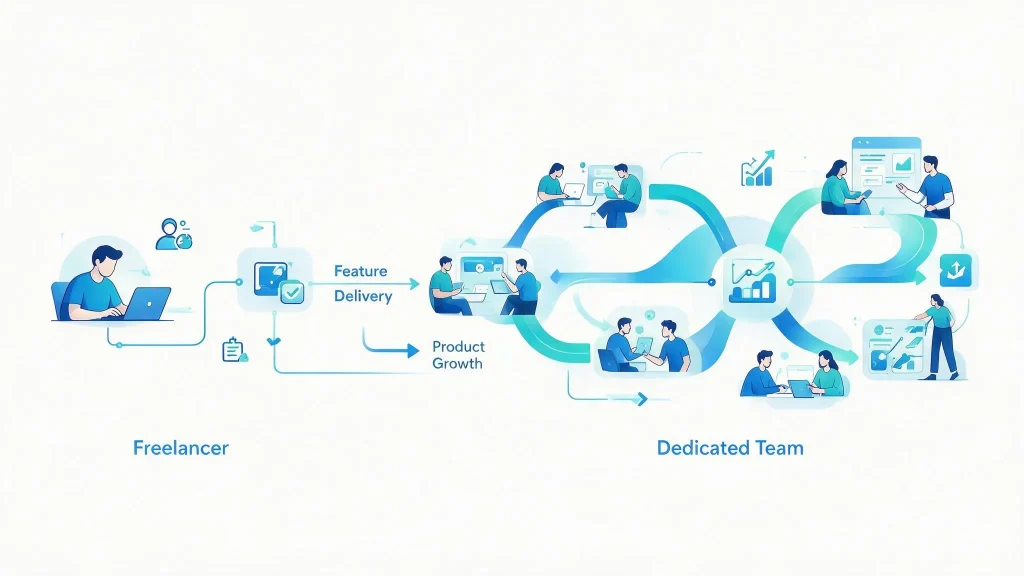
Freelancers are valuable resources and can play an important role in many organizations.
They are often ideal for specialized tasks, temporary workload increases, or projects that require niche expertise.
However, freelancers are generally optimized for execution, not continuity.
Most operate independently, support multiple clients, and engage with clearly defined tasks.
A dedicated team serves a different purpose.
Its value comes from accumulated product knowledge, long-term alignment, and shared ownership.
A freelancer may successfully deliver a feature.
A dedicated team helps shape the evolution of the entire product.
That distinction becomes increasingly important as software moves closer to the center of business strategy.
Scenario 1: Your Product Roadmap Extends Several Years Into the Future
Not every product requires a dedicated team.
However, products with long-term roadmaps almost always benefit from one.
If leadership already knows that development will continue over multiple years, repeatedly building and rebuilding teams introduces unnecessary friction.
Every transition creates onboarding time, architectural review cycles, and knowledge transfer requirements.
Dedicated teams eliminate much of this disruption.
Because the same group remains engaged, development momentum increases over time rather than resetting with every new engagement.
The longer the roadmap, the greater the value of continuity.
Scenario 2: Product Knowledge Has Become a Strategic Asset
One of the least visible but most valuable assets in software development is context.
Experienced engineers understand why specific technical decisions were made. They know which features customers use most often. They understand historical trade-offs, dependencies, and scaling considerations.
Much of this knowledge is never fully documented.
Organizations often don’t realize its value until it disappears.
We’ve seen companies spend months recovering from the loss of key product knowledge after vendor changes or team transitions.
Dedicated teams reduce this risk significantly.
Knowledge stays within a stable group that continues evolving alongside the product itself.
Over time, that continuity becomes a competitive advantage.
Scenario 3: Innovation Speed Matters
For many digital businesses, speed is a strategic metric.
Winning organizations are often those that release faster, experiment more effectively, and respond to customer feedback more quickly.
Frequent team changes work against these goals.
Every new contributor requires onboarding. Every new project begins with discovery.
Dedicated teams remove much of that overhead.
Because they already understand the technology, customers, and business priorities, they can focus immediately on execution.
This creates shorter feedback loops and faster product evolution.
For companies competing in fast-moving markets, that advantage can be significant.
Scenario 4: Scaling Engineering Capacity Is a Challenge
Many enterprises struggle not because they lack ideas, but because they lack delivery capacity.
As products grow, additional expertise becomes necessary.
Cloud infrastructure, cybersecurity, DevOps, QA automation, AI integration, and application modernization all require specialized skills.
Building these capabilities internally is expensive and time-consuming.
Dedicated team models allow organizations to expand incrementally.
Instead of recruiting entire departments, businesses can scale resources according to product needs.
This flexibility enables growth without the operational complexity associated with constant hiring.
Why Governance Matters More Than Most Companies Realize
A dedicated team is not simply a collection of developers.
The most successful engagements are built around governance, communication, and shared accountability.
Strong development partners establish clear processes for:
- Delivery planning
- Quality management
- Security compliance
- Performance tracking
- Escalation management
- Stakeholder communication
These frameworks allow offshore and internal teams to operate as a unified organization rather than separate groups.
Without governance, a dedicated team becomes another external vendor.
With governance, it becomes a true extension of the business.
Measuring ROI Beyond Hourly Rates

One reason some executives hesitate to adopt dedicated teams is the perception that they represent a larger ongoing investment.
The comparison is often made using hourly rates alone.
This can be misleading.
The true cost of software delivery includes much more than development effort. It also includes onboarding time, context-switching, vendor transitions, quality issues, knowledge loss, and delivery delays.
A dedicated team may require a larger long-term commitment than hiring individual freelancers.
However, if that team consistently delivers features faster, retains product knowledge, reduces rework, and supports business growth, the overall return can be significantly higher.
The most successful organizations evaluate dedicated teams as strategic capabilities rather than staffing expenses.
Choosing the Right Dedicated Team Partner
Not every provider offering dedicated development team services delivers the same value.
Technical expertise is important, but it should not be the only factor in the evaluation process.
The strongest partners demonstrate:
- Stable engineering teams
- Mature delivery processes
- Strong communication practices
- Scalability capabilities
- Product-oriented thinking
- Security and compliance expertise
- Long-term collaboration models
Most importantly, they understand that their role extends beyond coding.
They are helping build a product that contributes directly to business growth.
The Decision Is Less About Outsourcing and More About Ownership
When enterprises compare freelancers, project outsourcing, and dedicated teams, the conversation often revolves around cost.
In practice, the more important question is ownership.
Freelancers are excellent for completing specific tasks.
Project outsourcing works well when requirements are fixed and timelines are clear.
Dedicated teams serve a different purpose. They are designed to support continuous product evolution.
As software becomes increasingly central to growth, customer experience, and competitive differentiation, continuity becomes more valuable than short-term delivery efficiency.
That is why more enterprises are investing in dedicated development team services.
They are not simply purchasing development capacity.
They are building a long-term engineering capability that grows alongside their product and their business.
For many CTOs, that shift in mindset ultimately defines the difference between delivering projects and building sustainable digital products.
Relipa
Relipa is a Vietnam-based software development company established in April 2016. After two years of growth, our Japanese branch – Relipa Japan – was officially founded in July 2018.
We provide services in MVP development, web and mobile application development, and blockchain solutions. With a team of over 100 professional IT engineers and experienced project managers, Relipa has become a reliable partner for many enterprises and has successfully delivered more than 500 projects for startups and businesses worldwide.
