

Every successful enterprise reaches a point where technology becomes more than an operational tool. It becomes a competitive advantage.
At the beginning of a company’s digital journey, standard software often provides everything needed to support business operations. Customer relationship management platforms, ERP systems, project management tools, collaboration solutions, and SaaS applications help organizations move quickly without significant upfront investment.
However, as businesses grow, processes become more sophisticated. Customer expectations evolve. Operations become more complex. Unique workflows emerge that standard software was never designed to support.
This is when enterprise leaders begin asking a critical question: “Should we continue adapting our business to fit existing software, or should we build software that fits our business?”
The answer is not always obvious.
Many organizations continue relying on off-the-shelf solutions long after those solutions have become constraints rather than enablers. Others invest in custom development too early, creating unnecessary complexity.
Understanding when to make the transition is crucial.
This is where custom web application development services become strategically important. The objective is not simply to build software. It is to create digital capabilities that support long-term business growth.
Why Standard Software Works So Well in the Beginning
There is a reason the SaaS market has grown so rapidly.
Standard software solves common business problems quickly and efficiently. Organizations can deploy solutions in days or weeks instead of months. Costs are predictable, maintenance is handled by vendors, and implementation risks are generally lower.
For many business processes, this approach makes perfect sense.
Functions such as:
- Accounting
- Human resources
- Project collaboration
- Email marketing
- Customer support
often benefit from mature commercial products that already incorporate industry best practices.
In these scenarios, building custom solutions rarely delivers significant additional value.
The challenge emerges when competitive differentiation becomes important.
At that point, standard software may begin limiting what the organization can achieve.
The Hidden Cost of Adapting Your Business to Standard Software
Many organizations do not recognize the limitations of standard software immediately.
The symptoms appear gradually.
Teams develop workarounds.
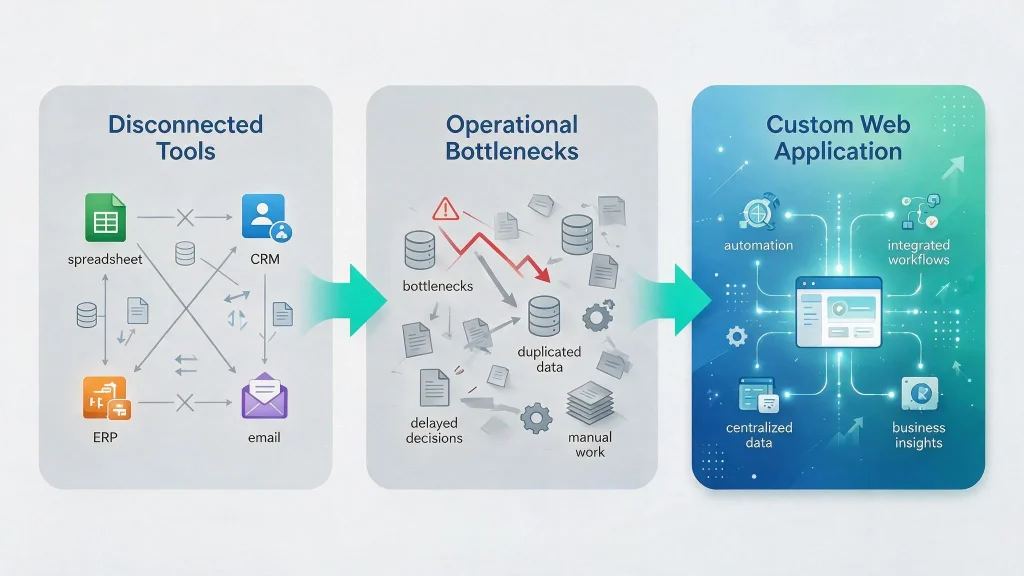
Employees move data between multiple systems manually.
Departments create spreadsheets to compensate for missing functionality.
Business processes become fragmented across several disconnected platforms.
At first, these issues seem manageable.
Over time, however, they introduce inefficiencies that impact productivity, decision-making, and customer experience.
This creates an important shift in perspective.
The original purpose of software is to support business operations.
Yet in many enterprises, business operations eventually become constrained by software limitations.
When this occurs, leadership teams should begin evaluating whether custom web application development services could provide a more sustainable path forward.
The Tipping Point: When Standard Software Becomes a Business Constraint
One of the most common questions executives ask is: “At what point do we actually need a custom application?”
There is no universal answer.
However, several indicators frequently signal that an organization is approaching that threshold.
The first indicator is process complexity.
If core business workflows require extensive customization, multiple workarounds, or manual intervention, the software may no longer align with operational requirements.
The second indicator is integration difficulty.
As businesses grow, applications must exchange data seamlessly across departments and systems. Standard software often struggles to support highly customized integration requirements.
The third indicator is scalability.
A solution that worked effectively for a 50-person organization may not support the needs of a global enterprise operating across multiple markets and business units.
When these challenges begin affecting business outcomes, organizations should seriously consider custom web application development services as part of their technology strategy.
Case 1: Your Business Processes Are Unique
Some organizations operate within highly specialized industries.
Others differentiate themselves through proprietary workflows, service models, or customer experiences.
In both cases, standard software often falls short.
Commercial applications are built to support broad markets. By design, they prioritize common requirements rather than unique business needs.
As a result, organizations with specialized processes frequently encounter limitations.
The more unique the business model becomes, the greater the likelihood that customized technology will deliver competitive advantages.
This is one of the strongest business cases for custom web application development services.
When software aligns directly with how the business operates, efficiency and agility often improve dramatically.
Case 2: You Need Multiple Systems to Work as One
Modern enterprises rarely operate with a single application.
Instead, they rely on a network of systems including:
- ERP platforms
- CRM solutions
- Data warehouses
- HR systems
- Finance applications
- Customer-facing platforms
The problem is that these systems do not always communicate effectively.
Data becomes fragmented.
Reporting becomes inconsistent.
Decision-making becomes slower.
A custom web application can serve as a central layer that connects systems, automates information flows, and creates a unified operational experience.
In this scenario, the application itself becomes a strategic integration platform.
Many enterprises engage custom web application development services specifically to eliminate silos and improve enterprise-wide visibility.
Case 3: Customer Experience Becomes a Competitive Advantage
Today’s customers expect more than functional digital experiences.
They expect personalized, intuitive, and seamless interactions.
Unfortunately, many standard platforms limit an organization’s ability to innovate.
When every competitor uses the same software, customer experiences often become similar.
Custom applications provide organizations with greater freedom to design experiences that reflect their brand, customer journey, and competitive positioning.
This may include:
- Advanced self-service capabilities
- Personalized portals
- Industry-specific functionality
- Intelligent workflows
- Real-time customer interactions
For customer-centric organizations, this can create meaningful differentiation.
This is another situation where custom web application development services deliver strategic business value rather than simple technical functionality.
Case 4: Data and Analytics Drive Business Decisions
Many executives understand the value of data.
Fewer organizations possess systems capable of transforming data into actionable intelligence.
Standard software typically provides generic reporting features, but enterprise leaders increasingly require deeper business insights.
They want visibility into:
- Operational performance
- Customer behavior
- Revenue opportunities
- Risk indicators
- Productivity metrics
Custom applications can aggregate data from multiple sources and present insights tailored specifically to business objectives.
Instead of adapting decision-making to fit standard reports, organizations gain access to information that directly supports strategic priorities.
For data-driven enterprises, this capability often justifies investment in custom web application development services.
Case 5: Rapid Growth Is Creating Technology Bottlenecks
Growth is positive.
Technology bottlenecks are not.
As organizations expand, existing software often struggles to keep pace with new requirements.
New business units may require additional workflows.
International expansion introduces localization needs.
Employee counts increase.
Transaction volumes grow.
Customer expectations evolve.
Eventually, systems that once supported growth begin slowing it down.
This is frequently the moment when enterprise leaders recognize they need technology designed specifically for future requirements rather than past realities.
Custom-built applications provide organizations with greater flexibility to scale strategically rather than reactively.
Why Enterprises Choose Custom Web Application Development Services Instead of Building Internally
Even when organizations determine that custom software is necessary, another question immediately follows: Should we build it ourselves?
For many enterprises, internal development presents several challenges.
Recruiting experienced developers, architects, UI/UX specialists, DevOps engineers, and quality assurance professionals requires significant time and investment.
Additionally, internal teams often have competing priorities related to maintenance, security, operations, and existing projects.
Building custom applications requires specialized expertise and dedicated focus.
This is why organizations frequently partner with providers of custom web application development services.
External partners bring:
- Specialized technical expertise
- Proven delivery frameworks
- Scalable talent models
- Faster project initiation
- Broader technology experience
Most importantly, they allow organizations to accelerate delivery without expanding internal teams dramatically.
What Enterprise Leaders Should Look for in a Development Partner
Not all development partners provide the same value.
The most effective providers act as strategic advisors rather than coding vendors.
When evaluating custom web application development services, business leaders should assess:
- Industry knowledge
- Technical expertise
- Solution architecture capabilities
- Security practices
- Cloud experience
- Integration capabilities
- Delivery governance
- Long-term support models
A strong partner focuses on business outcomes, not just software features.
They help organizations translate strategic objectives into digital solutions that create measurable value.
Measuring the ROI of Custom Applications
A common misconception is that custom software is always more expensive.
The reality is more nuanced.
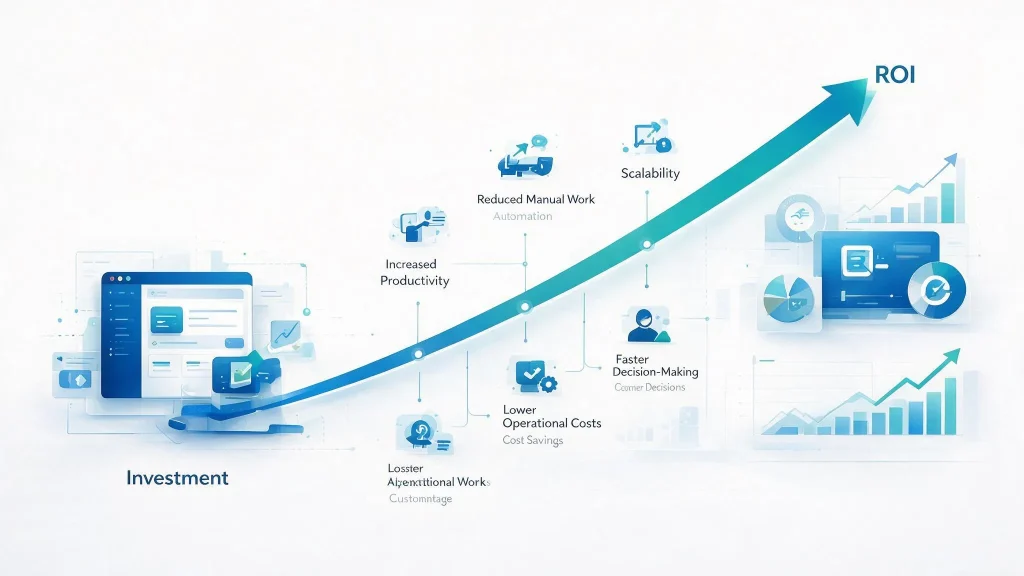
While initial investments may be higher, long-term value often justifies the cost.
Organizations frequently realize ROI through:
- Increased productivity
- Reduced manual work
- Lower operational costs
- Improved customer retention
- Faster decision-making
- Better scalability
- Greater competitive differentiation
The key is evaluating software as a business investment rather than a technology expense.
Successful enterprises measure custom applications based on the value they create, not merely the resources required to build them.
The Future Belongs to Businesses That Build Around Their Competitive Advantages
Technology is no longer just an operational necessity.
It is increasingly a source of differentiation.
The most successful organizations understand that not every process requires custom software. Standard platforms remain highly effective for many common business functions.
However, when technology becomes central to customer experience, operational excellence, innovation, or growth, generic solutions may no longer be enough.
This is where custom applications create the greatest impact.
They allow businesses to stop adapting to software limitations and start designing technology around their unique strengths.
Custom Software Is Not About Technology—It’s About Business Growth
The decision to invest in custom software should never be driven by technology alone.
It should be driven by business needs.
When standard software supports growth efficiently, there is little reason to replace it. But when systems begin creating bottlenecks, limiting innovation, or preventing scalability, the conversation changes.
That is the point where custom web application development services become a strategic enabler.
Rather than forcing the business to fit predefined software capabilities, organizations gain solutions designed around their goals, processes, customers, and growth ambitions.
For enterprises focused on long-term growth, innovation, and competitive advantage, the answer often leads toward custom web applications built specifically for the future they want to create.
Relipa
Relipa is a Vietnam-based software development company established in April 2016. After two years of growth, our Japanese branch – Relipa Japan – was officially founded in July 2018.
We provide services in MVP development, web and mobile application development, and blockchain solutions. With a team of over 100 professional IT engineers and experienced project managers, Relipa has become a reliable partner for many enterprises and has successfully delivered more than 500 projects for startups and businesses worldwide.
