
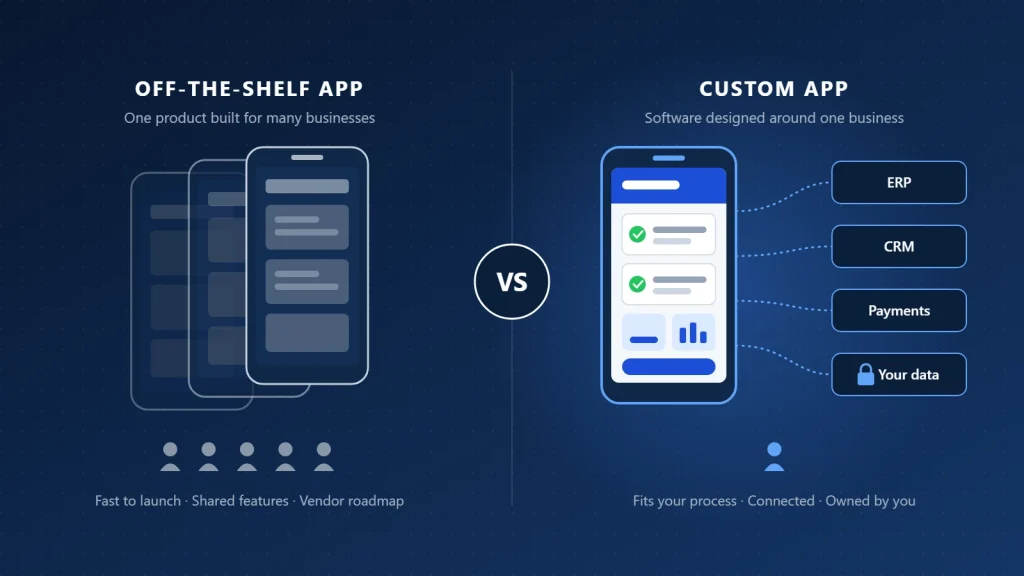
A custom app development company builds an app around your workflows, users and systems, while an off-the-shelf app gives you a ready-made product shared with many other businesses. Neither is automatically the better investment. Off-the-shelf apps go live faster and cost less at the start. Custom apps tend to pay off when the app is central to how you work, has to connect with your existing systems or handles sensitive data. The deciding factor is often a cost that never appears in the first quote.
Custom apps and off-the-shelf apps: two different ways to get the software you need
Before comparing costs or features, it helps to be clear about what each option is. The two differ less in technology than in who the app is designed for and who decides how it evolves.
Off-the-shelf apps are one product built for many businesses
An off-the-shelf app, also called a ready-made or packaged app, is built once by a software vendor and sold to many customers through licences or subscriptions. CRM apps, project management tools, booking systems and e-commerce platforms are typical examples. The vendor decides the features, the release schedule and the pricing. Each customer adjusts settings, chooses a plan and adapts its own processes to the way the product works.
The model works because most businesses share many common needs. Vendors can spread development costs across thousands of customers, so each one pays a relatively small fee for a mature, tested product that is ready to use from day one.
Custom apps are software designed around one business
A custom app is built specifically for one organization: its users, its processes and the systems it already runs. A custom app development company usually takes the project from discovery and UI/UX design through development, integration, testing and release, then supports the app after launch. What gets built is decided by the business’s requirements, not by a vendor’s roadmap.
Custom doesn’t mean every line of code is written from scratch. Experienced teams use proven frameworks, cloud services and third-party APIs for payments, maps or authentication, and write custom code where the business is genuinely different. So the question is less about building everything versus buying everything. It is about how much of the app needs to be shaped around your business, and whether that difference is worth paying for.
Custom vs off-the-shelf apps compared on the factors that decide long-term value
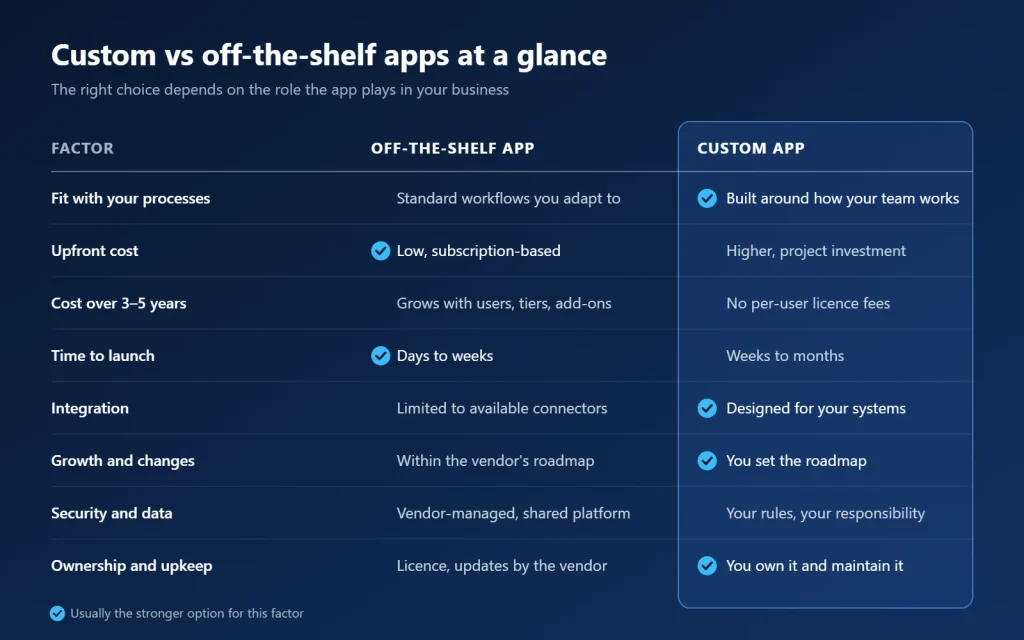
Both options can give you a working app. Where they differ is in how well the app fits your business, what it really costs over several years and how much control you keep once it becomes part of daily operations. These seven factors usually decide the outcome.
How closely each app fits the way your team actually works
An off-the-shelf app covers the common workflows in its category well. When your process differs, you have two choices: change how your team works, or work around the gaps. The difference might be an extra approval step, an industry-specific pricing rule or a field workflow that has to run offline. Workarounds usually mean spreadsheets, re-entering data in a second tool or side processes kept outside the system. Each one adds errors and slows people down, and over time it pushes users away from the app the company paid for.
A custom app follows your process, including the steps that set you apart from competitors, so users finish tasks in fewer steps and are more likely to adopt it. That advantage only holds when the process is clear, though. Automating a confused process makes it faster, not better. If your workflow is standard, an off-the-shelf app may fit just as well, and adapting to proven practices built into the product can even be an improvement.
What you pay upfront and what you pay over three to five years
Off-the-shelf apps are cheap to start with. You pay a monthly or annual subscription, often per user, and the first-year cost is easy to predict. The bill grows as you add users, move to higher tiers to unlock features, buy add-ons and integration connectors, and pay for whatever customization the vendor allows. The time staff spend on workarounds rarely appears in the budget, but it is still a cost.
A custom app needs a larger investment upfront for discovery, design, development and testing. After launch, you pay for hosting, maintenance and new features, but there are no per-user licence fees, so running costs don’t rise in step with your headcount or customer base.
The most common mistake is comparing the cost of building a custom app with one year of subscription fees. A fairer comparison looks at three to five years. For each option, include licences, add-ons, integrations, maintenance and the labour spent on workarounds. For a small team with standard needs, off-the-shelf often stays cheaper over the whole period. For a growing user base, or a process that needs heavy customization, custom often catches up and can end up costing less.
How quickly each option can go live
Speed is where off-the-shelf apps have the clearest advantage. You sign up, configure settings, import data and train users, and the app can be live within days or weeks. A custom app goes through requirements, design, development, testing and, for mobile apps, app store review. That takes weeks for a simple app and several months for a complex platform.
The gap can be narrowed but not erased. Many custom projects start with a minimum viable product covering only the core features, then add the rest in phases based on real user feedback. If the business needs something running next month, an off-the-shelf app or a hybrid approach is the realistic choice.
How well each app connects to the systems you already use
Off-the-shelf apps usually come with ready-made connectors for popular tools. If your ERP, internal database or older business system isn’t on that list, you depend on the APIs the vendor chooses to expose, on middleware, or on manual export and import. The result is often a data silo: the same customer or order recorded differently in several places, with staff spending time keeping them in sync.
With a custom app, integration is part of the design from the start. The app can read from and write to your ERP or CRM, process payments through your chosen gateway and exchange data with internal platforms in the format they expect. A custom app development company will usually list and estimate each integration separately, because integrations often account for a large share of the effort. In this AI customer support case study, for example, the solution was embedded into the client’s existing website and business systems instead of running as a separate tool. When the systems you need to connect are old or poorly documented, integration often goes hand in hand with legacy system modernization.
How each option handles growth and changing requirements
Off-the-shelf apps scale smoothly in the directions the vendor has planned. Adding users or moving to a bigger plan takes a few clicks. Getting a feature the vendor hasn’t prioritized is another matter. Because the vendor owns the roadmap, features you rely on can change, move to a more expensive tier or disappear, and pricing can change with them.
With a custom app, you set the roadmap. The architecture can be planned for the growth you expect, such as more users, new markets, additional languages or new modules, and features arrive when the business needs them. The flip side is that a poorly designed custom app can be harder to scale than a mature product. Its flexibility depends heavily on the architecture decisions made at the start.
Who controls security and where your data is stored
Established off-the-shelf vendors invest heavily in security, certifications and regular patches. For small teams without security expertise, that is a real benefit. You are also sharing a platform with many other customers, though. Your data is stored where the vendor decides, and you can only use the security settings the product offers. A vulnerability in a widely used product can expose all of its customers at once, and third-party plugins add further risk.
A custom app lets you decide where data is stored, who can access it, how it is encrypted and what is logged. That control matters most in finance, healthcare and insurance, where regulation and customer trust are at stake. It is not automatic, however. A custom app is only as secure as the team that builds it. The OWASP Mobile Top 10 (2024) lists risks such as improper credential usage, insecure data storage and inadequate supply chain security, and these need to be addressed during design and testing, not after an incident.
In the RENKIN crypto asset lending platform, for example, users pass KYC identity verification before entering the lending flow, and transaction and system logs support traceability and audits. Controls like these are difficult to shape exactly as needed inside a shared product. In a custom build, they are written into the requirements from the start.
Who owns the app and who keeps it running after launch
With an off-the-shelf app, you license the software rather than own it. The vendor handles updates, which saves you work, but you also accept its release schedule and any changes it makes. Leaving can be difficult because of data export limits, retraining and processes built around one product. A price increase, or the product being discontinued, affects you directly.
A custom app can become an asset your business owns. When you work with a custom app development company, make sure the contract states that the source code, design files and data belong to you, and keep the code in a repository you control. Ownership comes with responsibility: mobile operating systems change every year, libraries need updating and security patches can’t wait. Plan a maintenance budget from the start and decide who will handle it, whether an in-house team or a partner offering maintenance services.
Custom vs off-the-shelf apps at a glance
| Factor | Off-the-shelf app | Custom app |
|---|---|---|
| Fit with your processes | Standard workflows that you adapt to | Built around how your team works |
| Upfront cost | Low, subscription-based | Higher, project investment |
| Cost over 3–5 years | Grows with users, tiers and add-ons | Hosting and maintenance with no per-user licence |
| Time to launch | Days to weeks | Weeks to months, faster with an MVP |
| Integration | Limited to available connectors | Designed for your systems |
| Growth and changes | Within the vendor’s roadmap | You set the roadmap |
| Security and data | Vendor-managed on a shared platform | Your rules and your responsibility |
| Ownership and upkeep | Licence, with updates handled by the vendor | You own it and maintain it yourself or with a partner |
When an off-the-shelf app is enough and when a custom app pays off
The comparison shows that neither option wins everywhere. What tips the balance is the role the app plays in your business.
An off-the-shelf app is usually enough when:
- The process is much the same across companies, such as accounting, HR, internal chat or basic scheduling.
- You need the app running quickly and can live with its limits.
- The number of users is small and unlikely to grow fast.
- You are still testing an idea and don’t yet know which features matter.
A custom app is more likely to pay off when:
- The app is central to how you earn revenue or serve customers.
- Your process differs from what products on the market support.
- The app has to work closely with your ERP, CRM, payment systems or internal platforms.
- Regulation or customer trust requires full control over data and access.
- Licence costs keep rising as your user base grows.
Many businesses end up somewhere in between. Some validate an idea with an off-the-shelf tool and build custom once the requirements are clear. Others build a custom app that relies on ready-made services for payments, authentication or maps. Deciding which parts to build and which to buy is where an experienced custom app development company can add the most value, because building everything is rarely necessary.
What to check before hiring a custom app development company
If custom is the right path, the partner you choose shapes the result as much as the decision itself. These five points are worth checking before you sign:
- Relevant experience: Projects similar to yours in platform, industry and complexity, with case studies and references you can speak with.
- A discovery phase that questions your requirements: A good partner proposes simpler alternatives where they make sense, including off-the-shelf components, instead of just pricing a feature list.
- Security built into the process: Clear answers on authentication, data storage, encryption, code review and security testing before release.
- An engagement model that fits your product: Fixed price for a well-defined scope, or a dedicated development team for products that will keep evolving.
- Ownership and post-launch support: Code in your repository, documentation delivered throughout the project, and a defined plan for OS updates and new features.
A custom app development company that answers these points clearly and specifically has most likely delivered apps that keep working long after launch.
The choice between a custom app and an off-the-shelf app comes down to where your business needs to be different. Off-the-shelf apps are fast and affordable when your needs are standard. Custom apps cost more upfront, but they offer a closer fit, deeper integration, control over your data and an asset you own, and those advantages grow when the app sits at the center of how you operate. If that describes your situation, the right custom app development company can help you build only what needs to be yours, secure it from the start and keep it improving after launch.
About Relipa
Relipa is a Vietnam-based software development company established in April 2016. After two years of growth, our Japanese branch, Relipa Japan, was officially founded in July 2018.
We provide app development services from discovery and UI/UX design to development, integration and long-term maintenance, for mobile, web and cloud-based applications. If you are planning a new app, our team is ready to help you find the right approach.
