
The growing demand for AI talent, driven by the rapid integration of Generative AI into enterprise workflows, has fundamentally reshaped global tech recruitment. While the state of AI global surveys confirms that roughly 88% of organizations have adopted AI capabilities across their operational functions, this exponential trend has exacerbated a critical AI talent shortage, inflating local engineering salaries beyond $200,000 annually and straining corporate budgets.
In this article, we offer an analytical comparison between internal talent acquisition and partnering with a dedicated offshore team, exposing the hidden operational expenditures (OpEx) to assist technology leaders in optimizing their AI engineering investments.
What Is a Dedicated Offshore Team in AI Development?
Definition
A dedicated offshore team is a highly efficient remote software development model where an enterprise secures a full-time, exclusive team of AI engineers to execute its technical roadmap. While this specialized workforce operates solely on the client’s projects, the entire talent pool is officially recruited, onboarded, compensated, and administratively managed by a remote technology provider (an offshore vendor) located in an external jurisdiction.
In strict contrast to traditional, project-based IT outsourcing models, a dedicated offshore team does not function as an isolated third-party entity. Instead, it operates as a seamless, direct extension of the enterprise’s internal R&D department. The engineers work directly under the client’s technical leadership, utilizing the client’s internal development methodologies and communication pipelines, without occupying slots on the company’s direct local payroll or head-count liabilities.
Read more: https://relipa.global/what-is-offshore-development-how-to-succeed-in-offshore-development/
How a Dedicated Offshore Team Works
To successfully execute an IT outsourcing strategy, a clear separation of operational responsibilities between the enterprise and the technology partner is paramount. The operational workflow of a dedicated offshore team functions through a well-defined governance model:
- The Client: Retains absolute strategic and technical ownership. The client is responsible for defining the product vision, managing development roadmaps, executing direct technical direction, and evaluating final quality deliverables.
- The Offshore Vendor: Manages all legal and administrative infrastructure. This includes sourcing and recruiting candidates based on project requirements, providing state-of-the-art office spaces, equipping engineers with high-performance computing hardware (essential for AI processing), administering payroll, managing corporate benefits, and ensuring strict compliance with local labor regulations.
- Team Structure: A standard, product-ready deployment features a comprehensive matrix of specialized roles: AI/ML Engineers (ranging from Junior to Senior capacities), an AI System Architect, Data Annotators, Quality Assurance (QA) Specialists, and a dedicated Project Manager to drive execution.
- Communication & Collaboration Model: Interaction is maintained via continuous, real-time collaboration platforms, including Slack, Zoom, Jira, and Zoho. The engineering team operates under Agile/Scrum methodologies with synchronized 2-week Sprint cycles and Daily Standups to guarantee seamless progress alignment across distinct geographical boundaries.
Benefits of a Dedicated Offshore Team
Leveraging a dedicated offshore team provides significant competitive advantages for modern enterprises striving to deploy artificial intelligence models efficiently:
- Substantial Cost Reduction: Organizations can save between 40% to 70% in total personnel expenditure by capitalizing on the labor cost arbitrage present in developing economic regions such as Southeast Asia, India, and Eastern Europe.
- Accelerated Time-to-Market: Enterprises can onboard an active, project-ready dedicated offshore team within 1 to 2 weeks, contrasting sharply with the traditional 2-to-6-month domestic recruitment pipeline.
- Mitigated Recruitment Burdens: The technology vendor absorbs the exhaustive tasks of resume screening, technical vetting, human resource administration, and payroll management, allowing internal leadership to focus purely on product development.
- Unrestricted Access to Specialized Competencies: This model enables businesses to tap into scarce, highly sought-after technical skills globally—such as Computer Vision, Natural Language Processing (NLP), and Large Language Model (LLM) fine-tuning—which are heavily supply-constrained in domestic markets.
- Elastic Scalability: Tech leaders retain the flexibility to dynamically scale headcount upward during intensive development phases or downsize upon reaching specific milestones without incurring complex legal severance liabilities or violating strict local labor laws.
Potential Challenges and Strategic Mitigations
While highly advantageous, hiring a dedicated offshore team requires proactive management of inherent operational challenges:
| Operational Challenge | Business Impact | Strategic Mitigation Strategy |
| Time Zone Disparities | Can introduce communication latencies during daily development cycles. | Establish robust asynchronous workflows, standardize comprehensive technical documentation, and define a minimum 2-3 hour daily operational overlap for critical alignment. |
| Cultural & Linguistic Alignment | Divergent engineering styles or communication barriers can lead to technical misalignments. | Enforce standardized English proficiency during vetting, implement clear Product Requirement Documents (PRDs), and foster cross-cultural onboarding frameworks. |
| Data Security & Privacy Risks | Transporting sensitive datasets across international borders introduces severe compliance vulnerabilities. | Execute stringent Non-Disclosure Agreements (NDAs), deploy isolated secure sandbox environments, and ensure the vendor complies with global standards such as GDPR, HIPAA, or ISO 27001. |
What Is In-House AI Hiring?
Definition
Contrary to a dedicated offshore team, In-house AI hiring refers to the traditional corporate talent acquisition model where an organization utilizes its internal recruitment infrastructure to source, employ, and manage permanent artificial intelligence specialists. Under this framework, engineers sign direct, long-term employment contracts and enter the company’s official headcount. These professionals operate either directly within the corporate headquarters or via remote working arrangements under the immediate supervision of internal human resource departments and technical leadership.
Strategic Benefits of an Internal Workforce
While alternative paradigms are accelerating, establishing a native, internal engineering footprint offers clear operational justifications:
- Absolute Operational Control: The enterprise retains total, unshared autonomy over software architecture design, technology stack selection, compute infrastructure, and product development methodologies.
- Maximized Intellectual Property (IP) Protection: Highly sensitive components, such as proprietary training datasets, custom algorithms, and specific neural network model weights, remain exclusively behind the corporate firewall, significantly minimizing third-party data leakage risks.
- Deep Cultural Alignment: Native employees possess an intrinsic understanding of the organization’s long-term vision, brand DNA, and corporate culture, fostering 100% dedication toward the company’s core strategic objectives.
- Sustained Knowledge Retention: All technical breakthroughs, source code iterations, and research insights developed during the project are permanently retained within the enterprise as a vital, long-term strategic asset.
Critical Core Challenges
Despite the operational control, heavily relying on in-house AI hiring exposes an enterprise to substantial structural vulnerabilities:
- Massive Capital Expenditure (CapEx): Initiating internal engineering departments demands significant upfront financial deployment for recruitment operations, hardware infrastructure, and administrative support machinery.
- Rigid Scalability: Due to strict domestic labor regulations, altering headcount size or shifting technical directions dynamically becomes an expensive, legally complex, and protracted process.
- Severe Attrition Risks: The aggressive global competition for technical talent means top-tier engineers are continuously headhunted. The abrupt departure of a core internal engineer can stall critical development timelines indefinitely.
The Invisible Financial Layer: Hidden Costs of In-House AI Hiring
When financial executives blueprint their technology budgets, they routinely look only at base gross salaries. However, a comprehensive Total Cost of Ownership (TCO) analysis reveals several heavy, overlooked expenses that do not exist when leveraging a dedicated offshore team:
The Iceberg of Internal Recruitment: Base salary constitutes only the visible tip of corporate talent acquisition. The operational realities of maintaining full-time AI staff introduce massive compounding overheads.
- Recurrent Recruitment Overheads: Sourcing specialized profiles requires heavy recruitment advertising or elite headhunter services, typically commanding fees equivalent to 10% to 30% of the engineer’s first-year annual base salary.
- Onboarding Latency & Friction: Transitioning a new hire into complex internal product ecosystems consumes significant cycles from existing engineering leadership. This onboarding friction costs an estimated $5,000 to $15,000 per hire before the individual achieves optimum productivity.
- Compounding Taxes and Mandatory Benefits: Corporate payroll taxes, comprehensive health insurance, social security contributions, retirement matching, and office amenities add a mandatory 20% to 30% premium on top of basic gross salaries.
- Specialized Hardware & Provisioning: Unlike traditional software developers, AI engineers require enterprise-grade local workstations or dedicated server nodes equipped with high-performance graphics processing units (GPUs) for local model training and testing. As documented in comprehensive assessments on AI investments and infrastructure, this hardware infrastructure demands an upfront capital investment of $10,000 to $50,000 per seat.
- Defensive Attrition Mitigation (Retention Costs): To insulate the team against aggressive poaching from competitors, enterprises must continually fund salary adjustments, performance bonuses, and equity/ESOP allocations. Replacing an optimized AI engineer routinely costs up to 1.5 times their annual salary.
- Continuous Upskilling and Technical Audits: The field of artificial intelligence evolves at a breakneck pace. To prevent internal technical obsolescence, enterprises must dedicate $10,000 to $30,000 annually per engineer for advanced certifications, specialized training frameworks, and global academic summits.
Financial Showdown: Dedicated Offshore Team vs. In-House AI Hiring Cost
Initial Sourcing and Recruitment Cost
When evaluating the upfront capital required to launch an artificial intelligence initiative, the financial entry barriers differ drastically between the two models. Under an in-house AI hiring framework, the initial sourcing costs are exceptionally high; executive headhunter fees routinely command between $15,000 and $50,000+ for a single senior machine learning engineer. Furthermore, the prolonged domestic recruitment lifecycle, which typically spans 2 to 6 months, inflicts a severe opportunity cost of approximately $40,000 per month due to delayed product shipments and unexecuted technical workflows.
Conversely, integrating a dedicated offshore team reduces upfront recruitment capital expenditure to near zero. The remote technology vendor completely absorbs the financial burdens of talent sourcing, multi-stage technical screening, and initial team provisioning, leveraging their pre-existing, pre-vetted regional talent networks to accelerate deployment.
Long-Term Employment and Labor Overhead
The ongoing operational expenditure required to sustain technical talent over multiple fiscal years represents the largest variable in a company’s financial planning. The Total Cost of Ownership (TCO) to maintain a single permanent AI specialist in developed Western markets ranges from $270,000 to $580,000 annually, depending on seniority, once direct salaries, corporate taxes, healthcare allocations, and administrative overhead are consolidated.
Transitioning to a dedicated offshore team fundamentally transforms these rigid capital commitments into highly predictable, flexible operational expenses (OpEx). Enterprises utilize a streamlined, hourly service-rate model ranging from $20 to $70/hour in prime Asian engineering hubs, translating into a fixed monthly outlay of approximately $3,000 to $12,000 per engineer, completely inclusive of all secondary labor liabilities.
Computational Infrastructure and Development Tooling
Beyond direct human resource allocation, AI initiatives demand heavy engineering infrastructure to facilitate advanced data processing and neural network modeling. Internal operations force enterprises to independently architect, maintain, and fund dedicated cloud computing testbeds and model-training environments; standard allocations for tools like AWS SageMaker clusters range from $3,800 to $12,000/month, while Databricks pipelines require $2,000 to $6,000/month per development iteration. Consequently, the compounding hardware provisioning and enterprise software licensing fees routinely fluctuate between $30,000 and $70,000 annually per developer.
When partnering with a remote technology vendor, these development environment expenses are frequently optimized. Essential infrastructure components and local high-performance testing hardware are typically built into the vendor’s base service fee, or managed via highly optimized cloud resource utilization workflows that substantially eliminate computational waste.
Continuous Recruitment and Attrition Volatility
In an incredibly volatile labor market, employee turnover can completely destabilize long-term technological roadmaps. Every instance of resignation within an internal team forces the enterprise to restart the expensive, time-consuming in-house AI hiring loop from scratch, triggering severe development stagnation and fracturing project continuity.
This systemic risk is legally eliminated through a dedicated offshore team framework. The binding service level agreements (SLAs) guarantee strict headcount stability; if a remote engineer departs the project, the offshore technology provider is contractually obligated to immediately insert a replacement resource of equivalent technical competency at zero additional recruitment cost to the client.
Personnel Retention and Professional Upskilling
Insulating an internal technology department against poaching by competitors requires a sustained financial defense mechanism within an in-house AI hiring framework. Organizations must continually invest in salary benchmarking upgrades, performance-based bonuses, and equity incentives, given that the total cost to replace a departing permanent engineer routinely scales to 1.5 times their annual salary.
Under the managed remote team model, leveraging a dedicated offshore team ensures the external vendor assumes 100% of the financial responsibility for talent retention, continuous professional upskilling, and ongoing training frameworks. The vendor actively mitigates engineer attrition and funds advanced specialized training out of their native administrative budget, ensuring the enterprise receives cutting-edge technical execution without compounding secondary financial friction.
| Evaluation Criteria | Dedicated Offshore Team | In-House AI Team |
| Total Cost Structure | 40% – 70% lower; efficiently converts fixed overhead into flexible OpEx. | Extremely high (True TCO ranges from $270k to $580k/year per engineer in the US). |
| Hiring Speed | Ultra-fast (Fully operational engineering team onboarded within 1 – 2 weeks). | Slow and protracted (Requires 2 to 6 months for active sourcing and technical interviewing). |
| Scalability & Agility | Highly flexible; effortlessly scales headcount up or down based on project milestones. | Rigid; heavily restricted by complex local labor laws and expensive severance overhead. |
| Talent Pool Depth | Instant access to a global pool of specialized, high-tier AI experts. | Strictly constrained by local geographical boundaries and regional talent pools. |
| Management Control | Shared administrative burdens; client retains 100% direct technical control. | Direct, absolute internal control over all corporate processes, systems, and teams. |
| Data & Core Security | Managed via strict NDAs and isolated development sandbox environments. | Highest native security; all sensitive data lives entirely behind local corporate firewalls. |
| Knowledge Retention | Potential risk of knowledge loss if standard handover and documentation processes fail. | Sustainable asset accumulation retains engineering insights permanently as a long-term corporate asset. |
When Should You Choose a Dedicated Offshore Team?
Deploying this external personnel model represents the most strategically viable solution for enterprises navigating specific operational inflection points. Organizations should actively transition to a dedicated offshore team under the following critical scenarios:
- Capital-Constrained Startups: High-growth tech startups requiring maximum initial capital preservation to efficiently extend their financial operational runway before initiating subsequent venture capital funding rounds.
- Rapid MVP Development: Businesses needing to rapidly engineer Minimum Viable Products (MVPs) featuring integrated artificial intelligence algorithms—within highly restricted budgetary constraints ranging from $20,000 to $80,000—to effectively validate core product concepts against real-world user metrics.
- Experimental AI Pilot Projects: Enterprises executing preliminary initiatives designed to audit and quantify the operational efficacy of artificial intelligence frameworks within business workflows before committing to massive, long-term internal capital deployment.
- High-Velocity Rapid Scaling: Organizations facing aggressive product deployment timelines that demand the immediate injection of a high volume of AI engineers within a multi-week window – a transactional volume that domestic human resource departments cannot realistically fulfill.
- Highly Restrictive Hiring Budgets: Small and Medium-sized Businesses (SMBs) lacking the financial liquidity to engage in aggressive bidding wars against tech conglomerates, enabling them to circumvent localized salary inflation while securing top-tier technical expertise.
Read more: https://relipa.global/signs-need-it-support-outsourcing-companies/
When Should You Build an In-House AI Team?
While alternative delivery models offer unmatched financial agility, certain operational matrices require immediate, structural ownership of technology. Enterprises are strategically compelled to invest in and build a permanent in-house AI team under the following critical business parameters:
- Development of Proprietary AI Products: When artificial intelligence forms the core competitive differentiator and intellectual bedrock of the enterprise’s market valuation. Examples include proprietary algorithmic recommendation engines or unique, mission-critical financial fraud detection sub-systems.
- Operations Within Highly Regulated Industries: Organizations navigating heavily policed sectors, such as Healthcare, Banking, Insurance, and Legal services, must comply with stringent data sovereignty, user privacy, and compliance frameworks (including GDPR, HIPAA, and CCPA). These regulations legally prohibit sensitive, unanonymized source data from leaving secure internal corporate infrastructure.
- Long-Term R&D Initiatives: Highly complex technological explorations requiring sustained, multi-year empirical research, iterative experimentation, and continuous optimization designed to ultimately establish exclusive corporate patents.
- Deep Integration of Core AI Capabilities: When neural network systems are embedded directly into the daily operational lifecycle of the enterprise, requiring real-time local model fine-tuning, continuous maintenance, and immediate infrastructure adjustment by full-time staff.
Why Hybrid AI Teams Are Becoming Popular
The evolving complexities of machine learning deployment have transformed corporate human resource strategies, giving rise to the hybrid workforce as the dominant management trend in technology infrastructure. Analytical forecasts by Gartner indicate that the vast majority of highly successful enterprise artificial intelligence implementations systematically deploy a combined resource model rather than relying on a single sourcing silo.
This progressive model strategically deconsolidates the engineering hierarchy as follows:
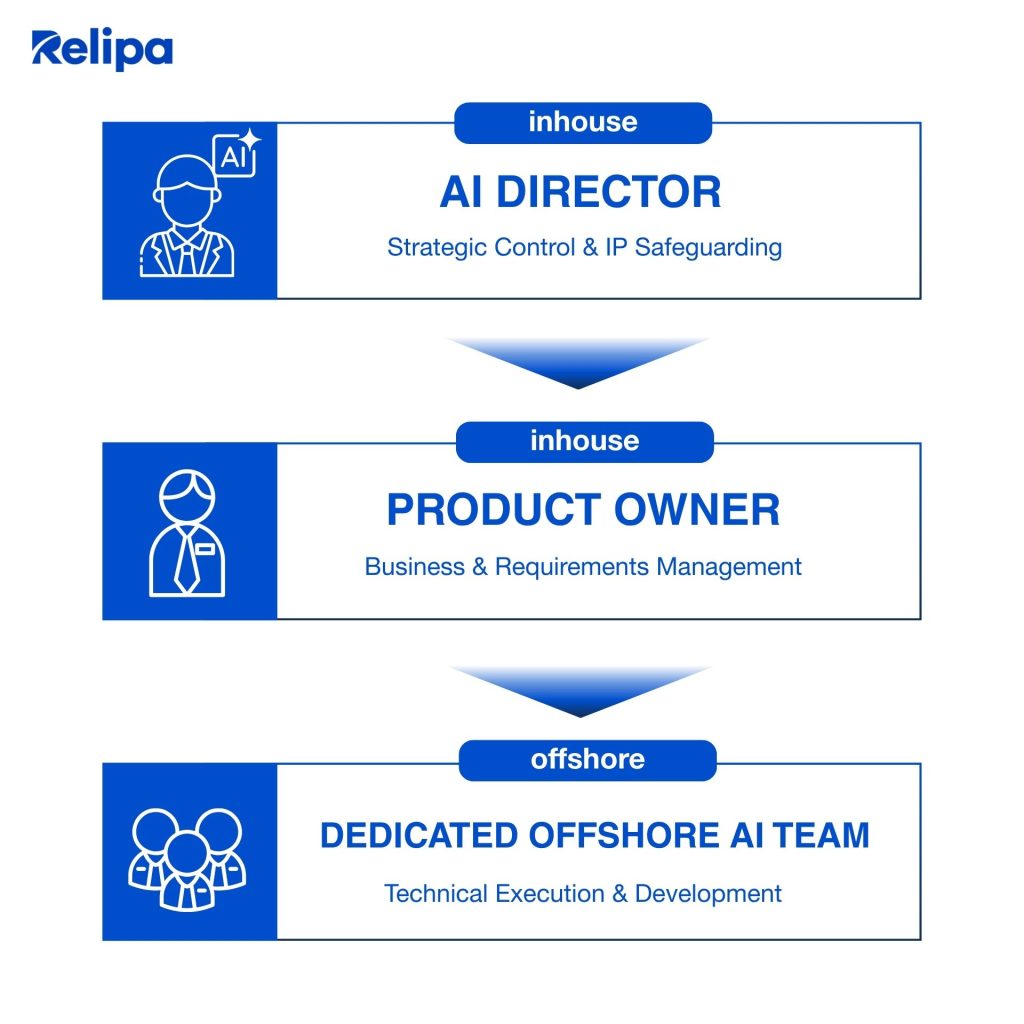
The rapid adoption of this organizational structure lies in its ability to balance operational control with aggressive resource optimization:
- Retention of Core Governance: Enterprises retain critical leadership roles, such as the AI Director, Product Owner, or Lead Architect, exclusively as internal, full-time staff. This internal anchor ensures absolute governance over high-level business logic, guards corporate technology secrets, and preserves primary Intellectual Property (IP).
- Delegation of Resource-Intensive Labor: Conversely, labor-heavy, time-consuming execution phases, including fundamental source-code writing, large-scale data annotation, regression testing, and model fine-tuning, are transferred directly to the dedicated offshore team.
Future Trends of Dedicated Offshore Teams in AI Development
As we advance through 2026, the intersection of artificial intelligence and global resource management is driving permanent shifts in corporate infrastructure. Looking ahead, several macroeconomic trends will define how enterprises leverage external technical expertise:
- The Prolonged AI Talent Shortage: The explosive market demands for Agentic AI applications and custom Large Language Models (LLMs) continue to drastically outpace global academic and professional supply. According to macroeconomic tech adoption indicators from the AI Index, navigating this persistent AI talent shortage via cross-border engineering networks is no longer merely a cost-saving tactic, but an operational necessity for corporate survival.
- The Normalization of a Remote-First Workforce: Global organizations have fully standardized their remote engineering governance, quality assurance frameworks, and asynchronous communication pipelines. This cultural shift eliminates historical prejudices regarding geographical distance, treating remote collaboration as a baseline standard.
- The Emergence of 24/7 Global Engineering Teams: Forward-thinking enterprises are systematically restructuring their R&D divisions to achieve continuous, round-the-clock product development. By strategically pairing a domestic core team with a dedicated offshore team in complementary time zones, businesses can maintain a continuous 24-hour engineering cycle, drastically accelerating time-to-market.
- Accelerated Growth in Targeted AI Staff Augmentation: Corporate hiring is shifting away from broad, generic contracts toward highly targeted talent injection. Modern enterprises increasingly utilize specialized remote engineers on a tactical, short-term basic, specifically recruiting niche experts for discrete phases, such as LLM fine-tuning or complex MLOps pipeline construction.
- Geographic Expansion of High-Tier Offshore AI Hubs: While traditional software development was decentralized globally, high-end AI development is concentrating within emerging regions backed by elite, highly competitive STEM education systems. Nations across Eastern Europe (such as Poland and Romania), India, and notably Southeast Asia (with Vietnam leading as a high-velocity tech exporter) are rapidly ascending as premier global epicenters for artificial intelligence engineering exports.
Conclusion
In summary, navigating the growing demand for AI talent requires a precise calibration of corporate financial engineering and human resource agility. Maintaining a competitive edge in 2026 does not tolerate inefficient resource allocation, making the total cost of ownership (TCO) the ultimate deciding factor for technology leaders.
While traditional in-house AI hiring provides absolute operational control and native intellectual property security, it burdens the enterprise with substantial capital expenditure (CapEx), ongoing upskilling overhead, and severe attrition liabilities. Conversely, partnering with a dedicated offshore team effectively converts these rigid financial commitments into highly predictable operational expenditure (OpEx), granting instant access to top-tier global competencies and elastic scaling agility without localized recruitment friction.
Ultimately, there is no one-size-fits-all roadmap; the choice between internal talent acquisition and offshore engineering must align with your product’s core compliance architecture and velocity requirements. By strategically deploying a hybrid workforce, modern tech enterprises can comfortably secure absolute strategic governance internally while leveraging external specialized teams to optimize development costs and accelerate time-to-market.
Relipa Software
Relipa Co., Ltd. is a Vietnam-based software development company established in April 2016. After two years of growth, our Japanese branch – Relipa Japan – was officially founded in July 2018.
We provide services in MVP development, web and mobile application development, and blockchain solutions. With a team of over 100 professional IT engineers and experienced project managers, Relipa has become a reliable partner for many enterprises and has successfully delivered more than 500 projects for startups and businesses worldwide.
