
For many enterprises, legacy systems are simultaneously their greatest operational asset and their greatest obstacle to growth.
They support mission-critical business processes, store years of valuable organizational knowledge, and often serve as the backbone of daily operations. Yet they can also limit innovation, increase operating expenses, slow business agility, and prevent organizations from fully embracing cloud-based transformation initiatives.
This creates a difficult challenge for executive leadership teams. While technology leaders may recognize the need for modernization, gaining approval from CEOs, COOs, CFOs, and board members requires far more than explaining outdated software architectures or aging infrastructure.
Business leaders do not invest in technology because it is old. They invest when there is a compelling financial reason to change.
This is why successful legacy system modernization initiatives begin with a business case rather than a technical roadmap.
The organizations that achieve meaningful transformation are those that can clearly demonstrate the cost of maintaining legacy environments, quantify operational and business risks, and present a realistic path toward measurable return on investment (ROI).
From our experience helping enterprises modernize technology ecosystems, the most successful projects are driven by business outcomes rather than technology upgrades. The goal is not simply to replace old systems. The goal is to create a stronger foundation for future growth, innovation, and competitiveness.

The Hidden Cost of Legacy Systems
One of the biggest mistakes enterprises make is underestimating the true cost of legacy systems.
Most organizations can easily identify visible expenses such as software maintenance contracts, infrastructure hosting fees, hardware replacement costs, and vendor support agreements. These costs appear clearly on financial reports and are therefore easy to measure.
However, the greatest financial burden is often hidden beneath the surface.
Legacy environments frequently create operational inefficiencies that become normalized over time. Employees develop manual workarounds. Teams spend hours reconciling data between disconnected systems. New product launches require extensive customization efforts. Business units become dependent on a shrinking pool of specialists who understand aging platforms.
These inefficiencies rarely appear as line items in annual budgets, yet they consume significant organizational resources.
The cumulative effect can be substantial.
Delayed decision-making, slower customer response times, reduced productivity, and missed market opportunities all contribute to the real cost of legacy systems. For enterprises competing in fast-moving markets, this cost often exceeds the direct expense of maintaining the technology itself.
When building a business case for legacy system modernization, executives must account for both direct and indirect costs. Only then can they understand the true financial impact of maintaining the status quo.
Why Legacy Architecture Prevents Cloud Adoption
Cloud transformation has become a strategic priority for enterprises seeking greater flexibility, scalability, and business resilience.
However, many organizations discover that moving to the cloud is not as simple as relocating applications from one environment to another.
The challenge lies in the architecture itself.
Most legacy systems were designed years or even decades ago for environments that bear little resemblance to today’s cloud ecosystems. These applications were built to operate in fixed infrastructures, rely on tightly coupled components, and often lack the flexibility required for modern cloud-native environments.
As a result, organizations frequently encounter obstacles when attempting cloud adoption.
Applications may not scale efficiently. Integrations become difficult to maintain. Security frameworks require extensive modification. Performance expectations are not met, leading to user dissatisfaction and increased operational costs.
In many modernization assessments, the issue is not cloud readiness—it is architecture readiness.
For this reason, legacy system modernization should not merely be viewed as an infrastructure upgrade. It is often the prerequisite that enables successful cloud transformation.
Without modernization, cloud migration can simply transfer existing inefficiencies into a new environment.
Building the Foundation Through a Cloud Readiness Assessment
Before launching a modernization initiative, organizations should evaluate their preparedness through a structured cloud readiness assessment.
Many executives view this process as a technical exercise. In reality, it is a business evaluation.
A cloud readiness assessment helps leadership teams understand how current systems support future business objectives. It identifies technology constraints that could limit growth, highlights operational risks, and provides visibility into modernization priorities.
Questions typically include:
- Can existing systems support projected business growth?
- How much technical debt has accumulated?
- What operational costs are increasing year over year?
- Which applications generate the highest business value?
- What compliance or security risks exist?
- How dependent is the business on aging technologies?
The assessment also helps quantify modernization opportunities and establish benchmarks for future ROI measurement.
Most importantly, it transforms modernization discussions from subjective opinions into data-driven business decisions.
Speaking the Language of Executives: ROI First
One of the primary reasons modernization proposals fail is that they focus on technical improvements instead of business outcomes.
Executives do not approve budgets because software is outdated. They approve investments when there is a clear path to measurable financial return.
A successful legacy system modernization business case therefore begins with ROI.
This requires translating modernization benefits into metrics that decision-makers care about.
Reduced infrastructure costs, lower maintenance expenses, faster product delivery, increased employee productivity, and improved customer retention all contribute to measurable financial value.
For example, if legacy applications require extensive manual intervention, modernization can reduce labor costs while improving operational efficiency.
If deployment cycles currently take months due to outdated environments, modernization may accelerate time-to-market and create revenue opportunities that would otherwise be delayed.
Similarly, if aging infrastructure requires ongoing capital expenditure, cloud-enabled modernization can shift spending toward a more flexible operating model.
The strongest business cases evaluate these benefits over a three- to five-year period. This longer perspective helps leadership teams understand modernization as an investment rather than a cost center.
The Often-Ignored Cost of Doing Nothing
When evaluating modernization initiatives, organizations frequently analyze project costs while overlooking the financial risk associated with maintaining existing systems.
This is a critical mistake.
The decision not to modernize is itself a business decision with measurable consequences.
As legacy environments age, operational risks increase. Vendor support may become unavailable. Skilled professionals familiar with older technologies become increasingly difficult to recruit. System outages become more frequent and costly.
Cybersecurity risks also grow significantly. Older platforms were not designed to defend against modern threat landscapes, leaving organizations vulnerable to breaches, compliance failures, and reputational damage.
From a financial perspective, the risk of inaction often exceeds the investment required for modernization.
Executives tend to support modernization initiatives more readily when discussions include not only the benefits of moving forward but also the costs of standing still.
Choosing Between Rehost, Replatform, and Refactor
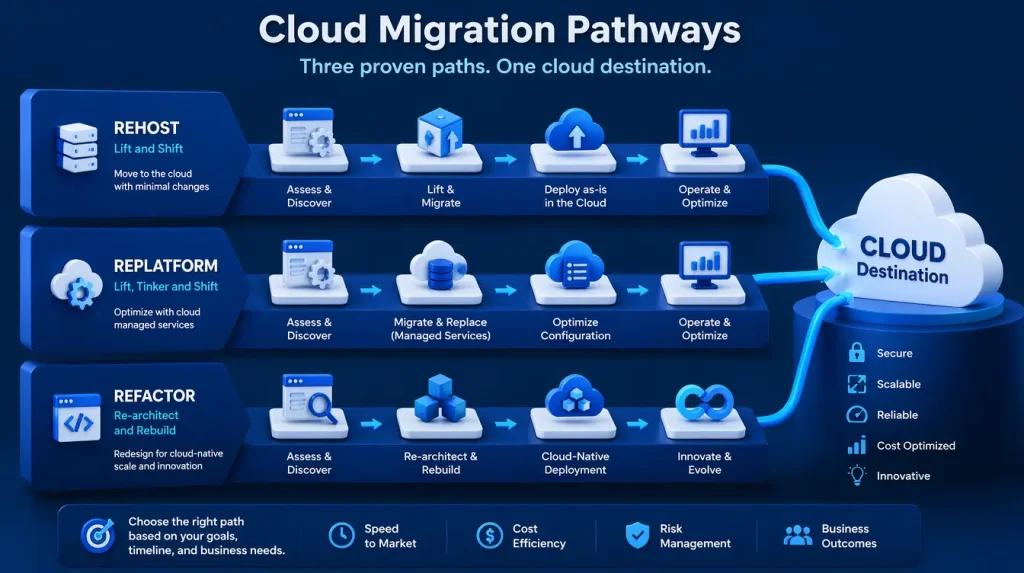
One of the most important decisions in any legacy system modernization initiative is determining the appropriate migration strategy.
Each option offers different levels of investment, complexity, and long-term value.
Rehost: Fastest, Lowest Initial Investment
Rehosting, commonly called “lift and shift,” involves moving applications to cloud infrastructure with minimal modification.
For organizations seeking rapid migration or immediate infrastructure savings, rehosting can provide a relatively quick path forward.
However, because applications remain largely unchanged, businesses may not realize the full strategic benefits of modernization.
While infrastructure efficiency improves, application agility often remains limited.
Replatform: Balancing Cost and Business Value
Replatforming introduces targeted improvements while migrating systems to modern environments.
Applications are optimized selectively, allowing organizations to gain performance and scalability improvements without undertaking complete redevelopment.
From a financial perspective, replatforming often offers an attractive balance between investment and outcome.
Many enterprises pursuing legacy system modernization choose this approach because it delivers measurable business value while minimizing operational disruption.
Refactor: Maximizing Long-Term ROI
Refactoring involves redesigning applications to fully leverage cloud-native capabilities and modern architectural principles.
Although this approach requires larger investments, it often generates the highest long-term return.
Organizations that view modernization as a strategic business transformation rather than an infrastructure upgrade frequently pursue refactoring for mission-critical systems.
The upfront costs may be higher, but the resulting agility, scalability, and innovation potential can deliver significantly greater ROI over time.
Multi-Cloud and Hybrid-Cloud Considerations
Today’s cloud strategies are far more sophisticated than simple migration projects.
Many enterprises now operate within multi-cloud or hybrid-cloud environments.
Hybrid-cloud models combine on-premises infrastructure with cloud platforms, enabling organizations to balance flexibility, compliance requirements, and operational control.
Multi-cloud strategies, meanwhile, leverage multiple cloud providers to reduce vendor dependency and increase resilience.
From a business standpoint, these approaches offer significant advantages.
Organizations gain greater flexibility in workload placement, enhanced business continuity, and improved negotiation power with technology providers.
However, they also introduce additional complexity.
Governance, security, integration management, and cost optimization become increasingly important.
A successful legacy system modernization strategy should therefore include a clear cloud operating model aligned with business objectives rather than technology trends.
The goal is not simply cloud adoption. The goal is creating an environment capable of supporting future growth.
Common Migration Challenges That Impact Business Outcomes
Modernization initiatives frequently face challenges that extend beyond technology.
Resistance to change remains one of the most significant obstacles. Employees accustomed to existing systems may be reluctant to adopt new workflows.
Data migration introduces additional risks. Poor data quality, incomplete records, and integration dependencies can delay projects and increase costs.
Budget overruns often occur when organizations underestimate technical debt or fail to align modernization plans with business priorities.
Leadership alignment can also become problematic. Different stakeholders may have competing expectations regarding scope, timing, and outcomes.
These challenges reinforce the importance of careful planning, phased execution, and experienced implementation partners.
Organizations that anticipate such risks early are more likely to achieve successful outcomes and realize projected ROI.
A Real-World Migration Roadmap for Enterprise Modernization
Successful modernization programs rarely happen through a single large-scale migration.
Instead, they are typically executed through a phased business-first approach.
The journey begins with assessment and business case development. Organizations evaluate the cost of legacy systems, identify modernization priorities, and establish measurable objectives.
The second phase focuses on application portfolio analysis, identifying which systems should be rehosted, replatformed, or refactored.
Pilot migrations are then conducted to validate assumptions, reduce risk, and refine governance processes.
Once successful outcomes have been demonstrated, broader modernization efforts can scale across the organization.
Finally, continuous optimization ensures that cloud investments, operational processes, and technology strategies continue delivering value over time.
This phased roadmap minimizes disruption while allowing organizations to generate incremental returns throughout the modernization journey.
Why the Right IT Outsourcing Partner Matters
Many organizations understand the need for legacy system modernization but struggle with execution.
Internal teams often face competing priorities, limited resources, and skills gaps related to cloud transformation and modernization programs.
This is where experienced IT outsourcing partners create measurable value.
Beyond technical expertise, the right partner helps build financial justification, conduct cloud readiness assessments, evaluate migration strategies, and manage execution risks.
They bring proven frameworks, industry experience, and delivery methodologies that accelerate outcomes while reducing uncertainty.
For enterprise leaders, partnering with a trusted outsourcing provider transforms modernization from a high-risk initiative into a structured business investment.
Build the Case Around Business Value, Not Technology
Ultimately, legacy system modernization is not about replacing old technology.
It is about enabling business growth.
Organizations that successfully secure executive support focus their business case on financial outcomes, operational efficiency, risk reduction, and long-term strategic value.
By quantifying the cost of legacy systems, assessing cloud readiness, selecting the appropriate migration strategy, and developing a realistic roadmap, enterprises can build a compelling case for change.
The strongest modernization initiatives are not driven by technology teams alone. They are championed by business leaders who understand that future competitiveness depends on the ability to evolve.
In an increasingly digital economy, modernization is no longer a technical upgrade—it is a business imperative.
Relipa
At Relipa, we help enterprises design and implement scalable AI solutions through tailored, dedicated team models. When you hire dedicated development team resources from us, you gain a partner focused on long-term success, not just short-term delivery.
