

When organizations set out to build a Software-as-a-Service (SaaS) product, speed is often the top priority. Whether it’s a venture-backed startup, an innovation team within a large enterprise, or a company testing a new digital business model, the goal is usually the same: launch quickly, validate assumptions, and minimize risk.
However, one critical decision often determines whether an MVP reaches the market successfully or becomes another delayed development initiative: choosing the right execution model.
Should you hire an individual freelancer or partner with a dedicated development team?
At first glance, freelancers appear attractive. They offer flexibility, lower initial costs, and quick onboarding. Dedicated teams, on the other hand, require a larger investment but promise scalability, reliability, and strategic execution.
The reality is that neither approach is inherently better. The right choice depends on business goals, risk tolerance, product complexity, and long-term growth plans.
From our experience delivering SaaS development projects for organizations across multiple industries, one of the most common mistakes companies make is comparing freelancers and dedicated teams solely based on hourly rates. In practice, successful SaaS MVP development is rarely determined by cost alone.
It is determined by how effectively a delivery model supports speed, quality, scalability, and business outcomes.
This is where understanding modern outsourcing and offshoring business services becomes critical.
Why SaaS MVP Development Is Different from Traditional Software Projects
An MVP is not simply a smaller version of a product.
Its purpose is to test business assumptions, validate market demand, and create a foundation for future growth.
Unlike internal applications or fixed-scope software projects, SaaS MVPs operate in highly uncertain environments.
Founders and executives often do not have all the answers at the beginning. Customer requirements evolve, priorities change, and product roadmaps shift based on real-world feedback.
As a result, SaaS MVP development requires more than coding capabilities.
It requires collaboration, adaptability, and continuous decision-making.
This is why the choice between freelancers and dedicated teams has a direct impact on business outcomes.
The development model influences how quickly organizations can learn, iterate, and respond to market opportunities.
Why Enterprises Consider Freelancers
Freelancers have become an increasingly popular option for organizations seeking short-term development support.
The appeal is obvious.
Hiring a freelancer is often faster than recruiting full-time employees. Businesses can access specialized skills on demand, engage talent for specific tasks, and reduce upfront commitments.
For relatively simple projects, this flexibility can be beneficial.
Startups with limited budgets often view freelancers as a practical way to build an MVP without making significant investments.
In some situations, freelancers provide excellent value. An experienced specialist can help accelerate design work, develop isolated features, or support an internal engineering team during peak workloads.
Within the broader landscape of outsourcing and offshoring business services, freelancers can play an important role when project requirements are clearly defined and relatively narrow in scope.
However, SaaS products rarely stay simple for long.
The Hidden Challenges of Freelancer-Based Development
While freelancers can reduce initial costs, enterprises often discover hidden challenges as products evolve.
The first challenge is continuity.
Most freelancers work independently and manage multiple clients simultaneously. Priorities can shift unexpectedly. Availability may become inconsistent. Knowledge remains concentrated in a single individual rather than distributed across a broader team.
This creates operational risk.
If a freelancer becomes unavailable during a critical release cycle, project timelines may be affected significantly.
Another challenge involves scalability.
A successful SaaS MVP requires multiple skill sets, including architecture design, frontend engineering, backend development, cloud infrastructure, testing, security, and user experience expertise.
Few freelancers possess deep expertise across all these areas.
As a result, organizations often find themselves coordinating multiple independent contractors, effectively becoming project managers and engineering leaders themselves.
For CEOs, CTOs, and product leaders, this coordination effort can become a significant distraction from core business priorities.
Understanding the Dedicated Team Model
A dedicated team operates differently.
Rather than hiring individuals for isolated tasks, organizations gain access to a structured team that functions as an extension of their business.
Typically, dedicated teams include the expertise required to deliver a product end-to-end. Depending on project needs, this may include software engineers, quality assurance specialists, DevOps engineers, UI/UX designers, solution architects, and project managers.
The team works exclusively on the client’s product and aligns with its strategic objectives.
Modern outsourcing and offshoring business services have evolved significantly in this direction. Rather than focusing solely on labor arbitrage, leading providers now offer integrated product development teams capable of supporting the entire software lifecycle.
For SaaS MVP development, this model often aligns more closely with how successful products are built.
Cost Comparison: Looking Beyond Hourly Rates
One of the biggest misconceptions about freelancers and dedicated teams involves cost.
Freelancers often appear less expensive because hourly rates are lower.
However, total project cost is influenced by many factors beyond hourly pricing.
Organizations must consider:
- Project management effort
- Team coordination
- Quality assurance
- Technical debt
- Rework requirements
- Delays caused by knowledge gaps
- Onboarding replacement resources
A freelancer may cost less per hour but require additional management overhead.
Dedicated teams typically present a higher initial investment, yet they often reduce hidden costs by providing structured delivery processes and cross-functional expertise.
For decision-makers evaluating outsourcing and offshoring business services, the key question should not be:
“Which option costs less?”
Instead, it should be:
“Which option delivers business outcomes more efficiently?”
Speed to Market: A Critical SaaS KPI
For SaaS businesses, time-to-market directly impacts competitiveness.
The faster an MVP reaches real users, the sooner organizations gain market feedback.
Freelancers can be effective when the scope is small and highly focused. However, speed often decreases as complexity increases.
When multiple freelancers are involved, dependencies emerge. Communication gaps become more common. Integration challenges increase.
Dedicated teams typically mitigate these issues by working within established delivery frameworks.
Team members collaborate daily, share responsibility for outcomes, and follow consistent development practices.
This synchronized approach often enables faster iteration cycles and more predictable releases.
For organizations racing to validate product-market fit, this advantage can be significant.
Risk Management and Business Continuity
Enterprise decision-makers frequently evaluate technology initiatives through a risk-management lens.
This perspective becomes particularly important during MVP development because uncertainty is already high.
Freelancer-based models introduce several risks:
- Single points of failure
- Knowledge concentration
- Limited documentation
- Inconsistent availability
- Variable quality standards
Dedicated teams generally provide stronger continuity.
Knowledge is shared across multiple professionals. Processes are documented. Governance structures exist. Project visibility is improved.
From a business standpoint, dedicated teams reduce dependency on individual contributors.
This makes them particularly attractive for companies seeking long-term scalability rather than short-term delivery.
Scalability: Planning Beyond the MVP
An MVP is only the beginning of a product journey.
The real challenge emerges after validation.
User growth increases infrastructure requirements. Security requirements become more demanding. Product roadmaps expand.
Many organizations underestimate how quickly development needs evolve after launch.
A freelancer who successfully developed an MVP may not have the capacity or expertise to support later growth phases.
Dedicated teams, by contrast, are structured to scale.
Additional engineers can be added. Specialized expertise can be introduced. Development capacity can expand alongside business growth.
Within the context of modern outsourcing and offshoring business services, scalability has become one of the primary reasons organizations choose dedicated team models.
They are not simply purchasing delivery capacity; they are building a long-term product development capability.
Which Model Works Best for Different Business Scenarios?
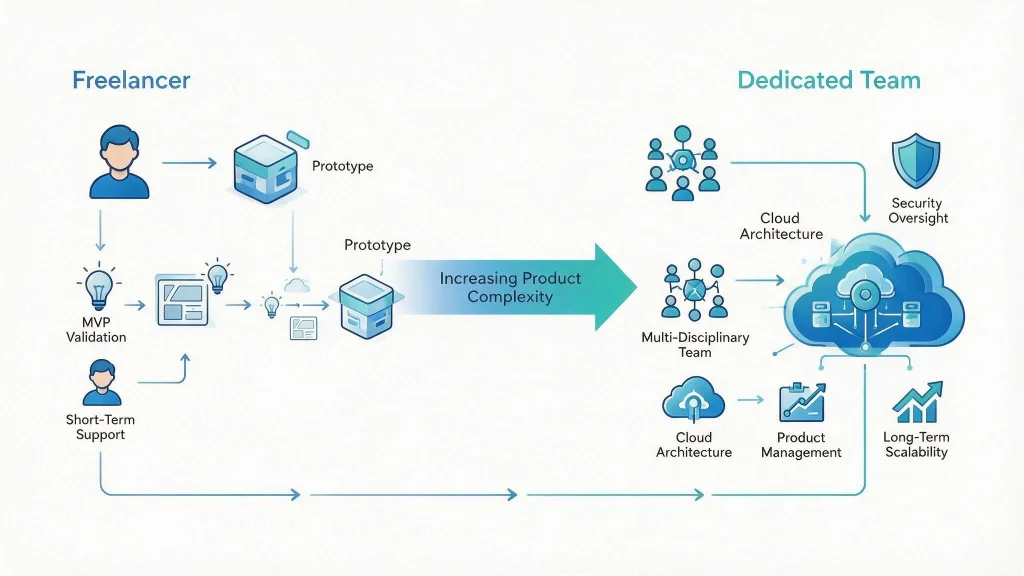
There are situations where freelancers are entirely appropriate.
If the objective is validating a simple concept, creating a prototype, or supplementing an existing engineering organization, freelance talent may provide an efficient solution.
However, as product complexity increases, dedicated teams generally become more advantageous.
For example, enterprises launching new SaaS business lines often require:
- Multiple development disciplines
- Security oversight
- Cloud architecture expertise
- Product management support
- Long-term scalability planning
These requirements typically exceed what individual freelancers can deliver consistently.
As a result, organizations focused on growth and sustainability often prefer dedicated teams from the beginning.
How Enterprises Evaluate Outsourcing Partners
When assessing providers of outsourcing and offshoring business services, enterprise leaders increasingly focus on strategic fit rather than cost alone.
The most successful partnerships are built around business outcomes.
Key evaluation criteria often include:
- Industry experience
- Product development expertise
- Communication maturity
- Security practices
- Scalability capabilities
- Delivery governance
- Long-term support models
A strong partner should function as more than a vendor.
They should contribute insights, challenge assumptions, and help guide product decisions.
This collaborative approach often determines whether an MVP evolves into a successful SaaS platform.
The Future of SaaS Development: Collaboration Over Cost
The outsourcing market has changed dramatically over the past decade.
Organizations no longer view external teams simply as a way to reduce expenses.
Instead, they increasingly leverage outsourcing and offshoring business services to access specialized talent, accelerate innovation, and improve execution speed.
This shift reflects a broader trend in product development.
Success is no longer measured solely by development efficiency.
It is measured by how quickly organizations can learn from customers, adapt products, and create business value.
Dedicated teams are particularly well positioned to support this model because they combine technical expertise with continuity, governance, and scalability.
Choosing the Right Model for Long-Term Success
The decision between a freelancer and a dedicated team should not be viewed as a procurement exercise.
It is a strategic business decision.
Freelancers can offer flexibility and lower upfront costs for narrowly defined projects. For certain early-stage initiatives, they may be entirely sufficient.
However, SaaS MVP development typically requires sustained collaboration, multiple skill sets, and the ability to scale rapidly after validation.
This is where dedicated teams often deliver greater long-term value.
For enterprises evaluating outsourcing and offshoring business services, the goal should not be selecting the cheapest option. The goal should be selecting the model that best supports business objectives, minimizes risk, and accelerates product success.
In today’s competitive SaaS landscape, the companies that win are not necessarily those that spend the least. They are the ones that build, learn, and scale the fastest.
Read more: The Power of a Dedicated Software Development Team: Your Guide to Strategic Growth
Relipa
Relipa is a Vietnam-based software development company established in April 2016. After two years of growth, our Japanese branch – Relipa Japan – was officially founded in July 2018.
We provide services in MVP development, web and mobile application development, and blockchain solutions. With a team of over 100 professional IT engineers and experienced project managers, Relipa has become a reliable partner for many enterprises and has successfully delivered more than 500 projects for startups and businesses worldwide.
