

Across industries, cloud transformation has evolved from a technology trend into a strategic business priority. Executives no longer view cloud adoption simply as a way to reduce infrastructure costs. Today, it is widely recognized as a foundation for business agility, innovation, resilience, and long-term growth.
Yet despite significant investments in cloud technologies, many organizations struggle to achieve the outcomes they expect.
Executives often ask a common question:
“Why are we investing in cloud transformation but still experiencing slow innovation, operational inefficiencies, and technology bottlenecks?”
The answer frequently lies in one overlooked factor: legacy systems.
Many enterprises attempt to modernize their business operations while continuing to rely on architectures that were designed decades ago. Although these systems may still support core operations, they often prevent organizations from realizing the full value of cloud transformation.
From our experience helping enterprises modernize digital ecosystems, successful cloud adoption rarely starts with cloud migration alone. It begins with a thoughtful legacy modernization approach that aligns technology decisions with business goals.
The organizations gaining the most value from cloud investments understand a critical reality: cloud transformation is not about where applications run. It is about enabling the business to move faster.
The Business Promise of Cloud Transformation
Before discussing the challenges of legacy systems, it is important to understand why cloud transformation has become such a strategic priority.
Business leaders are increasingly expected to respond rapidly to market changes, customer demands, and competitive pressures. This requires technology environments capable of scaling, adapting, and evolving continuously.
Cloud technologies support these objectives by providing flexibility that traditional environments often cannot deliver.
Organizations can launch new products faster, deploy applications more frequently, improve disaster recovery capabilities, and access advanced technologies such as artificial intelligence, data analytics, and automation without significant infrastructure investments.
Most importantly, cloud transformation creates business agility.
When technology becomes easier to adapt, businesses gain the ability to make strategic decisions more quickly.
However, this agility depends heavily on the applications and systems running within the environment.
If those systems remain constrained by outdated architectures, cloud migration alone may deliver only marginal benefits.
Why Legacy Systems Become Transformation Bottlenecks
Many legacy systems were built during a period when business priorities looked very different.
Years ago, applications were designed for predictable workloads, fixed infrastructure, and relatively stable business requirements. Scalability was not a primary concern because growth patterns were easier to forecast.
Today, the business landscape is fundamentally different.
Organizations need systems capable of supporting remote workforces, global operations, digital customer experiences, and real-time decision-making.
Unfortunately, legacy applications often lack the flexibility required to support these expectations.
Their architectures were designed around highly interconnected components, proprietary technologies, and rigid deployment models.
As a result, they become significant obstacles during cloud transformation initiatives.
The problem is not necessarily the age of the technology itself. The challenge lies in the architectural assumptions embedded within those systems.
When businesses attempt to move these applications into modern cloud environments, the limitations quickly become apparent.
How Legacy Systems Restrict Business Agility
One of the most overlooked consequences of legacy technology is its impact on business responsiveness.
When launching a new product, integrating with a partner, or entering a new market, technology should accelerate progress. Instead, legacy environments often slow it down.
Development teams become constrained by outdated infrastructure and complex dependencies. Every application update requires extensive testing. New integrations demand significant customization.
From a business perspective, these delays translate directly into missed opportunities.
The issue becomes especially problematic in industries where competitive advantage depends on rapid innovation.
Organizations that can release products faster, respond to customer feedback quickly, and experiment with new business models often outperform competitors still constrained by legacy platforms.
This is why a modern legacy modernization approach should be evaluated primarily through the lens of agility rather than technology.
The question is not whether a system is old.
The question is whether it enables or limits future growth.
Why Legacy Architecture Prevents Cloud Efficiency
Many organizations assume that simply moving applications to cloud infrastructure will reduce costs and improve performance.
Unfortunately, cloud migration does not automatically solve architectural problems.
Applications built for traditional on-premises environments often carry inefficiencies into the cloud.
Some systems consume excessive resources because they were never designed to scale dynamically. Others require specialized maintenance, custom integrations, or manual intervention.
As a result, businesses end up paying cloud infrastructure costs without realizing corresponding operational benefits.
In some cases, cloud spending can actually increase after migration.
Executives then question whether cloud transformation was worth the investment.
The reality is that the cloud was not the problem.
The underlying architecture was.
Without a comprehensive legacy modernization approach, organizations risk transferring technical debt into a new environment instead of eliminating it.
Common Signs Your Legacy Systems Are Blocking Cloud Transformation
Many executives recognize modernization needs only after operational problems become severe.
However, warning signs usually emerge much earlier.
A common indicator is the increasing difficulty of deploying new features. What should take days or weeks begins requiring months of planning and development effort.
Another warning sign involves integration challenges. Modern digital ecosystems depend on APIs, automation platforms, and real-time data exchange. Legacy systems frequently struggle to support these capabilities.
Organizations may also notice rising maintenance expenses. More budget becomes devoted to keeping existing systems operational than enabling innovation.
Finally, cloud projects may consistently miss expectations. Despite substantial investment, teams continue facing scalability issues, performance limitations, and operational inefficiencies.
Together, these symptoms often indicate the need for a more strategic legacy modernization approach.
Building a Business Case for Modernization
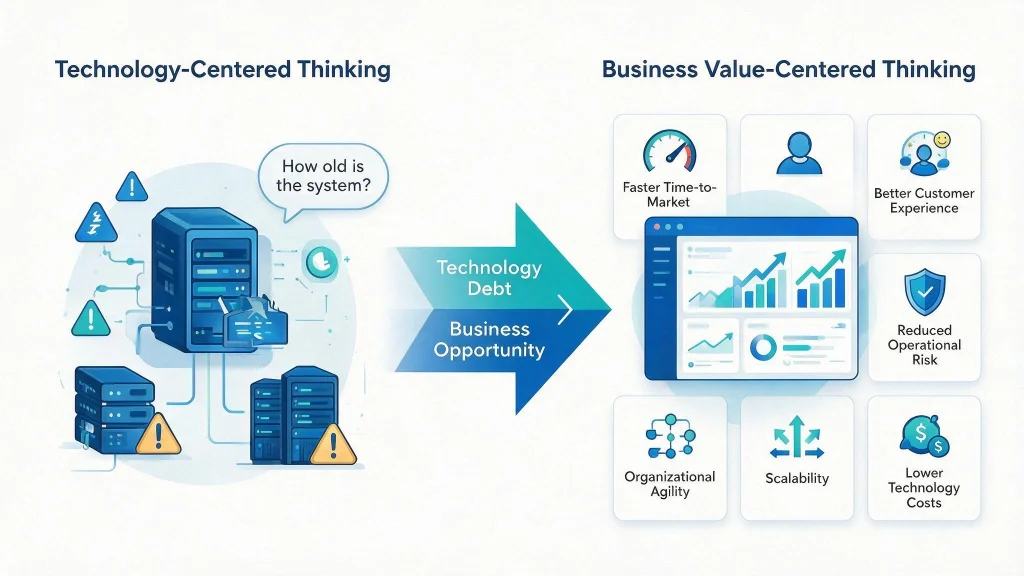
Modernization initiatives should never be justified solely on technical grounds.
Enterprise leaders approve investments when there is a clear connection to business value.
The most effective modernization business cases focus on outcomes such as:
- Faster time-to-market
- Improved customer experiences
- Reduced operational risk
- Increased organizational agility
- Better scalability
- Lower long-term technology costs
A successful leadership discussion shifts the conversation from technology debt to business opportunity.
Instead of asking, “How old is the system?”
Executives should ask:
“How much business value are we losing because this system limits our ability to grow?”
This perspective fundamentally changes modernization priorities.
Choosing the Right Legacy Modernization Approach
One reason modernization projects become overwhelming is that organizations view them as all-or-nothing initiatives.
In reality, modernization can take multiple forms.
The right legacy modernization approach depends on business objectives, application criticality, risk tolerance, and investment capacity.
Some businesses may choose incremental modernization, improving systems gradually while maintaining operational stability.
Others may prioritize cloud-native transformation for applications that directly influence customer experience and revenue generation.
The key is understanding that modernization is not a single project.
It is a strategic journey that aligns technology investments with business objectives.
Organizations that adopt this mindset typically achieve more sustainable outcomes than those pursuing purely technology-driven initiatives.
Read more: Unlocking Business Agility: Comprehensive Legacy System Modernization Services
Cloud-Native Thinking: The Future of Enterprise Growth
The most successful enterprises increasingly view cloud transformation as an opportunity to redesign how technology supports the business.
Rather than replicating old environments in the cloud, they focus on creating systems that enable continuous innovation.
Cloud-native architectures support modular development, faster deployment cycles, and greater resilience.
This allows organizations to experiment more rapidly, launch products faster, and respond to market changes with greater confidence.
Most importantly, it enables technology teams to spend less time maintaining infrastructure and more time creating business value.
A forward-looking legacy modernization approach helps enterprises build a foundation for these capabilities rather than simply upgrading existing systems.
The Role of Strategic IT Partners
For many organizations, the biggest challenge is not recognizing the need for modernization but executing it successfully.
Internal teams often face competing priorities, limited resources, and uncertainty about where to begin.
This is where experienced IT outsourcing partners create significant value.
A capable partner brings technical expertise, proven modernization frameworks, cloud strategy knowledge, and implementation experience gathered across multiple industries.
More importantly, they help organizations connect modernization efforts to business objectives.
Rather than focusing solely on technology migration, strategic partners help leaders answer critical questions:
- Which systems should be modernized first?
- Where can cloud transformation create the most value?
- How can risks be minimized during migration?
- What modernization roadmap aligns best with business goals?
These insights often determine the success of transformation initiatives.
A Practical Roadmap to Cloud-Ready Modernization
Successful cloud transformation typically follows a structured progression.
The first step is understanding the current environment. This includes evaluating application portfolios, business dependencies, and operational risks.
The second step involves prioritization. Not every application requires the same level of modernization. Organizations should focus first on systems that create the greatest business impact.
The third step is implementing the chosen legacy modernization approach, balancing speed, risk, and expected value.
Finally, modernization should become an ongoing capability rather than a one-time project. Continuous optimization ensures that technology remains aligned with evolving business needs.
This phased strategy reduces disruption while maximizing returns on investment.
Conclusion
Many enterprises begin their cloud journey believing that infrastructure migration alone will deliver transformation.
In reality, meaningful cloud transformation requires something more fundamental.
Legacy systems often represent the single largest barrier to agility, innovation, and scalability. Unless these limitations are addressed, organizations will struggle to realize the full value of cloud investments.
This is why a thoughtful legacy modernization approach is essential.
Modernization is not simply about replacing outdated technology. It is about enabling business growth, improving responsiveness, reducing complexity, and creating a foundation for future innovation.
The enterprises that succeed in cloud transformation are not necessarily those with the largest technology budgets. They are the ones that align modernization efforts with business outcomes and view technology as a strategic enabler of growth.
For CEOs, COOs, and CTOs planning the next phase of digital transformation, the question is no longer whether modernization is needed.
The question is how quickly your organization can remove the barriers preventing the business from moving forward.
Relipa
Relipa is a Vietnam-based software development company established in April 2016. After two years of growth, our Japanese branch – Relipa Japan – was officially founded in July 2018.
We provide services in MVP development, web and mobile application development, and blockchain solutions. With a team of over 100 professional IT engineers and experienced project managers, Relipa has become a reliable partner for many enterprises and has successfully delivered more than 500 projects for startups and businesses worldwide.
