
For enterprise leaders, few technology initiatives carry as much strategic significance as legacy system modernization.
Modernization promises many benefits: improved business agility, faster innovation, reduced operational costs, stronger security, and greater readiness for cloud transformation. Yet despite these potential advantages, modernization projects continue to be among the most challenging initiatives organizations undertake.
The reason is simple. Legacy modernization is rarely just a technology upgrade. It is a business transformation effort that impacts people, processes, operations, customers, and revenue streams.
Many organizations enter modernization programs with confidence, only to encounter delays, budget overruns, stakeholder conflicts, or unexpected disruptions that threaten the project’s success.
From our experience supporting enterprise transformation initiatives, the organizations that succeed are not necessarily those with the largest budgets or the most advanced technologies. They are the ones that recognize modernization risks early and establish governance frameworks that prevent those risks from becoming business problems.
This is where effective legacy modernization strategies become critical. Successful enterprises understand that modernization is ultimately about risk management as much as it is about technology improvement.
Why Legacy Modernization Projects Fail
When modernization projects struggle, technology often receives the blame. However, technical issues are rarely the primary cause of failure.
In many cases, modernization initiatives fail because organizations underestimate the complexity of change itself.
Legacy systems are deeply embedded within business operations. They support critical processes, store years of institutional knowledge, and often connect with dozens of other applications.
Changing these systems affects multiple departments simultaneously. As a result, modernization projects introduce risks that extend far beyond software development.
The most successful legacy modernization strategies begin with understanding this reality. They treat modernization as an enterprise-wide transformation program rather than a standalone IT initiative.
The Biggest Risks in Legacy System Modernization Projects
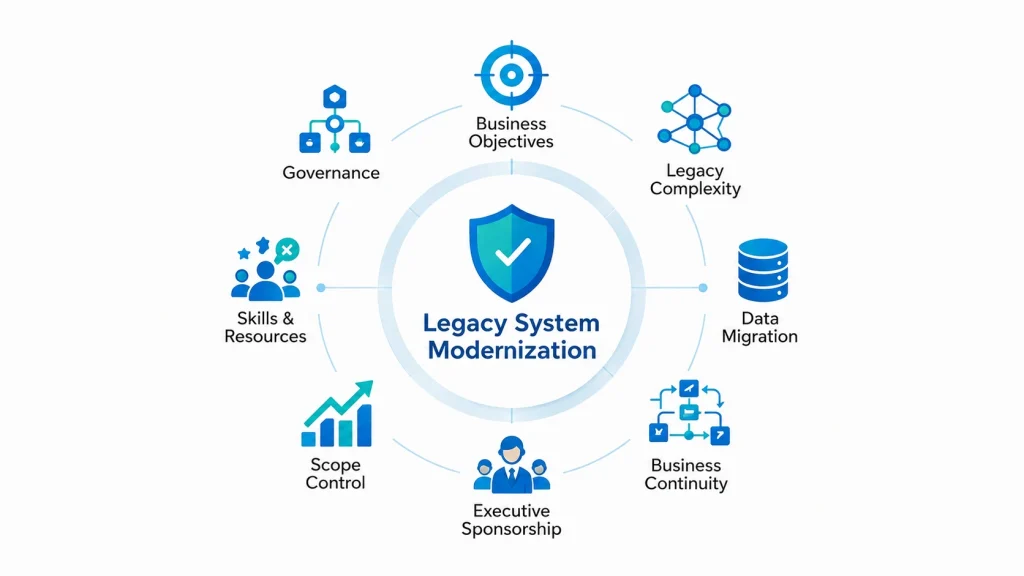
Risk #1: Unclear Business Objectives
One of the most common causes of modernization failure occurs before any technology work begins.
Organizations frequently launch projects because systems are old, support costs are rising, or cloud migration has become a strategic priority. While these concerns are valid, they do not provide a clear definition of success.
Without measurable business objectives, modernization efforts often lose direction.
Project teams may spend months debating technical decisions while executives struggle to determine whether progress is being made. Budgets grow, timelines expand, and stakeholder confidence begins to decline.
Successful enterprises approach modernization differently.
Before selecting technologies, they establish business outcomes.
These outcomes might include reducing operational expenses, increasing deployment speed, improving customer experience, enhancing compliance capabilities, or enabling business expansion into new markets.
When objectives are clearly defined, modernization teams can evaluate decisions based on business value rather than technical preferences.
Risk #2: Underestimating Legacy Complexity
Many organizations assume they understand their legacy environment.
Unfortunately, years of incremental changes often create a level of complexity that remains largely undocumented.
Applications become interconnected through APIs, database dependencies, custom integrations, manual workflows, and third-party systems. Over time, these relationships become difficult to track.
When modernization begins, hidden dependencies frequently emerge.
A seemingly minor application change may unexpectedly impact finance processes, customer workflows, reporting systems, or operational functions.
This is one of the primary reasons modernization timelines are often underestimated.
Strong legacy modernization strategies begin with comprehensive discovery and assessment activities. Instead of rushing into migration efforts, organizations map dependencies, identify critical systems, and understand operational impacts before making architectural decisions.
Investing in assessment early often prevents costly surprises later.
Risk #3: Data Migration Failures
For most enterprises, data is more valuable than the applications that manage it.
Customer records, financial information, operational histories, intellectual property, and compliance-related data often represent decades of accumulated business value.
Yet data migration remains one of the highest-risk components of modernization.
Common challenges include:
- Inconsistent data formats
- Poor data quality
- Duplicate records
- Missing documentation
- Regulatory compliance requirements
Problems may not become visible until migration activities are already underway.
Even relatively small data issues can cause operational disruptions, reporting inaccuracies, or customer service challenges.
Organizations that successfully modernize treat data as a business asset rather than a technical artifact.
They establish governance processes, perform data quality assessments early, and validate migration approaches before executing large-scale transformations.
Risk #4: Operational Disruption During Modernization
Business continuity is often a top concern for executive stakeholders.
Legacy systems frequently support critical operations that cannot tolerate significant downtime. Revenue-generating activities, customer transactions, supply chain processes, and regulatory obligations may all depend on these environments.
Modernization introduces the possibility of disruption at multiple stages.
Unexpected outages, failed integrations, deployment errors, and process changes can all impact daily operations.
For executive leadership, this creates a difficult balancing act.
The organization must modernize to remain competitive, but it cannot sacrifice ongoing operations in the process.
This is why phased modernization approaches have become increasingly popular.
Rather than replacing entire environments simultaneously, organizations modernize incrementally. Risks remain more manageable, lessons can be applied between phases, and operational continuity is better protected.
Risk #5: Insufficient Executive Sponsorship
Modernization initiatives often begin as technology projects and remain confined within IT departments.
This can become a serious problem.
Legacy modernization affects multiple business units, operational workflows, budgets, and strategic priorities. Without executive sponsorship, cross-functional alignment becomes difficult to maintain.
Conflicting priorities emerge. Departments resist changes. Project decisions slow down.
Eventually, momentum is lost.
Successful modernization efforts typically have visible support from executive leadership.
CEOs, CTOs, COOs, and business leaders actively communicate modernization goals and reinforce organizational alignment. Their involvement helps remove barriers and ensures modernization remains connected to business objectives.
Strong governance begins at the executive level.
Risk #6: Scope Creep and Project Expansion
Another common challenge is scope expansion.
As modernization programs progress, stakeholders often identify additional opportunities for improvement. New requirements are introduced. Additional applications are added. Business units request enhancements that were not part of the original plan.
While these requests may seem beneficial individually, they can collectively undermine project success.
Budgets increase. Timelines extend. Teams become overloaded.
Eventually, modernization objectives become diluted.
Organizations with effective legacy modernization strategies manage this challenge through governance frameworks.
Clear prioritization criteria, steering committees, and change approval processes help ensure that modernization remains focused on its original business goals.
Not every improvement needs to happen at the same time.
Risk #7: Skills Gaps and Resource Constraints
Legacy modernization requires expertise across multiple disciplines.
Organizations often need professionals with knowledge in:
- Legacy technologies
- Cloud platforms
- Security architecture
- Data migration
- Enterprise integration
- Change management
Finding individuals who possess all these capabilities internally can be difficult.
This challenge becomes particularly significant when modernization competes with day-to-day operational responsibilities.
Internal teams may simply lack the time or resources required to support complex transformation efforts.
Many enterprises address this challenge by partnering with experienced outsourcing providers.
External specialists bring proven methodologies, dedicated resources, and cross-industry modernization experience. This reduces execution risk while allowing internal teams to remain focused on business-critical operations.
Risk #8: Weak Governance and Decision-Making Structures
Poor governance is one of the most overlooked drivers of modernization failure.
Without clearly defined decision-making authority, projects often encounter confusion regarding priorities, responsibilities, and accountability.
Questions arise:
- Who approves architectural changes?
- Who manages budget decisions?
- Who resolves conflicts between business units?
- Who determines project success criteria?
Without governance structures, these questions can delay execution significantly.
Effective modernization governance includes executive oversight, stakeholder representation, risk management processes, and performance metrics.
The goal is not bureaucracy.
The goal is ensuring that decisions are made quickly, consistently, and transparently.
Building a Governance Framework That Supports Success
Organizations rarely avoid modernization risk by eliminating it entirely.
Instead, they reduce risk through effective governance.
A strong governance model provides visibility across the modernization lifecycle. It aligns stakeholders around common objectives and enables proactive management of emerging challenges.
Successful governance frameworks typically include:
- Executive steering committees
- Clear escalation paths
- Risk management reviews
- Business outcome tracking
- Change management processes
- Communication plans
Most importantly, governance should remain focused on business value rather than technical deliverables.
Modernization succeeds when organizations continuously measure progress against strategic objectives.
How Leading Enterprises Reduce Modernization Risk
Leading organizations approach modernization differently from those that struggle.
Rather than focusing exclusively on technology replacement, they develop comprehensive legacy modernization strategies that balance innovation with operational stability.
These organizations typically:
- Define measurable business outcomes early.
- Conduct thorough application and dependency assessments.
- Prioritize critical systems based on business impact.
- Modernize in phases rather than executing large-scale replacements.
- Establish strong governance structures.
- Invest in change management and stakeholder communication.
- Leverage experienced technology partners where appropriate.
This disciplined approach helps transform modernization from a high-risk initiative into a structured business transformation program.
The Role of IT Outsourcing Partners in Risk Reduction
For many enterprises, modernization risks are magnified by internal resource limitations.
Technology teams may possess deep knowledge of existing systems but limited experience executing large-scale modernization initiatives.
This is where IT outsourcing partners create significant value.
Beyond technical execution, experienced partners contribute governance expertise, risk mitigation frameworks, modernization methodologies, and industry best practices.
They help organizations identify potential issues before they become major obstacles.
Most importantly, they bring lessons learned from previous modernization projects, enabling enterprises to avoid common mistakes.
The right partner accelerates transformation while reducing uncertainty throughout the modernization journey.
Conclusion
The biggest threat to modernization success is not technology complexity.
It is failing to recognize and manage the business risks that accompany transformation.
Organizations that view modernization solely as an IT initiative often encounter delays, budget overruns, and operational disruptions. Those that approach modernization through governance, risk management, and strategic planning achieve significantly better outcomes.
Effective legacy modernization strategies recognize that technology decisions are business decisions. They prioritize operational continuity, stakeholder alignment, and measurable outcomes alongside technical improvement.
For enterprise leaders evaluating modernization initiatives, the objective should not be eliminating risk altogether. The objective should be creating a governance framework that allows modernization to deliver value while keeping risks under control.
In today’s rapidly evolving digital economy, modernization is not simply about changing systems. It is about building an organization capable of adapting, innovating, and competing with confidence.
Relipa
Relipa is a Vietnam-based software development company established in April 2016. After two years of growth, our Japanese branch – Relipa Japan – was officially founded in July 2018.
We provide services in MVP development, web and mobile application development, and blockchain solutions. With a team of over 100 professional IT engineers and experienced project managers, Relipa has become a reliable partner for many enterprises and has successfully delivered more than 500 projects for startups and businesses worldwide.
