
Artificial intelligence has rapidly moved from experimentation to boardroom priority.
Across industries, CEOs are asking how AI can improve efficiency, reduce costs, enhance decision-making, and unlock new revenue streams. CTOs are evaluating technology roadmaps that increasingly include generative AI, predictive analytics, machine learning, intelligent automation, and AI-powered customer experiences. COOs are looking for ways to streamline operations while gaining greater visibility across business processes.
The challenge, however, is not understanding AI’s potential.
The challenge is execution.
Most enterprises quickly discover that building AI solutions requires capabilities that are difficult to hire, expensive to retain, and often unavailable when needed. Data scientists, machine learning engineers, AI architects, MLOps specialists, and AI product managers remain among the most sought-after professionals in the technology market.
As demand continues to outpace supply, organizations face a critical strategic decision:
Should they build AI capabilities internally or partner with an external provider offering AI outsourcing services?
From our experience supporting enterprise AI initiatives, the answer is rarely as straightforward as choosing one model over the other. Instead, successful organizations evaluate AI through the lens of business value, time-to-market, talent availability, risk management, and scalability.
The organizations creating measurable AI outcomes today are not necessarily the ones hiring the largest internal AI teams. They are often the ones that can access expertise quickly and execute efficiently.

Why Enterprises Are Under Pressure to Adopt AI Quickly
Artificial intelligence is no longer viewed as a future technology.
Customers increasingly expect intelligent experiences. Employees expect automation to reduce repetitive work. Executives expect AI to generate measurable improvements in productivity and business performance.
As a result, many organizations are launching AI initiatives simultaneously across multiple functions.
Marketing teams seek AI-powered personalization. Finance departments explore predictive forecasting. Operations groups investigate workflow automation. Customer service organizations deploy conversational AI and intelligent support systems.
The challenge is that AI adoption timelines are often measured in months, while building internal AI capabilities can take much longer.
Recruiting specialized professionals, assembling teams, establishing development processes, and building governance frameworks often delays execution.
This gap between business urgency and internal capability development has fueled growing demand for AI outsourcing services.
Organizations increasingly recognize that the speed at which they implement AI may become a competitive advantage in itself.
The Internal AI Team Approach: Advantages and Challenges
Building AI capabilities internally offers several benefits.
Internal teams possess deep organizational knowledge and understand company-specific processes, systems, and objectives. They often maintain direct relationships with business stakeholders and can align AI initiatives closely with strategic priorities.
For organizations planning extensive long-term investments, building internal expertise may seem like the most logical path.
However, this approach is not without challenges.
The first challenge is talent acquisition.
AI professionals are among the most competitive resources in today’s technology market. Finding experienced candidates often requires long recruitment cycles, significant compensation packages, and substantial investment in retention programs.
The second challenge is team composition.
Successful AI initiatives rarely depend on a single specialist. Enterprises typically need a combination of data engineers, machine learning engineers, AI architects, cloud specialists, domain experts, product managers, and governance professionals.
Building such multidisciplinary teams internally takes time.
During that period, competitors may already be launching AI-powered products and services.
The Hidden Cost of Building AI Internally
Many organizations evaluate internal AI teams primarily through salary expenses.
However, the true cost extends well beyond compensation.
Enterprises must account for recruitment costs, onboarding activities, AI infrastructure investments, cloud platforms, MLOps tools, employee training, and ongoing professional development.
There is also an opportunity cost.
While organizations focus on building internal capabilities, valuable AI use cases may remain delayed.
For example, a company that spends twelve months assembling an AI team may lose the opportunity to automate operational processes, improve customer experiences, or gain data-driven insights during that period.
In highly competitive markets, these delays can have meaningful business consequences.
This is one reason why many enterprises increasingly view AI outsourcing services as a strategic accelerator rather than simply a staffing alternative.
Why AI Outsourcing Services Are Gaining Momentum
Historically, outsourcing was often associated with cost reduction.
Today’s AI landscape is different.
Organizations are not turning to external partners solely to reduce expenses. They are doing so to access expertise, accelerate implementation, and reduce execution risk.
Leading providers of AI outsourcing services offer immediate access to specialized talent, established delivery frameworks, and proven methodologies.
Instead of spending months building teams, enterprises can begin development initiatives almost immediately.
This enables leadership teams to focus on business outcomes rather than recruitment challenges.
In practice, many organizations find that speed becomes one of the most valuable benefits of an outsourcing model.
Comparing Time-to-Value: Internal Teams vs AI Outsourcing
One of the most important metrics in AI initiatives is time-to-value.
How quickly can the organization move from concept to measurable business impact?
Internal AI teams often require considerable preparation before development begins. Recruiting key positions, defining operating models, and implementing infrastructure can consume a large portion of the project timeline.
AI outsourcing partners typically shorten this process significantly.
Experienced external teams bring established working models and specialized expertise from similar projects. They understand common implementation challenges and often possess reusable frameworks for machine learning, generative AI, data engineering, and automation.
As a result, organizations can transition from strategy discussions to implementation much faster.
For enterprises under pressure to show results, this difference can be substantial.
When AI Outsourcing Services Create the Most Business Value
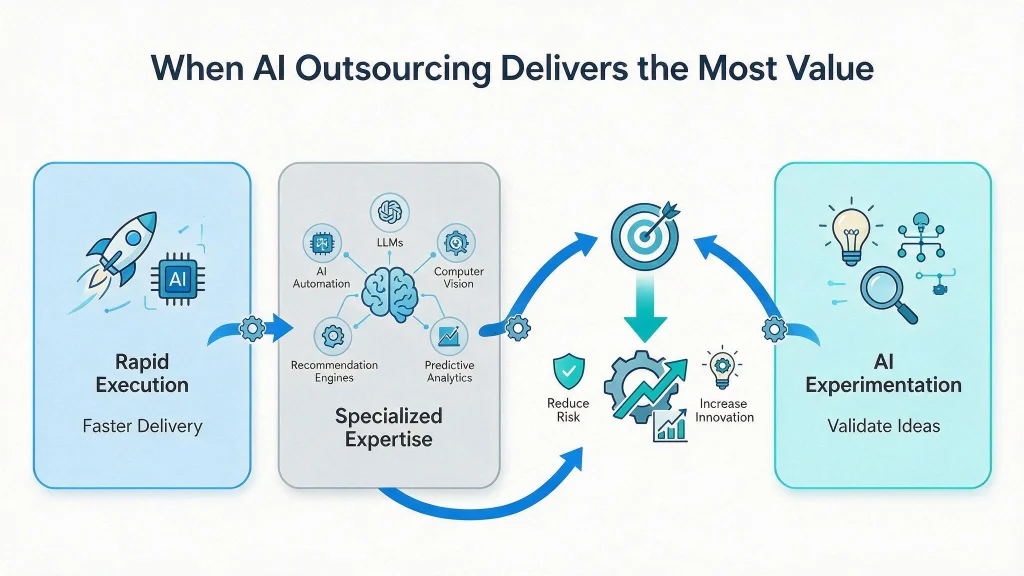
Not every organization requires the same AI operating model.
However, there are several scenarios where outsourcing often generates exceptional value.
The first is when organizations need rapid execution. If the objective is deploying AI within months rather than years, external expertise can significantly accelerate delivery.
The second involves specialized use cases.
Many enterprises need expertise in areas such as large language models, computer vision, predictive analytics, recommendation engines, or AI-driven automation. Hiring specialists for each capability internally can become impractical.
The third scenario involves experimentation.
Organizations exploring AI opportunities may not yet know which use cases will generate meaningful returns. AI outsourcing services allow them to validate ideas before committing to large internal investments.
This flexibility reduces risk while supporting innovation.
Enterprise Risks of an Outsourcing-Only Strategy
Despite its benefits, outsourcing is not a universal solution.
Organizations that rely entirely on external providers may encounter challenges related to knowledge retention, long-term governance, and organizational adoption.
AI initiatives often influence business processes, compliance requirements, and strategic decisions. Internal stakeholders must remain engaged throughout implementation.
The most successful enterprises avoid treating outsourcing providers as isolated vendors.
Instead, they establish collaborative operating models where external specialists work alongside internal teams.
This approach combines internal business knowledge with external technical expertise.
The Rise of the Hybrid AI Operating Model
Increasingly, enterprises are choosing a hybrid approach.
Rather than viewing internal teams and outsourcing providers as competing options, they combine the strengths of both models.
Internal teams focus on governance, business alignment, strategic priorities, and stakeholder management.
External partners contribute specialized expertise, scalable delivery capacity, and implementation acceleration.
This model offers several advantages.
Organizations gain faster access to AI capabilities while simultaneously building internal knowledge over time. They avoid lengthy hiring cycles without sacrificing strategic control.
For many enterprises, this balanced approach represents the most sustainable path to AI maturity.
How Executives Should Evaluate an AI Outsourcing Partner
Choosing the right partner is one of the most important decisions in any AI initiative.
The best providers of AI outsourcing services do far more than build models.
They help organizations identify high-value use cases, establish governance frameworks, address compliance concerns, and align AI investments with business objectives.
Executives evaluating potential partners should look beyond technical expertise alone.
The most valuable providers demonstrate:
- Deep AI and machine learning experience
- Strong cloud and data engineering capabilities
- Proven AI governance practices
- Security and compliance expertise
- Experience across multiple industries
- Scalable delivery models
- Clear communication and stakeholder alignment
Most importantly, they understand how AI creates business value rather than simply delivering technology.
Building AI Without Expanding Internal Teams
One of the most appealing aspects of outsourcing is its ability to support innovation without increasing organizational complexity.
Many enterprises already face pressure to control headcount while continuing to pursue transformation initiatives.
Hiring large AI teams may not always align with financial or operational objectives.
AI outsourcing services allow organizations to access the capabilities they need when they need them.
Resources can scale according to project requirements rather than becoming permanent fixed costs.
This flexibility enables enterprises to pursue ambitious AI programs while maintaining operational efficiency.
For business leaders balancing growth, productivity, and cost management, this advantage can be particularly compelling.
The Future of AI Adoption Will Be Built on Ecosystems
Looking ahead, successful AI strategies are unlikely to depend entirely on internal teams or external providers.
Instead, enterprises will increasingly operate within AI ecosystems.
Internal stakeholders will focus on business outcomes, governance, and strategic direction. External partners will contribute specialized capabilities, emerging technology expertise, and execution capacity.
This collaborative model reflects a broader shift occurring across digital transformation initiatives.
Organizations are no longer asking, “Can we build this ourselves?”
They are asking, “What operating model creates the fastest and most sustainable business value?”
That question often leads to a combination of internal leadership and external expertise.
AI Success Depends on Execution, Not Headcount
The decision between building internal AI teams and leveraging AI outsourcing services is not fundamentally a technology choice.
It is a business decision.
While internal teams provide organizational knowledge and long-term ownership, they often require significant time and investment to establish. AI outsourcing offers faster access to expertise, accelerated execution, and greater flexibility.
For many enterprises, the most effective strategy combines both approaches.
The organizations succeeding with AI today are those that focus less on where expertise resides and more on how quickly they can translate AI opportunities into measurable business outcomes.
At our company, we help enterprises accelerate AI adoption through scalable AI outsourcing services that combine technical excellence with strategic business alignment. Whether you’re exploring your first AI use case or expanding an enterprise-wide AI program, the right partnership can help transform AI ambition into real business value faster.
Relipa
Relipa is a Vietnam-based software development company established in April 2016. After two years of growth, our Japanese branch – Relipa Japan – was officially founded in July 2018.
We provide services in MVP development, web and mobile application development, and blockchain solutions. With a team of over 100 professional IT engineers and experienced project managers, Relipa has become a reliable partner for many enterprises and has successfully delivered more than 500 projects for startups and businesses worldwide.
