
In today’s digital economy, software has become a primary driver of competitive advantage.
Whether an organization aims to improve operational efficiency, enhance customer experiences, launch new digital products, or enable data-driven decision-making, success increasingly depends on having the right technology capabilities in place.
However, when enterprises identify a business need, a critical question quickly follows:
Should we build software internally, buy an existing solution, or outsource development to a specialized technology partner?
For CEOs, COOs, and CTOs, this decision extends far beyond technology considerations. It directly influences cost structures, speed-to-market, innovation potential, talent strategy, operational risk, and long-term business agility.
Many organizations approach the decision from the wrong perspective. They focus primarily on implementation costs or technology preferences when they should be evaluating business outcomes.
From our experience supporting enterprise software and application development initiatives across multiple industries, there is no universally correct answer. The most effective option depends on business objectives, competitive requirements, available resources, and growth ambitions.
The key is understanding the trade-offs associated with each approach.
Why the Build vs Buy vs Outsource Decision Matters More Than Ever
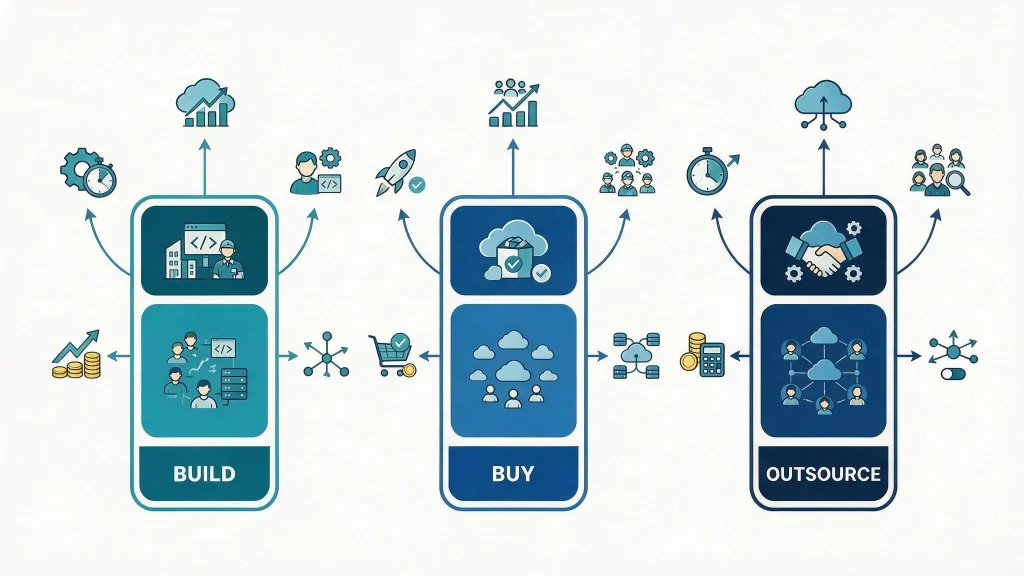
A decade ago, enterprises could often rely on standard software packages to address most operational needs.
Today, business requirements are significantly more complex.
Organizations are increasingly competing through digital experiences, data capabilities, workflow automation, customer personalization, and industry-specific innovation.
As a result, technology is no longer just a support function. It has become a strategic business asset.
The decision surrounding software and application development therefore affects more than IT departments. It impacts revenue growth, operational efficiency, customer satisfaction, and long-term competitiveness.
Choosing the wrong model can introduce unnecessary costs, delay strategic initiatives, and limit future scalability.
Choosing the right model can accelerate innovation and create sustainable business value.
Option 1: Build Software Internally
For many enterprises, building software internally appears to be the most attractive option.
The primary advantage is control.
Organizations maintain full ownership over product strategy, architecture, development processes, security policies, and intellectual property. Internal teams can align closely with business objectives and adapt quickly when priorities change.
This approach is particularly appealing for companies whose technology platforms directly support their market differentiation.
If software is a core competitive advantage, developing in-house capabilities may offer strategic benefits.
However, building internally also presents significant challenges.
Enterprise-grade software and application development requires diverse expertise across architecture, coding, quality assurance, DevOps, cybersecurity, cloud infrastructure, business analysis, and product management.
Finding, hiring, and retaining this talent can be expensive and time-consuming.
Additionally, internal teams must balance development work with ongoing support, maintenance, governance, and organizational demands.
As a result, projects often take longer than expected, especially when organizations underestimate the complexity of software delivery.
The Hidden Costs of Building In-House
Many executives evaluate in-house development solely through salary expenses.
The reality is much more complex.
The true cost of internal development frequently includes:
- Recruitment and onboarding
- Employee benefits and retention programs
- Software licenses and development tools
- Cloud infrastructure
- Security investments
- Training and certifications
- Management overhead
There is also a significant opportunity cost.
While organizations spend months building teams, competitors may already be launching products and capturing market share.
For many enterprises, the challenge is not whether they can build internally.
It is whether they can build quickly enough to support business objectives.
When Internal Development Makes Sense
Building software internally is often the right choice when technology represents a core strategic asset.
Examples include:
- Proprietary platforms that differentiate the business
- Mission-critical intellectual property
- Products requiring deep domain expertise
- Long-term innovation programs with dedicated budgets
In these circumstances, investing in internal capabilities may generate substantial long-term value.
However, enterprises should still evaluate the cost and speed implications carefully.
Complete internal ownership does not always translate into operational efficiency.
Option 2: Buying an Existing Solution
Buying software is often the fastest path to solving a business problem.
Modern software markets offer thousands of SaaS products and enterprise platforms covering functions such as finance, CRM, HR, supply chain management, analytics, and collaboration.
Instead of building from scratch, organizations can deploy proven solutions relatively quickly.
From a business perspective, this approach offers several advantages.
Implementation timelines are generally shorter. Upfront development investment is reduced. Vendors assume responsibility for maintenance, updates, and infrastructure management.
This makes buying particularly attractive for standardized business processes.
Not every capability requires custom development.
In many cases, purchasing a mature platform allows organizations to focus resources on strategic priorities rather than recreating widely available functionality.
The Limitations of Buying Software
Although purchasing software can accelerate deployment, it also introduces trade-offs.
The most significant limitation is flexibility.
Commercial platforms are designed to support broad customer bases. As a result, they may not align perfectly with specific workflows or business requirements.
Organizations often find themselves adapting processes to fit software instead of adapting software to support processes.
Over time, customization requests can increase implementation complexity and cost.
Vendor dependency also becomes a consideration.
Changes in pricing, product direction, licensing models, or support quality may impact long-term business operations.
For enterprises pursuing unique digital strategies, these limitations can become significant obstacles.
This is often where discussions around custom software and application development begin.
When Buying Is the Right Choice
Buying software is generally most effective when:
- Business requirements are common across industries
- Speed is more important than differentiation
- Budget constraints limit custom development
- Internal resources are unavailable
- The process being supported is not a competitive differentiator
Examples include payroll systems, collaboration platforms, customer support tools, and standard ERP modules.
In these cases, purchasing proven solutions often delivers faster ROI than building custom applications.
Option 3: Outsourcing Software Development
The third option increasingly adopted by enterprises is outsourcing.
Rather than building everything internally or relying entirely on commercial software, organizations collaborate with external development partners to design and build custom solutions.
This model combines many of the advantages of internal development with greater speed and flexibility.
Leading providers of software and application development services offer access to specialized talent, mature delivery processes, and scalable development teams without requiring enterprises to build those capabilities themselves.
For organizations under pressure to accelerate digital initiatives, outsourcing can significantly reduce time-to-market.
From Cost-Saving Strategy to Business Growth Enabler
Enterprise attitudes toward outsourcing have evolved significantly over the past decade.
Historically, outsourcing was often viewed primarily as a way to reduce development costs. Today, organizations are taking a much more strategic approach. Executives increasingly recognize that outsourcing can help accelerate innovation, fill critical skills gaps, and improve the speed of software delivery.
This shift is largely driven by the growing complexity of modern technology ecosystems. Developing enterprise applications now requires expertise across multiple disciplines, including cloud architecture, cybersecurity, DevOps, user experience design, data engineering, and quality assurance. Building and maintaining all these capabilities internally can be costly and time-consuming.
As a result, many organizations view outsourcing as a way to gain immediate access to proven expertise while allowing internal teams to focus on strategic priorities. Instead of expanding headcount for every new initiative, businesses can leverage external development partners to extend their capabilities and accelerate execution.
In this context, outsourcing becomes more than a delivery model. It becomes a strategic tool for supporting growth, improving agility, and bringing digital initiatives to market faster.
Why Enterprises Are Increasingly Choosing to Outsource
The global talent shortage has fundamentally changed how enterprises approach software delivery.
Recruiting experienced engineers, architects, cloud specialists, and security experts has become increasingly challenging.
Outsourcing allows organizations to access these capabilities immediately.
Rather than spending months recruiting, enterprises can begin execution using established teams with proven expertise.
This creates multiple business advantages:
- Faster project initiation
- Reduced hiring risk
- Access to broader technical expertise
- Greater scalability
- Enhanced delivery flexibility
From our experience, many executives choose outsourcing not because they lack internal capabilities, but because they need to accelerate outcomes.
Cost Comparison: Build vs Buy vs Outsource
One of the most common executive questions involves cost.
While cost matters, it should never be evaluated in isolation.
Building internally often requires the highest initial investment due to hiring and infrastructure requirements.
Buying software typically provides the lowest entry cost but may introduce recurring licensing expenses and customization limitations.
Outsourcing often occupies the middle ground.
Organizations gain access to dedicated expertise without assuming the full cost of building and maintaining internal teams.
More importantly, outsourcing frequently reduces opportunity costs by accelerating delivery.
For many enterprises, the financial advantage comes not from lower development costs alone, but from reaching business outcomes faster.
Understanding Scalability and Long-Term Growth
Technology decisions should not be based solely on immediate requirements.
Executives must also consider future growth.
A solution that supports today’s needs may become a bottleneck tomorrow.
Purchased software may struggle to accommodate unique business models.
Internal teams may encounter capacity constraints.
Outsourced development partners, particularly those using dedicated-team models, often provide greater flexibility for growth.
Resources can scale as business needs evolve.
New capabilities can be added without lengthy recruitment cycles.
This adaptability makes outsourcing particularly attractive for enterprises undergoing rapid transformation.
How Enterprise Leaders Should Evaluate Their Options
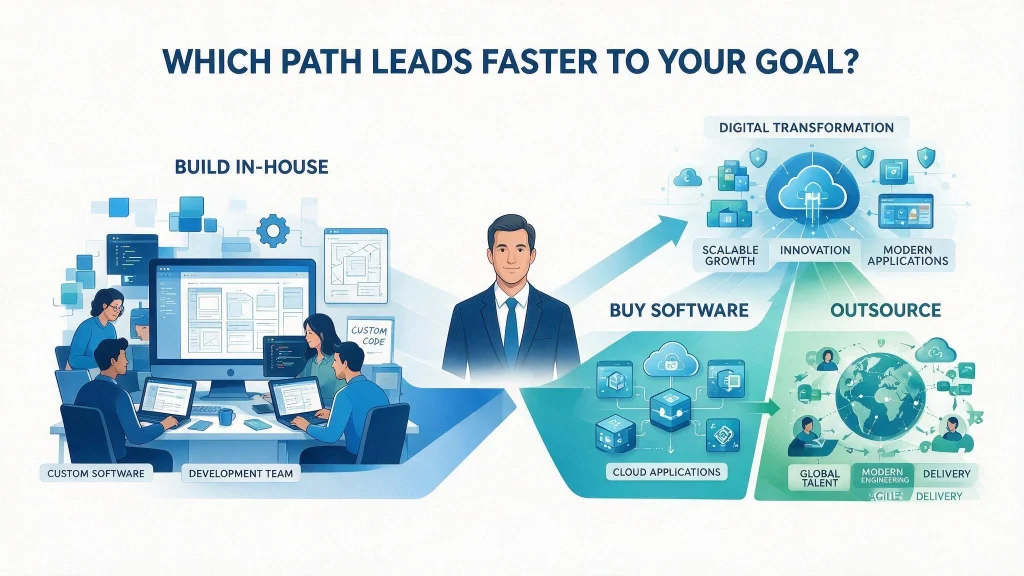
The most successful technology decisions begin with business objectives rather than technical preferences.
Before choosing a model, leadership teams should ask several strategic questions:
- Is this capability a competitive differentiator?
- How quickly must the solution be delivered?
- What internal expertise exists today?
- What level of customization is required?
- How important is long-term scalability?
- What operational risks must be managed?
The answers often reveal which approach is most appropriate.
In practice, many organizations adopt a combination of models rather than relying exclusively on one.
The Emerging Hybrid Strategy
Increasingly, enterprises are blending build, buy, and outsource approaches.
Standardized capabilities may be purchased through SaaS platforms.
Strategic applications may be developed through outsourcing partnerships.
Proprietary innovation initiatives may remain under internal ownership.
This hybrid strategy allows organizations to optimize investment while maintaining flexibility.
Rather than viewing build, buy, and outsource as competing options, leading enterprises view them as complementary tools within a broader technology strategy.
The goal is not choosing a single model.
The goal is selecting the right model for each business challenge.
Why Outsourcing Frequently Delivers the Best Balance
For many enterprise initiatives, outsourcing offers the most balanced combination of speed, customization, expertise, and scalability.
Unlike buying software, outsourcing allows organizations to create solutions tailored to their specific business needs.
Unlike building entirely in-house, outsourcing provides immediate access to specialized talent and proven delivery frameworks.
Most importantly, outsourcing enables leadership teams to focus on strategic objectives while leveraging experienced development partners for execution.
In today’s fast-changing business environment, this balance can be a significant competitive advantage.
Choose the Model That Maximizes Business Value
The debate surrounding build, buy, or outsource is not fundamentally about technology.
It is about business outcomes.
Building internally provides control but requires significant investment.
Buying software accelerates deployment but may limit flexibility.
Outsourcing delivers access to expertise, customization, and scalability without requiring large internal teams.
For enterprise leaders evaluating software and application development strategies, the best decision is the one that aligns technology investments with growth objectives, operational requirements, and long-term competitiveness.
Increasingly, organizations are discovering that outsourcing is not simply a delivery model. It is a strategic enabler that allows them to innovate faster, execute more efficiently, and adapt more effectively to changing market demands.
As digital transformation continues to reshape industries, the question is no longer whether to build, buy, or outsource.
The question is which approach will create the greatest business value for your organization.
Relipa
Relipa is a Vietnam-based software development company established in April 2016. After two years of growth, our Japanese branch – Relipa Japan – was officially founded in July 2018.
We provide services in MVP development, web and mobile application development, and blockchain solutions. With a team of over 100 professional IT engineers and experienced project managers, Relipa has become a reliable partner for many enterprises and has successfully delivered more than 500 projects for startups and businesses worldwide.
