
When executives discuss digital transformation, the spotlight usually lands on customer-facing technologies.
The conversation revolves around mobile apps, digital experiences, AI initiatives, and new products. These investments are important, but they are rarely where the biggest operational constraints exist.
More often than not, the real barriers to agility sit deep inside the organization.
A finance team relies on an ERP platform that requires manual reporting. Sales teams struggle with fragmented customer data spread across multiple systems. Employees navigate outdated internal portals that were designed for how the business operated years ago rather than how it operates today.
The result is a familiar scenario.
The company wants to move faster, but its systems move slowly.
The organization wants better visibility, but information remains fragmented.
Leaders want innovation, but internal processes consume too much time and effort.
This is why application modernization has become a boardroom topic rather than an IT initiative.
The purpose of modernization is not to replace technology for the sake of replacing technology. The purpose is to ensure that critical business systems support growth, adaptability, and operational efficiency rather than limiting them.
Increasingly, enterprises are also using AI-powered legacy application modernization to better understand application portfolios, reduce modernization risks, and accelerate decision-making throughout the transformation journey.
The first challenge, however, is determining where modernization will create the greatest business value.
Most Legacy Systems Don’t Become a Problem Overnight
One reason modernization is frequently postponed is that most legacy applications continue to function.
Invoices are still processed.
Customers are still managed.
Employees still complete their daily tasks.
From a purely operational perspective, nothing appears broken.
The issue is that business requirements evolve much faster than enterprise systems.
What began as a practical solution ten years ago may now require dozens of workarounds, manual interventions, and custom processes just to keep pace with business demands.
Many organizations don’t immediately recognize the impact.
Employees create spreadsheets to fill gaps.
Departments build their own unofficial processes.
Managers spend more time reconciling information than analyzing it.
Over time, these inefficiencies become so familiar that they are accepted as part of normal operations.
The hidden cost is significant.
Business agility declines. Decision-making slows. Innovation becomes harder. New initiatives take longer to launch because existing systems were never designed to support them.
At this stage, modernization is no longer a technical improvement project.
It becomes a business performance initiative.
Stop Looking at Software Age. Start Looking at Business Impact
One of the most common mistakes organizations make is treating modernization as a technology lifecycle exercise.
Applications are labeled “old,” and therefore considered modernization candidates.
The reality is much more complex.
Some legacy applications continue delivering substantial business value despite their age. Others may be relatively modern but create major operational bottlenecks.
The more useful question is not: “Which systems are the oldest?”
It is: “Which systems are limiting the business?”
In our experience, the highest-value modernization projects usually involve applications that directly influence decision-making, customer interactions, operational efficiency, or organizational growth.
These systems may include ERP platforms, CRM environments, employee portals, workflow applications, or industry-specific operational systems.
When leaders focus on business impact rather than technical age, modernization priorities become much clearer.
Why ERP Systems Often Become the First Modernization Priority

Few applications influence an enterprise more than its ERP environment.
ERP platforms sit at the center of operations. They support procurement, inventory management, finance, supply chain activities, production planning, and a wide range of business processes.
Because ERP systems are so deeply integrated into operations, organizations are often reluctant to change them.
This hesitation is understandable.
Modernizing an ERP system can affect multiple departments simultaneously.
However, delaying modernization carries its own risks.
As businesses become more data-driven and responsive, legacy ERP environments can create challenges that extend far beyond technology.
Reporting becomes slower.
Integrations become more difficult.
Business processes require additional manual work.
Launching new initiatives often depends on custom modifications or workarounds.
The issue is rarely that the ERP system has stopped functioning.
The issue is that it no longer helps the organization operate with the speed and flexibility required in today’s environment.
Modernization gives enterprises an opportunity to simplify operations, improve visibility, and create a stronger foundation for future growth.
CRM Modernization Is Really About Customer Visibility
Customer expectations have changed dramatically.
Businesses today are expected to understand customer behavior, personalize interactions, and deliver consistent experiences across every channel.
Many legacy CRM environments struggle to support those expectations.
Customer information frequently exists across multiple applications and departments.
Sales teams see one version of the customer.
Marketing sees another.
Customer service often works with incomplete information.
This fragmentation affects far more than reporting.
It influences the quality of customer interactions, forecasting accuracy, sales productivity, and strategic planning.
Modernizing CRM systems is ultimately about creating a complete view of the customer.
When organizations can access reliable, connected information, they make better decisions and respond more effectively to changing customer needs.
This is why CRM modernization is increasingly viewed as a growth initiative rather than a technology project.
Internal Portals May Be the Most Overlooked Opportunity
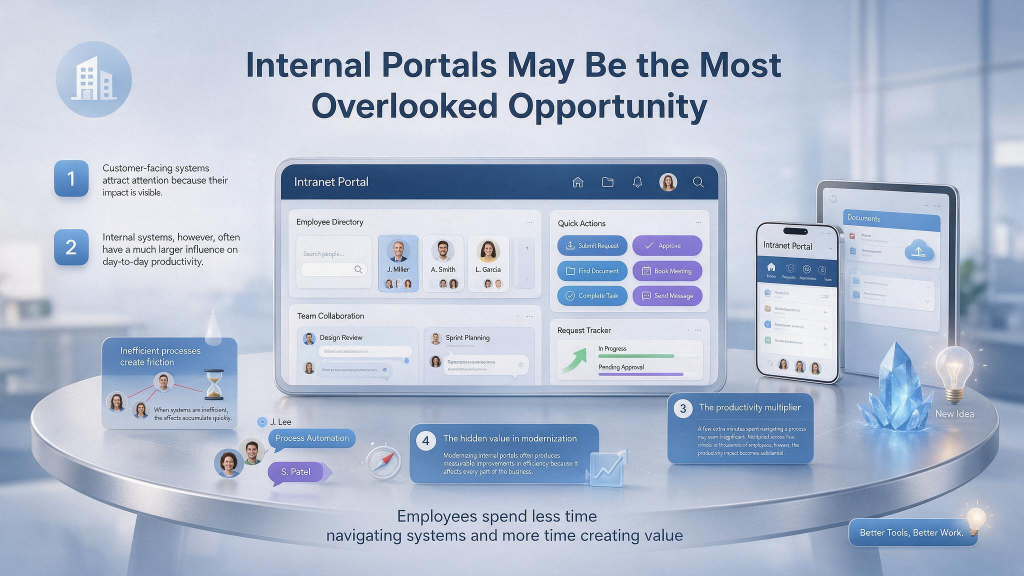
Customer-facing systems attract attention because their impact is visible.
Internal systems, however, often have a much larger influence on day-to-day productivity.
Employee portals support countless interactions across an enterprise.
Employees use them to access information, submit requests, complete approvals, manage documents, and collaborate with colleagues.
When these systems are inefficient, the effects accumulate quickly.
A few extra minutes spent navigating a process may seem insignificant. Multiplied across hundreds or thousands of employees, however, the productivity impact becomes substantial.
We frequently see organizations investing heavily in customer experience while employees continue working through outdated internal systems that create unnecessary friction.
Modernizing internal portals often produces measurable improvements in efficiency because it affects every part of the business.
Employees spend less time navigating systems and more time creating value.
Workflow Systems Usually Reveal Where Work Actually Gets Stuck
If there is one type of application that consistently exposes operational inefficiencies, it is workflow platforms.
Many enterprises discover that their biggest delays are not caused by technology failures but by how decisions move through the organization.
Purchase requests require multiple approvals.
Contract reviews pass through several departments.
Compliance processes become increasingly complex.
Product changes wait in approval queues.
Employees frequently spend more time tracking progress than performing the work itself.
As organizations grow, these workflows become increasingly difficult to manage.
Applications that were originally designed to support basic approval processes often struggle to provide the visibility and flexibility required by larger enterprises.
Modern workflow platforms address this issue by making work visible.
Leaders can identify bottlenecks quickly. Employees know exactly where requests stand. Approvals move faster without sacrificing governance.
The business becomes more responsive because information and decisions move more efficiently.
Why AI Is Changing How Modernization Happens
Historically, one of the most difficult aspects of modernization was understanding existing systems.
Many organizations rely on applications that have evolved over many years. Documentation may be incomplete. Integrations have accumulated over time. Valuable technical knowledge often resides with only a small number of employees.
This uncertainty increases modernization risk.
Before making changes, organizations need to understand dependencies, workflows, integrations, and potential impacts.
This is where AI-powered legacy application modernization is creating new opportunities.
Rather than relying entirely on manual analysis, organizations can use AI-assisted tools to examine application structures, identify dependencies, generate documentation, and evaluate modernization options more efficiently.
The value extends beyond speed.
Organizations gain better visibility into complex environments before major investments are made.
This allows leadership teams to make more informed modernization decisions while reducing uncertainty.
Modernization Should Ultimately Be Measured in Agility
Many modernization programs focus heavily on technical deliverables.
Systems migrated.
Applications upgraded.
Integrations completed.
While these milestones matter, they are not the outcomes executives care about most.
Business leaders invest in modernization because they want greater agility.
They want the ability to launch products faster.
Enter new markets more easily.
Integrate acquisitions more effectively.
Support growth without increasing complexity.
Improve customer experiences.
Scale operations confidently.
The most successful modernization initiatives are measured against those objectives rather than technical outputs alone.
Technology is not the destination.
Business agility is.
Why Enterprises Often Partner With Modernization Specialists
Application modernization rarely involves a single system.
It typically affects architecture, integrations, security, governance, data management, business processes, and user adoption.
For many organizations, balancing these activities alongside day-to-day operations is difficult.
Internal teams already support critical business systems and ongoing initiatives.
Asking them to simultaneously execute large-scale modernization programs can introduce additional risks.
This is why many enterprises partner with providers experienced in AI-powered legacy application modernization.
The right partner contributes technical expertise, modernization experience, governance frameworks, and dedicated resources.
More importantly, they help keep modernization aligned with business objectives rather than turning it into a purely technical exercise.
Modernize the Systems That Matter Most
Not every application deserves the same level of attention.
Some systems continue delivering value despite their age. Others quietly create obstacles that affect growth, efficiency, customer experience, and decision-making.
The organizations that achieve the strongest modernization outcomes are not necessarily those modernizing the most applications.
They are the ones modernizing the right applications.
ERP systems that slow operational visibility.
CRM environments that fragment customer information.
Employee portals that reduce productivity.
Workflow platforms that delay execution.
These are often the systems with the greatest influence on enterprise agility.
As AI-powered legacy application modernization continues to mature, organizations now have more tools than ever to understand complex environments, reduce risk, and accelerate transformation.
The goal is not simply to upgrade technology.
The goal is to create business systems that can evolve as quickly as the organization itself.
That is what turns modernization from an IT project into a competitive advantage.
Relipa
Relipa is a Vietnam-based software development company established in April 2016. After two years of growth, our Japanese branch – Relipa Japan – was officially founded in July 2018.
We provide services in MVP development, web and mobile application development, and blockchain solutions. With a team of over 100 professional IT engineers and experienced project managers, Relipa has become a reliable partner for many enterprises and has successfully delivered more than 500 projects for startups and businesses worldwide.
