
In today’s fast-moving digital landscape, organizations routinely adopt automation to streamline routine tasks. Yet many such efforts remain limited: they automate isolated steps, but do not transform the end-to-end processes where real business value lies. This is particularly true at the enterprise level, where complex workflows span multiple systems, teams, and decision points. AI workflow automation — a key category of enterprise AI solutions — extends beyond simple task automation. It embeds artificial intelligence directly into business processes, enabling systems to understand context, make decisions, and execute multi-step workflows with minimal human intervention. This article explains what AI workflow automation is, how it works, what makes it different from other AI paradigms like AI agents, and how enterprises can evaluate and implement it effectively.
What Is AI Workflow Automation?
At its core, AI workflow automation refers to the automated execution of business processes in which artificial intelligence is responsible for decision-making, task orchestration, and dynamic routing across systems. Instead of using fixed “if-then” rules, AI-enabled workflows adapt based on data, context, and outcomes — making them far more flexible and sophisticated than traditional automation. As part of enterprise AI solutions, AI workflow automation focuses on workflows that would otherwise require human judgment — such as triaging incoming information, escalating exceptions, coordinating across disparate systems, or performing adaptive prioritization in real time. This level of automation unlocks both operational efficiency and strategic agility, transforming work rather than simply speeding it up.
According to Gartner’s research on hyperautomation, organizations are increasingly combining AI, machine learning, and process orchestration technologies to create intelligent enterprise operations capable of adapting continuously to changing business conditions.
Why AI Workflow Automation Matters for Enterprises
Organizations increasingly adopt AI workflow automation because traditional automation is too static for the dynamic nature of enterprise work. Reducing Manual Bottlenecks Many enterprise processes stall because humans must intervene — for example, to review exceptions, route decisions, or reconcile data between systems. AI workflow automation reduces reliance on manual coordination, helping processes flow smoothly even as scale and complexity increase. Enabling Intelligent Decision-Making Legacy rules engines handle deterministic logic well. However, for processes that involve judgment — such as routing customer issues based on sentiment or prioritizing safety alerts based on evolving risk factors — enterprise AI solutions that embed machine intelligence enable more accurate and context-aware outcomes. Bridging Insight and Execution Analytics platforms and business intelligence dashboards generate insights, but insights alone do not create value unless organizations act on them. Intelligent workflows operationalize these insights by automatically generating actions based on analytical signals. Scaling Across the Organization Enterprise environments involve interdependent systems and cross-functional teams. Unlike simple, isolated bots, AI workflows can coordinate across CRM, ERP, ticketing, HR systems, and more, making them central to truly scalable automation.
How AI Workflow Automation Works
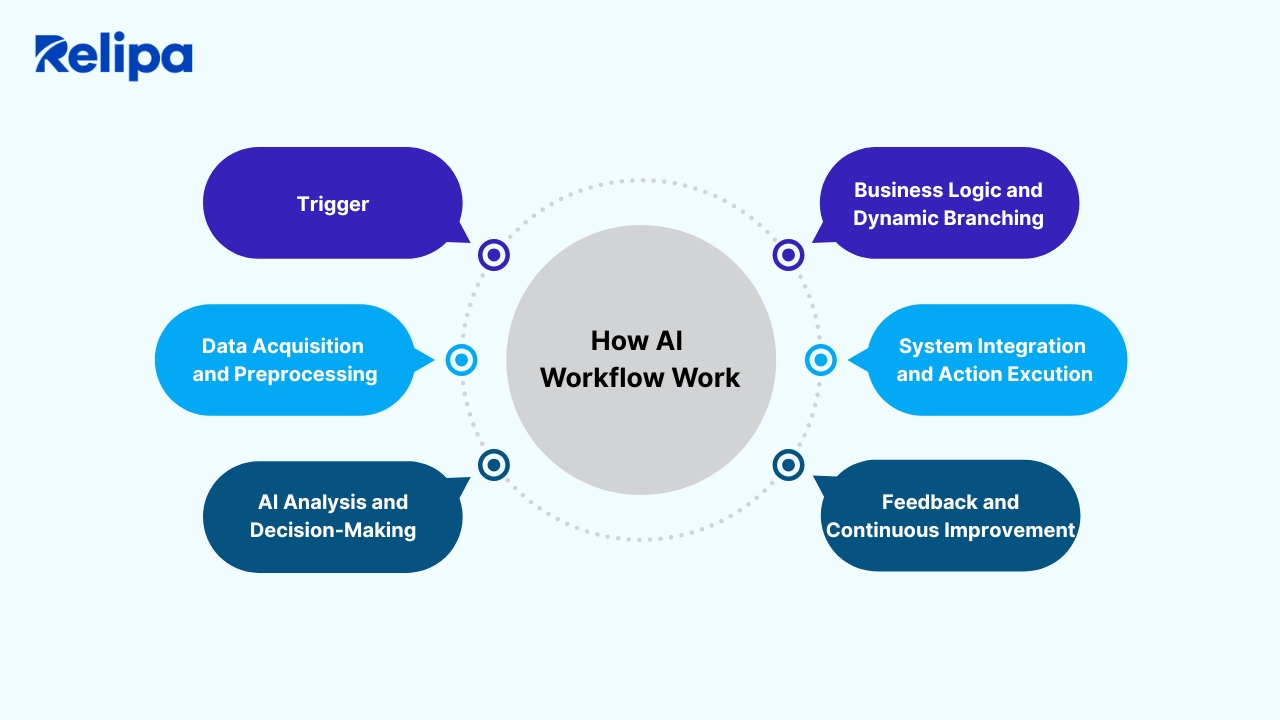
Implementing AI workflow automation involves a series of connected stages that integrate data, intelligence, and action:
- Event Trigger: Every workflow begins with a trigger — an occurrence that initiates processing. This could be a user request, the arrival of new data, a scheduled interval, or an external event. The trigger ensures that workflows respond in real time to business needs.
- Data Acquisition and Preprocessing: Once triggered, the workflow collects relevant data from one or more sources. This may include structured data (e.g., database records) and unstructured content (e.g., text from emails or documents). Preprocessing cleans and normalizes this data so it can be consumed reliably.
- AI-Driven Analysis: Here, enterprise AI models — including natural language processing (NLP), predictive analytics, or classification systems — generate insights relevant to the task. For example, sentiment analysis may classify customer messages, while predictive models estimate risk levels or forecast demand.
- Dynamic Decision Logic: AI outputs are interpreted against business logic to determine the next step in the workflow. This might involve escalating a high-priority issue, routing a task to a specific team, or triggering an approval process based on risk scores.
- System Integration and Execution: The workflow integrates with enterprise systems — such as CRM, ERP, or ticketing platforms — to take action automatically. This eliminates manual handoffs and ensures consistent execution across platforms.
- Feedback and Continuous Improvement: Modern AI workflows incorporate feedback loops that capture performance data and outcomes. This continuous learning mechanism helps refine models and improve accuracy over time, which is a hallmark of mature enterprise AI solutions.
AI Workflow Automation vs AI Agents
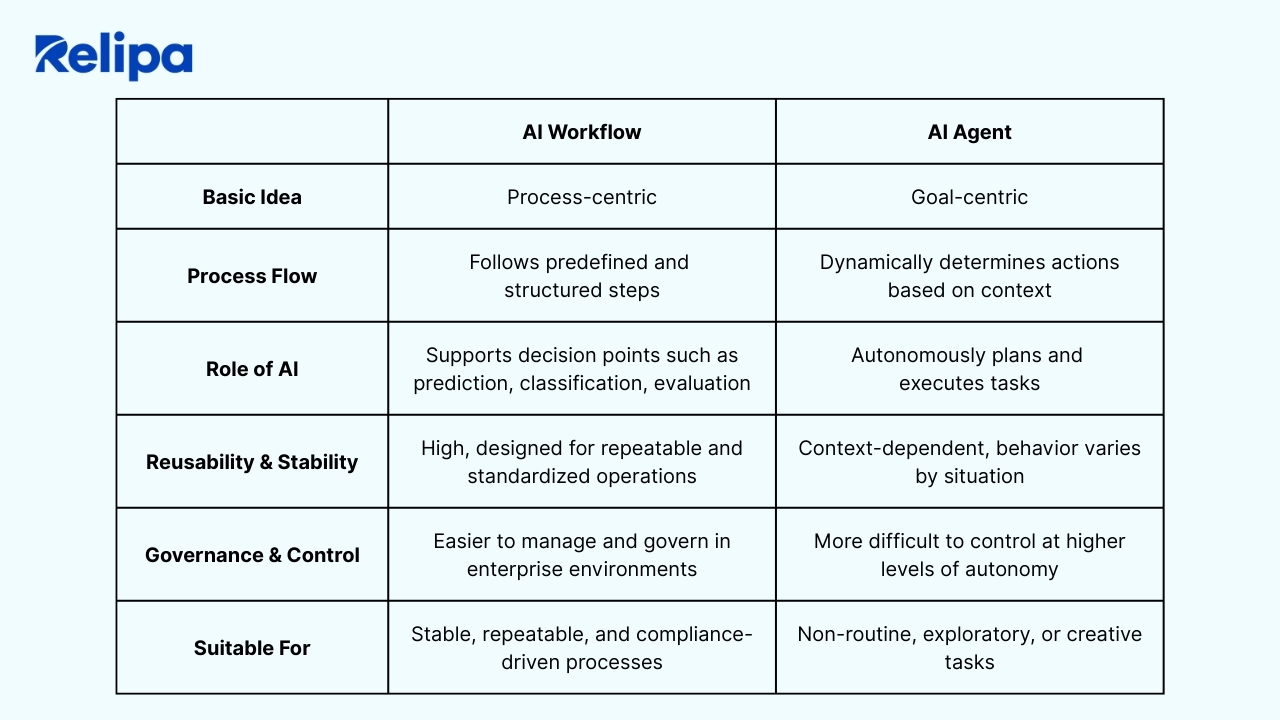
It’s important to distinguish AI workflow automation from AI agents — related concepts that serve different purposes in enterprise AI architectures. AI workflow automation focuses on process orchestration: it ensures that a sequence of tasks runs end to end, integrating business logic and AI models into a structured, governed framework. AI agents, by contrast, are autonomous problem-solvers that reason about goals and take actions to achieve them. While workflow automation executes processes defined by business logic, AI agents may independently determine which processes to invoke based on objectives. In practical enterprise deployments, these two approaches often coexist: agent systems may generate insights or recommendations, while workflow automation ensures that those insights are operationalized consistently within governed processes. Read more: AI Agents Explained: The Complete Guide For Businesses
How to Evaluate AI Workflow Automation for Enterprise Needs
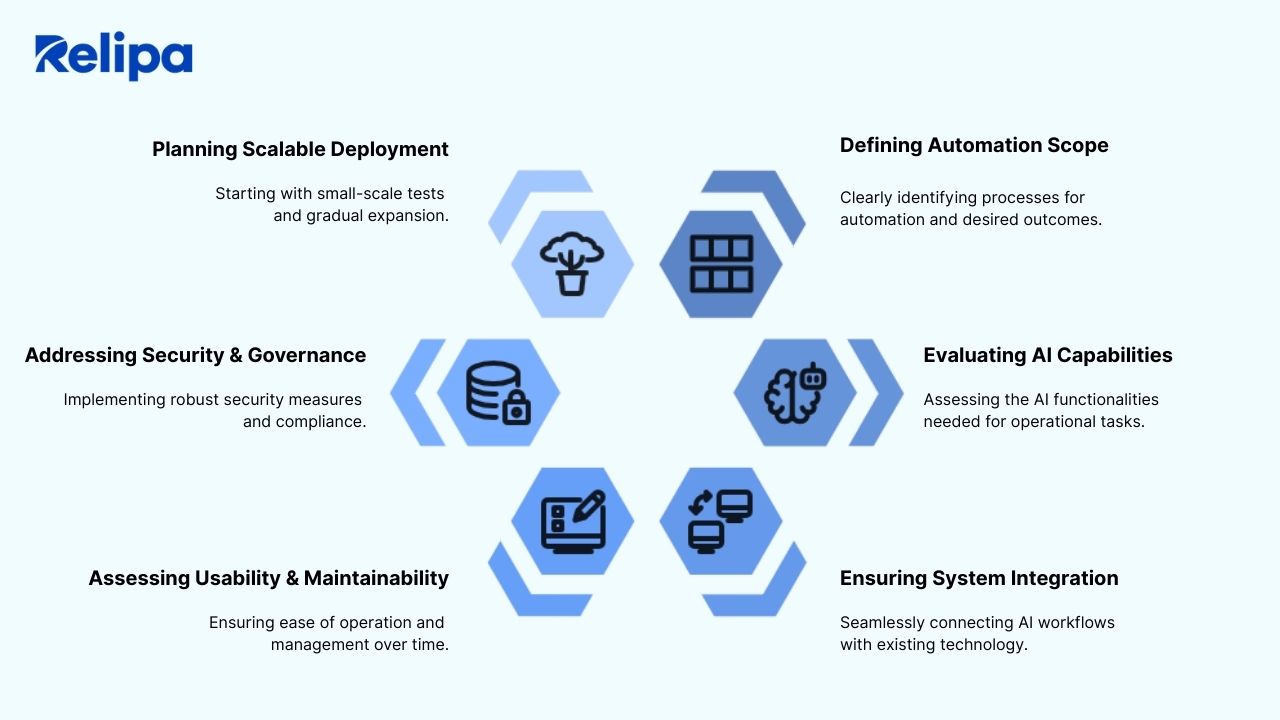
Choosing the right approach to AI workflow automation requires careful alignment with organizational goals, technical constraints, and operational needs. Here are key considerations: Clarify Business Objectives Start by identifying the workflows that are most in need of automation and the outcomes you seek — whether that’s reducing turnaround time, lowering costs, improving accuracy, or enhancing customer satisfaction. Determine Required AI Capabilities Different workflows call for different AI capabilities. Text classification and sentiment analysis may suffice for customer service automation, while predictive analytics might be needed for demand forecasting or risk estimation. Assess Integration Requirements AI workflow automation delivers value only when it connects meaningfully with existing enterprise systems. Evaluate whether your workflow platform or implementation partner supports robust integration via APIs, connectors, and middleware. Plan for Governance and Operational Control Enterprise environments demand observability, audit trails, and control planes. Ensure workflows provide visibility into decision outcomes, exception cases, and performance metrics. Prioritize Security and Compliance Workflows often touch sensitive data. Ensure that your automation architecture includes strong access control, encryption, and compliance alignment with standards like GDPR, HIPAA, or industry-specific regulations. Adopt Incremental Deployment Begin with a prototype or proof of concept to validate assumptions before scaling. Incremental deployment reduces risk, enables faster feedback, and provides early ROI.
Real-World Use Cases of AI Workflow Automation
Across industries, organizations are leveraging AI workflow automation as part of broader enterprise AI solutions to streamline operations and unlock new value. Financial Services Banks and insurers automate customer onboarding by using AI to extract information from documents, validate identities, perform risk scoring, and route exceptions for human review. This reduces processing time and compliance risk simultaneously. Retail and E-Commerce Retailers automate fulfillment operations by using AI to prioritize orders, optimize inventory allocation, and manage customer inquiries in real time. This enables faster delivery and improves customer satisfaction. Healthcare Healthcare providers automate patient intake and clinical documentation workflows, extraction of structured data from unstructured clinical notes, and real-time alerting for critical conditions — improving care quality while reducing administrative burden. Read more: Top AI Trends in Healthcare (2026 Guide) for AI Development ServicesManufacturing and Supply Chain Manufacturers embed predictive models into maintenance workflows. Sensor data triggers predictive alerts, which automatically schedule service tasks and allocate resources — reducing unplanned downtime. Technology and SaaS Technology firms automate incident management by analyzing logs with AI, categorizing issues, and triggering escalation paths based on severity scores without developer intervention. Human Resources Human resources departments use AI workflow automation to screen resumes, schedule interviews, manage onboarding tasks, and synchronize employee data across systems — reducing time-to-hire and boosting HR productivity.
Strategic Benefits of Enterprise AI Solutions
When designed and implemented strategically, AI workflow automation delivers far more than basic productivity improvements. Modern businesses are increasingly adopting intelligent automation to create faster, smarter, and more scalable operations. Combined with advanced enterprise AI solutions, workflow automation becomes a critical driver of digital transformation, operational resilience, and long-term business growth.
- Improve Operational Speed and Precision:
AI-powered workflows reduce manual intervention in repetitive and error-prone tasks, allowing organizations to accelerate operations while improving accuracy. By integrating enterprise AI solutions into daily business processes, companies can automate data processing, customer support, document management, approvals, and decision-making workflows in real time. This enables employees to focus on higher-value strategic initiatives instead of time-consuming administrative tasks. Faster execution and improved precision also lead to better customer experiences and stronger operational consistency across departments. - Enhance Scalability Without Linear Cost Growth:
One of the greatest advantages of AI workflow automation is the ability to scale operations efficiently. Traditional growth models often require additional staffing, infrastructure, and operational overhead. In contrast, enterprise AI solutions enable organizations to manage increasing workloads without proportional increases in cost. Automated systems can handle growing volumes of transactions, customer interactions, and internal processes while maintaining performance and reliability. This scalability is especially valuable for startups, SaaS companies, eCommerce platforms, and global enterprises aiming to expand rapidly in competitive markets. - Align Insights With Action:
Many organizations already collect large amounts of data, but the real value comes from turning insights into immediate action. Enterprise AI solutions connect predictive analytics with operational workflows, enabling businesses to respond automatically to real-time signals. For example, AI can detect anomalies in supply chains, predict customer churn, optimize marketing campaigns, or identify security threats and instantly trigger predefined actions. By embedding AI intelligence directly into workflows, companies create faster response cycles, improve decision-making accuracy, and increase overall business agility. - Break Down System Silos Across the Organization:
Disconnected systems and fragmented data remain major barriers to enterprise efficiency. AI workflow automation helps unify business processes across departments such as sales, marketing, finance, HR, and operations. Modern enterprise AI solutions integrate with multiple platforms, cloud services, CRMs, ERPs, and internal databases to create seamless cross-functional workflows. This connected ecosystem improves collaboration, enhances visibility into business operations, and reduces delays caused by manual coordination between teams. As a result, organizations can achieve more agile and data-driven operations at scale. - Enable Continuous Optimization and Long-Term Value Creation:
Unlike static automation tools, AI-driven workflows continuously learn and improve over time. Built-in feedback loops allow enterprise AI solutions to monitor performance metrics, identify inefficiencies, and optimize processes automatically. Machine learning models can adapt to changing business conditions, customer behaviors, and operational patterns, helping organizations maintain competitive advantages in dynamic markets. Continuous optimization not only improves productivity but also increases ROI from AI investments over the long term. - Strengthen Competitive Advantage Through Intelligent Automation:
Companies that successfully implement enterprise AI solutions gain the ability to innovate faster, reduce operational bottlenecks, and deliver better digital experiences. AI workflow automation empowers organizations to become more responsive, data-driven, and customer-centric while reducing dependency on manual processes. As industries continue evolving toward automation-first operations, businesses that invest in scalable AI infrastructure today will be better positioned for sustainable growth and market leadership in the future.
Conclusion
AI workflow automation represents a transformative category of enterprise AI solutions. By embedding intelligence into end-to-end business processes, organizations shift from task-centric automation to adaptive, intelligent orchestration that scales across systems and teams. Successful implementation requires thoughtful alignment of technical capabilities, process objectives, integration requirements, and governance considerations. For enterprises ready to embark on this journey, the result is a system that not only runs faster but learns, adapts, and delivers sustained value. Whether you are optimizing customer experiences, streamlining operations, or future-proofing your business, understanding how AI workflow automation fits within your broader enterprise AI strategy is key to achieving long-term success.
Relipa Software
Relipa Co., Ltd. is a Vietnam-based software development company established in April 2016. After two years of growth, our Japanese branch – Relipa Japan – was officially founded in July 2018.
We provide services in MVP development, web and mobile application development, and blockchain solutions. With a team of over 100 professional IT engineers and experienced project managers, Relipa has become a reliable partner for many enterprises and has successfully delivered more than 500 projects for startups and businesses worldwide.
