
At the moment, NFTs are redefining the value of digital content, turning everything from artwork and music to videos and tickets into unique, irreplaceable assets. While anyone can list a simple token on a marketplace, transforming digital content into a secure, high-value NFT project requires a structured technical process. To achieve this, understanding the right blockchain development solutions is essential.
In this blog, we will guide you through the exact programming languages and frameworks needed to bring your NFT ideas to life.
About NFT
NFT stands for and has the meaning of “Non-Fungible Token”. Bitcoin, other cryptocurrencies, and even cash do not vary in value no matter how many tokens are exchanged; 100 JPY holds the same value for everyone. This “exchangeable” nature means they are “fungible.”
On the other hand, an NFT is an irreplaceable (non-fungible) token. It utilizes robust blockchain development solutions to prove unique ownership of digital content – similar to physical sculptures or jewels, giving it a one-of-a-kind value in the world. Traditionally, digital content could be duplicated indefinitely across the internet, making it impossible to verify the true owner. NFTs changed the game by leveraging blockchain technology to ensure that ownership records cannot be tampered with or forged.
Therefore, NFTs add undeniable value and original ownership to images, videos, and music. Today, this impact is expanding rapidly into RPGs and trading card games. A prime example is “My Crypto Heroes,” Japan’s first NFT game playable on both PCs and smartphones. Players collect, buy, and sell hero characters and weapon items as NFTs directly in the marketplace.

However, you cannot simply sell characters from a general online or social game in the NFT market. Unless a game is built using smart contract technology on a platform like Ethereum, often requiring the expertise of an experienced blockchain app development agency, it is impossible to secure authentic asset value or trade them in open marketplaces.
Additionally, by utilizing these smart contracts, developers can build a mechanism that automatically rewards the original author with royalties every time the work is resold. Implementing these advanced blockchain development solutions remains one of the most remarkable ways to secure continuous monetization in the world of NFTs.
What is Ethereum?
Ethereum is the second-largest blockchain ecosystem after Bitcoin, officially launched in July 2015. Its native currency, Ether (ETH), generates blocks every 15 seconds—making it significantly faster than Bitcoin’s 10-minute block time and highly capable of handling high-volume transactions. As a decentralized application platform, Ethereum utilizes “smart contracts” to run unique tokens and decentralized applications (DApps), providing the foundational tech stack that allows NFTs to operate.
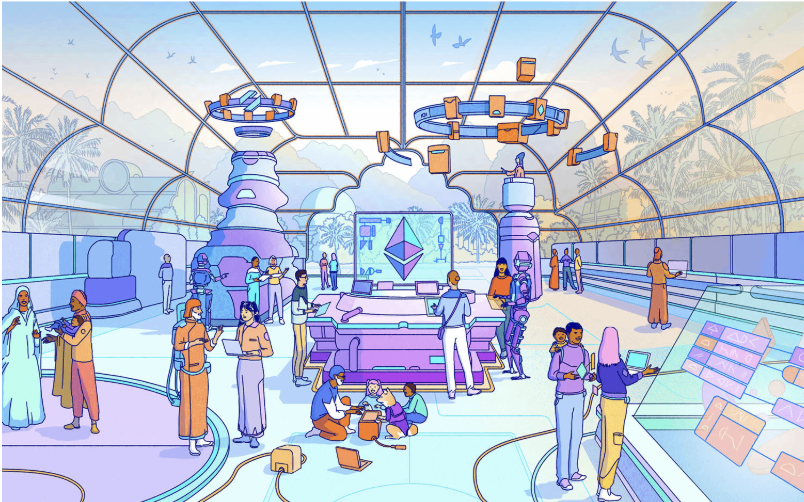
This platform-type architecture offers a high degree of flexibility, making it the go-to blockchain for developers. However, building custom tokens on a blockchain requires compatible crypto wallets. In the early days, if every developer created tokens using their own custom standards, users would have to set up a new wallet for every single token, which was completely impractical.
To solve this friction and drive market adoption, the developer community realized they needed a unified standard to ensure seamless compatibility and centralized wallet management. Today, navigating these standards to build scalable ecosystems is a major reason why businesses collaborate with professional partners providing blockchain development solutions to deploy their Web3 projects safely.
What is The ERC Standard?
With the above circumstances, the common standard for smart contracts (described later) called “ERC” was established with the aim of improving convenience for the entire developer community. It will become a formal standard once it is proposed on GitHub and approved by the developer community. (GitHub is a service provided by a Microsoft-affiliated US company that allows multiple software developers to manage and share source code.)
ERC20 was first born in November 2015, and when it was released, it was used to create various unique tokens. ERC223 was born in March 2017 as the improved version.
Furthermore, “ERC721” was born in September of the same year with the purpose of developing the idea of this common standard in a completely different direction.
Unlike the previous ERCs, this ERC721 has made it possible to create an irreplaceable new type of token called NFT. All NFTs are created according to the rules of this ERC721, and conversely, the app cannot be launched on Ethereum unless it complies with this standard. Of course, Japan’s first NFT game, “My Crypto Heroes”, introduced earlier, was also developed according to the ERC721 standard.
By the way, Canada’s Dapper Labs launched the world’s first NFT game, “CryptoKitties”, just two months after approval (November 2017), after proposing this ERC721. This “CryptoKitties” ignited the NFT game and, at the same time, raised awareness of NFTs worldwide.
Ethereum and Smart Contracts
ERC is a common standard for “smart contracts,” which are indispensable technologies for Ethereum. A smart contract is a program that automatically executes transactions on the blockchain according to pre-defined rules coded in a specific programming language. Once deployed onto the blockchain, the software becomes virtually immutable and tamper-proof, while significantly speeding up transactions and reducing operational intermediaries.
These standards are proposed on GitHub by developers and become official once approved by the community. The number following “ERC” simply represents the sequential order of the proposal; for instance, ERC-20 was the 20th proposal, while ERC-721 was the 721st.
By utilizing the ERC-721 standard, developers can certify unique ownership of digital content and record all transaction histories transparently on the Ethereum blockchain. This ensures absolute traceability, meaning you will never lose track of ownership no matter how many times an asset is traded. Furthermore, configuring complex features, such as embedding automated royalty clauses to guarantee secondary-market payouts for creators, is a primary reason why enterprises seek specialized blockchain development solutions before launching their smart contracts.
“Solidity” Language For Creating Smart Contracts
To develop an NFT according to the ERC-721 standard, developers primarily use a programming language called Solidity. Solidity is a high-level, object-oriented language designed specifically for writing smart contracts on Ethereum and other EVM-compatible (Ethereum Virtual Machine) networks. Because it is a high-level language, it requires compilation—similar to C++ or Java. Its syntax heavily borrows from C++, Python, and JavaScript; web developers with JavaScript experience will find its learning curve remarkably smooth. Furthermore, as Solidity undergoes continuous updates, its security features and gas optimization capabilities improve over time.
While high-level code is easy for humans to read, computers require low-level instructions. Therefore, Solidity code must be compiled into bytecode so the EVM can execute it on the network. While alternative languages like Vyper (a Python-like alternative) exist, they still lack the mature ecosystem, tooling, and widespread adoption that Solidity enjoys. Consequently, integrating Solidity into your blockchain development solutions remains the safest and most efficient choice for long-term NFT project success.
Modern Frameworks for Smart Contract Development
Frameworks play a crucial role in streamlining the development workflow by automating the compilation, testing, and deployment of smart contracts. For years, Truffle was considered the de facto standard for Solidity developers, providing structured application templates and local node testing environments. However, the Web3 ecosystem evolves rapidly, and older tools are continuously replaced by more advanced, efficient alternatives.
Today, modern development teams have shifted to next-generation frameworks like Hardhat and Foundry, which offer superior debugging tools, faster compilation speeds, and better network integration. Staying updated with these cutting-edge frameworks and incorporating them into your blockchain development solutions is non-negotiable. Utilizing the right development environment not only saves significant time but also ensures that your smart contracts are thoroughly tested, secure, and ready for seamless mainnet deployment.
Summary
NFTs are transforming the way we view digital ownership, but capturing their full value requires much more than just a simple marketplace upload. Building a secure, scalable, and tamper-proof ecosystem demands a deep understanding of core languages like Solidity and modern testing frameworks. As the Web3 landscape continues to evolve, adapting your project to these cutting-edge blockchain development solutions is essential for long-term market success.
Are you a startup or a developer ready to enter the NFT space with confidence? Relipa’s team of specialized engineers is here to help you navigate every technical layer. Contact Relipa today to transform your digital assets into high-performance NFT realities.
Relipa Software
Relipa Co., Ltd. is a Vietnam-based software development company established in April 2016. After two years of growth, our Japanese branch – Relipa Japan – was officially founded in July 2018.
We provide services in MVP development, web and mobile application development, and blockchain solutions. With a team of over 100 professional IT engineers and experienced project managers, Relipa has become a reliable partner for many enterprises and has successfully delivered more than 500 projects for startups and businesses worldwide.
