

Most companies don’t start by building their own digital platforms.
In the early stages of growth, buying software is usually the smartest decision. SaaS platforms enable organizations to move quickly, reduce upfront investment, and avoid the complexity of building and maintaining custom systems.
CRM platforms help manage customers. ERP systems support operations. Marketing automation tools streamline campaigns. Collaboration platforms improve productivity.
For years, these solutions may serve the business perfectly well.
The challenge emerges when the business itself begins to evolve faster than the software supporting it.
What once accelerated growth gradually becomes a constraint.
Processes become more specialized. Customer expectations become more demanding. Teams require workflows that standard platforms were never designed to support.
At that point, organizations face an important strategic decision:
Should we continue adapting our business to fit third-party software, or should we invest in proprietary digital products built around how we create value?
This is the question many enterprise leaders eventually encounter.
It’s also where an experienced custom web app development firm can become a strategic partner rather than simply a software vendor.
Why Third-Party Platforms Work So Well Initially
There is a reason SaaS has transformed enterprise technology.
Buying software is often faster, simpler, and less risky than building it.
Organizations gain access to mature capabilities without investing heavily in product development, infrastructure, security management, or ongoing maintenance.
For many business functions, this remains the right approach.
Very few companies gain competitive advantage from building their own accounting software, email platform, or project management tool.
Standardized functions are usually best served by standardized solutions.
Problems arise when software begins supporting activities that directly influence competitive differentiation.
That is where the economics of technology decisions begin to change.
The Moment Software Stops Supporting Growth
One of the clearest signals that a company is outgrowing third-party software is the appearance of operational workarounds.
The symptoms rarely appear all at once.
Employees start exporting data into spreadsheets because reports don’t answer important business questions.
Departments purchase additional tools to compensate for missing functionality.
Teams manually move information between systems.
Managers rely on email chains because workflows cannot be customized.
Individually, these activities seem manageable.
Collectively, they create friction throughout the organization.
Over time, the business becomes increasingly dependent on software that doesn’t fully align with how it operates.
Ironically, the systems that once accelerated growth begin slowing it down.
This is often the stage where leadership teams start evaluating whether a custom platform could create greater long-term value.
Competitive Advantage Usually Comes From Unique Processes

Businesses rarely become market leaders by doing exactly what everyone else does.
Competitive advantage typically comes from unique products, differentiated customer experiences, specialized workflows, proprietary data, or distinctive service models.
Yet most third-party software is designed around common business needs.
By definition, it serves the average customer.
That creates a potential conflict.
The more unique your business becomes, the more difficult it may be to find software that aligns perfectly with your requirements.
We’ve seen organizations invest heavily in customization projects only to discover they were still constrained by the underlying architecture of the platform.
At some point, adding more customization to a standard product becomes less effective than building a solution designed specifically for the business.
This is one of the most common reasons enterprises engage a custom web app development firm.
The goal is not customization for its own sake.
The goal is creating technology that supports how the organization creates value.
When Customer Experience Becomes a Strategic Asset
Customer expectations have increased dramatically over the past decade.
Today, customers expect seamless digital experiences, personalized interactions, and immediate access to information.
Standard platforms can support many of these requirements. However, they often limit a company’s ability to differentiate itself.
If every competitor uses the same tools, customer experiences tend to become increasingly similar.
This is particularly important for organizations competing through service quality, user experience, or digital innovation.
A proprietary customer portal, self-service platform, partner ecosystem, or industry-specific application can become a meaningful source of competitive advantage.
In these situations, the question is no longer about software functionality.
It becomes a strategic question about market positioning.
Custom digital platforms allow organizations to design experiences around customer needs rather than platform limitations.
Data Is Often the Tipping Point
Many companies underestimate the strategic value of their data until growth reaches a certain scale.
Data often lives across CRM systems, ERP platforms, customer support applications, marketing tools, and operational systems.
Third-party platforms generally manage this information effectively within their own environments.
The challenge emerges when organizations need a unified view of the business.
Leadership teams may want answers to questions such as:
- Which customers are most profitable?
- What drives retention?
- Where do operational delays occur?
- Which services create the highest margins?
The information exists.
It simply isn’t connected.
This is where proprietary platforms can create significant value.
Rather than adapting business reporting to fit multiple software products, organizations can build applications that integrate information around their specific decision-making requirements.
The result is often better visibility, faster decisions, and stronger business intelligence.
Internal Efficiency Can Become a Competitive Advantage
Customer-facing innovation receives considerable attention, but internal efficiency often creates just as much strategic value.
Consider a business that processes thousands of transactions, requests, approvals, or customer interactions every day.
Even small inefficiencies become expensive when multiplied across large volumes.
Many organizations discover that their biggest productivity barriers are not external.
They exist within internal processes.
Employees navigate multiple applications to complete simple tasks. Information moves slowly between departments. Reporting requires manual effort.
Third-party platforms weren’t necessarily designed to support the organization’s specific operating model.
In these situations, custom applications can eliminate unnecessary complexity by aligning technology with actual workflows.
The outcome is often faster execution, lower operating costs, and greater organizational agility.
Why Digital Platforms Are Different From Software Projects
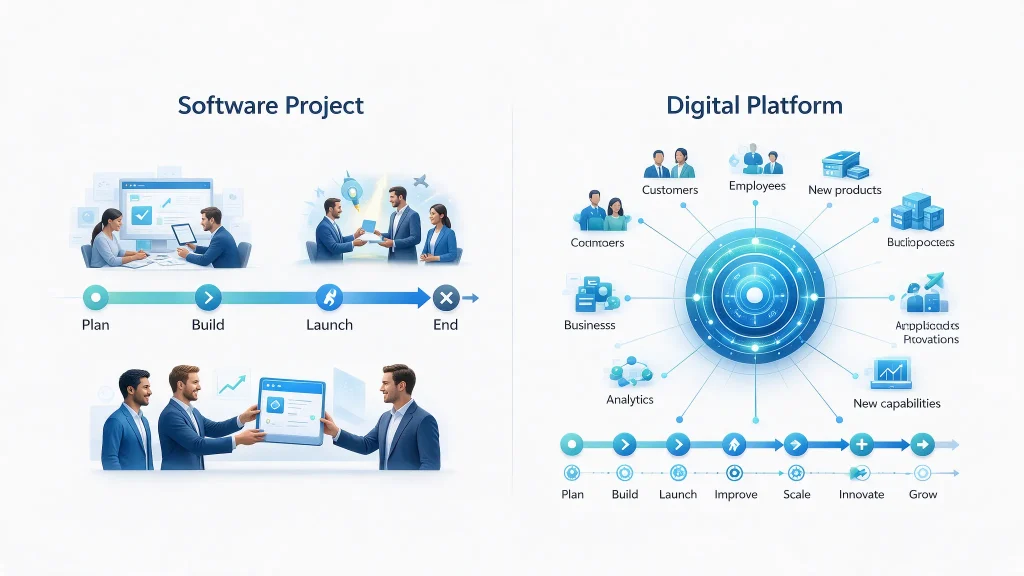
One mistake organizations often make is viewing custom application development as a one-time technology project.
The most successful companies approach it differently.
They view proprietary digital platforms as business assets.
The difference is significant.
A project has an end date.
A platform evolves continually.
As markets change, customer expectations increase, and business priorities shift, the platform develops alongside the organization.
This perspective influences how investments are evaluated.
The discussion moves beyond development cost and focuses on long-term value creation.
A strong platform can support innovation, scalability, operational efficiency, and competitive differentiation for years.
That is why enterprises increasingly treat digital products as strategic investments rather than technical expenditures.
Signs Your Business May Be Ready for a Proprietary Platform
Not every company should build custom software.
However, there are several indicators that suggest the timing may be right.
One of the strongest indicators is when software limitations begin affecting business strategy.
For example:
- Growth initiatives require extensive process workarounds.
- Teams rely heavily on spreadsheets and manual operations.
- Customer experience requirements exceed platform capabilities.
- Reporting and analytics remain fragmented.
- Competitive differentiation depends on unique digital experiences.
- Multiple systems need to operate as a unified platform.
When these patterns appear consistently, the underlying challenge is often not technology.
It is alignment between technology and business objectives.
Custom platforms become valuable when they support capabilities that directly influence business performance.
Why Many Enterprises Choose a Custom Web App Development Firm
Building a proprietary digital platform requires much more than software engineering.
Organizations need expertise across architecture, user experience, scalability, security, integrations, cloud infrastructure, governance, and long-term product evolution.
Even large enterprises may struggle to assemble these capabilities internally.
Technology teams are often busy maintaining existing systems while supporting ongoing transformation initiatives.
This is why many organizations work with a custom web app development firm.
The right partner brings not only technical expertise but also product thinking.
Rather than asking what features should be built, they help answer more strategic questions:
- Which capabilities create competitive advantage?
- Which processes deserve investment?
- How should the platform scale over time?
- What business outcomes should be measured?
The focus shifts from development activity to business impact.
Read more: The Power of a Dedicated Software Development Team: Your Guide to Strategic Growth
Measuring Success Beyond Development Costs
One of the most common objections to custom development is cost.
At first glance, buying software almost always appears less expensive.
However, this comparison often ignores long-term value.
The real question is not: “What does it cost to build?”
The better question is: “What value does it create?”
A proprietary digital platform can generate returns through:
- Increased revenue opportunities
- Improved customer retention
- Faster product innovation
- Better operational efficiency
- Reduced dependency on third-party vendors
- Greater scalability
- Stronger market differentiation
Organizations that evaluate custom development through a strategic lens often find that the business impact extends far beyond software itself.
The Future Belongs to Companies That Own Their Digital Advantage
Not every capability should be built internally.
Third-party platforms will continue playing a critical role in enterprise technology ecosystems.
However, the capabilities that differentiate a business deserve special consideration.
The most successful organizations are increasingly identifying where proprietary technology can strengthen customer experiences, improve efficiency, and create sustainable competitive advantages.
In many cases, those opportunities become the foundation of long-term growth.
The goal is not replacing every third-party platform.
The goal is owning the digital capabilities that make the business unique.
Build What Makes You Different
Technology decisions should ultimately support business strategy.
For standardized processes, third-party platforms remain highly effective.
But when software begins influencing competitive differentiation, customer experience, operational efficiency, or innovation, the equation changes.
At that point, relying entirely on third-party tools may limit future growth.
This is when partnering with a custom web app development firm becomes a strategic decision rather than a technical one.
The organizations creating the strongest digital advantages today are not building software simply because they can.
They are building platforms around the capabilities that make them different.
And in increasingly competitive markets, those proprietary capabilities often become the very thing that separates industry leaders from everyone else.
Relipa
Relipa is a Vietnam-based software development company established in April 2016. After two years of growth, our Japanese branch – Relipa Japan – was officially founded in July 2018.
We provide services in MVP development, web and mobile application development, and blockchain solutions. With a team of over 100 professional IT engineers and experienced project managers, Relipa has become a reliable partner for many enterprises and has successfully delivered more than 500 projects for startups and businesses worldwide.
