
The evolution of AI has come a long way since its inception, evolving from the realm of science fiction to an increasingly essential technology transforming industries worldwide. Rapid advances in machine learning, natural language processing, and computer vision are making today’s enterprise AI solutions no longer a dream of the future, but a tangible corporate reality. Especially with the advent of GPT heating the AI arms race, global businesses are shifting focus from basic automation to scalable integration.
In this article, let’s take a closer look at the evolution of AI, its profound impact on various industries, and the strategic possibilities it holds for the future of business.
What is Artificial Intelligence (AI)
According to the Merriam-Webster Dictionary, “Artificial intelligence is a branch of computer science that simulates intelligent behavior in computers.” In the business world, when a system can make autonomous, data-driven decisions to solve complex problems, it becomes the backbone of modern enterprise AI solutions.
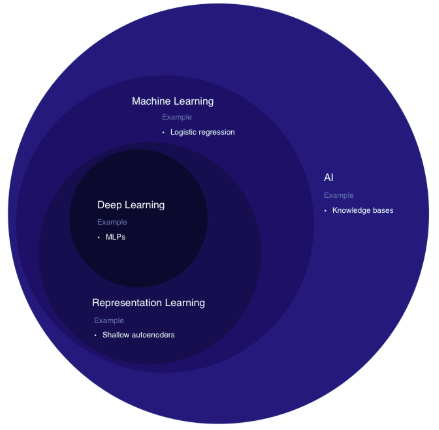
To deploy these systems effectively, it is crucial to understand their core architecture. While the terms Artificial Intelligence (AI), Machine Learning (ML), and Deep Learning (DL) are often used synonymously in casual tech talk, they represent distinct, nested layers of technology:
- Artificial Intelligence (AI): The overarching field focused on building smart machines capable of performing tasks that typically require human intelligence.
- Machine Learning (ML): A critical subset of AI that allows software applications to learn from data and improve accuracy over time without being explicitly programmed.
- Deep Learning (DL): A specialized form of representation learning within ML, utilizing large-scale neural networks to mimic the human brain’s decision-making process.
The Venn diagram below illustrates how deep learning fits within representation learning, machine learning, and the broader spectrum of AI, showcasing how these technologies stack up to power scalable business applications.
When Did the Evolution of AI Begin?
A Concise Overview of the Evolution of AI from Turing to the Present
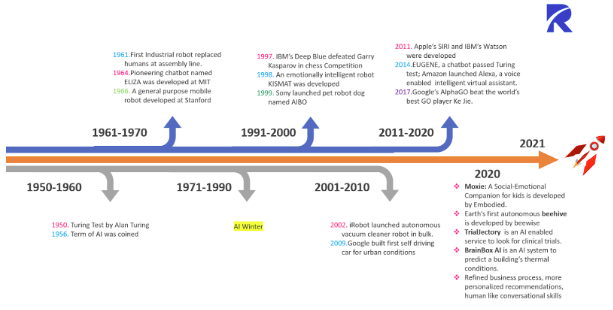
The evolution of AI is not an overnight phenomenon, but a decades-long accumulation of technological breakthroughs. Understanding this journey helps modern organizations realize how deeply rooted and stable today’s enterprise AI solutions actually are.
- 1950s – 1980s: The Foundations of Logic
The journey began in the 1950s with Alan Turing’s pioneering Turing Test, which questioned whether machines could imitate human intelligence. By the 1960s, John McCarthy advanced the field with LISP, the first AI programming language. These early generations focused primarily on symbolic reasoning and rule-based approaches, eventually leading to the creation of expert systems in the 1970s and 1980s. - 1990s: The Shift to Data-Driven Decisions
As computing power surged and digital data became more accessible, machine learning took center stage. This pivotal era saw the rise of neural networks and support vector machines (SVMs). Instead of following rigid rules, AI systems began learning directly from data, drastically improving their adaptability—a core requirement for any scalable business application today. - 2000s: Expanding the Senses (NLP & Vision)
At the turn of the millennium, AI research broke into commercial fields like Natural Language Processing (NLP), computer vision, and robotics. This expansion provided the critical building blocks that allow modern enterprise AI solutions to understand human speech, analyze legal documents, and automate complex physical workflows in real time.
GPT: A Ground-breaking Innovation
With the advances in deep learning and large-scale neural networks such as Google’s LaMDA and OpenAI’s Generative Pre-trained Transformer (GPT) series, the recent boom in AI has drawn the world’s attention. GPT-3, released in 2020, is a classic example of the evolution of AI, with 175 billion parameters and demonstrating unprecedented natural language understanding and generation capabilities.
GPT-3 and previous achievements are proof of the potential of AI and are accelerating further research and development in this field. The latest GPT-4 builds on previous versions and demonstrates even more advanced features, pushing the boundaries of AI even further and enhancing the position of enterprise AI solutions.
Read more: What Is Medical AI? Top 4 Medical AI Use Cases Explained for AI Development Companies
The Industrial Landscape Changed by AI
Far beyond consumer applications, modern enterprise AI solutions are fundamentally reshaping core infrastructures across high-stakes industries, transforming complex data into measurable operational efficiency.
- Healthcare (High-Precision Diagnostic Ecosystems):
AI-powered diagnostic tools are drastically improving early disease detection, enabling faster and more accurate clinical decisions. In pharmaceutical sectors, AI-driven drug discovery is accelerating R&D timelines for new treatments, while specialized robotics enhances precision surgery, minimizing patient recovery times and reducing hospital operational overhead. - Finance (Automated Risk & Fraud Management):
In the financial sector, robust enterprise software handles everything from real-time fraud detection to automated portfolio management. By deploying advanced risk assessment models, financial institutions can maximize the accuracy of credit scoring and loan evaluations, while algorithmic trading systems can safely streamline high-volume market transactions. - Manufacturing (Smart Factories & Predictive Operations):
Industrial environments utilize advanced automation and robotics to optimize production lines and minimize material waste. A key implementation of AI here is predictive maintenance—analyzing machine telemetry in real time to prevent costly equipment downtime and drastically lower long-term operating costs. - Logistics & Transportation (Supply Chain Optimization):
Beyond self-driving vehicles, enterprise systems focus heavily on streamlining complex logistics. AI algorithms optimize dynamic delivery routes, predict supply chain bottlenecks, and manage warehouse traffic networks to ensure seamless, cost-effective global distribution. - Retail (Data-Driven Personalization & Inventory Control):
AI elevates the retail sector by syncing advanced inventory management with predictive customer analytics. Sophisticated B2B chatbots handle tier-1 support, while personalized recommendation engines analyze consumer behavior to optimize product placement and boost conversion rates. - Agriculture (Precision Farming & Resource Scale):
Large-scale agricultural enterprise AI solutions leverage precision farming techniques to maximize crop yields and protect global food security. From automated pest and disease identification to predictive modeling for optimal planting and harvesting schedules, data-driven tools ensure smart resource management.
The Future of AI: Challenges and Opportunities
Despite the impressive advances in AI, there are still challenges and ethical concerns we must address as the technology continues to evolve. Privacy, security, and the potential misuse of data should be addressed as critical issues when deploying enterprise AI solutions, requiring careful consideration and appropriate regulation. Ensuring transparency and explainability in these models is also essential to minimizing algorithmic bias.
On the other hand, the potential opportunities presented by AI are enormous. As AI systems become more capable and integrated into business workflows and our daily lives, they will increasingly expand human capabilities and contribute to the improvement of society. The possibilities are expanding in many fields, such as climate modeling using AI to help respond to climate change, and its use in education to enable personalized learning.
It is also possible to utilize the power of robust enterprise AI solutions to process huge amounts of corporate data and tackle complex operational issues that are difficult for humans to handle alone. Recent advances in AI are providing entirely new approaches to complex global and organizational problems that were previously unsolved.
The evolution of AI has seen tremendous development, advancing the field with numerous breakthroughs and innovations. From early exploration in the 1950s to today’s advanced deep learning models, AI has transformed our lives and industries in ways beyond imagination. The future requires us to continue to invest in research and development, address global challenges, and harness the full potential of AI responsibly and ethically.
This is a flourishing time for tech innovation, and the possibilities are endless. As AI continues to evolve, it will also face new operational challenges and ethical dilemmas. However, through close collaboration between researchers, businesses, and policymakers, we can ensure that the deployment of enterprise AI solutions is guided by a collective vision that focuses on the betterment of society and the well-being of individuals.
Read more: The Future of AI: Exciting Use Cases and Pioneering Adopters
Summary
To recapitulate, the evolution of AI is a testament to human creativity and the constant pursuit of knowledge. As technology continues to advance, it has the potential to redefine the way we live, work, and leverage modern enterprise AI solutions to interact with the world around us. Addressing the inherent challenges of AI while making the most of the strategic opportunities it presents will be the absolute key to making it a force for good, driving future progress and corporate prosperity.
As a trusted tech partner, Relipa has 7 years of experience working as a reliable software development company in information technology, blockchain, and AI. Aiming for cost-effective and highly efficient offshore development, our team of dedicated Developers, PMs, and UI/UX Designers possesses excellent English capabilities. By maintaining 100% English communication throughout the project lifecycle to ensure seamless collaboration and top-tier product quality, we pledge to bring the absolute best solutions and value to our global clients.
Relipa Software
Relipa Co., Ltd. is a Vietnam-based software development company established in April 2016. After two years of growth, our Japanese branch – Relipa Japan – was officially founded in July 2018.
We provide services in MVP development, web and mobile application development, and blockchain solutions. With a team of over 100 professional IT engineers and experienced project managers, Relipa has become a reliable partner for many enterprises and has successfully delivered more than 500 projects for startups and businesses worldwide.
