

Before you hire dedicated developers team members, the real question isn’t whether it will be cheaper, but whether the team will still be adding value a year from now. That value comes from a team that works only on your product, brings skills you can’t hire locally, scales with your roadmap and keeps the product knowledge it builds. Weigh these benefits against an in-house team or freelancers, plan for the few risks that come with any outside team, and it becomes clear whether a dedicated team fits the stage your product is in.
Key benefits when you hire dedicated developers team members
Most companies start looking at this model at the same moment: the roadmap is growing faster than the engineering team. Local hiring takes months, freelancers come and go between tasks, and project-based contracts end just as the product starts to need steady work. A dedicated team solves these problems in a different way, and its benefits tend to grow the longer the collaboration runs.
Full focus on your product
When developers are split across several clients or internal projects, your product has to compete for their attention. Context switching slows the work down, priorities get negotiated instead of executed, and small issues wait in the queue until someone has time for them.
A dedicated team works only on your product. The engineers join your planning sessions, use your tools, such as Jira, Slack and your Git workflow, and follow your priorities sprint after sprint. You decide what gets built first, and the team never has to weigh your requests against another client’s deadline.
The impact shows in the rhythm of delivery. Sprints become more predictable, estimates get more accurate as the team learns the codebase, and your product managers spend less time chasing progress and more time on the product itself.
Faster access to the right skills
Finding a senior backend engineer, a DevOps specialist or a QA automation lead in a competitive local market can take months, and every open position holds the roadmap back. Some skills are only needed for part of the project, which makes a full-time local hire hard to justify.
With a dedicated team, the partner handles sourcing, screening and the first technical interviews. You review the shortlisted candidates, interview them if you want to, and approve the final team. Depending on the roles and the tech stack, a team can often be assembled in a few days to a few weeks rather than the months a typical recruitment cycle takes.
You also gain access to a much wider talent pool. Instead of choosing from whoever is available nearby, you can build a team around the exact mix of skills your product needs, from frontend and mobile to cloud, data and AI.
Flexible scaling as your roadmap changes
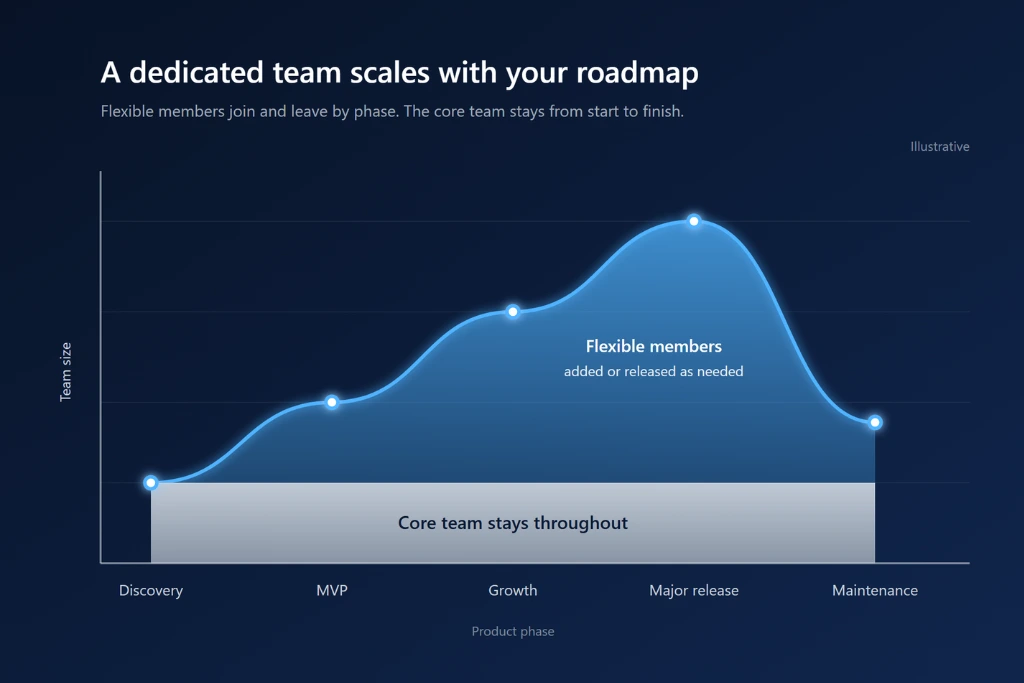
Product needs rarely stay the same. A major release, a new market or a funding round can double the workload in a single quarter, while a stable maintenance phase needs a smaller team. With in-house staff, scaling up means another long hiring cycle, and scaling down is costly and hard on morale.
A dedicated team is designed to change size with the roadmap. You can add a mobile developer for a new app, bring in extra QA engineers before a big release, or reduce the team once the product moves into maintenance, usually with notice periods agreed in the contract. The core members stay, so the knowledge of the product stays as well.
This flexibility lets you match engineering capacity to real demand, instead of planning headcount a year in advance and hoping the estimate holds.
Predictable cost without hiring overhead
Salary is only one part of what a developer costs. Recruitment fees, onboarding time, benefits, equipment, software licenses, office space and management overhead all add up, and many of these costs are hard to forecast.
In a dedicated team model, most of them are bundled into a monthly fee per team member. Budgeting becomes simpler because the monthly cost is known in advance and only changes when the team size changes. Working with a team in a region with lower labor costs can also bring the total cost down noticeably compared with hiring locally in North America or Western Europe, without lowering the seniority of the people working on your product.
The actual price depends on location, tech stack, seniority and contract length. For a closer look at each of these factors, along with estimated price ranges, see this guide on how much it costs to hire a dedicated offshore team.
Product knowledge that stays with the team
Every product builds up knowledge that isn’t written down anywhere: why a module was designed a certain way, which integration struggles under load, which customers still rely on an older feature. When developers rotate in and out, as often happens with freelancers or short project contracts, that knowledge leaves with them, and each newcomer spends weeks rebuilding it.
A dedicated team stays with the product over the long term. The same engineers who build a feature later fix it, extend it and maintain it. Over time, they start to anticipate problems, suggest improvements and make decisions that fit the product’s history.
This continuity is one of the least visible benefits at the start and one of the most valuable after six months to a year. It also makes the long-term maintenance and evolution of the product much smoother, because the team already knows the code it is changing.
More control over security and IP
Sharing source code, customer data and system access with an outside team is a fair concern. With a rotating group of freelancers, it is hard to know who has access to what, where the code is stored and what happens to it when the work ends.
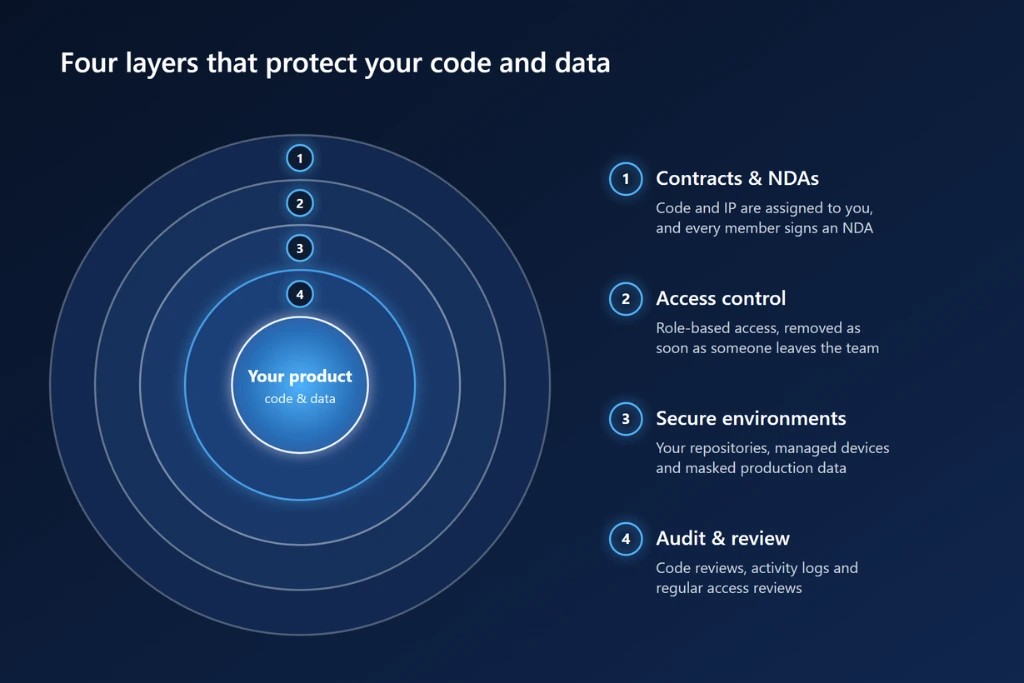
A dedicated team makes security easier to manage because the group is fixed and known. You can set clear rules from day one:
- Contracts and NDAs: Ownership of all code and documentation is assigned to you in the contract, and every team member signs a confidentiality agreement.
- Access control: Each engineer gets only the access their role requires, and that access is removed as soon as someone leaves the team.
- Secure environments: Code stays in your repositories, work happens on managed devices and networks, and production data is masked or replaced with test data wherever possible.
- Audit and review: Code reviews, activity logs and regular access reviews show who changed what and when.
It is also worth checking whether a partner follows recognized standards such as ISO/IEC 27001 for information security. With these controls in place, a dedicated team can work on sensitive products with the same level of protection you expect from your own staff.
Faster time-to-market
All of the benefits above lead to one result: your product reaches users sooner. A team that is assembled quickly, focused on one product, sized to the workload and familiar with the codebase spends less time waiting and more time shipping.
In practice, the team can start on the backlog within weeks, run several workstreams in parallel when needed and keep a steady release cadence. For a startup, that can mean putting an MVP in front of users and investors earlier. For an established company, it means new features and fixes reach customers before competitors catch up.
Faster delivery also tightens the feedback loop. The sooner a feature goes live, the sooner you learn whether it works, and the sooner the team can adjust.
Dedicated team vs. in-house team vs. freelancers
The benefits of a dedicated team become clearer when you compare it with the other common options. Many businesses only hire dedicated developers team members after trying one of the alternatives below.
| Criteria | Dedicated team | In-house team | Freelancers |
| Time to start | Days to a few weeks | Often months per role | Fast for single roles |
| Cost structure | Predictable monthly fee, no hiring overhead | Salary plus recruitment, benefits, office and equipment | Hourly or per task, varies widely |
| Scaling up or down | Flexible, agreed in the contract | Slow and costly | Flexible, but little continuity |
| Focus on your product | Full-time | Full-time | Often split across clients |
| Product knowledge | Builds up and stays with the team | Stays in-house | Leaves when the contract ends |
| Security and IP control | Clear contract, fixed team, managed access | Highest direct control | Harder to manage across many individuals |
| Management effort | Shared with the partner | Fully on your side | Fully on your side |
An in-house team is still the right core for many companies, especially for roles close to business strategy. A dedicated team often works best alongside it, as an extension that adds capacity and skills without the long hiring cycle.
Risks to consider and how to manage them
Like any way of working, the dedicated team model comes with a few points to plan for. None of them are unusual, and most are handled with a clear setup at the start.
- The first weeks need onboarding: A new team needs time to learn your product, codebase and processes. A short onboarding plan, access to documentation and a few well-scoped early tasks help the team reach full speed quickly.
- Communication takes some planning: Working across locations and time zones means agreeing on how and when the team communicates. A few hours of daily overlap, regular stand-ups and shared tools usually keep collaboration as smooth as with a local team.
- Results depend on choosing the right partner: The model works best when the partner has relevant experience and a stable team. Reviewing case studies, talking to past clients and starting with a smaller team or a trial period keep this risk low.
- Someone needs to own the priorities: A dedicated team follows your direction, so it needs a product owner on your side who sets priorities and makes decisions. Clear goals and a well-maintained backlog keep the team focused on what matters most.
With these points covered, the risks stay small compared with the value the team brings over time.
When a dedicated team brings the most value
The choice to hire dedicated developers team members pays off most in the following situations:
- Long-term products: SaaS platforms, internal systems or apps that need continuous development rather than a one-off build.
- Evolving requirements: Projects where the scope will change as you learn from users, so a fixed-price contract would be too rigid.
- Skill gaps in the current team: Cases where you need specific expertise, such as mobile, cloud, AI or legacy modernization, that is hard to hire locally.
- Fast growth: Startups after a funding round, or companies entering new markets, that need to expand engineering capacity quickly.
- Products already in operation: Live products that need a stable team to fix, improve and extend them over time.
For small, well-defined projects with a fixed scope and a short timeline, project-based outsourcing may be the simpler choice.
Conclusion
The decision to hire dedicated developers team members gives you more than extra hands. You get engineers who focus fully on your product, skills that would take months to hire locally, a team size that follows your roadmap, predictable costs, product knowledge that builds up over time and clear control over security and IP. The risks are familiar ones, such as onboarding, communication and partner choice, and a clear setup from the start keeps them small. For companies building products for the long term, a dedicated team is often the most practical way to grow engineering capacity without slowing down.
About Relipa
Relipa is a Vietnam-based software development company established in April 2016. After two years of growth, our Japanese branch, Relipa Japan, was officially founded in July 2018.
We provide dedicated development team services with engineers, QA and project managers who work as an extension of your team, using your tools and priorities. If you are planning to expand your engineering capacity, our team is ready to help you find the right setup.
