
The year 2026 will mark a turning point in global technology trends, as artificial intelligence, advanced computing, and human-machine collaboration evolve from experimental innovations into core business enablers. Organizations across industries are no longer questioning whether to adopt emerging technologies—they are actively redefining their strategies to integrate them effectively.
In this new landscape, it support outsourcing companies are playing an increasingly critical role. As enterprises face talent shortages, rising costs, and rapid technological change, outsourcing IT support and development capabilities has become a strategic solution rather than a temporary fix. Businesses are leveraging it support outsourcing companies to accelerate deployment, reduce operational risks, and access specialized expertise that is difficult to build internally.
In this blog, we break down the key technology trends shaping the next wave of digital transformation, spanning AI foundations, next-generation computing paradigms, and intelligent systems that enhance human performance. Combining insights from Gartner with real-world use cases, this overview provides a clear roadmap for companies seeking to strengthen their technological foundation while effectively collaborating with it support outsourcing companies to stay competitive.
Global Technology Market Overview
The global technology sector continues to expand at a rapid pace, driven by enterprise demand for digital transformation and AI adoption. Worldwide IT spending is projected to reach USD 5.43 trillion in 2025, marking a 7.9% increase from the previous year. This growth reflects a fundamental shift in how organizations invest in technology—not just as infrastructure, but as a strategic growth driver.
AI investment is expected to accelerate further in 2026, supported by hyperscaler infrastructure and enterprise adoption. As AI systems become more complex, many organizations are turning to it support outsourcing companies to manage deployment, integration, and ongoing maintenance. These companies provide scalable support models that align with evolving enterprise needs.
Cloud computing remains a key driver of this expansion. The global cloud market is projected to grow from USD 738.2 billion in 2025 to USD 1.6 trillion by 2030. This transformation is reshaping enterprise operations, enabling businesses to operate more flexibly across regions such as the US, India, and Africa.
At the same time, it support outsourcing companies are becoming essential partners in managing multi-cloud environments, ensuring system reliability, and optimizing performance across distributed infrastructures.
Market Expansion and Investment Insights
Emerging technologies such as agentic AI are driving a new wave of investment. According to market forecasts, the global agentic AI market will grow exponentially over the next decade, supported by enterprise demand for automation and intelligent decision-making systems.
Reports from Deloitte indicate that 25% of enterprises using generative AI plan to deploy AI agents by 2025, with this figure expected to reach 50% by 2027. This rapid adoption creates both opportunities and challenges, particularly in terms of implementation and scalability.
This is where it support outsourcing companies play a crucial role. They help organizations bridge the gap between strategy and execution by providing ready-to-deploy teams, proven frameworks, and continuous technical support.
According to PwC, many organizations are already experimenting with AI agents. While some have deployed them at scale, others are still in pilot phases. This fragmented adoption highlights the need for external expertise—another reason why it support outsourcing companies are increasingly in demand.
Venture capital investment further reflects this trend. Generative AI startups raised tens of billions of dollars in recent years, signaling strong confidence in AI-driven innovation. As funding continues to grow, it support outsourcing companies will remain key enablers in transforming these innovations into scalable enterprise solutions.
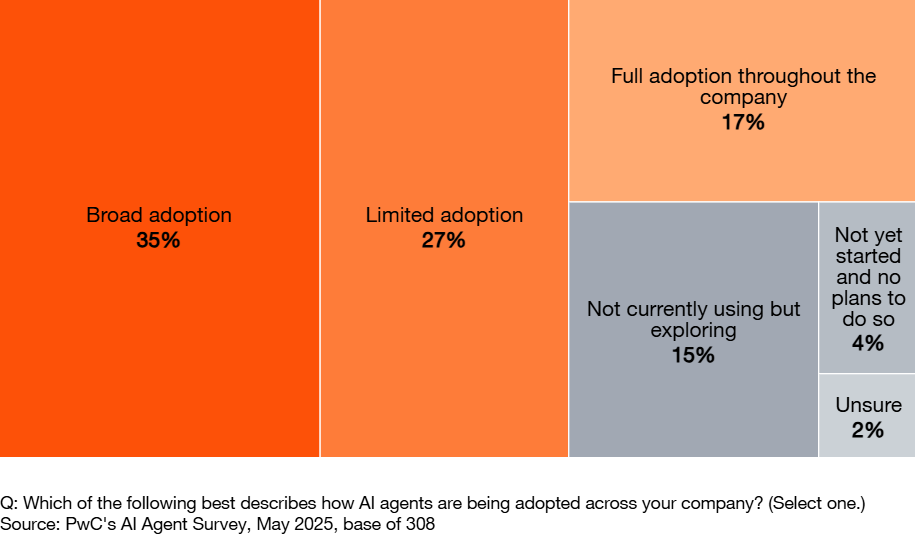
Source: PwC’s 2025 Survey
Measurable Business Impact
AI is no longer just a theoretical advantage—it is delivering measurable business outcomes. Research from McKinsey & Company shows that AI can automate up to 60–70% of work activities, allowing organizations to shift focus toward higher-value strategic tasks.
Productivity gains are already evident across industries. Developers report significant efficiency improvements, while customer service teams benefit from faster response times and improved accuracy.
However, achieving these outcomes requires robust implementation and ongoing optimization. Many organizations rely on it support outsourcing companies to ensure that AI systems are properly integrated into existing workflows and continuously improved over time.
Additionally, companies using AI-driven automation report reduced operational costs, faster processing times, and improved compliance. These benefits are amplified when working with experienced it support outsourcing companies, which provide structured methodologies and best practices for scaling AI solutions.
Top 10 Tech Trends in 2026
In line with the 3 themes advocated by Gartner and McKinsey, we will provide a thorough explanation of the top 10 tech trends that companies should prioritize, examples, and an image of return on investment.
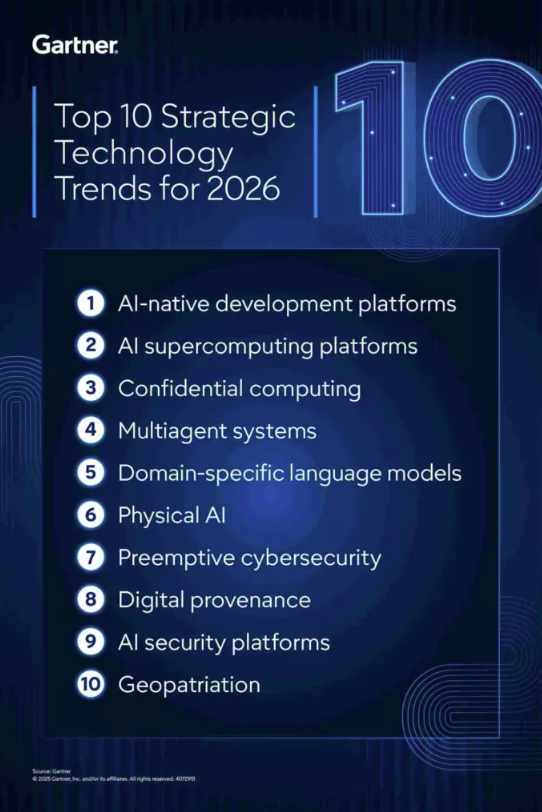
Category 1: Essential Elements of AI
AI Native Development Platform
AI-native development platforms represent a new paradigm in software engineering. These platforms integrate generative AI, low-code/no-code tools, and automated workflows to enable rapid application development.
For many organizations, adopting these platforms requires significant technical expertise. As a result, it support outsourcing companies are often engaged to implement and customize these environments.
Key Roles:
- Dramatically streamlined application development
- Establishing a standardized AI workflow
- Securing integration with internal data
- Promoting Citizen Development to fill the IT human resource shortage
Risks to Consider:
- Inadequate data quality and access management can lead to incorrect answers and incorrect processing
- Governance, quality assurance, and auditing mechanisms are essential
Gartner predicts that by 2030, 80% of organizations will restructure their large software engineering teams due to the proliferation of AI-native development platforms, especially towards smaller, more agile teams augmented by AI.
AI Supercomputing Platform
High-performance computing is becoming essential for large-scale AI applications. AI supercomputing platforms enable advanced model training and real-time processing.
Given the complexity of these systems, many enterprises partner with it support outsourcing companies to design and manage their infrastructure efficiently.
Key Roles:
- Enables high-speed training and real-time inference for large-scale LLMs
- Optimizes distributed processing, including edge environments
- Eliminates bottlenecks in legacy systems and supports the transition to a modern AI-ready infrastructure
Risks to Consider:
- Infrastructure costs, including initial investment and ongoing operations, and power consumption, tend to remain high
- Potential vendor lock-in with specific cloud providers or GPU vendors
- Strengthening security and access control for models and data is essential
Gartner predicts that by 2028, more than 40% of major enterprises will adopt hybrid computing paradigms for their critical business workflows. This indicates that architecture combining on-premises systems, cloud, and edge computing is becoming the standard infrastructure model in the AI era.
Domain-Specific Language Models
Domain-specific models deliver higher accuracy by focusing on industry-specific data. These models are particularly valuable in sectors such as healthcare, finance, and manufacturing.
To build and maintain such systems, organizations often collaborate with it support outsourcing companies that specialize in AI model development and data management.
Key Roles:
- Strong understanding of language context and honorific expressions, providing accuracy suitable for real-world business use
- Significantly reduces incorrect responses (hallucinations) by leveraging industry-specific knowledge
- Enables safe integration and utilization of internal data through RAG (Retrieval-Augmented Generation)
Risks to Consider:
- Excessive specialization may reduce generality and flexibility
- Model updates and retaining can incur substantial costs
- Strengthening data governance and privacy protection is essential
Gartner predicts that by 2028, the majority of generative AI models used by enterprises will be domain-specific rather than general-purpose. The reason is that specialized models deliver greater business value from the perspective of accuracy, safety, and compliance.
AI Security Platform
As AI adoption grows, security risks increase. AI security platforms help protect data, models, and systems from threats such as data leakage and cyberattacks.
Many enterprises rely on it support outsourcing companies to implement these security solutions effectively and ensure compliance with regulations.
Key Roles:
- Strengthening access control, encryption, and authorization management
- Ensuring secure management of training data and generated data
- Providing AI log auditing, anomaly detection, and automated alerting
- Supporting various compliance requirements
Risks to Consider:
- Enterprise-wide AI literacy must be improved in parallel
- Excessive security controls may slow down development
- Maintaining a balance between security and usability is crucial
Gartner predicts that by 2028, more than 50% of companies will use AI security platforms to protect their AI investments.
Category 2: The New Frontier of Computing
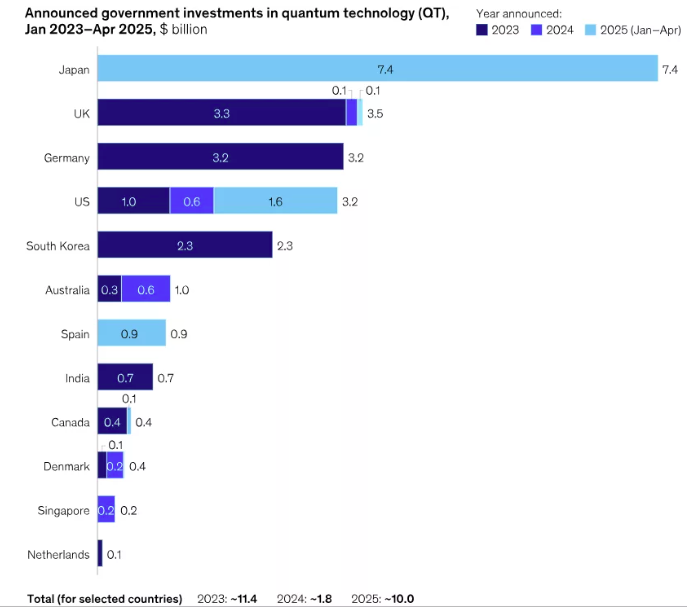
Quantum Technology
Quantum computing offers unprecedented processing power, enabling breakthroughs in complex problem-solving.
Due to its complexity, organizations frequently seek support from it support outsourcing companies to explore practical applications and integration strategies.
Key Roles:
- Rapidly solving highly complex problems
- Supporting the design of new materials and pharmaceuticals
- Enabling quantum cryptography to enhance security
Risks to Consider:
- Hardware stability and error correction remain major challenges
- Technological maturity is still limited for widespread practical use
- Concerns over high costs and a shortage of specialized talent
Use Cases:
- New drug development projects at major pharmaceutical companies
- Portfolio optimization support for financial institutions
Gartner predicts that commercial applications of quantum computing technologies wll accelerate by 2028.
Next-Generation Connectivity
Technologies such as 5G, 6G, and Wi-Fi 7 are enabling real-time data transmission and advanced digital services.
It support outsourcing companies play a key role in deploying and managing these networks, ensuring performance and reliability.
Key Roles:
- Enabling real-time data transmission with ultra-low latency
- Supporting simultaneous connections for massive numbers of devices through networking slicing
- Incorporating advanced security features
Risks to Consider:
- High costs associated with infrastructure development
- Need to address increasingly complex security risks
- Requirement to adapt flexibility to changing regulations and standards
Use Cases:
- Real-time production management in manufacturing
- Remote surgical support in the medical field
- Smart tracking in the logistics industry
Gartner predicts that by 2026, more than 50% of major enterprises will leverage next-generation networks to accelerate business transformation.
Confidential Computing
Confidential computing is a technology that keeps data encrypted even while it is being processed, significantly enhancing privacy and security. It is particularly essential for secure data sharing in cloud and multi-tenant environments.
Key Roles:
- Secure data processing through Trusted Execution Environments (TEE)
- Maintaining encryption of sensitive data during computation
- Supporting secure collaborative analytics across multiple organizations
Risk to Consider:
- Operational complexity due to hardware dependencies
- Limited availability of compatible software and services
- Higher cost burdens for early adopters
Use Cases:
- Risk management through secure computation in financial institutions
- Safe sharing of patient data among medical organizations
- Strengthened confidentiality within supply chain operations
Gartner predicts that by 2029, more than 75% of operations running on untrusted infrastructure will be protected by confidential computing, ensuring security even when data is in use. This reflects a broader shift in cloud and hybrid environments from protecting data at rest and in transit to protecting data during processing.
Category 3: Synergy Between Humans and Machines
Preventive cybersecurity
Preventive cybersecurity uses AI to detect and prevent threats before they occur.
Organizations increasingly depend on it support outsourcing companies to deploy these systems and maintain continuous monitoring.
Key Roles:
- Real-time threat detection and automated response
- Predicting unknown attacks through behavioral analysis
- Reducing risks before incidents occur
Risks to Consider:
- Excessive automation may lead to false positives or operational disruptions
- Advanced technologies can increase operational costs
- Need for continuous development of skilled security personnel
Use Cases:
- Major financial institutions are reducing incidents by 30% through preventive security systems
- Preventing supply chain attacks in the manufacturing industry
Gartner predicts that by 2026, more than 60% of enterprises will adopt preventive security approaches
Digital Provenance
Digital provenance ensures data authenticity and transparency, often leveraging blockchain technology.
It support outsourcing companies assist in building and integrating these systems into enterprise workflows.
Key Roles:
- Comprehensive tracking and management of data history
- Enhancing transparency and providing reliability
- Building trust in supply chains and media ecosystems
Risks to Consider:
- Increased costs for data management
- Need to balance transparency with privacy protection
- Challenges related to standardization and interoperability
Use Cases:
- Strengthening traceability in the food industry
- Fact-checking and anti-fake news measures in media companies
Gartner predicts that by 2027, more than 40% of enterprises will adopt digital provenance technologies.
Physical AI
Physical AI refers to technologies that embed AI into robots, sensors, and IoT devices operating in the physical world, enhancing and augmenting human perception and actions. It is increasingly being adopted in manufacturing, logistics, and healthcare settings.
Key Roles:
- Automation and human task support through robotics
- Environmental awareness and real-time feedback
- Improved safety and increased productivity
Risks to Consider:
- Risk management related to equipment failures or malfunctions
- Privacy and ethical concerns
- High implementation and maintenance costs
Use Cases:
- Efficiency improvements through collaborative robots on manufacturing lines
- Patient care support robots in hospitals
Gartner predicts that by 2026, systems powered by physical AI will be deployed in more than 50% of enterprises.
Conclusion
The year 2026 will represent a period of rapid technological advancement, driven by AI, next-generation computing, and human-machine collaboration. While these innovations offer significant opportunities, they also introduce challenges related to talent, security, and implementation complexity.
To navigate this evolving landscape, organizations must adopt flexible strategies and leverage external expertise. This is why it support outsourcing companies are becoming indispensable partners in digital transformation. They enable businesses to scale faster, reduce risks, and stay competitive in an increasingly complex environment.
By combining internal capabilities with the expertise of it support outsourcing companies, enterprises can unlock the full potential of emerging technologies and position themselves for long-term success in the digital era.
