
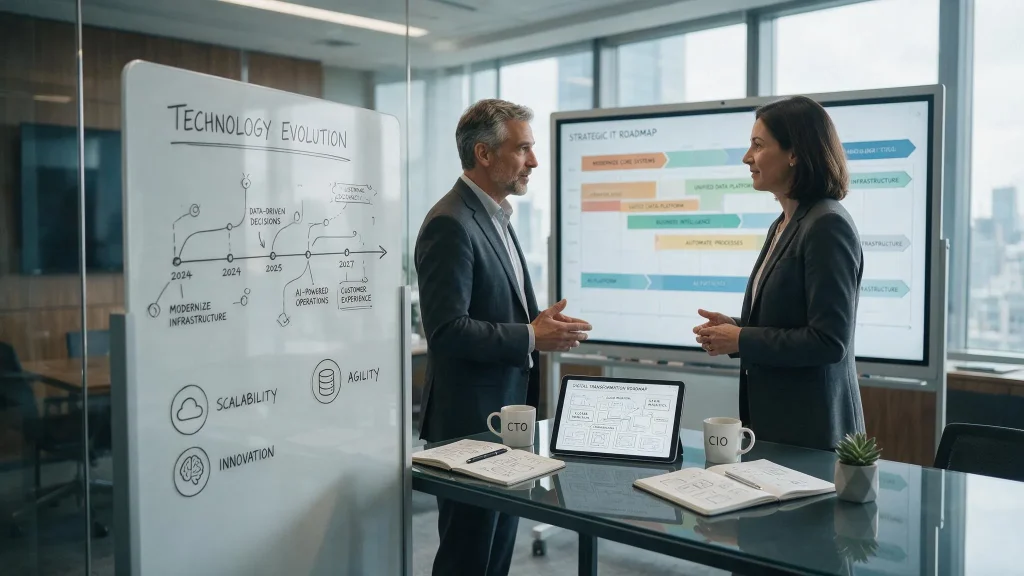
Most enterprise leaders agree on one thing: legacy systems can no longer support future business growth indefinitely.
The challenge, however, is determining what comes next.
For years, organizations have been told they need to modernize. Yet many modernization initiatives struggle because the conversation starts with technology choices rather than business objectives.
Executives are often presented with options such as rehosting, replatforming, refactoring, rebuilding, or replacing applications. While these approaches are technically valid, they rarely answer the questions business leaders are actually asking:
- How can we reduce operational costs?
- How do we accelerate cloud adoption?
- How can we improve customer experience?
- How do we support business expansion?
- How can we reduce risk without disrupting operations?
The reality is that successful modernization begins with business goals, not technology decisions.
From our experience delivering enterprise transformation projects, the most effective legacy modernization strategies are those aligned with specific business scenarios. Different objectives require different modernization paths.
The question is not: “Which modernization strategy is best?”
The better question is: “Which modernization strategy is best for the business outcome we want to achieve?”
Why Enterprise Modernization Projects Often Miss Expectations
Many modernization projects fail to deliver expected results because organizations assume that updating technology automatically creates business value.
In practice, modernization is only successful when it solves a specific business problem.
For example, a company focused on reducing infrastructure costs may pursue a very different strategy than an organization trying to launch digital products faster.
When modernization efforts are disconnected from business priorities, companies frequently encounter:
- Budget overruns
- Extended timelines
- Unexpected operational disruptions
- Limited business benefits
- Stakeholder dissatisfaction
This is why effective legacy modernization strategies start with understanding the enterprise’s destination before choosing a technical route.
Scenario 1: The Enterprise Wants to Reduce Operating Costs
For many organizations, rising maintenance expenses become the trigger for modernization.
Legacy applications often require specialized skills, aging hardware, increasing support costs, and frequent workarounds that consume valuable resources.
In this scenario, leadership’s primary objective is financial efficiency.
The goal is not necessarily innovation.
It is reducing the cost of keeping the business running.
Organizations pursuing cost optimization typically prioritize:
- Infrastructure consolidation
- Simplified support models
- Reduced maintenance overhead
- Better resource utilization
In these cases, modernization efforts often focus on streamlining environments and eliminating unnecessary complexity rather than undertaking large-scale application redesigns.
Among various legacy modernization strategies, lower-risk approaches tend to generate the fastest financial returns.
Business leaders often favor initiatives that produce measurable savings within a relatively short timeframe.
Scenario 2: The Enterprise Wants to Accelerate Cloud Transformation
Cloud transformation remains one of the most common drivers behind modernization initiatives.
Many organizations recognize the strategic benefits of cloud adoption, including scalability, flexibility, improved resilience, and access to innovation platforms.
However, legacy applications frequently prevent enterprises from fully realizing these advantages.
Applications built for traditional environments may struggle with:
- Elastic scaling
- Cloud-native architecture
- Modern integrations
- Automated deployment practices
In this scenario, modernization becomes an enabler of broader transformation goals.
The objective is not simply moving workloads to the cloud.
The objective is creating an environment where future growth can occur without traditional infrastructure constraints.
Among available legacy modernization strategies, organizations often prioritize approaches that balance speed with long-term cloud readiness.
The most effective path depends on the importance of the application and the organization’s overall cloud roadmap.
Scenario 3: The Enterprise Needs Faster Time-to-Market
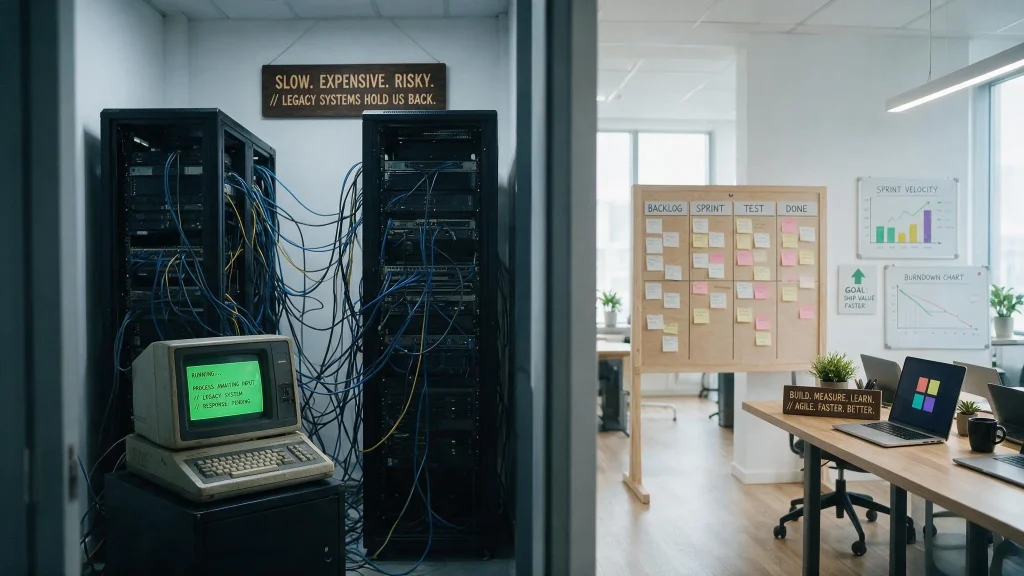
Speed has become a competitive advantage in many industries.
Organizations launching new products, digital services, or customer-facing capabilities frequently discover that legacy systems are slowing innovation.
Development teams spend more time maintaining existing systems than creating new value.
Release cycles become lengthy.
Application changes require extensive testing and coordination.
As market expectations accelerate, these limitations become increasingly problematic.
For organizations focused on innovation, modernization efforts aim to create greater business agility.
Success is measured through outcomes such as:
- Faster product launches
- Shorter development cycles
- Improved responsiveness to customer needs
- Increased experimentation
In this business scenario, legacy modernization strategies are closely linked to creating more flexible technology environments that support rapid change.
The emphasis shifts from maintenance to innovation.
Scenario 4: The Enterprise Is Concerned About Business Continuity Risk
Not all modernization projects are driven by growth objectives.
Many are driven by risk.
Business-critical applications often become increasingly fragile over time.
Organizations may face challenges associated with:
- Vendor end-of-support announcements
- Aging infrastructure
- Scarcity of skilled resources
- Security vulnerabilities
- Compliance requirements
For executive teams, these issues introduce operational uncertainty.
The cost of maintaining current systems may be high, but the cost of an unexpected failure could be significantly higher.
In these situations, modernization becomes part of a broader risk management strategy.
Organizations evaluate legacy modernization strategies through the lens of resilience, stability, and continuity.
The primary objective is ensuring that critical operations remain protected while technology risks are reduced.
Scenario 5: The Enterprise Is Preparing for Mergers, Acquisitions, or Expansion
Business growth often creates new modernization requirements.
Organizations expanding into new markets, acquiring companies, or launching new business units frequently discover that legacy applications lack the flexibility required to support future operations.
Common challenges include:
- Complex system integrations
- Limited scalability
- Inconsistent data management
- Duplicated business processes
As enterprises grow, technology environments must become more adaptable.
Modernization initiatives in this scenario are designed to support strategic expansion.
The goal is creating an application landscape capable of evolving alongside the business.
Among various legacy modernization strategies, organizations often prioritize initiatives that improve interoperability, scalability, and long-term flexibility.
The focus extends beyond current requirements and considers future growth opportunities.
Scenario 6: The Enterprise Wants to Improve Customer Experience
Customer expectations continue to rise across every industry.
Organizations increasingly compete based on digital experiences.
Unfortunately, many legacy applications were designed primarily for internal efficiency rather than customer engagement.
As a result, businesses often encounter:
- Slow user experiences
- Limited self-service capabilities
- Inconsistent customer interactions
- Integration challenges across channels
For customer-focused enterprises, modernization is closely tied to business differentiation.
Leaders evaluate modernization initiatives based on their ability to improve customer satisfaction, retention, and engagement.
In this scenario, the most effective legacy modernization strategies are those that enable seamless digital experiences without introducing operational disruption.
The customer becomes the primary driver of modernization decisions.
Scenario 7: The Enterprise Is Investing in AI and Data-Driven Decision-Making
Artificial intelligence has become a major business priority.
However, many organizations quickly discover that legacy systems create obstacles to AI implementation.
Modern AI initiatives require:
- Accessible data
- Real-time information flows
- Scalable infrastructure
- Integration capabilities
Legacy environments often struggle to support these requirements.
As a result, modernization becomes a prerequisite for broader AI adoption.
Executives increasingly view modernization as a foundation for future innovation rather than simply a technology upgrade.
In this scenario, legacy modernization strategies support data accessibility, analytics capabilities, and AI readiness.
The ultimate goal is enabling smarter decision-making across the organization.
Why Many Enterprises Choose Outsourcing Partners
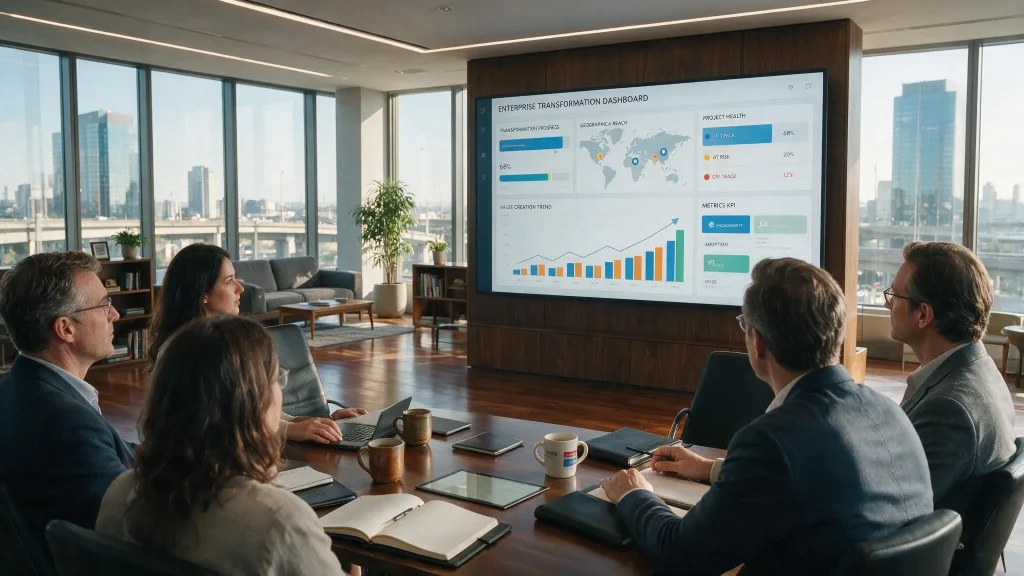
Once organizations understand their modernization objectives, execution becomes the next challenge.
Enterprise modernization initiatives require expertise across multiple disciplines, including:
- Application architecture
- Cloud technologies
- Security
- Integration
- Governance
- Change management
Internal teams often possess strong business knowledge but may face resource constraints or competing priorities.
This is one reason many organizations partner with providers specializing in legacy modernization strategies and execution services.
Experienced modernization partners bring:
- Proven delivery frameworks
- Cross-industry experience
- Specialized technical expertise
- Dedicated modernization teams
- Established governance processes
More importantly, they help enterprises align modernization efforts with business outcomes rather than technical milestones alone.
How to Select the Right Modernization Strategy
The best modernization strategy depends entirely on business priorities.
Before making technology decisions, leadership teams should ask several important questions:
- What business problem are we solving?
- What outcome are we trying to achieve?
- How much operational risk can we tolerate?
- How quickly do we need results?
- What level of investment is available?
- Which applications create the greatest business impact?
Answering these questions creates a clearer foundation for evaluating modernization options.
Technology choices become easier when strategic objectives are clearly defined.
Start with the Business Goal, Not the Technology
Modernization conversations often become focused on technical approaches.
Yet the most successful enterprises take a different view.
They begin by defining business outcomes and then selecting the modernization path that best supports those objectives.
Whether the goal is reducing costs, accelerating cloud adoption, improving customer experience, supporting AI initiatives, reducing risk, or enabling business growth, different scenarios require different approaches.
This is why there is no universal modernization playbook.
The most effective legacy modernization strategies are those aligned with the organization’s unique objectives, priorities, and future vision.
For enterprise leaders, modernization should never be viewed as a technology project alone.
It should be viewed as a business transformation initiative designed to create measurable value while preparing the organization for the future.
Relipa
Relipa is a Vietnam-based software development company established in April 2016. After two years of growth, our Japanese branch – Relipa Japan – was officially founded in July 2018.
We provide services in MVP development, web and mobile application development, and blockchain solutions. With a team of over 100 professional IT engineers and experienced project managers, Relipa has become a reliable partner for many enterprises and has successfully delivered more than 500 projects for startups and businesses worldwide.
