
Legacy systems still run the core of many enterprises, from order processing and billing to logistics and customer records. Yet every year they stay in service, they cost more to maintain, take longer to change, and expose the business to greater risk. What began as a pragmatic shortcut slowly becomes a structural drag on growth.
This is why legacy software modernization services have moved from a back-office IT concern to a board-level priority. The real problem is rarely the age of the code itself. It is the technical debt that accumulates around it: undocumented logic, brittle integrations, outdated frameworks, and workarounds layered on top of workarounds.
In this article, we examine how technical debt drives hidden costs, recurring defects, and upgrade barriers. We then compare the cost of continued maintenance with the investment in modernization, outline the main approaches, and explain how to choose the right delivery partner.
What Are Legacy Software Modernization Services?
Legacy software modernization services are a set of engineering and consulting activities that update, re-architect, or replace outdated applications so they deliver better performance, security, scalability, and maintainability while preserving the business logic that still creates value.
What Makes a System Legacy?
Age alone does not define a legacy system. The label applies when software becomes a constraint rather than an enabler. Typical characteristics include:
- An outdated technology stack or end-of-life runtime with no vendor support
- A tightly coupled, monolithic architecture
- Little or no documentation and limited automated test coverage
- Dependence on a few engineers who understand how the system works
Scope of Modernization Services
A mature engagement typically combines code and architecture assessment, refactoring, re-platforming, cloud migration, API enablement, UI/UX redesign, data migration, and QA automation.
Signals It Is Time to Modernize
- Release cycles keep getting longer
- The same defects reappear after each patch
- Integrating with new tools requires custom workarounds
- Maintenance consumes most of the IT budget
- Hiring and retaining engineers for the stack is increasingly difficult
Technical Debt: The Root Cause of Legacy Software Problems
Technical debt is the most useful lens for understanding why legacy systems become expensive. It explains not only what is wrong with the software, but why the cost of fixing it keeps rising.
What Is Technical Debt?
The term describes the future cost of choosing an expedient solution over a sound one. The shortcut is the principal; the interest is the additional effort every later change requires because of it. A team that skips refactoring to meet a deadline gains speed today but pays for it on every subsequent release.
Types of Technical Debt
- Code debt: duplicated logic, long functions, and inconsistent standards lead to slower changes and more defects.
- Architectural debt: a monolith with tight coupling between modules limits scalability and independent releases.
- Infrastructure debt: unsupported servers and manual deployments create security exposure and downtime risk.
- Documentation and test debt: missing specifications and no automated regression tests breed fear of change and knowledge loss.
Debt can also be deliberate, a conscious trade-off to hit a launch date, or accidental, the result of knowledge gaps and evolving requirements. Both kinds need active management.
How Technical Debt Compounds
Interest accumulates with every patch. Each workaround makes the next change slower and riskier, because engineers must first understand, then avoid, the earlier shortcuts. Over time, delivery slows: release cycles lengthen, developer velocity falls, and onboarding new team members takes months rather than weeks. Eventually, the team spends more time servicing the debt than building new capabilities.
The Hidden Costs of Maintaining Legacy Systems
Most organizations track the visible costs of legacy software: licenses, hosting, and support contracts. The larger share sits below the surface, spread across budgets and teams where it is rarely attributed to the system itself.
Direct Costs vs. Hidden Costs
Direct costs are easy to budget. Hidden costs emerge from the friction the system creates every day, and they usually grow faster than the direct ones.
Hidden Cost Categories
- Scarce, expensive talent. Engineers skilled in obsolete languages and frameworks, such as COBOL or end-of-life .NET and Java versions, command premium rates and are hard to replace.
- Opportunity cost. Slow-release cycles delay new features, which means lost revenue and market share.
- Security and compliance exposure. Unpatched components and unsupported platforms raise the likelihood of breaches and audit findings.
- Integration of workarounds and manual processes. Staff compensate for missing APIs with spreadsheets, re-keying, and batch jobs.
- Downtime and productivity loss. Outages and slow performance affect both employees and customers.
- Vendor lock-in and extended support fees. Premiums for aging platforms tend to rise each year.
The “Keep-the-Lights-On” Ratio
A useful indicator is the share of the IT budget spent on maintaining existing systems versus building new capabilities. When that ratio tilts heavily toward upkeep, innovation stalls by design: the budget that should fund growth is consumed by keeping the current system running.
A Simple Illustration
Consider a hypothetical mid-sized business running a 15-year-old order management system. Licensing and hosting are budgeted at a fixed amount. Over three years, however, add a specialist contractor retained at a premium, two security incidents that require emergency patching, and a customer-portal launch delayed by two quarters. None of these appear under “software maintenance,” yet together they often exceed the visible cost of the system.
Recurring Bugs and System Instability
Few signals of technical debt are as visible as defects that keep coming back. Teams close a ticket, and weeks later a variation of the same failure reappears elsewhere.
Why the Same Defects Keep Returning
- Tight coupling. A change in one module triggers unexpected behavior in several others.
- Missing automated tests. Without regression coverage, fixes cannot be verified safely.
- Patch-on-patch repairs. Teams treat symptoms because the root cause sits in code that no one fully understands.
- Knowledge loss. When the original developers leave, the reasoning behind critical logic leaves with them.
Business Consequences
Recurring defects translate into customer-facing outages, data inconsistencies between systems, a growing support burden, and reputational damage. Internally, they erode confidence: engineers hesitate to touch fragile areas, so problems persist longer.
Fixing Root Causes Through Modernization
Modernization addresses cause rather than symptoms. A modular architecture contains the blast radius of any change. Automated testing and CI/CD pipelines catch regressions before release. Observability and monitoring surface anomalies early, shifting the team from reactive firefighting to proactive quality control.
Why Legacy Systems Are Hard to Upgrade
Upgrading a legacy system is rarely a simple version of bump What Makes a System Legacy? Several structural barriers make even modest changes more expensive.
Common Barriers
- Monolithic codebases where components cannot be changed or deployed independently
- Hard-coded dependencies and outdated or unsupported libraries
- Undocumented business logic embedded in code or stored procedures
- Tight database coupling that makes schema changes risky
- Limited or absent API support
Integration Challenges
Modern business depends on connecting systems: SaaS platforms, cloud services, analytics and AI tools, and mobile applications. Legacy architectures were not designed for this. Each new connection typically requires a custom adapter, which adds more debt and another point of failure.
The Risk Paradox
Teams often postpone upgrades because they fear breaking critical operations. Yet delay makes the eventual upgrade larger, riskier, and more expensive, since dependencies drift further from supported versions every year.
Scalability and Compliance Limits
Legacy platforms also struggle with peak loads, global expansion, and new regulatory requirements such as stricter data protection and audit-trail rules. When growth or compliance demands change, the system becomes a bottleneck rather than a foundation.
Maintenance Cost vs. Modernization Investment
The central decision is not whether modernization costs money. It is whether continued maintenance costs more over the relevant horizon.
Understanding the True Cost of Maintenance
Maintenance spending on a legacy system tends to follow a rising curve. Each year brings more patches, more specialist effort, more incident response, and more workarounds. Because the growth is gradual, it is often accepted as normal until a major failure or a strategic initiative exposes it.
Upfront Modernization Costs
Modernization requires investment in assessment, planning, migration, parallel running of old and new systems, training, and a temporary dip in productivity during the transition. These costs are visible and concentrated, which is why they attract more scrutiny than the diffuse costs of the status quo.
ROI and TCO Framework
Compare total cost of ownership over three to five years, including hidden costs, and calculate the payback period. Track measurable indicators before and after the project: deployment frequency, mean time to recovery (MTTR), defect rate, infrastructure spend, and cost per feature delivered.
Managing Cost During Modernization
Phase the work and start with the modules that deliver the highest impact. Avoid big-bang rewrites, which concentrate risk. Reserve a contingency budget for discoveries that assessment cannot predict, such as undocumented dependencies.
In short, the two paths compare as follows:
- Cost profile: maintaining is cheap upfront but rises over time, while modernizing costs more upfront and lowers running costs.
- Risk: maintaining carries growing security and failure risk, while modernizing carries transition risk that phasing keeps manageable.
- Agility: maintaining keeps teams slow and change-averse, while modernizing enables faster, modular delivery.
- Security: maintaining leaves aging platforms that are hard to patch, while modernizing brings current standards and tooling.
- Scalability: maintaining stays constrained by the architecture, while modernizing delivers elastic, cloud-ready capacity.
Common Modernization Approaches
Modernization is not a single technique. The widely used “6 Rs” framework describes the main options:
- Rehost: Move the application to new infrastructure with minimal change (“lift and shift”).
- Replatform: Make targeted optimizations, such as adopting a managed database, without altering the core architecture.
- Refactor: Restructure code to reduce debt while preserving external behavior.
- Rearchitect: Redesign the application, for example from a monolith to a modular or microservices architecture.
- Rebuild: Rewrite from scratch while retaining the business requirements.
- Replace: Retire the system in favor of a commercial or SaaS product.
Choosing by Business Context
The right choice depends on system criticality, budget, timeline, and technical condition. Many organizations combine approaches across their application portfolio. The Strangler Fig pattern is a common risk-reducing tactic: new functionality gradually replaces legacy components behind a routing layer, so the old system can be retired piece by piece without a disruptive cutover.
How to Choose a Legacy Software Modernization Partner
The delivery partner largely determines whether modernization reduces technical debt or simply relocates it. Evaluate candidates against these criteria:
- Proven experience with your legacy stack and your target architecture
- A structured assessment methodology that quantifies debt and risk
- A security and compliance track record relevant to your industry
- Transparent cost estimation and clear change-control processes
- Agile delivery with frequent, demonstrable releases
- Post-launch support and knowledge transfer
- Strong communication practices, especially for distributed or offshore teams
A Typical Modernization Roadmap
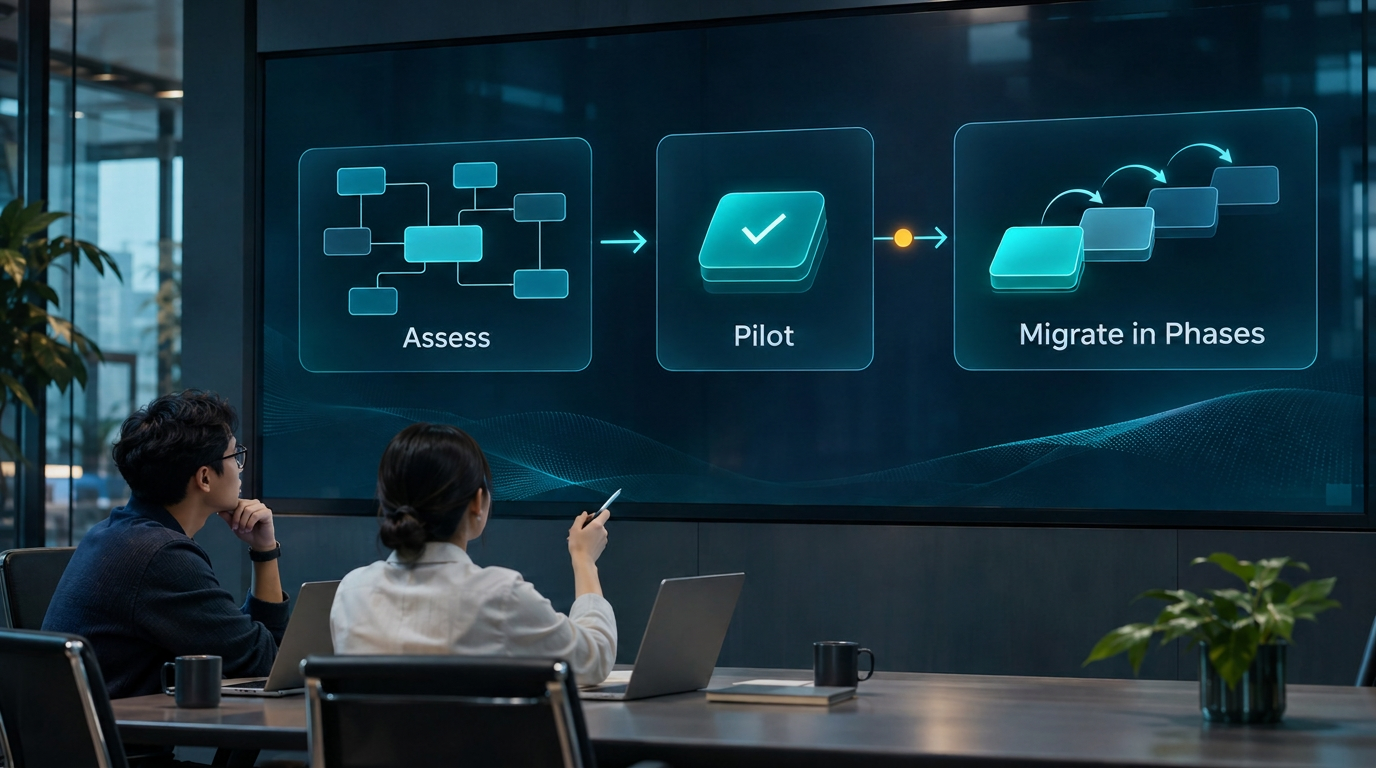
- Assess: audit code, architecture, dependencies, and data.
- Plan: prioritize modules, choose approaches, and define success metrics.
- Pilot: modernize a low-risk, high-visibility component to validate the approach.
- Migrate in phases: deliver incrementally, with parallel running where needed.
- Test: automate regression, performance, and security testing.
- Optimize and support: monitor, tune, and transfer knowledge to your team.
Organizations looking for end-to-end support can explore legacy software modernization services that cover assessment, phased migration, and long-term maintenance. If you are unsure where to begin, request a system assessment to quantify your current technical debt before committing an approach.
Conclusion
Technical debt, hidden costs, recurring defects, and upgrade barriers are not separate problems. They are symptoms of the same underlying issue: software that has stopped evolving with the business. Each year of delay raises the cost of maintenance and narrows the options available.
Legacy software modernization services give organizations a structured way to break that cycle by reducing debt, stabilizing delivery, and restoring the ability to change. The most effective programs start with a clear assessment, proceed in phases, and measure results against business outcomes rather than technical milestones alone.
Relipa
Relipa is a Vietnam-based software development company established in April 2016. After two years of growth, our Japanese branch – Relipa Japan – was officially founded in July 2018.
We provide services in MVP development, web and mobile application development, and blockchain solutions. With a team of over 100 professional IT engineers and experienced project managers, Relipa has become a reliable partner for many enterprises and has successfully delivered more than 500 projects for startups and businesses worldwide.
