
Currently, discussions around software development models like Scrum, Agile, and Waterfall typically hinge on the specific nature and requirements of each product. However, within the competitive landscape of offshore software development, Agile is increasingly becoming the preferred choice due to its inherent speed and adaptability.
Alongside this shift, ‘MVP development’ has emerged as a vital strategy for modern enterprises that prioritize rapid market entry. In this article, we will take a deep dive into the core concepts of MVP, clarifying its distinctions from the Agile framework while providing a detailed roadmap of the development process and key factors for success.
What is MVP?
MVP development is an abbreviation for “Minimum Viable Product”. In MVP development, it is important to build the most basic version with minimal features and resources, and to evaluate market demand and feedback. MVP development has become a powerful method for grasping customer needs and market trends and determining product direction.
MVP development has the following characteristics.
- Cost-Effective Market Validation: This approach enables businesses to validate their core hypotheses in a highly condensed timeframe and with minimal financial investment.
- Early Strategic Course Correction: It enables teams to assess the product’s direction from the very beginning, providing the flexibility to pivot or adjust the roadmap based on real-world user data.
- Efficient Maximization of Product Value: By focusing strictly on essential functionalities, this process ensures that every resource is utilized to deliver the highest possible impact to the end-user.
Differences from Agile development
While often used in tandem, Agile and MVP development are distinct methodologies with unique roles in the software engineering landscape. MVP development is primarily concerned with the rapid delivery of a foundational feature set to validate a product’s core value. In contrast, Agile development focuses on driving long-term efficiency within offshore software development projects by breaking down complex tasks into high-priority features and refining them through continuous, iterative cycles of planning, design, implementation, and testing.
The specific differences between these approaches are as follows:
- MVP development places significant importance on verification results.
- In Agile development, the primary emphasis lies on the efficiency of progress.
- MVP development only proceeds if there is a clear need for verification.
- Agile development involves releasing each function individually upon completion.
As a result, MVP development serves as a cost-effective strategy by releasing essential functionalities early on, whereas Agile development is a rapid methodology that emphasizes iterative verification and testing in each phase.
Main types of MVP development
There are many different types of MVP development. Each type can be selected to align with specific development goals and requirements, and we’ll explore common MVP development types in more detail in the table below.
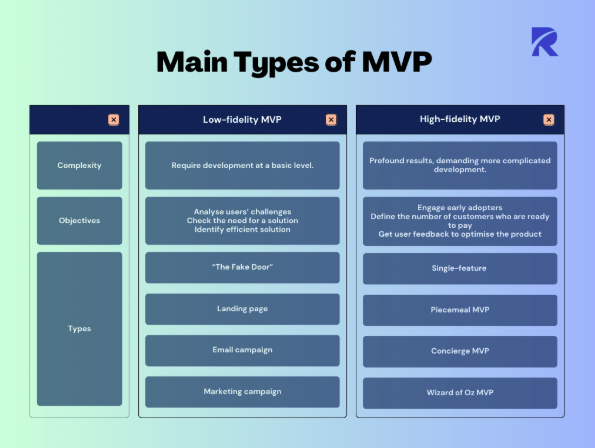
Low-fidelity MVP: A low-fidelity MVP is a minimal version of the product with the most basic features and functionalities. It typically lacks the polish and user experience that a fully developed product would have. Low-fidelity MVPs are quick and inexpensive to build, allowing teams to test their core assumptions without investing too much time or resources. They may involve wireframes, mockups, or even simple prototypes. Low-fidelity MVPs are often used in the early stages of product development to test fundamental ideas and concepts.
4 common types of low-fidelity MVP:
- “Fake door” MVP: Often referred to as “an MVP before an MVP,” this approach helps evaluate interest in a product or specific feature without actually building it. It usually involves creating a landing page with product information, even though the product hasn’t been developed yet. By doing so, you can assess market interest before investing time and effort in creating a full MVP or prototype. However, there is a risk of appearing untrustworthy or scammy, which could negatively impact your credibility.
- Landing page MVP: This strategy entails presenting your product’s idea and conceptual framework to potential consumers through a video or plain text on a landing page. The goal is to collect feedback from users without extensive time and financial investments. It’s an effective way to connect with your target audience and future-proof software products. Although it is relatively inexpensive and simple to deploy, it lacks a conversion factor, meaning that the data collected might be limited if visitors do not take action or engage further.
- Email campaign MVP: If you already have an email database of potential customers, the email campaign MVP can be a suitable option to gauge their interest in your new idea. This approach allows you to validate your value proposition quickly and affordably. However, it is essential to note that it requires a substantial database of user emails and is most effective when used in conjunction with other types of MVPs.
- Marketing campaign MVP: This MVP involves a full-scale promotion of your app concept even before the actual app launch. It aims to reach a broader audience than landing pages or emails. However, it demands significant time, effort, and financial resources. Consequently, it is better suited for larger companies with more extensive budgets.
High-fidelity MVP: A high-fidelity MVP, on the other hand, is a more advanced version of the product that closely resembles the final product in terms of design, features, and user experience. It aims to provide a more comprehensive and polished experience to early users. High-fidelity MVPs require more time and resources to build, as they involve a higher level of detail and complexity. These MVPs are often used when the core concept has already been validated through low-fidelity testing, and the team wants to gather more specific feedback on the refined features and design.
- Single-feature MVP: Focuses on implementing one crucial aspect of your product and testing it with users. Despite the controversy, this approach has proven successful for major businesses like Pokémon Go, which started with a single feature and expanded based on its success.
- Piecemeal MVP: Utilizes existing third-party tools and solutions for product features, speeding up development and reducing costs. Ideal for ideas with advanced functionality but limited time and technical resources.
- Concierge MVP: Employs human assistance to simulate a fully functional software solution. Helps evaluate product effectiveness and popularity before full development, saving resources and optimizing customer service.
- Wizard of Oz MVP: Presents a seemingly complete product with some backend tasks manually executed by humans, unbeknownst to users. Useful for testing advanced ideas like machine learning, but consistency in customer interactions may be challenging due to the human factor.
Advantages of MVP development
In the modern era, MVP development has introduced a transformative shift in the product lifecycle, becoming a cornerstone for many companies leveraging offshore software development. This approach centers on delivering the most basic, functional version of a product to evaluate market appetite and gather real-world insights with minimal initial investment. By focusing on core functionalities, organizations can refine their product direction based on actual user behavior rather than assumptions. Below are the key advantages of integrating MVP development into your business strategy:
- High efficiency: MVP development streamlines the development process by focusing on minimal features. Eliminate unnecessary functionality and complexity for optimal resource utilization. High efficiencies reduce development time and costs, and bring products to market faster and more efficiently.
- Early market validation: In MVP development, it’s important to bring your product to market early and collect feedback from real users. By understanding market reactions and needs, we can identify product direction and feature improvements. Early market validation can increase the market adaptability of your product and increase your chances of greater success.
- Minimize risk: MVP development is a technique that can minimize risk. By developing a minimal version and evaluating market demand and feedback, you can get an early idea of the product’s acceptability and success prospects. Risk minimization gives you more specific information and data before embarking on large development projects.
- Customer-oriented development: MVP development is the development that prioritizes customer needs and demands. Through early feedback, you can listen to your customers and improve your products. A customer-oriented development approach can increase market competitiveness and improve customer satisfaction.
Considering these benefits, MVP development is an important method for product and business success and is essential for many companies.
Introducing the detailed process and actual steps of MVP development
MVP development has established itself as a highly effective methodology, widely embraced throughout the modern product and service development lifecycle. Especially within the dynamic field of offshore software development, this approach allows teams to prioritize a foundational version with only essential features, providing a strategic way to validate market demand and gather critical user feedback early on.
To help you navigate this strategy effectively, we will provide a comprehensive breakdown of the detailed MVP development process in the following section.
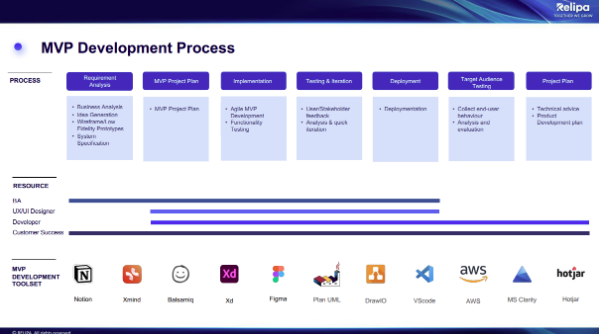
1. Request analyst/idea generation & product concept
- Business Analyst/Request Analyst
- Generation of ideas
- Wireframe/low fidelity – Lo-fi prototype
- System specifications
2. MVP project planning
3. Implementation of MVP development
- Implement MVP development in an agile style
- Function testing
4. Testing & Agile iterations
- Collect user/stakeholder feedback
- Feedback analysis & rapid iteration
5. Deploy (Place in the test environment/production environment and make it ready for actual operation)
6. Market test, market verification, target audience verification, end-user test
- Release to the market for product verification
- Collection of end-user behavior
- Analysis and evaluation
7. Planning product development
- Technical consulting
- Product development planning
The MVP development process described above is the most commonly adopted around the world and provides a framework that facilitates continuous improvement and product development according to customer needs. By performing the above steps in order, you can efficiently develop your products and meet market demands.
However, successfully navigating this path requires a highly proficient technical team to ensure the final product meets your strategic objectives and hits the market on schedule.
To provide a clearer picture, we will now explore the practical application of these steps through a mobile development case study, focusing on the critical tasks and feature prioritization necessary for a seamless launch.
Step 1: Establish and understand sales demand and target market
The first thing to do is to research and consider how much demand there is in the market for the product you want to sell. Likely to be in demand by your organization and your customers. The important thing is to research and analyze competitors, make your company stand out more than competitors’ products, and complete them.
Once the demand for the product is established, it is important to plan long-term business goals. It’s best to set your application development goals, success criteria, etc., before starting your development plan.
Step 2: Create an MVP customer journey
An integral part of developing an MVP is designing user-friendly products. The best way to give your users a positive experience the first time they use your app is to create a user journey map.
This allows you to look at your product from the user’s point of view. At the same time, it can provide detailed information for users to design useful apps. Additionally, don’t miss the entire user journey by identifying the user journey and resolving the actions the user needs to take to reach their end goal.
Step 3: Create a map of user benefits and problems
After identifying the user journey, you should create a map showing the benefits and problems of each action. The Benefits and Problems Map establishes all the user’s pain points and the benefits the user gains when each action is resolved.
You can identify the areas that have the most value and potential for your app, allowing you to focus on your MVP areas.
Step 4: Decide which features to develop
When starting development on a product, you should start by answering the following questions:
- What is my user’s most difficult problem?
- How do your product’s features solve that problem?
In planning your MVP, it’s important to limit the number of prioritized features and focus on what you need to bring your application to market.
In order to identify the parts that support the MVP’s core functionality, it’s a good idea to create an overall wish list for all the features that the final product will offer. To keep your MVP simple, you can organize and select your features. A common technique for identifying required features in a mobile app MVP is to use the MoSCoW matrix.
MoSCoW is an abbreviation for must (necessary features), should (necessary features), could (features that can be present), and not (features that are not required), and is used for prioritization.
Moscow can be used to identify the following features:
- Features that need to be developed first
- Features to develop next
- You can identify features that you don’t need at all.
Determining the key requirements of the product in advance will greatly reduce the scope of the project.
More features usually emerge as the project progresses. If the Moscow matrix fails to narrow the ‘must’ and ‘should’ ranges, the MVP may be destroyed. The MoSCoW methodology allows the project scope to be properly managed.
If too many features are prioritized without waste, it can impact the process, budget, and achievement of business goals.
After that, consider creating a prototype of your application.
Step 5: Collect and evaluate feedback
User feedback is a valuable source of information that shows if the product is working smoothly and if there are areas for improvement.
With this information, you can decide if your current MVP development method is right for you or if you need to change to another development method. By considering user feedback and tracking user behavior, you will be able to better understand what your users want and want from your product.
The role of the MVP model in startups and SMEs
MVP is a minimal viable product for startups and small businesses. This is provided in the minimum possible state that can solve the problems faced by the customer. Some roles in MVP startups and small businesses include:
- MVP is a tool to support market research, allowing each company to formulate a hypothesis before starting a business model. Successful completion of this process is a prerequisite for deployment in the next step. Product improvement and additional personnel are required.
- A minimal product allows startups to receive objective feedback from users. You can analyze this feedback and draw lessons to fix the problem. At the same time, business owners can add new features to improve product quality.
- This is the first step for the customer to recognize the existence of the product in the market. Business owners can let their customers know they were the first to come up with it.
- A minimal product is a product that targets a specific target group. Regular products are priced lower than full-fledged products.
Is MVP development necessary before starting a new business?
Prior to starting a new business or product, developing an MVP stands as a crucial step that can determine long-term success. Within the realm of offshore software development, building a minimal version allows organizations to test their vision while optimizing resources effectively. The following points outline the fundamental reasons why prioritizing MVP development is a smart move for today’s enterprises:
- Minimize risk: MVP development can validate basic product functionality and market demand with minimal resources. Risk minimization allows you to assess a product’s market suitability and acceptability before large investments and time are spent. You can improve your product based on the feedback and data you get through your MVP. Minimize risk and minimize failures and losses.
- User-centered development: MVP development is a great way to understand your users’ needs and requirements and design your product to meet those needs. Getting early feedback helps us improve our products by reflecting users’ opinions and wishes. Improving user satisfaction is a key factor in long-term success.
- Efficient development and resource optimization: MVP development streamlines the development process by focusing on the core functionality of the product, eliminating unnecessary features and complexity. You can make the best use of your limited resources and get your product to market faster. We can also plan the next development steps and strategies based on market demand and feedback.
- Continuous improvement and growth: MVP development provides a framework for continuous improvement and growth. You can continue to improve your product through short iteration cycles. Stay competitive and meet customer expectations by understanding market feedback and competitor trends to evolve your products.
For all of these reasons, developing an MVP before launching a new product or business is an important step toward success. By grasping market demand and user feedback through MVP and continuing to improve our products, we can build sustainable growth and competitiveness.
Notes for MVP development
- Be clear on purpose: In MVP development, the goal is to develop a minimal version of the product with the most important features and value. Before development, it is important to set clear goals and be clear about what you want to achieve.
- Focus on user feedback: MVPs value getting early feedback. Collect user feedback and actively use it to improve your product. By understanding user needs and desires, we can develop more valuable products.
- Focus on core functionality: It is important for MVPs to focus on the core functionality of the product. In the first version, focus on the most important features and eliminate unnecessary features and complexity for efficient development.
- Iterate quickly: Rapid iteration cycles are critical in MVP development. Develop your product in small steps, get feedback, and continuously improve. Identifying problems and challenges early and responding quickly is key to success.
- Strengthen team communication: Smooth communication within the team is important in MVP development. Actively share information and exchange opinions among members, and share progress and issues in product development. Effective communication contributes to better product quality and speed.
Summary
At its core, an MVP serves as a dynamic product version that evolves alongside real-world business feedback, bridging the gap between an initial idea and its first customers. This strategy empowers stakeholders to visualize tangible benefits almost immediately. Across the global offshore software development, a common practice involves refining these products through structured phases, moving from alpha and beta stages to a final, polished release. Once a product hits its technical milestones in the alpha phase, it transitions into a dedicated testing environment where a fixed user group provides the necessary evaluations for a successful launch.
At Relipa, we pride ourselves on our ability to transform these concepts into reality through rapid, high-quality MVP development. We specialize in helping companies validate new ideas as part of a cost-effective offshore software development strategy, ensuring that innovation doesn’t come with an overwhelming price tag. From the initial spark of an idea to long-term post-market support, we collaborate closely with our clients to guarantee quality and sustainable growth
Relipa Software
Relipa Co., Ltd. is a Vietnam-based software development company established in April 2016. After two years of growth, our Japanese branch – Relipa Japan – was officially founded in July 2018.
We provide services in MVP development, web and mobile application development, and blockchain solutions. With a team of over 100 professional IT engineers and experienced project managers, Relipa has become a reliable partner for many enterprises and has successfully delivered more than 500 projects for startups and businesses worldwide.
