
As blockchain adoption continues to move from experimentation into real-world business applications, NFTs are becoming an increasingly relevant component of enterprise digital strategy. What was once seen primarily as a niche use case in digital art has now expanded into areas such as loyalty programs, digital identity, intellectual property management, ticketing, and even supply chain verification.
However, despite this growing interest and diversification of use cases, one consistent challenge continues to surface across enterprise discussions: the complexity and unpredictability of gas fees.
From our experience delivering blockchain development solutions, many organisations underestimate the strategic importance of understanding NFT minting costs. While gas fees may seem like a technical detail at first glance, they directly influence product feasibility, pricing strategy, platform scalability, and user adoption. For decision-makers such as CTOs and COOs, overlooking these factors can result in solutions that are technically functional but commercially unsustainable.
What Is NFT Minting and Why It Matters for Enterprises
NFT minting refers to the process of converting a digital asset into a unique token recorded on a blockchain. This process creates verifiable ownership and ensures that the asset cannot be duplicated or altered without traceability.
From a technical perspective, minting involves executing a smart contract that writes data onto the blockchain, assigns a unique token ID, and stores metadata associated with the asset. This operation requires computational resources and network validation, which is why minting always incurs a cost.
From a business perspective, however, minting represents something much more significant. It is the foundation that enables enterprises to build digital ownership models, whether that involves tokenizing assets, issuing digital credentials, or creating new forms of customer engagement. For example, a retail company may mint NFTs to enhance loyalty programs, while a media platform might use NFTs to establish ownership over digital content.
The key takeaway is that NFT minting is not just a technical step—it is a critical business process that defines how value is created and exchanged within a blockchain-based ecosystem.
Understanding Gas Fees in a Business Context
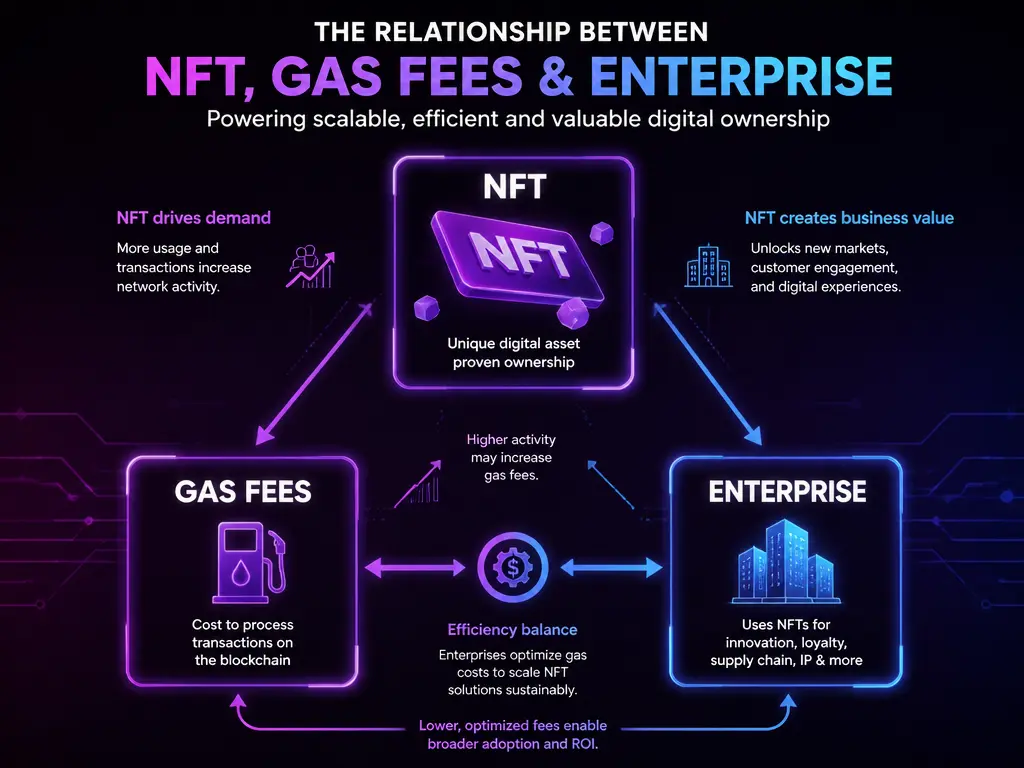
Gas fees are the transaction costs required to perform operations on a blockchain network, including minting NFTs and executing smart contracts.
These fees serve several essential purposes. First, they incentivize validators or miners to process transactions and maintain the integrity of the network. Second, they help allocate computational resources efficiently, ensuring that the network operates smoothly even during periods of high demand.
From an enterprise standpoint, gas fees can be understood as a variable infrastructure cost. Unlike traditional cloud computing models, where costs are often predictable, blockchain transaction fees fluctuate based on factors such as network congestion and complexity of operations.
This variability introduces both a challenge and an opportunity. On one hand, it complicates cost forecasting and budgeting. On the other hand, it creates opportunities for optimisation through smart architectural decisions and well-designed blockchain development solutions.
Why Gas Fees Are a Strategic Concern for Enterprises
Although gas fees originate from technical mechanisms within blockchain networks, their impact extends far beyond development teams. For enterprises, gas fees influence multiple layers of business performance and decision-making.
One of the most immediate impacts is on the overall cost structure of blockchain initiatives. On networks such as Ethereum, the cost of minting an NFT can vary widely, ranging from relatively modest fees to significantly higher amounts during periods of congestion. This variability becomes particularly important when enterprises plan large-scale deployments involving thousands or even millions of transactions. Without proper cost optimisation, operational expenses can escalate quickly and erode profit margins.
In addition to cost considerations, gas fees also play a critical role in shaping user experience. Unlike traditional applications, where end-users rarely interact with underlying infrastructure costs, blockchain applications often expose these fees directly. When users encounter high or unpredictable transaction costs, they may hesitate to complete actions or abandon transactions entirely. This has a direct impact on engagement, conversion rates, and overall platform success.
Moreover, gas fees influence scalability in a fundamental way. Applications that depend on frequent user interactions—such as gaming platforms, marketplaces, or loyalty systems—require a cost model that supports high transaction volumes. If each interaction carries a significant fee, scaling such applications becomes economically challenging. As a result, managing gas fees effectively is not just about cost reduction—it is about enabling sustainable growth.
Key Factors That Influence NFT Gas Fees
To develop effective strategies, enterprises must first understand what drives gas fees and why they fluctuate.
One of the primary factors is network congestion. When a large number of users attempt to transact simultaneously, they compete for limited processing capacity, which drives fees upward. This situation is common on highly popular networks and during peak activity periods.
Another important factor is transaction complexity. Minting an NFT involves executing a smart contract, which requires more computational effort than simple token transfers. As a result, more complex operations consume more gas and lead to higher fees.
Additionally, gas fees are influenced by parameters such as gas price and gas limit, which determine how much a user is willing to pay for processing and how much computational work is required. These parameters can vary based on the design of the smart contract and user configuration.
Finally, the choice of blockchain infrastructure has a significant impact. Ethereum, while widely adopted and secure, is often associated with higher gas fees due to its popularity. In contrast, alternative solutions such as Polygon or other Layer-2 networks can reduce transaction costs dramatically by processing transactions off-chain before settling them securely.
How Blockchain Development Solutions Reduce and Optimise Gas Fees
Gas fees are not an unavoidable limitation. With the right approach, they can be optimised and, in some cases, significantly reduced. This is where blockchain development solutions play a critical role in enterprise adoption.
A foundational strategy involves selecting the appropriate blockchain architecture. By leveraging Layer-2 networks or alternative chains, enterprises can maintain security while dramatically lowering transaction costs. This approach is particularly effective for high-volume applications where cost efficiency is essential.
Another key area is smart contract optimisation. Efficiently designed contracts require less computational power to execute, which reduces gas consumption across all transactions. Over time, these savings can become substantial, particularly for platforms handling large-scale operations.
Enterprises can also adopt techniques such as batch minting, where multiple NFTs are created within a single transaction, reducing the cost per asset. Similarly, lazy minting allows assets to be minted only when a transaction occurs, eliminating unnecessary upfront expenses and improving capital efficiency.
In addition, many enterprise solutions incorporate gas abstraction, where transaction fees are hidden from end-users or subsidized by the platform. This approach aligns blockchain applications with familiar Web2 experiences, significantly improving usability and adoption.
Timing strategies also play a role. Executing transactions during periods of lower network activity can reduce costs, although this approach is typically used as a supplementary optimisation rather than a primary strategy.
Why Enterprises Choose Outsourced Blockchain Development Solutions
Implementing and maintaining these optimisation strategies requires deep expertise in blockchain architecture, smart contract development, and infrastructure design. For most enterprises, building this level of capability internally is both time-consuming and costly.
As a result, many organisations choose to partner with providers specialising in blockchain development solutions. This approach offers several advantages. It provides immediate access to experienced professionals who understand both the technical and strategic aspects of blockchain implementation. It also accelerates time-to-market, allowing enterprises to launch products and iterate more quickly.
Furthermore, outsourcing reduces risk. Experienced partners bring proven methodologies, best practices, and a deep understanding of common challenges, helping enterprises avoid costly mistakes. This is especially important in a rapidly evolving space where technologies, standards, and market dynamics are constantly changing.
Our Approach to Delivering Blockchain Development Solutions
Our approach to blockchain development is grounded in the belief that technology should always serve business objectives. Rather than focusing solely on implementation, we work closely with enterprises to ensure that every solution is aligned with measurable outcomes.
We begin by identifying the most relevant use cases and evaluating their feasibility from both a technical and commercial perspective. This ensures that resources are allocated effectively and that projects are designed with clear ROI in mind.
Following this, we design a tailored architecture that balances scalability, performance, and cost efficiency. By leveraging platforms such as Polygon and other Layer-2 solutions where appropriate, we help enterprises achieve the optimal combination of low cost and high performance.
Our development process covers the full lifecycle, from smart contract engineering and platform integration to testing and deployment. Beyond launch, we continue to optimise systems to ensure they remain efficient as usage grows.
This structured and business-focused approach allows enterprises to move beyond experimentation and build blockchain solutions that are scalable, sustainable, and aligned with long-term strategic goals.
Conclusion: Turning Cost Challenges into Competitive Advantage
NFT minting and gas fees are often viewed as operational challenges, but for enterprises, they represent an opportunity to gain a strategic advantage. Organisations that understand and optimise these factors are better positioned to build scalable solutions, deliver superior user experiences, and achieve sustainable growth.
With the right blockchain development solutions, gas fees can be managed effectively, transforming what was once a barrier into an enabler of innovation.
As the adoption of Web3 technologies continues to accelerate, the organisations that succeed will not simply be those that experiment with blockchain, but those that implement it with precision and strategic clarity.
For enterprise leaders, the next step is clear: approach blockchain not just as a technology, but as a business capability—and build it with the right expertise from the start.
Relipa Software
Relipa Co., Ltd. is a Vietnam-based software development company established in April 2016. After two years of growth, our Japanese branch – Relipa Japan – was officially founded in July 2018.
We provide services in MVP development, web and mobile application development, and blockchain solutions. With a team of over 100 professional IT engineers and experienced project managers, Relipa has become a reliable partner for many enterprises and has successfully delivered more than 500 projects for startups and businesses worldwide.
