
Web3 is transforming how businesses build digital products by enabling decentralized applications, digital ownership, and blockchain-powered ecosystems. As adoption accelerates across industries, choosing the right outsource web development services partner has become essential for turning Web3 ideas into secure, scalable, and production-ready solutions.
In this article, you’ll learn what Web3 is, why businesses are investing in it, real-world enterprise use cases, how blockchain powers Web3 applications, and how Outsource Web Development Services can help accelerate your Web3 development journey.
What is Web3.0?
Web 3.0 is the next generation based on blockchain, in which all nodes (devices) are connected by P2P (Peer to Peer) and data can be exchanged directly without going through a client-server operated by a centralized administrator. It refers to the era in which the Internet and services that make use of that technology are provided.

Differences Between Web 2.0 and Web 3.0
| Aspect | Web2 | Web3 |
|---|---|---|
| Architecture | Centralized client-server model controlled by platform providers | Decentralized peer-to-peer (P2P) network powered by blockchain |
| Data Ownership | User data is stored and controlled by centralized platforms | Users own and control their data and digital identities |
| Transactions | Transactions rely on intermediaries such as banks or platform operators | Peer-to-peer transactions enabled by blockchain and smart contracts |
| Privacy | Platforms collect and monetize user data for advertising and analytics | Personal data remains under users’ control, reducing reliance on centralized platforms |
| Security | Data stored on centralized servers is more vulnerable to single points of failure and cyberattacks | Blockchain’s distributed ledger makes data transparent, immutable, and highly resistant to tampering |
| System Availability | Service interruptions occur if the central server fails | Distributed nodes keep the network running even if some nodes become unavailable |
| Transaction Costs | Additional fees are often charged by intermediaries | Smart contracts automate processes, reducing intermediary costs and transaction fees |
| Automation | Business processes require manual management by administrators | Smart contracts automatically execute predefined rules without human intervention |
| Typical Examples | YouTube, Facebook, Amazon | Ethereum, Uniswap, OpenSea, Decentraland |
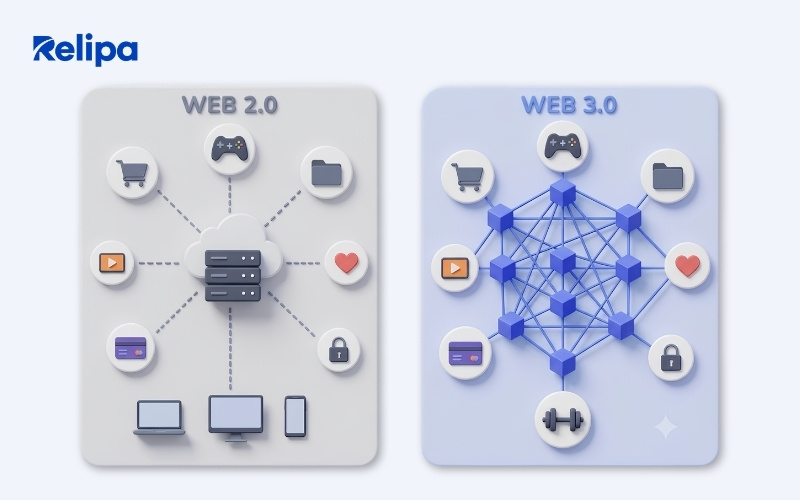
How Web3.0 (Web3) Works?
“Blockchain” is translated as a “distributed ledger.” The reason it is called “distributed” is that it consists of numerous nodes, which are individual computers connected in a peer-to-peer manner without the need for a central server managed by a large tech company. Each node plays an equal role in sharing and managing the data. The location of the nodes is not significant as long as they are connected to the internet, allowing the network to span across different regions and countries.
Periodically, all transaction data within a specific time frame is recorded in a database as a block, forming a chain of transaction blocks that continues endlessly over time. Storing each block independently would make the system fragile and vulnerable to hacking. Therefore, the name “blockchain” was given to highlight the interconnectedness of the generated blocks, ensuring consistency between them.
In the blockchain, the data within each block is converted into a unique digital signature called a hash value using a special mathematical function called a hash function. This hash value is included in the subsequent block. The hash function consistently generates the same hash value for the same input data, but it is virtually impossible to reverse-engineer the original data from the hash value. If an attempt is made to tamper with the data within a block, the hash value changes, and the consistency of the blockchain is compromised. This makes it exceptionally difficult to alter the data, as it would require changing the hash values of all subsequent blocks.
With this mechanism, various transaction data, such as currency transfers, sales, supply chain details, transportation information, and delivery routes from suppliers to consumers, can be converted into data and managed securely. Once recorded in a block, the data is immutable and remains preserved indefinitely. Moreover, all participants in the blockchain network can view the data, ensuring transparency and enhancing trust in the system’s reliability.
Why Businesses Are Investing in Web3
Web3 is rapidly evolving from an emerging technology into a strategic investment for businesses. Powered by blockchain, smart contracts, decentralized applications (dApps), and digital assets, Web3 enables organizations to build new business models, improve transparency and security, automate business processes, reduce operational costs, and create new revenue streams through tokenization and digital ownership. It also helps businesses strengthen customer engagement by giving users greater control over their digital identities and assets.
Leading global brands have already demonstrated the business value of Web3. Nike entered the Web3 market through its acquisition of RTFKT and has generated more than USD 185 million in NFT revenue, making it one of the most successful consumer brands in the NFT space. Meanwhile, Starbucks Odyssey combines blockchain-based digital collectibles with its loyalty program, offering members NFT “Journey Stamps” that unlock exclusive rewards and experiences, creating a more engaging customer loyalty ecosystem.
Market research also highlights the rapid growth of Web3 adoption. According to Grand View Research, the global Web 3.0 market was valued at USD 2.25 billion in 2023 and is projected to reach USD 33.53 billion by 2030, expanding at a compound annual growth rate (CAGR) of 49.3% from 2024 to 2030. This growth is driven by the increasing demand for decentralized applications, stronger data privacy, blockchain-based digital identity, and continuous advancements in internet technologies.
As Web3 adoption expands across industries, including finance, healthcare, gaming, retail, and supply chain—businesses require reliable technical expertise to transform innovative ideas into production-ready applications. Many organizations choose to outsource web development services to accelerate development, access experienced blockchain engineers, reduce development costs, and build secure, scalable Web3 solutions more efficiently.
Enterprise Web3 Applications Built by Outsource Web Development Services
The following are some of the most common enterprise applications of Web3.
Traceability
Blockchain facilitates traceability in the manufacturing and logistics sectors. For instance, it enables the comprehensive management of process data across various stages, ranging from food and pharmaceutical production to transportation and sales. This allows for quick and accurate identification of the specific process that encountered issues, such as contamination or product defects. By focusing on the affected products and their sources, the damage can be minimized, and food waste can be reduced.
As time goes on, there is an increasing demand from business partners and stakeholders for effective management of manufacturing processes and product liability. With the widespread adoption of blockchain-based traceability in Web 3.0, there is an expectation that industries will witness improved quality control measures. This, in turn, will contribute to the establishment of safer and more secure supply chains.
Manage and Share Medical Data and Transcripts
Blockchain makes it possible to manage and share medical data such as an individual’s health status, medical history, treatment history, and medication history. If this data can be shared with medical institutions and pharmacies, it will be very useful when the patient is in need of emergency surgery and cannot dictate his or her chronic illness or medication history, or when a pharmacist wants to confirm whether or not to drink together.
Blockchain is also very suitable for managing and sharing documents that require accurate data management, such as university transcripts, and that do not allow the contents to be changed after entering the data.
DeFi
Web 3.0 uses smart contracts. DeFi (decentralized finance) is also attracting a lot of attention. In addition to remittance and settlement, it will be possible to automatically execute all functions, such as lending of virtual currency and insurance services, without human intervention. When you use financial services at banks and brokerages, you have to pay considerable fees. In that respect, DeFi has a great advantage because it can be used for free or very cheaply.
NFT
Through the use of smart contracts, digital content such as images, videos, music, and text messages can be tokenized and distributed as Non-Fungible Tokens (NFTs). NFTs provide a way to establish ownership and uniqueness for digital content that was previously easily duplicated. Furthermore, smart contracts can enable secondary usage rights, ensuring that the original creator receives a percentage of the sales proceeds each time the NFT is sold.
We can already see numerous examples of famous sports teams, luxury brands, idols, and artists from around the world selling images, videos, and trading cards as NFTs. Some of these NFTs have been traded for incredibly high prices, reaching millions of units, and the potential for growth in this field is immense.
Moreover, NFTs have a strong connection to the concept of the Metaverse, where virtual worlds and experiences merge with reality. Services that allow the trading of virtual paintings displayed in virtual buildings and galleries as NFTs are also expanding in popularity and reach.
Blockchain Game
Blockchain Game is a game that uses its own tokens and NFTs. Players can purchase NFT characters and items with virtual currency and get virtual currency as a reward when they clear a stage or win a battle. Moreover, NFTs used in the game can be bought and sold at any time. In other words, blockchain has realized an epoch-making system that has not existed in the conventional game industry, where rewards can be obtained while enjoying the game. This earning while playing is called “GameFi” or “Play to Earn”. As we will introduce later in “Specific Use Cases of Web 3.0” various blockchain games have already appeared in Japan and overseas.
DAO
DAO, which stands for “Decentralized Autonomous Organization,” refers to a type of organization that operates on the principles of decentralization and automation. In fact, the aforementioned DEX (Distributed Exchange) can be considered a form of DAO, where transactions are executed automatically on the blockchain using smart contracts. DAOs enable various functions to be carried out automatically without the need for direct human interaction, such as fundraising, work ordering, and project management.
Participants in a DAO acquire tokens specific to that organization and exercise their voting rights based on their token holdings to make decisions regarding projects and operations. In a DAO, there is no centralized manager or hierarchical structure with superiors and subordinates. Instead, decision-making and governance are decentralized, allowing all participants to have a say and contribute to the organization’s direction.
One significant difference between DAOs and traditional organizations is the ability to trade and operate continuously, 24 hours a day, 365 days a year. This non-stop operation is made possible by the automated and decentralized nature of DAOs, setting them apart from traditional organizational structures.
Read more: Pros and cons of DAO – Next-generation organization
Distributed Computing (Edge Computing)
Providing data and services online is the main purpose of edge computing. Edge computing can occur when centralized computers have trouble processing “big data.” For example, data may be processed on a local PC and then sent to a central site for aggregation. Distributed computing, or edge computing, combines the processing power of devices at the edge of a network to create a large distributed supercomputer.
Machine learning and Artificial Intelligence
Natural Language Processing (NLP) enables you to communicate with intelligent systems that comprehend your needs and requests. By utilizing machine learning techniques, vast quantities of data can be analyzed in real-time to anticipate customer preferences and actions. Smart, interconnected devices powered by the Internet of Things (IoT) are ubiquitous, providing businesses with the capability to gather data and convert it into valuable insights for informing their strategic decisions.
How Outsource Web Development Services Turn Blockchain into Real-World Web3 Applications
Blockchain is the foundation of every Web3 application, but building a production-ready solution requires much more than understanding the technology itself. Businesses need secure architecture, scalable infrastructure, seamless user experiences, and reliable deployment processes. This is where outsource web development services provide significant value.
An experienced Web3 development partner helps businesses transform blockchain concepts into practical applications that support digital ownership, decentralized transactions, and tokenized ecosystems while reducing development costs and accelerating time to market.
Typical Web3 development services include:
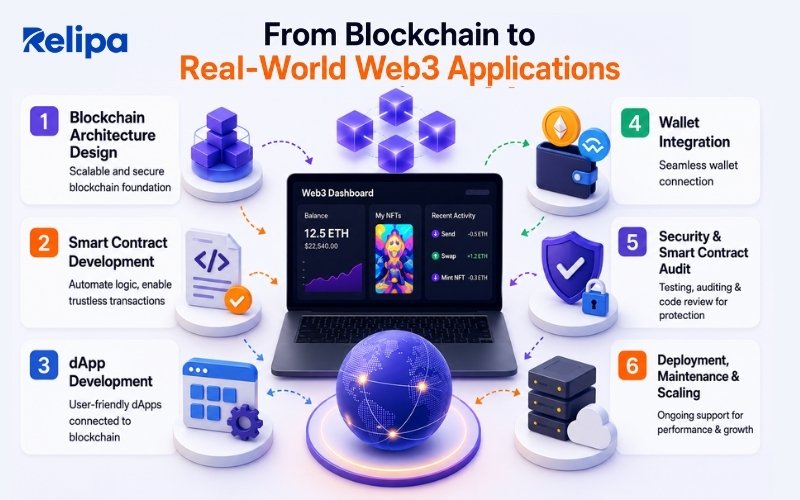
Blockchain Architecture Design
The first step is selecting the right blockchain infrastructure based on business goals, performance requirements, and scalability. Depending on the project, developers may recommend public blockchains such as Ethereum, Polygon, or Solana, or private and consortium blockchains for enterprise applications requiring greater control and privacy.
Smart Contract Development
Smart contracts automate business logic without relying on intermediaries. They enable secure and transparent execution of transactions for NFT marketplaces, DeFi platforms, token ecosystems, DAO governance, and other blockchain-based applications.
Decentralized Application (dApp) Development
Outsource development teams build user-friendly decentralized applications that connect front-end interfaces with blockchain networks. These applications allow users to securely manage digital assets, execute transactions, and interact with Web3 services.
Wallet Integration
A seamless wallet experience is essential for Web3 adoption. Developers integrate popular crypto wallets such as MetaMask and WalletConnect, enabling users to authenticate, manage assets, and complete blockchain transactions securely.
Security Testing and Smart Contract Auditing
Because blockchain applications manage valuable digital assets, security is a critical priority. Professional development teams perform smart contract testing, vulnerability assessments, penetration testing, and code reviews to reduce security risks before deployment.
Deployment, Maintenance, and Scaling
Launching a Web3 application is only the beginning. Outsource web development services also provide ongoing maintenance, performance optimization, infrastructure monitoring, feature enhancements, and scalability planning to ensure long-term business growth.
By partnering with an experienced outsource web development services provider, businesses can reduce technical complexity while gaining access to specialized blockchain expertise. This enables faster development of secure, scalable, and future-ready Web3 applications that support digital transformation and create new business opportunities.
Summary
Web3 is reshaping the future of digital business by enabling decentralized applications, digital ownership, and blockchain-powered ecosystems. However, successfully delivering a Web3 product requires specialized expertise in blockchain architecture, smart contracts, security, and scalable application development.
Partnering with experienced outsource web development services allows businesses to reduce development costs, accelerate time to market, and gain access to dedicated Web3 specialists without building an in-house blockchain team.
Relipa provides extensive support for blockchain development in Web 3.0. We have a large number of excellent engineers and staff who can fully meet the needs of our clients, such as blockchain games, NFTs, DAOs, and DeFi. Please feel free to contact us for any requirements.
Relipa
Relipa is a Vietnam-based software development company established in April 2016. After two years of growth, our Japanese branch – Relipa Japan – was officially founded in July 2018.
We provide services in MVP development, web and mobile application development, and blockchain solutions. With a team of over 100 professional IT engineers and experienced project managers, Relipa has become a reliable partner for many enterprises and has successfully delivered more than 500 projects for startups and businesses worldwide.
