
SaaS adoption has grown rapidly over the past few years, with the average number of SaaS applications used per company increasing by 130% between 2018 and 2022. As businesses rely more heavily on cloud technologies, they also face increasing challenges in infrastructure management, cybersecurity, AI integration, and emerging technologies. Based on our experience as one of the IT support outsourcing companies serving global clients, we have identified four SaaS trends that are reshaping the industry. This article explores these trends and shares practical insights to help businesses prepare for future technology investments.
SaaS Market Overview from IT Support Outsourcing Companies
According to the Business Intelligence Insight report, the Global software as a service (SaaS) market size reached USD 215.10 billion in 2021 and is forecasted to grow from USD 251.17 billion in 2022 to USD 883.34 billion in 2029. Since 2020, the COVID-19 epidemic has increased the demand for remote work, and the application of SaaS has increased rapidly. Companies are using it for operational efficiency and business expansion. In the future, the SaaS market will further accelerate in various corporations and nations.
Read more: ODC and Fixed Cost Contract
The Importance of Following the Latest SaaS Trends
As the Business Intelligence Insight report states, SaaS will be part and parcel of almost all aspects of the business. The booming of SaaS may have its roots in SaaS’s benefits. Having a firm knowledge of SaaS will bring about specific advantages stated below:
- Project management (productivity improvement): In addition to task management and schedule management, you can centrally manage resources such as progress and issue management.
- Security: SaaS security is managed by the provider, so we always implement the latest security measures.
- Customer satisfaction: By using customer management tools, you can respond smoothly to all inquiries. Customers can use the service with peace of mind.
- Data sharing: Anyone with an internet connection can easily access the data. Since it can be shared by multiple people at the same time, it can be centrally managed without complicating the storage destination.
By introducing the SaaS trends, entrepreneurs can expect business expansion along with technological evolution.
Read more: What is Offshore Development? How to Succeed in Offshore Development?
Cloud-based Solutions
Next, we’ll dive deeper into the overview, benefits, and use cases for cloud-based solutions.
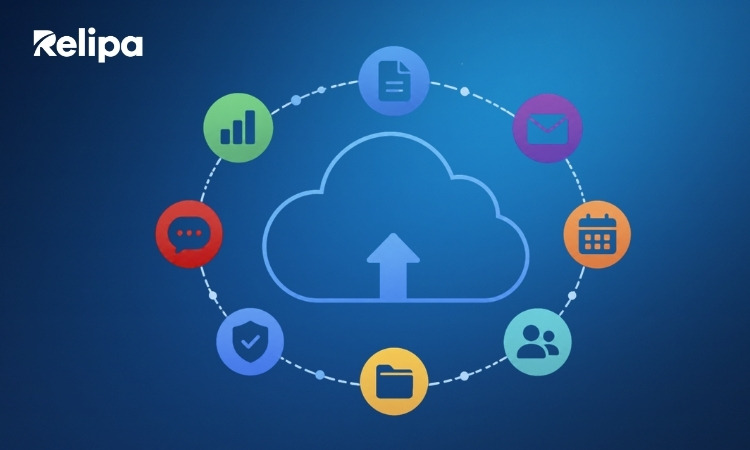
About Cloud-based SaaS Solutions
Cloud-based SaaS solutions are software services available over the internet. Costs can be reduced because there is no need to store servers. Especially, it’s great for file syncing and sharing as you can access your data from anywhere. It is also easy and customizable to back up and restore. Because it can be used in an environment where the Internet is connected, it is easy to use and flexible.
For example, despite being the earliest adopters of SaaS in Asia, Japanese companies are still wary of leaving most of their core operations to the cloud. Security concerns aside, established businesses often require more resources to upload years of data to the cloud. Therefore, adopting a cloud-based solution when entering the Japanese market is a smart way to stay ahead of the competition, reduce overhead costs, and make quick decisions when entering.
Cloud Enterprise resource planning (ERP) systems facilitate cross-border collaboration. Your home country experts can connect and collaborate with your team in another country to rapidly customize various business processes for the Japanese market.
Due to Japan’s aging population, new branches may find it difficult to recruit staff to manage all core operations. With cloud ERP, local teams can outsource daily functions such as administration, human resources, and finance to local agencies or push them to teams at headquarters, while maintaining Japan’s new capabilities for production, sales, and marketing on-site realities.
Benefits of using Cloud-based SaaS solutions
The following are the four benefits of cloud-based SaaS solutions.
- First: It helps cost efficiency
There is no need to manage servers, which can save costs. It is also a low initial investment and easy to use. If you are weighing the pros and cons of applying the Cloud to your business, there are several factors that you need to pay attention to, rather than the initial price.
- Second: It is easy-to-use
Cloud-based SaaS solutions offer the advantage of accessibility through an internet connection, making it possible to utilize the software on various devices such as mobile phones or tablets, including from the comfort of your home. This is in contrast to traditional software that has device-specific limitations for accessing data and services. With SaaS solutions, data and services can be accessed easily over the internet.
- Third: It is flexible
One of the benefits of using a cloud-based SaaS solution is its ability to adapt to fluctuations in user demand. This means that you can easily use or modify the services you need through the Internet without incurring the additional costs associated with resource allocation. In contrast, traditional software may require expensive measures such as resource scaling to accommodate fluctuations in user demand. The flexibility of SaaS solutions allows for more cost-effective and adaptable responses to your business needs.
- Fourth: Security management is unnecessary
With SaaS solutions, security does not need to be managed by the users either. This is because the provider is constantly updating against security threats. Users do not need to consider security, leading to work cost reduction. At the same time, it can be used in a safe environment.
Leveraging a cloud-based SaaS solution has many benefits for your business.
Recommended Cloud SaaS Tools from IT Support Outsourcing Companies
In addition, there are many SaaS solution services, but in this article, Relipa will introduce the main cloud SaaS solutions.
- Slack is a business chat tool used internally. It also supports voice calls.
- Microsoft Teams is a chat tool similar to Slack. You can also link with Office products such as online meetings.
- Chatwork is a free business chat tool. It can be used for task management and file sharing.
- Zoom is an online meeting tool that has been widely used since 2020. The feature is that the organizer can share the invitation URL with the participants.
- Notion is a note and task management tool for work and personal life. You can customize it to your liking, and there are free and paid options, but the free one is enough.
- Redmine is a project management tool. You can manage task management and project information sharing.
- Trello is a task management tool with a clean design. The Kanban system is used, so you can see the progress at a glance.
There are many other cloud-based software, so it is important to choose the one that is easy to use according to your needs.
Artificial Intelligence and Machine Learning
In addition, we will discuss artificial intelligence and machine learning, which play an integral role in SaaS solutions.
Leveraging Artificial Intelligence (AI) and Machine Learning (ML) in SaaS
Japanese companies are increasingly using artificial intelligence (AI) and machine learning (ML) to optimize operations across all functional departments. First, we will explain the use of AI and ML in SaaS. It is of pivotal benefit to utilize AI and ML in SaaS. For instance, AI is mainly useful for the “continuous collection of data”, “collection of product demand information”, “collection of market size information”, “collection of entry barrier information”, and “collection of information on customers”. Mainly in ML, it is useful for “identifying patterns from huge amounts of data”, “predicting data”, “classifying data”, and “automatic task execution”.
In today’s world, where the shortage of human resources is accelerating, AI and ML are attracting attention. Therefore, by leveraging AI and ML, every manual task in business can be automated.
Use Cases of AI and ML in SaaS
There are some use cases of AI and ML in SaaS solutions.
- Visitor management helps improve sales by analyzing needs from customer trends and implementing product placement and improvement measures.
- SNS automatic posting automatically sends messages to users who have sent specific messages. It reduces the labor of the contributor and makes the SNS operation more efficient.
- With a call center automated voice, it is possible to respond to many customers by automatically answering calls using voice recognition. It will improve the shortage of human resources in call centers and improve operational efficiency.
There are many other use cases, and the use of AI and ML can be expected to improve operations. In particular, it is often used in the service industry, financial industry, and SNS.
AI and ML Market Leader in SaaS
We will now present some leading companies that have integrated AI and ML into their SaaS solutions.
First up is Google, the largest search engine service that provides a range of SaaS services, including email and YouTube. Google employs AI in popular products such as “Google Translate” and “Google Pixel”, and is a global leader in AI and ML.
The second company is Salesforce, a centralized customer management system (CRM) that incorporates Salesforce Einstein, an AI system that enhances CRM efficiency. By leveraging AI, customer analysis is performed, and chatbots automate interactions, facilitating customer development from answering basic inquiries.
The third company is FREEE, a cloud-based accounting software service mainly used for back-office operations. With the use of AI, FREEE reads receipt information and provides automatic input, leading the charge in streamlining accounting operations through AI.
Several other SaaS solutions utilize AI and ML, and an increasing number of companies are adopting these technologies to improve operational efficiency.
Web 3.0 and the Metaverse for SaaS Companies
In addition, we will explain Web 3.0 and the Metaverse, which are emerging in 2022, for SaaS companies.
Definition of Web 3.0 and the Metaverse
Web 3.0 and the Metaverse are popular trends for 2022. Now let’s talk about Web 3.0 and the Metaverse. Before explaining Web 3.0, let’s review Web 1.0 and Web 2.0. Web 1.0 is mainly a service for browsing the Web, as the Internet has started to spread. Users can only browse the homepage and use the mail service. Web 2.0 enables two-way communication with the Internet, allowing you to view images and videos and post them on SNS. Web 2.0 means that information can be easily sent on SNS, and users not only browse but also participate in the Internet. Web 3.0 is a term that refers to the next generation of the Internet, the decentralized Internet.
Web 3.0 has emerged to eliminate the security risks and problems of Web 2.0. Blockchain technology allows individuals to own and control their information. The provider side is not the administrator, and instead of entrusting the information to the company side, the information is distributed and the security level is increased by self-management. Web 3.0 means that each individual manages their own information.
Metaverse means the virtual world. Metaverse stands for meta (transcendent) and verse (universe). Individuals can create their own avatars and act and interact with others in a virtual world created on the Internet. These days, some people make money from their businesses by selling their personal creations as NFTs. What you can do with Metaverse is sell items and land in the virtual space as NFTs, and users can build and sell NFTs to earn profits. Metaverse is a space where individuals can play, buy things, and move freely in a virtual world.
Leveraging Web 3.0 and the Metaverse in SaaS Companies
Next, we will discuss opportunities for SaaS companies to take advantage of Web 3.0 and the Metaverse. Blockchain technology makes it possible to distribute and manage personal information. This opportunity allows SaaS companies to securely manage their customers’ data. In addition, the decentralization of the Internet enables data collection and analysis with minimal use of SaaS solutions, leading to lower SaaS costs. An opportunity to use the Metaverse is to transfer huge amounts of data to a virtual environment in real-time using a digital twin and use it for analysis. Recreating real-world situations can improve SaaS product processes and services.
Benefits of Leveraging Web 3.0 and the Metaverse in SaaS
More crucially, what are the benefits of implementing Web 3.0 and the Metaverse in SaaS? Here are 3 benefits.
- By implementing Web 3.0, it is possible to analyze the user’s action history and customer attributes and provide services. Increased customer satisfaction and increased brand awareness.
- By implementing Web 3.0 and the Metaverse, you can safely manage customer information using blockchain technology. It guarantees high data security.
- By implementing the Metaverse, we will utilize digital twins (constructed in the virtual world based on information in the real world) to provide technology for performing various simulations. Therefore, development time can be shortened and costs can be reduced, enabling efficient development.
As a SaaS company, implementing Web 3.0 and the Metaverse will increase your business’s profitability while reducing customer trust and SaaS needs.
Quantum Computing
Conventional computer processing cannot handle huge amounts of data. As such, it cannot solve problems that quantum computers can handle. The demand for quantum computers will certainly increase in the future. Therefore, we will explain quantum computing in SaaS.

An Easy-to-understand Explanation of Quantum Computing
A quantum computer is a complex calculation method based on the principles of quantum mechanics. A quantum computer was developed based on quantum computing. Unlike conventional computers, it can process at high speed. Specifically, a conventional computer computes four times to do four things. However, quantum computers can compute the same process at the same time. Conventional computers are said to reach their processing limits, but the advent of quantum computers has made it possible to process large amounts of data.
The Importance of Quantum Computing in SaaS
Quantum computers are important in the SaaS market. Quantum computers can use high-speed processing and advanced encryption. For example, customer data can be managed with encryption technology. Therefore, it is possible to protect security holes that were broken in the past. This makes the SaaS solution operationally efficient. In the future, the use of quantum computing will expand the possibilities for important roles in SaaS.
Potential Applications of Quantum Computing in SaaS
There are several potential applications for quantum computers in SaaS. Here are four things to consider.
- The first is data analysis. Quantum computing allows us to analyze data efficiently. Accurate data can be obtained from customer data and behavior history.
- The second is data security. Quantum computing allows sophisticated cryptography. You can safely manage customer information and important data.
- The third is computational processing. Quantum computing enables large-scale computational processing, unlike conventional computers. You can expect fast and accurate processing.
- The fourth is machine learning. Quantum computing is also used in AI and machine learning. It required a huge amount of data and was not possible with conventional computers. However, we can expect the application of machine learning by utilizing quantum computing.
We mentioned the potential applications of SaaS as an example, and quantum computers will be necessary for the development of SaaS.
Conclusion
The SaaS landscape continues to evolve with advancements in cloud computing, AI, Web3, and quantum technologies. For businesses, staying competitive requires more than simply adopting new tools—it requires a clear technology strategy and the ability to adapt as the market changes.
Drawing on our experience as one of the IT support outsourcing companies serving global clients, we believe organizations should evaluate emerging technologies based on business value, scalability, and long-term sustainability. With the right IT partner, businesses can modernize their SaaS infrastructure, strengthen security, improve operational efficiency, and accelerate digital transformation while minimizing risks.
By virtue of our well-endowed experiences in developing SaaS, Relipa pledges to provide customized and optimized packages that can serve clients’ demands and expectations. If you have any inquiries related to SaaS, please feel free to contact us.
Relipa
Relipa is a Vietnam-based software development company established in April 2016. After two years of growth, our Japanese branch – Relipa Japan – was officially founded in July 2018.
We provide services in MVP development, web and mobile application development, and blockchain solutions. With a team of over 100 professional IT engineers and experienced project managers, Relipa has become a reliable partner for many enterprises and has successfully delivered more than 500 projects for startups and businesses worldwide.
