
In the 2026 digital era, where AI integration, cybersecurity resilience, and cloud agility are defining market leaders, a robust tech infrastructure is no longer a luxury; it has become a survival requirement. Yet, many organizations remain trapped by the hidden inefficiencies of in-house management, such as stagnant productivity, soaring operational costs, and overwhelming team burnout. Therefore, it’s time to move from maintenance to momentum.
That’s why global enterprises are pivoting their strategies, and this article aims to highlight 5 critical signs your business must partner with IT support outsourcing companies to reclaim its competitive edge.
Strategic IT Outsourcing: Definitions, models, and the role of IT support outsourcing companies
To stay ahead in 2026, it is vital to understand that outsourcing is not just a cost-cutting tactic, but it is a sophisticated strategic management initiative. For many, this journey begins by partnering with IT outsourcing services to gain a distinct competitive advantage.
Understanding the core definition of Outsourcing
Outsourcing is a business agreement, whether domestic or international (offshoring), where a firm contracts out its internal or external functions to specialized providers. Meanwhile, IT Outsourcing is a distinct, complex model. It is not a single service but a comprehensive bundle of technology, combining hardware, software, people, and processes.
When businesses work with IT support outsourcing companies, they are delegating specific roles to ensure services are produced more efficiently. These functions typically fall into three categories:
- Non-value-added functions: Routine administrative IT tasks that don’t directly drive revenue.
- Value-added functions: Specialized technical support that enhances user experience.
- Core competencies: High-level system architecture and digital transformation strategies.
Navigating the models: Outsourcing vs. Offshoring
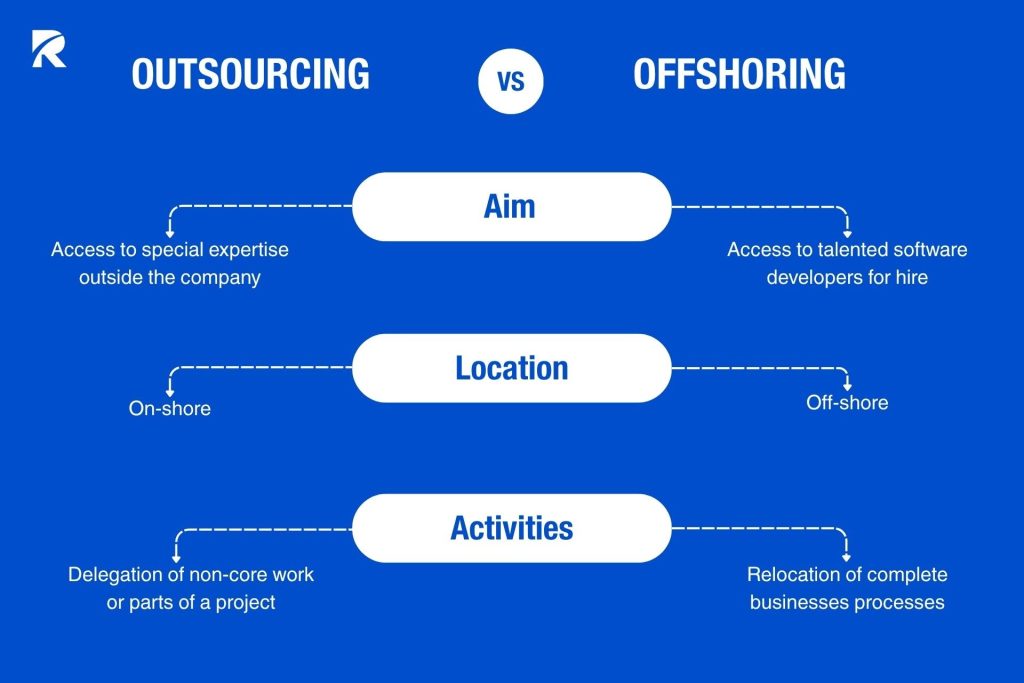
When evaluating IT support outsourcing companies, it is crucial to distinguish between local outsourcing and offshoring. Both models help firms produce services effectively, but they serve different strategic needs:
- Aim: Outsourcing targets specialized expertise unavailable in-house for specific functions, whereas offshoring focuses on accessing a broad global pool of software development talent.
- Location: Outsourcing is typically conducted on-shore within the same country, while offshoring relocates business activities to a different geographic region.
- Activities: Outsourcing involves delegating non-core tasks or specific project segments, whereas offshoring frequently entails the relocation of entire business processes.
If you want to find more about the critical choice of In-house vs. Outsourcing, visit our expert analysis here: https://relipa.global/ai-automation-solutions-inhouse-vs-outsourcing/
Market dynamics: A trillion-dollar shift
According to recent data from Grand View Research, the global outsourcing services market has surged significantly, with IT-specific services taking the lion’s share. As businesses worldwide race to solve the “IT talent crisis,” demand for IT support outsourcing companies is projected to keep the market on track toward a $1.2 trillion valuation by 2030.
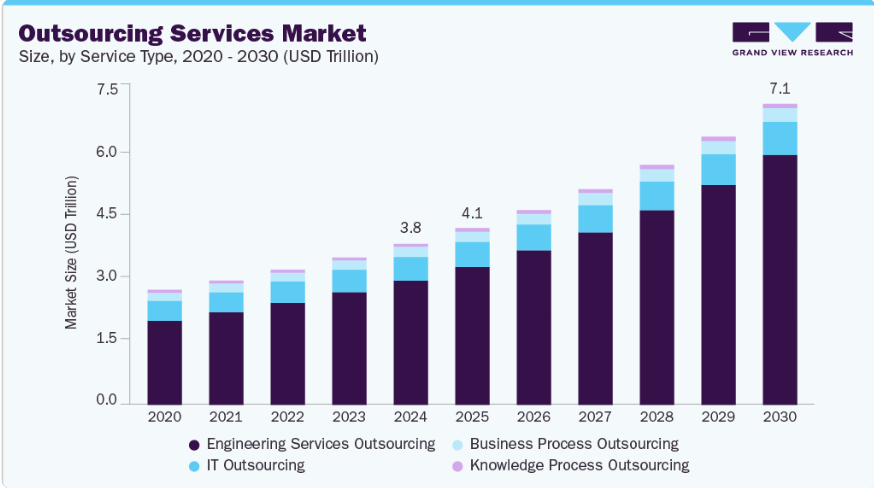
Notably, this growth is undeniably fueled by a fundamental change in mindset: companies are moving away from transactional “task-based” hiring toward strategic, value-driven partnerships.
Core Trends Shaping the 2026 Tech Strategy
Drawing from the latest industry benchmarks and insights from Forbes and KPMG, several key shifts are currently redefining how modern enterprises structure their external technical partnerships:
- Organizations are increasingly integrating local leadership with offshore talent to guarantee 24/7 operational continuity while maintaining high-touch communication standards.
- Technical strategies now prioritize combining AI automation with mandatory human oversight to ensure all processes remain accurate, ethical, and globally compliant.
- Small and medium enterprises are leveraging external expertise to access specialized AI tools and achieve the operational scalability typically reserved for large corporations.
- Advanced OCR and LLM technologies are being deployed to automate the consolidation of complex, fragmented data into actionable, real-time business intelligence.
- Transparency in labor practices and environmental sustainability has become a primary selection criterion for ensuring long-term brand integrity and corporate responsibility.
- Strategic market priorities have shifted toward 24/7 cybersecurity SOC monitoring and the effective orchestration of complex, multi-cloud environments.
Ultimately, these developments signify a transition from transactional vendors to long-term strategic partners focused on continuous technological evolution rather than simple maintenance. Bear in mind that understanding these shifts is the first step, but applying them to your specific infrastructure is where true growth happens.
5 Critical signs you should hire an IT support outsourcing company
Recognizing the shift in global trends is only the first step. For many leaders, the real challenge lies in identifying the exact moment when internal resources are no longer sufficient to sustain growth. Waiting for a systemic failure to occur can be a costly mistake. Instead, high-performing organizations look for specific operational alarming signs that indicate a need for external expertise. Partnering with IT support outsourcing companies at the right time can prevent long-term technical debt and ensure your infrastructure remains a catalyst for innovation rather than a bottleneck.
The following signs indicate that your internal IT structure may be reaching its limit and requires professional intervention to maintain a competitive advantage:
Elevated System Instability and Rising MTTR
A primary indicator of resource exhaustion is a consistent decline in system availability. When your internal team is overwhelmed, the Mean Time to Repair (MTTR) – the time taken to resolve a failure typically increases. In an era where even fractional downtime leads to significant revenue leakage, relying on a “reactive” internal model is high-risk. Dedicated IT support outsourcing companies can provide a “proactive” framework, utilizing continuous monitoring to identify and mitigate system bottlenecks before they result in a service outage.
Disproportionate Allocation of Resources to “Maintenance” vs. “Innovation”
A healthy IT strategy follows a clear ratio between maintaining existing systems and developing new capabilities. If your technical leadership is consumed by “Keep the Lights On” (KTLO) activities, such as server patching, routine help-desk tickets, or hardware upkeep, your company is suffering from a high opportunity cost.
By delegating these baseline operations to a professional IT outsourcing company, you liberate your internal talent to focus on high-impact projects, such as AI integration or proprietary software development, that directly drive market share.
Inability to Meet Evolving Cybersecurity and Compliance Standards
The 2026 regulatory environment is increasingly punitive regarding data protection. If your organization manages compliance (such as GDPR, ISO 27001, or SOC2) as a series of manual, periodic checks rather than a continuous automated process, you are exposed to significant liability. IT support outsourcing companies treat security as a core deliverable, providing access to specialized Security Operations Centers (SOC) and real-time compliance tracking that is often too expensive to build and maintain in-house.
Technical Friction During Rapid Scaling
Scalability requires an “Elastic” IT infrastructure. If your growth is currently hindered by long lead times for hardware procurement, software deployment, or onboarding new departments, your IT has become a bottleneck rather than an accelerator.
Therefore, partnering with a professional partner gives you instant access to on-demand resources and cloud-native expertise. This allows your infrastructure to expand or contract in real-time based on market demand, ensuring that technology supports your growth velocity.
Chronic Difficulty in Recruiting and Retaining Niche Tech Talent
It is true that the “IT Talent Gap” remains a significant challenge in 2026. Finding and keeping experts in specialized fields like cybersecurity, cloud orchestration, or AIOps is both difficult and costly. If your internal turnover is high or you have persistent “open roles” that stall critical projects, the talent deficit is hurting your business.
In this sense, IT support outsourcing companies solve this by providing a pre-vetted pool of specialists across multiple domains, ensuring that your projects always have the necessary expertise without the overhead of a full-time hiring cycle.
Why Top Enterprises Partner with Reliable IT Support Outsourcing Companies
Moving from identifying the indicators of inefficiency to implementing a solution is where enterprises truly begin to see a shift in their trajectory. In the high-stakes environment of 2026, the decision to hire an IT support outsourcing company is no longer just a defensive move; it is a proactive strategy to optimize every layer of the business.
Here is an analytical look at why top enterprises are increasingly moving toward this partnership model.
Strategic Cost Efficiency and TCO Optimization
For a modern enterprise, the financial benefit of outsourcing extends far beyond simple labor arbitrage. Partnering with IT support outsourcing companies allows for a shift from Capital Expenditure (CapEx) to Operating Expenditure (OpEx).
- Reduced Overhead: Internal hiring involves hidden costs, including recruitment, benefits, office infrastructure, and continuous training.
- Optimized Total Cost of Ownership (TCO): By utilizing the shared infrastructure and specialized tools of an external partner, businesses can access enterprise-grade technology without the massive upfront investment. This allows for a predictable monthly budget that is easier to manage and scale.
Instant Access to Specialized and Niche Expertise
The “Tech Talent War” of 2026 has made it nearly impossible for a single organization to maintain in-house experts in every emerging field. When you partner with a reputable company in this field, you gain immediate access to a deep pool of specialized talent that spans:
- Advanced Cybersecurity: 24/7 monitoring by professionals who specialize in neutralizing AI-powered threats.
- Cloud Orchestration: Architects who can manage complex hybrid and multi-cloud environments seamlessly.
- Legacy System Modernization: Specialists who know how to bridge the gap between older infrastructure and new, agile technologies. This “on-demand” expertise ensures that your projects are always handled by top-tier talent without the long lead times of internal recruitment.
Operational Scalability and Strategic Flexibility
Market conditions in 2026 change overnight. A rigid internal IT department often struggles to adapt to sudden pivots or rapid expansion. An professional partner provides the “Elasticity” required for modern business:
- Rapid Deployment: Whether you are launching a new product or entering a new global market, an external partner can provision the necessary infrastructure and personnel in a fraction of the time it would take in-house.
- Resource Flexibility: You can scale services up during peak periods and scale down when demand decreases. This flexibility ensures that you are only paying for the resources you actually need, maximizing your ROI and allowing the business to remain lean and agile.
Ultimately, partnering with reliable IT support outsourcing companies provides more than just technical assistance; it creates a resilient foundation for long-term business growth by aligning your technical capabilities with your strategic goals.
If you want to find more about the specific geographic advantages and cost efficiencies of this model in one of Asia’s fastest-growing tech hubs, visit our article: https://relipa.global/benefits-it-services-outsourcing-companies-vietnam/
How to select the best IT support outsourcing partner for your success
Selecting the right partner is a high-stakes decision that directly impacts your operational stability. To ensure a successful collaboration, consider the following steps when evaluating potential IT support outsourcing companies:
- First, define your specific technical and operational objectives. Clearly outline which IT functions, such as infrastructure management, application support, or 24/7 help desk, require external expertise. Having a defined scope prevents “scope creep” and ensures the potential company can provide a tailored solution that meets your exact needs.
- Second, conduct a comprehensive evaluation of their technical track record. Look beyond marketing materials to examine detailed case studies and verified client testimonials. A reliable partnershould demonstrate success in managing environments of similar complexity and scale to your own.
- Third, audit their security protocols and disaster recovery capabilities. In the 2026 threat landscape, security must be a core component of the service. Verify that the IT support outsourcing company adheres to international standards (like ISO 27001 or SOC2) and has redundant systems in place to ensure business continuity during unforeseen disruptions.
- Fourth, scrutinize the Service Level Agreements (SLAs) for accountability. Ensure the contract includes specific, measurable metrics for system uptime, initial response times, and Mean Time to Resolution (MTTR). A professional partner should be willing to tie its compensation to these performance benchmarks.
- Fifth, assess their communication transparency and reporting structures. Evaluate how the partner handles project management and incident reporting. Effective collaboration requires a partner that provides regular, detailed updates and maintains a communication style that aligns with your internal team’s workflow.
Choosing the right partner is a critical step in future-proofing your business. If you want to find more about how startups and growing enterprises can navigate the complexities of selecting a partner in 2026, visit our detailed guide: https://relipa.global/it-services-outsourcing-companies-startup-scale-2026/
Conclusion
In such a rapidly evolving landscape of 2026, the decision to engage IT support outsourcing companies has transitioned from a tactical cost-saving measure to a fundamental strategic requirement. As technical complexity increases and the global talent gap persists, organizations must prioritize operational resilience, security, and scalability to maintain their market position.
By recognizing the critical signs of infrastructure strain and selecting a partner based on technical depth and transparency, businesses can transform their IT department into a powerful engine for innovation.
Relipa Software
Relipa Co., Ltd. is a premier software development company based in Vietnam, established in April 2016. Following two years of consistent growth and excellence, we expanded our global footprint by founding our Japanese branch (Relipa Japan) in July 2018.
We specialize in delivering high-impact technical solutions, including:
- MVP Development
- Web and Mobile Application Development
- Blockchain Solutions
With a dedicated team of over 100 professional IT engineers and highly experienced project managers, Relipa has cemented its reputation as a reliable IT support outsourcing company for enterprises worldwide. To date, we have successfully delivered more than 500 projects for startups and established businesses, helping them navigate the complexities of digital transformation with precision and expertise.
Contact Relipa today to discover how our technical excellence can drive your business success.
