
As enterprises explore new ways to raise capital and modernize financial operations, blockchain technology is rapidly emerging as a viable alternative to traditional systems. Among the most promising innovations in this space is the Security Token Offering (STO)—a model that combines the efficiency of blockchain with the regulatory clarity of traditional securities.
Unlike earlier blockchain fundraising methods such as ICOs, which often operated in regulatory grey areas, STOs are designed to comply with financial regulations while still delivering the benefits of blockchain. For enterprise leaders, this represents a significant opportunity to access global capital markets in a more efficient, transparent, and secure way.
From our experience delivering blockchain development solutions, STOs are not just a financial tool—they are part of a broader transformation in how assets are issued, managed, and traded. However, their successful implementation requires careful planning, technical expertise, and a deep understanding of both regulatory and business requirements.
What Is a Security Token Offering (STO)?
A Security Token Offering is a method of raising capital by issuing security tokens, which are digital representations of real-world financial assets such as equity, debt, or revenue shares. These tokens are recorded on a blockchain, allowing them to be traded and managed more efficiently than traditional securities.
Unlike utility tokens, which provide access to a product or service, security tokens represent ownership or financial rights, making them subject to regulatory oversight. This distinction is critical for enterprises, as it provides greater investor protection while also enhancing credibility.
From a business perspective, STOs offer a hybrid model that combines:
- The programmability and transparency of blockchain
- The legal framework and investor confidence of traditional securities
This makes STOs particularly attractive for enterprises seeking to raise funds without compromising on compliance.
How STOs Work in Practice
Implementing an STO involves several steps, each requiring both technical and strategic consideration. The process typically begins with defining the asset to be tokenized, which could range from company shares to real estate or investment funds.
Once the asset is defined, enterprises must structure the token to reflect the associated rights, such as dividends, voting power, or revenue sharing. This is followed by the development of smart contracts that govern the issuance and management of these tokens.
Regulatory compliance is a central aspect of STOs. Unlike ICOs, which often bypassed traditional frameworks, STOs must adhere to securities laws in the jurisdictions where they are offered. This includes investor verification (KYC/AML), reporting requirements, and trading restrictions.
From a technical standpoint, the tokens are issued on a blockchain platform and can be traded on compliant exchanges. Smart contracts automate processes such as dividend distribution, ownership transfer, and compliance checks.
For enterprises, this results in a system that is not only more efficient but also more transparent and secure.
Key Benefits of STOs for Enterprises
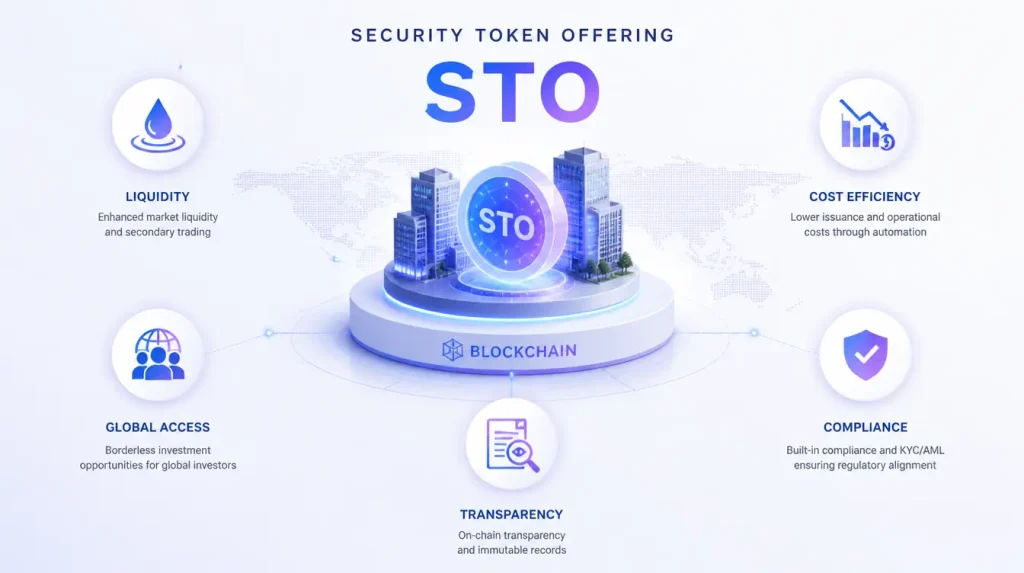
The growing interest in STOs can be attributed to several significant advantages they offer over traditional fundraising methods.
Enhanced Liquidity
One of the most compelling benefits of STOs is the potential for increased liquidity. Traditional securities often involve lengthy settlement processes and limited trading opportunities, particularly for private investments. By tokenizing assets on a blockchain, enterprises can enable faster and more flexible trading, opening up new opportunities for investors.
Global Investment Access
STOs allow enterprises to reach a broader pool of investors beyond geographical boundaries. This is particularly valuable for companies seeking to expand internationally or attract diverse funding sources.
Improved Transparency
Blockchain technology ensures that all transactions are recorded on an immutable ledger, providing a high level of transparency. Investors can verify ownership and transaction history, which enhances trust and reduces the risk of fraud.
Cost Efficiency
By automating processes through smart contracts, STOs reduce the need for intermediaries such as brokers and clearinghouses. This leads to lower operational costs and more efficient capital raising.
Regulatory Compliance
Unlike ICOs, STOs operate within established legal frameworks, providing greater protection for both issuers and investors. This compliance also enhances credibility, making it easier to attract institutional investors.
STO vs ICO vs IPO: Understanding the Differences
To fully appreciate the value of STOs, it is important to compare them with other fundraising models.
ICOs (Initial Coin Offerings) gained popularity due to their accessibility and speed but were often criticized for lack of regulation and investor protection. Many projects faced legal challenges or failed to deliver on their promises.
IPOs (Initial Public Offerings), on the other hand, are highly regulated and offer strong investor protection but involve complex processes, high costs, and limited accessibility for smaller enterprises.
STOs combine the best aspects of both models. They offer the efficiency and innovation of blockchain while maintaining the compliance and trust of traditional financial systems. This balance makes STOs particularly suitable for enterprises seeking a modern yet reliable approach to fundraising.
Use Cases of STOs Across Industries
STOs are not limited to a single industry; they can be applied across various sectors where asset ownership and investment play a role.
In real estate, STOs enable fractional ownership, allowing investors to participate in high-value properties with smaller investments. In finance, they facilitate the tokenization of equities, bonds, and funds, creating more efficient financial markets.
In private equity, STOs provide a way to raise capital while offering liquidity options that are traditionally unavailable. Similarly, in infrastructure projects, tokenization can enable community-based funding and investment.
These use cases highlight the versatility of STOs and their potential to transform how assets are managed and traded.
Challenges in Implementing STOs
Despite their benefits, STOs present several challenges that enterprises must address.
One of the primary challenges is regulatory complexity. Different jurisdictions have varying rules regarding securities, and navigating these requirements can be time-consuming and resource-intensive.
Another challenge is technical implementation. Developing secure and efficient smart contracts requires specialized expertise, and any errors can have significant consequences.
There is also the issue of market infrastructure. While the ecosystem for security tokens is growing, it is still developing compared to traditional financial markets. This can impact liquidity and accessibility.
Finally, enterprises must consider investor education and adoption. Since STOs are still a relatively new concept, potential investors may require additional information and support.
How Blockchain Development Solutions Enable STO Success
Given these complexities, enterprises increasingly rely on blockchain development solutions to successfully implement STOs.
A comprehensive approach begins with strategic consulting to identify the most suitable use cases and assess feasibility. This ensures that the STO aligns with business objectives and regulatory requirements.
Next, technical architecture is designed to support scalability, security, and compliance. This includes selecting the appropriate blockchain platform and designing smart contracts that automate key processes.
Development and testing follow, ensuring that all components function correctly and securely. This is particularly important for STOs, where errors can have financial and legal implications.
Integration with existing systems is another critical step, enabling seamless operation across different platforms and stakeholders.
Finally, ongoing support and optimization ensure that the STO continues to perform effectively as the business grows.
Why Enterprises Choose Outsourced Blockchain Development Solutions
Building in-house capabilities for STO implementation can be challenging, particularly given the specialized skills required. Outsourcing provides a practical alternative that allows enterprises to access expertise without significant upfront investment.
Working with an experienced partner enables faster time-to-market and reduces the risk of technical or regulatory issues. It also allows organizations to scale resources as needed, ensuring flexibility in project execution.
From a strategic perspective, outsourcing allows enterprise teams to focus on business development and investor relations, while technical execution is handled by specialists.
Our Approach to Blockchain Development Solutions for STOs
Our approach to STO implementation is built on a foundation of business alignment, technical excellence, and regulatory awareness.
We begin by understanding the enterprise’s goals and identifying opportunities where STOs can deliver maximum value. This includes evaluating market conditions, investor expectations, and compliance requirements.
From there, we design tailored solutions that leverage the most suitable blockchain technologies. Our focus is on creating systems that are secure, scalable, and easy to manage.
During development, we prioritize quality and reliability, ensuring that all smart contracts and infrastructure components meet the highest standards.
We also support integration with existing systems and provide ongoing optimization to ensure long-term success.
Conclusion
Security Token Offerings represent a significant evolution in how enterprises raise capital and manage assets. By combining blockchain innovation with regulatory compliance, STOs offer a powerful alternative to traditional financial systems.
However, realizing this potential requires more than adopting new technology. It requires a strategic approach that aligns technical solutions with business objectives and market realities.
With the support of experienced blockchain development solutions, enterprises can navigate the complexities of STOs and unlock new opportunities for growth.
For decision-makers, the message is clear: STOs are not just a technological innovation—they are a strategic tool for building more efficient, transparent, and globally accessible financial systems.
Relipa Software
Relipa Co., Ltd. is a Vietnam-based software development company established in April 2016. After two years of growth, our Japanese branch – Relipa Japan – was officially founded in July 2018.
We provide services in MVP development, web and mobile application development, and blockchain solutions. With a team of over 100 professional IT engineers and experienced project managers, Relipa has become a reliable partner for many enterprises and has successfully delivered more than 500 projects for startups and businesses worldwide.
