

When executives discuss artificial intelligence, the conversation usually begins with technology.
Which AI platform should we use?
Should we build a custom model or use an existing one?
How much will implementation cost?
Which use cases offer the highest ROI?
These are important questions. However, in our experience, they are rarely the questions that determine whether an AI initiative succeeds or fails.
Most failed AI projects never fail because of the model.
They fail because the organization wasn’t ready for AI in the first place.
The reality is that many enterprises attempt to deploy AI on top of operational foundations that were never designed to support intelligent systems. Data is fragmented. Business processes are inconsistent. Governance is unclear. Teams have different definitions of success.
Under these conditions, even the most capable AI model will struggle to create meaningful business value.
This is why a good AI development services provider spends less time talking about algorithms in the early stages of engagement and more time understanding an organization’s operational readiness.
Before investing in AI, leaders should ask a simpler question: What needs to be fixed internally before AI can succeed?
The answer often determines the outcome of the entire initiative.
The AI Industry Has a Technology Obsession
One reason organizations struggle with AI adoption is that most discussions focus almost exclusively on technology.
Conferences showcase advanced models. Software vendors promote new AI capabilities. Industry analysts discuss emerging tools and platforms.
As a result, many organizations assume AI success depends primarily on selecting the right technology.
In reality, technology is only one piece of the equation.
AI sits at the end of a much larger chain that includes data quality, operational processes, governance structures, organizational alignment, and business objectives.
If any of those areas are weak, AI simply exposes the weakness faster.
We’ve worked with enterprises that invested heavily in AI pilots only to discover that the underlying issue wasn’t model performance.
The issue was inconsistent data.
Or fragmented business processes.
Or unclear ownership.
Or a lack of measurable business objectives.
The lesson is simple:
AI rarely fixes organizational problems.
More often, it magnifies them.
Many Organizations Don’t Have an AI Problem
They Have a Data Problem.
If there is one issue that appears repeatedly across failed AI initiatives, it is data readiness.
Organizations often believe they possess enormous amounts of data.
In most cases, they do.
The challenge is that data frequently exists across multiple systems with varying levels of quality, accessibility, and consistency.
Customer information may exist in the CRM.
Operational data lives inside ERP platforms.
Support data resides in ticketing systems.
Spreadsheets fill gaps between departments.
Over time, information becomes fragmented.
AI systems, however, depend on reliable and accessible data.
When information is duplicated, incomplete, outdated, or inconsistent, AI outputs become less trustworthy.
Executives are often surprised by how much of an AI project involves preparing data rather than developing models.
In many successful AI programs, data preparation represents a larger effort than model development itself.
This is one reason experienced organizations engage an AI development services provider early in the planning process.
The goal is to assess whether the data environment can realistically support the desired business outcomes.
Poor Process Design Creates Poor AI Outcomes

Organizations frequently assume that AI will improve inefficient workflows.
Sometimes it does.
More often, it automates inefficiencies.
Consider a business process that already suffers from unclear approvals, inconsistent inputs, and manual workarounds.
Adding AI into that environment may increase speed, but it does not necessarily increase effectiveness.
The underlying process remains flawed.
In some cases, AI simply accelerates bad decisions.
This is why successful AI implementation starts with understanding how work actually moves through the business.
- Where do delays occur?
- Which decisions require excessive manual effort?
- Where is information lost?
- Which processes generate the largest operational costs?
The strongest AI use cases typically emerge after organizations improve and standardize these workflows.
AI performs best when operating within clear, repeatable, and well-defined business processes.
Most AI Projects Start Without Clear Business Ownership
Another common issue is organizational ambiguity.
Many AI initiatives begin as technology experiments.
IT teams lead implementation.
Data teams prepare models.
Business stakeholders provide occasional feedback.
Yet no one clearly owns the outcome.
The result is predictable.
Projects move forward without clear accountability.
Use cases expand beyond their original objectives.
Priorities shift.
Success becomes difficult to measure.
Effective AI initiatives require strong business ownership from the beginning.
AI is not primarily a technology investment.
It is a business investment enabled by technology.
This distinction matters.
The departments expected to benefit from AI should play a major role in defining goals, evaluating success metrics, and prioritizing implementation efforts.
Without business ownership, even technically successful projects can fail to deliver value.
Governance Should Exist Before AI Does
Many organizations think about governance after AI implementation begins.
That is usually too late.
Questions surrounding access, compliance, accountability, security, and decision-making authority should be addressed before development starts.
For example:
- Who has access to the training data?
- How is sensitive information protected?
- Who validates AI outputs?
- Who is accountable when the model makes recommendations?
- How are risks monitored?
Without answers to these questions, organizations expose themselves to operational, compliance, and reputational risks.
Strong governance does not slow innovation.
It enables sustainable innovation.
The most successful enterprises build governance frameworks alongside their AI strategies rather than treating governance as a separate initiative.
Organizations Often Overestimate Their AI Maturity
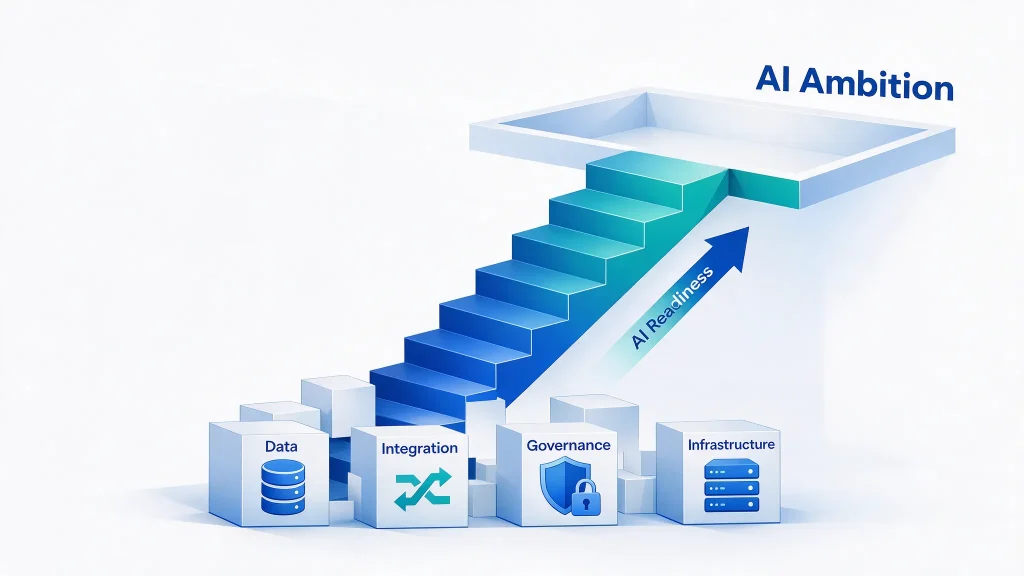
One of the most common patterns we observe is a gap between AI ambition and AI readiness.
Leadership teams may have ambitious goals.
They want intelligent automation.
Predictive insights.
AI-driven customer experiences.
Personalized recommendations.
Advanced analytics.
Yet foundational capabilities remain underdeveloped.
The organization may lack:
- Reliable data management practices
- Integrated systems
- Cross-functional alignment
- AI governance processes
- Scalable infrastructure
AI maturity is not determined by enthusiasm.
It is determined by readiness.
Organizations that accurately assess their current capabilities usually achieve better long-term outcomes because they focus on foundational improvements before pursuing large-scale AI initiatives.
Why Infrastructure Matters More Than Many Leaders Realize
Modern AI systems require more than access to data.
They require an environment capable of collecting, processing, storing, governing, and distributing information effectively.
Many organizations discover that existing infrastructure limits their ability to scale AI.
Legacy systems may not support real-time access.
Applications may be difficult to integrate.
Data pipelines may require significant manual intervention.
As AI workloads grow, these limitations become increasingly visible.
Infrastructure modernization therefore becomes an important part of AI readiness.
The objective is not necessarily replacing every existing system.
The objective is creating an environment where data can move efficiently and support intelligent decision-making.
Why Change Management Is Often Overlooked
AI transformation is frequently discussed as a technology initiative.
In practice, it is also a people initiative.
Employees must understand how AI fits into their workflows.
Managers must adjust decision-making processes.
Teams must learn how to interpret and use AI outputs.
Without proper change management, adoption often becomes the largest obstacle.
The technology may work perfectly.
The organization simply does not use it effectively.
Successful enterprises invest in communication, training, stakeholder alignment, and process redesign as part of their AI programs.
They recognize that organizational adoption matters just as much as technical implementation.
What an AI Development Services Provider Should Evaluate First
When organizations begin exploring AI, many expect development discussions to focus on models, platforms, and implementation timelines.
In reality, an experienced AI development services provider often starts somewhere else.
The initial assessment typically focuses on questions such as:
- Is the data environment ready?
- Are business objectives clearly defined?
- Are processes standardized enough for AI?
- Does governance exist?
- Who owns the outcome?
- Can existing systems support AI integration?
- Is the organization prepared for adoption?
The answers reveal far more about project success than the choice of algorithm.
Organizations that address these questions early are significantly more likely to achieve measurable results.
Read more: AI Software Development Services: Turning AI Investment Into Value
AI Success Begins Long Before Model Development
One misconception persists across many AI initiatives.
The belief that AI development begins when a model starts training.
In reality, successful AI projects begin much earlier.
They begin when organizations improve data quality.
When workflows become more consistent.
When governance structures are established.
When business objectives become measurable.
When leadership aligns around desired outcomes.
By the time model development starts, much of the most important work should already be complete.
This preparation may not feel as exciting as deploying new AI technologies.
However, it is often the difference between a successful implementation and an expensive experiment.
Fix the Organization Before Fixing the Model

Organizations often approach AI as a technology challenge.
The more successful ones recognize that it is ultimately an organizational challenge.
The majority of AI failures occur long before model development begins.
They occur when poor data quality, fragmented processes, unclear ownership, weak governance, and unrealistic expectations create barriers that technology alone cannot solve.
That is why working with an experienced AI development services provider should begin with readiness assessments rather than model selection.
Before investing in AI, organizations should focus on strengthening the foundations that support it.
Because the most important question is not: “Which AI model should we build?”
It is: “Is our organization ready to benefit from AI at all?”
The enterprises that answer that question honestly are the ones most likely to turn AI from a promising idea into measurable business value.
Relipa
Relipa is a Vietnam-based software development company established in April 2016. After two years of growth, our Japanese branch – Relipa Japan – was officially founded in July 2018.
We provide services in MVP development, web and mobile application development, and blockchain solutions. With a team of over 100 professional IT engineers and experienced project managers, Relipa has become a reliable partner for many enterprises and has successfully delivered more than 500 projects for startups and businesses worldwide.
