

 Copy link


AI In Retail: Transforming Efficiency, Personalization, And Customer Experience
Retail organizations are under growing pressure to operate more efficiently while delivering personalized experiences across multiple channels. To meet these demands, many global retailers are moving beyond basic AI tools and investing in comprehensive AI automation solutions that integrate intelligence directly into core business workflows.
Rather than treating artificial intelligence as a standalone innovation project, retailers are embedding AI automation solutions into pricing engines, inventory planning systems, customer engagement platforms, and supply chain operations. This shift enables organizations to move from reactive reporting to predictive and autonomous decision-making.
AI automation solutions combine machine learning, advanced analytics, real-time data processing, and workflow automation. When properly implemented, these systems transform fragmented retail data into coordinated, actionable intelligence that scales across enterprise operations.
This blog explores how AI automation solutions are reshaping retail environments, where they create the most measurable business impact, and how retailers can strategically implement them for sustainable growth.
Overview of AI in Retail
When we refer to AI in retail today, we are increasingly talking about full-scale AI automation solutions rather than isolated machine learning experiments. These solutions combine predictive modeling, computer vision, natural language processing (NLP), optimization algorithms, and generative AI into integrated automation frameworks.
AI automation solutions in retail are commonly applied to:
-
Merchandising and assortment optimization
-
Demand forecasting and replenishment
-
Pricing and promotion management
-
Customer personalization
-
Loss prevention and fraud detection
-
Workforce scheduling
-
Store operations and compliance
Unlike traditional automation systems that rely on predefined rules, AI automation solutions continuously learn from new data inputs. They improve performance over time by adjusting models based on customer behavior, operational shifts, and market changes.
Deployment models vary depending on organizational maturity. Some retailers adopt SaaS-based AI automation solutions, while others build custom enterprise AI architectures integrated directly into ERP, CRM, and commerce platforms. The key distinction is not deployment style, but integration depth. The most successful retailers embed AI automation solutions directly into operational decision loops.
Market growth reflects this structural shift. Industry research consistently shows rapid expansion in AI investment across retail sectors, signaling that intelligent automation is becoming foundational infrastructure rather than optional innovation.
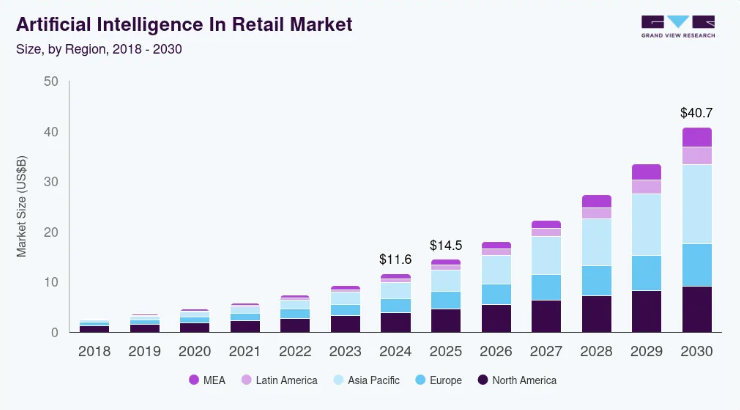 Source: Grand View Research
Market-size estimates and adoption surveys show rapid expansion of AI in retail as a commercial category. One market research estimate places the global AI in retail market at roughly USD 11.6 billion in 2024, with expected continued growth in the coming years.
Adoption is already material: a 2024 industry report found that about 42% of surveyed retailers were already using AI, with many larger organizations further along in deployment. That mix of adopters and pilots means that practical lessons are available now for companies of most sizes.
Benefits of AI in Retail
Revenue Uplift through Better Personalization
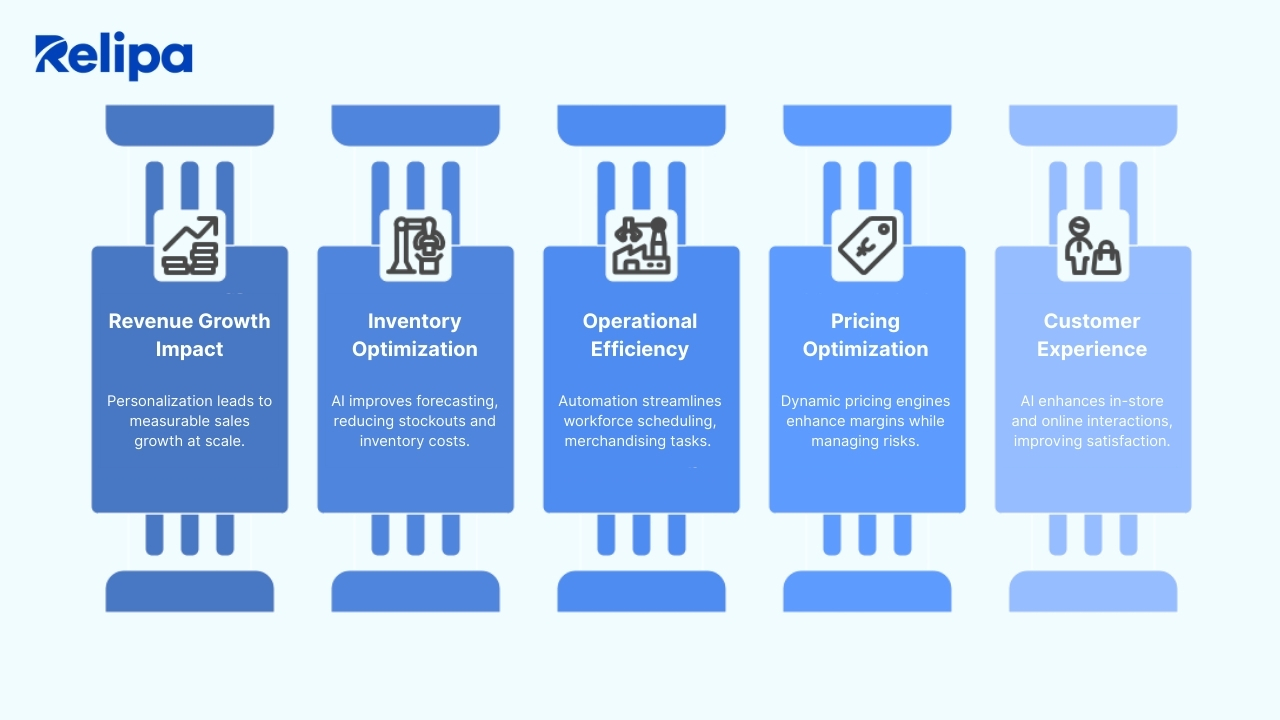
Personalization remains one of the strongest drivers of return on AI automation solutions. By analyzing behavioral signals, transaction history, browsing patterns, and contextual data, AI systems deliver highly individualized recommendations in real time.
Advanced AI automation solutions do more than suggest products. They optimize:
-
Product ranking order
-
Promotional incentives
-
Content presentation
-
Cross-sell and upsell timing
-
Customer lifecycle messaging
Research consistently indicates revenue uplift between 5–15% when personalization is deployed effectively. AI automation solutions enable this impact by continuously retraining models based on engagement outcomes, ensuring that personalization improves rather than stagnates.
The shift from segmented marketing to individual-level inference marks a fundamental change in how retail decisions are made.
. (Source: McKinsey & Company)
Improved Forecasting and Lower Inventory Costs
Inventory mismanagement remains one of the costliest challenges in retail. AI automation solutions enhance demand forecasting by combining internal sales data with external variables such as weather, local events, economic indicators, and social signals.
Traditional forecasting relies on historical averages. AI automation solutions apply probabilistic modeling, scenario simulation, and continuous recalibration to produce more accurate SKU-level predictions.
Retailers implementing these systems often report:
-
Reduced stockouts
-
Lower safety stock requirements
-
Decreased inventory holding costs
-
Improved fulfillment reliability
By automating replenishment triggers based on predictive thresholds, AI automation solutions reduce manual intervention and accelerate response times across supply networks.
More Efficient Operations and Labor Allocation
Workforce management and store operations involve complex scheduling decisions. AI automation solutions analyze traffic patterns, transaction volume, and seasonal demand to optimize staffing levels.
Instead of manually adjusting schedules, managers receive predictive staffing recommendations aligned with forecasted foot traffic. Automation systems also prioritize in-store tasks such as replenishment, shelf audits, and promotional setup.
These operational AI automation solutions reduce labor inefficiencies while preserving service quality. Employees spend less time coordinating routine tasks and more time engaging customers or solving exceptions.
Better Pricing and Margin Optimization
Pricing decisions require balancing competitiveness, profitability, and customer trust. AI automation solutions evaluate demand elasticity, competitor pricing, product lifecycle stage, and inventory levels simultaneously.
Dynamic pricing engines powered by AI automation solutions enable:
-
Region-specific pricing adjustments
-
Channel-based price differentiation
-
Real-time promotional optimization
-
Margin simulation under varying demand conditions
However, intelligent pricing must be governed carefully. Transparent guardrails, audit logs, and fairness controls are essential components of responsible AI automation solutions. Retailers that embed governance directly into pricing algorithms protect both revenue and brand integrity.
. (Source: Tom’s Guide)
Enhanced Customer Experience and Conversion
Customer experience improvements extend beyond digital personalization. AI automation solutions enhance physical store operations through computer vision systems that monitor shelf availability, detect checkout queues, and verify planogram compliance.
Online, AI-powered assistants synthesize product information, availability, and reviews into conversational responses that accelerate purchase decisions.
These intelligent systems reduce friction at every touchpoint, improving conversion rates while lowering operational inefficiencies.
Use Cases of AI in Retail
Demand Forecasting and Inventory Optimization
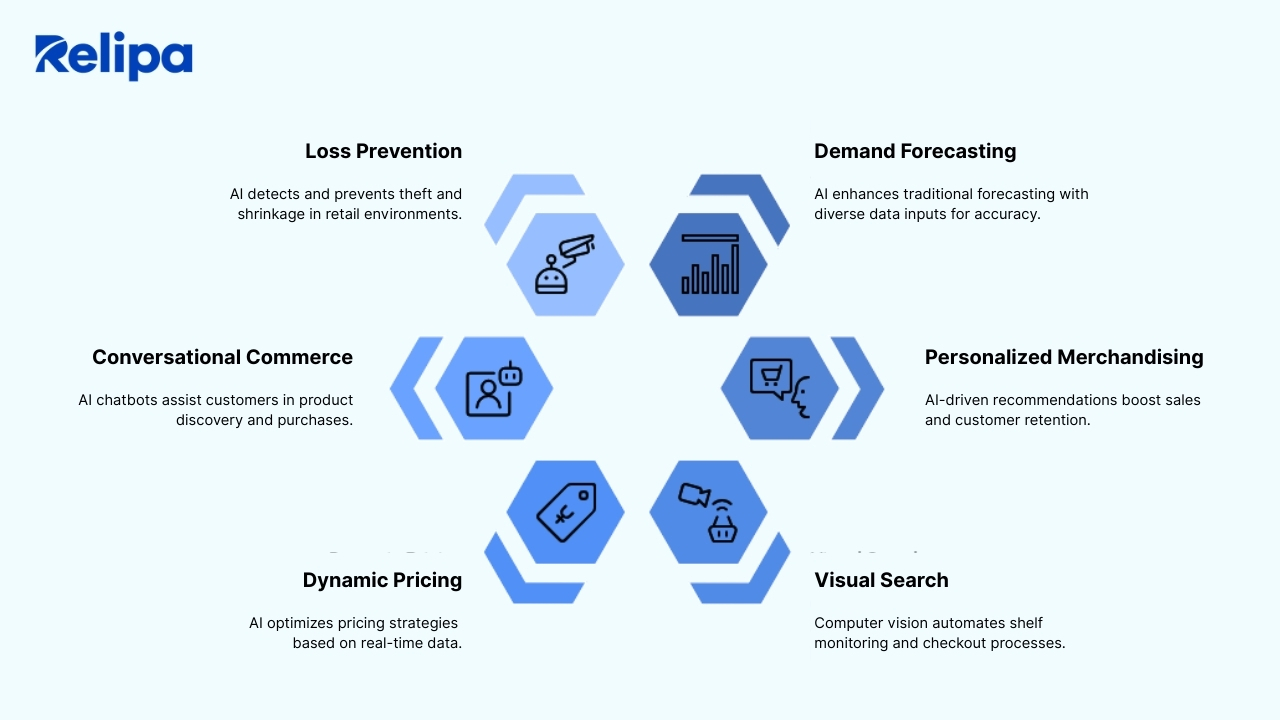
AI automation solutions transform forecasting into a continuously learning system. Instead of recalculating projections monthly or quarterly, models update dynamically as new data flows into the system.
Automated replenishment engines generate purchase recommendations based on predictive safety stock calculations. This reduces both understock and overstock scenarios, improving working capital efficiency.
Personalized Merchandising and Recommendation Engines
Modern recommendation systems rely on neural networks, collaborative filtering, and hybrid modeling approaches. AI automation solutions personalize homepage content, product bundles, and email campaigns at scale.
Unlike static recommendation widgets, automated systems continuously evaluate click-through rates, conversion data, and customer retention patterns to refine algorithms in real time.
Personalization becomes an automated revenue engine rather than a marketing experiment.
Visual Search and Computer Vision in Stores
Computer vision technologies are central components of AI automation solutions. Cameras combined with machine learning models monitor shelf conditions, detect misplaced items, and identify out-of-stock products.
These systems automatically generate task notifications for store associates, reducing audit time and improving merchandising accuracy.
Visual search capabilities also enable customers to upload images and find similar products instantly, improving discovery and conversion.
Dynamic Pricing and Promotion Optimization
AI automation solutions simulate promotional scenarios before execution. Retailers can test multiple discount depths, timing strategies, and bundling combinations through predictive modeling. By forecasting expected uplift and margin impact, retailers deploy promotions with greater confidence and reduced risk of cannibalization. Automation ensures pricing decisions align with strategic objectives rather than short-term revenue pressure.
Conversational Commerce and Virtual Shopping Assistants
Conversational AI, from rule-based chatbots to generative assistants, helps customers discover products and complete purchases. Some retailers now integrate assistant bots that can pull up in-stock items, suggest bundles, and even complete checkout flows. Early adopters have seen improvements in conversion for visitors who interact with these bots, especially on mobile.
Loss Prevention and Security
AI in retail computer-vision systems detects suspicious behaviors and patterns correlated with shrinkage, enabling faster interventions. When combined with POS analytics, these systems help close the loop between detection and resolution while producing measurable reductions in loss.
The Future of AI in Retail
Generative AI for Discovery and Content at Scale
Generative models will automate product descriptions, generative tailored merchandising content, and fuel AI assistants that synthesize product comparisons. Retailers that combine product data with controlled generative outputs will scale content creation while preserving brand voice.
AI Agents and Autonomous Shopping Flows
Personal AI agents that autonomously shop on behalf of consumers, negotiating, comparing, and purchasing, will start to influence discovery and conversion. Retailers should prepare product metadata and trust signals so AI agents can make correct choices. Industry commentary already highlights this shift and its implications for discoverability.
Tighter Integration of AI Across Omnichannel Operations
The most successful AI in retail deployments will unify online and in-store signals: inventory, customer behavior, and loyalty data will be combined to deliver seamless experiences and smarter fulfillment.
Responsible AI Governance Becomes Standard Practice
Beyond ad hoc compliance, leading retailers will formalize model registries, bias testing, and human-in-the-loop approval workflows for customer-impacting decisions.
Edge and Real-time AI in Physical Stores
Low-latency models running at the edge on cameras and sensors will enable real-time (e.g., dynamic signage, immediate restocking alerts), improving in-store experiences and operational efficiency. Market and advisory commentary from both research firms and consulting organizations reinforce that personalization and operational optimization will remain core ROI drivers, while generative capabilities will open new channels for customer engagement. (Source: McKinsey)
Read more: Top AI Trends In Retail in 2026: How Intelligent Systems Are Redefining Global Commerce
Conclusion
AI automation solutions have evolved from experimental projects into strategic infrastructure for modern retail enterprises. They drive measurable improvements in forecasting accuracy, margin optimization, personalization performance, and operational efficiency.
Retailers that move beyond isolated pilots and embed AI automation solutions into core operating models will gain sustained competitive advantage. Success depends not only on technology deployment, but on structured governance, scalable architecture, and continuous optimization.
As retail continues to digitize and customer expectations intensify, AI automation solutions will define the next phase of industry transformation. Organizations that invest strategically today will build resilient, adaptive, and intelligence-driven retail ecosystems capable of thriving in an increasingly complex market landscape.