

 Copy link


Top AI Trends in Healthcare (2026 Guide) for AI Development Services
Artificial intelligence is transforming healthcare delivery at an unprecedented pace. From diagnostics to operations, AI systems are reshaping how medical professionals diagnose diseases, manage patient care, and optimize workflows. For healthcare organizations planning digital transformation projects — especially those working with an AI development services partner — understanding the major AI trends in healthcare is essential to make strategic investments that deliver measurable impact.
In this article, we explore the top AI trends in healthcare for 2026 and beyond, highlight real-world applications, and provide guidance on how to approach implementation with scalable and compliant AI solutions.
Top 5 AI Trends in Healthcare
AI-Augmented Diagnostic Imaging
Among all AI trends in healthcare, AI-augmented radiology and diagnostic imaging remain the most clinically validated and widely adopted. AI systems can analyze imaging data — including X-rays, CT scans, MRI, and mammography — faster and with high accuracy, assisting radiologists in detecting anomalies that can be subtle or easily missed by human review alone.
Recent large-scale clinical studies reinforce this trend. For example, a 2024 prospective breast-cancer screening study in Germany involving more than 463,000 women showed that AI-assisted screening increased cancer detection rates by approximately 17.6% without raising recall rates. A multicenter trial in Korea also reported a 13.8% improvement in detection accuracy in mammography using AI systems.
These results demonstrate not only improved clinical accuracy but also strong potential for workflow efficiency. Integrating AI into imaging pipelines is a priority for health systems aiming to handle rising imaging volumes driven by aging populations and increasing screening programs.
Implementation Considerations
Deploying AI for imaging requires careful integration with clinical workflows and Picture Archiving and Communication Systems (PACS). Models must generalize across different scanner types and population demographics, and hospitals must establish monitoring frameworks to detect performance drift over time.
Role of AI Development Services: Advanced AI development services help design and integrate these solutions, configuring explainability mechanisms (such as heatmaps or confidence scoring) and ensuring seamless EHR/PACS connectivity.
AI-Powered Clinical Decision Support (CDS) and Risk Prediction

Another leading trend is the adoption of AI-powered clinical decision support systems (CDS). These systems process vast and diverse healthcare data — including labs, vitals, imaging, and electronic health records (EHRs) — to generate risk scores and recommendations that augment clinician judgment.
These tools are especially impactful in time-sensitive settings such as emergency departments and intensive care units. For example, an npj Digital Medicine study from 2024 showed that AI-based sepsis prediction systems, when integrated with rapid response protocols, were associated with up to a 20% reduction in mortality. Separate work at Mayo Clinic found that AI-enhanced ECG analysis could identify left ventricular dysfunction with sensitivity around 90%.
Implementation Considerations
Effective CDS requires governance policies that ensure AI guidance supports, rather than overrides, clinical judgment. Integration with EHR workflows is essential to minimize alert fatigue, and systems must enable transparent outputs that clinicians can trust in real time.
Role of AI Development Services: AI partners can help build CDS solutions that align with clinical work patterns, regulatory requirements, and ongoing performance evaluation frameworks.
Hospital Workflow Automation and Operational AI
While clinical applications draw the most attention, operational AI is one of the fastest-growing trends in healthcare. Administrative demands — such as documentation, scheduling, coding, and resource planning — continue to strain clinical capacity. AI systems are now automating these tasks, improving productivity while reducing human error.
In 2024, the American Medical Association reported that generative AI documentation systems reduced clinician note-taking time by about 28%, enabling physicians to spend more time on direct patient care. Real-time bed management, automated triage, and patient flow optimization solutions are also gaining traction in high-volume settings.
Implementation Considerations
Operational AI must work with standard clinical data and comply with privacy and consent requirements, particularly for systems that collect continuous or passive inputs. Clear escalation protocols must be defined so that high-risk alerts trigger appropriate human intervention.
Role of AI Development Services: Experienced AI development services teams play a critical role in architecting operational automation solutions that integrate with care pathways and existing clinical systems.
Personalized Medicine and AI-Driven Treatment Optimization
Personalized medicine — where treatments are tailored to an individual’s genetic, lifestyle, and clinical data — is rapidly becoming a reality thanks to AI. Predictive models now help clinicians forecast patient responses to therapies, identify optimal treatment plans, and minimize side effects across specialties such as oncology and cardiology.
A 2023 Nature Medicine study found that AI-assisted precision oncology workflows improved treatment-matching accuracy by 32% compared with traditional tumor board decisions, illustrating how AI can elevate precision in therapeutic choices.
Implementation Considerations
AI systems supporting personalized care must be validated on local datasets to avoid bias and performance degradation. Thresholds for clinical alerts must be tuned to minimize alarm fatigue, and transparent reasoning is essential for clinician acceptance.
Role of AI Development Services: Building AI systems for personalized medicine is inherently complex, often requiring multimodal data integration and advanced predictive analytics — areas where specialized AI development services provide significant technical leadership.
Ambient Clinical Documentation and AI-Driven Workflow Tools
One of the most transformative trends in healthcare today is ambient clinical documentation. Clinicians often report spending a majority of their time on documentation, detracting from direct patient care. AI-enabled ambient listening tools — which capture spoken clinical conversations and automatically generate structured notes — are redefining this workflow.
Platforms with NLP-based clinical note generation have shown documentation time reductions of up to 50% in some large health systems, and improved completeness of clinical notes significantly enhances both care quality and billing accuracy.
Implementation Considerations
Ambient AI must integrate with existing EHR platforms while ensuring compliance with privacy regulations. Providers should be trained to review and edit AI-generated content, and auditing processes are necessary to maintain accuracy and prevent regulatory issues.
Role of AI Development Services: Delivering ambient documentation systems that are secure, compliant, and clinician-friendly requires deep expertise in natural language processing, EHR integration, and user experience design.
AI Market Dynamics and Healthcare Investment Landscape
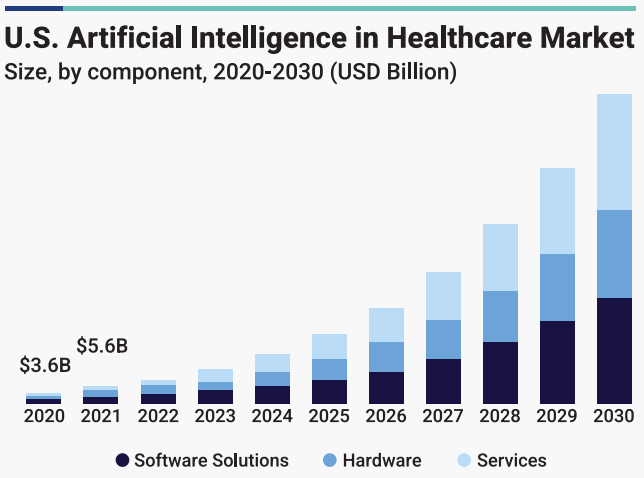
The global AI in healthcare market continues to expand rapidly. While older estimates projected growth from approximately $18.16 billion in 2024 to $72.85 billion by 2029 (reflecting a CAGR near 31.7%), newer forecasts suggest ongoing acceleration driven by enterprise demand and integration of AI across value chains.
Investment trends show volatility in startup funding, but healthcare AI remains a priority for digital transformation. Even as global venture funding fluctuates, major health systems, insurers, and governments continue to invest in AI solutions that deliver clinical quality improvements and operational efficiencies.
For organizations considering AI initiatives, partnering with an AI development services provider helps navigate implementation complexity, compliance, and evolving industry requirements.
Strategic Considerations for Healthcare AI Projects
When planning AI initiatives in healthcare, several strategic themes consistently emerge:
- Clinical Validation and Safety: AI solutions, especially in diagnosis or decision support, must undergo rigorous validation. Performance across varied clinical populations and practice settings is critical for safe deployment.
- Integration and Workflows: AI should enhance clinician work patterns, not disrupt them. Deep integration with EHR systems and clinical workflows is essential for adoption and value realization.
- Ethics, Explainability, and Governance: As AI influences care decisions, systems must be transparent and auditable. Governance frameworks and bias mitigation strategies are necessary to build trust among clinicians and patients.
- Data Protection and Compliance: Healthcare data is highly regulated. AI systems must adhere to HIPAA, GDPR, and local privacy laws, with strong safeguards for patient confidentiality and consent.
An experienced AI development services partner can help healthcare organizations navigate these challenges, translating strategic goals into practical, compliant, and scalable AI solutions.
Conclusion
The future of healthcare is being reshaped by AI, with trends in diagnostic imaging, clinical decision support, workflow automation, personalized medicine, and ambient documentation taking center stage. These innovations promise not only improved outcomes and operational efficiencies but also new opportunities for delivering more proactive, patient-centric care.
For healthcare organizations and providers looking to implement these technologies, working with AI development services is not just a convenience — it’s a strategic enabler. With specialized expertise in data engineering, model development, integration, and compliance, such partners help ensure that AI solutions are safe, effective, and built to scale.
As AI continues to mature in healthcare, the organizations that prioritize thoughtful planning, ethical governance, and deep integration of AI systems will be best positioned to capture long-term value for patients and providers alike.
Relipa Software
Relipa Co., Ltd. is a Vietnam-based software development company established in April 2016. After two years of growth, our Japanese branch – Relipa Japan – was officially founded in July 2018.
We provide services in MVP development, web and mobile application development, and blockchain solutions. With a team of over 100 professional IT engineers and experienced project managers, Relipa has become a reliable partner for many enterprises and has successfully delivered more than 500 projects for startups and businesses worldwide.