

 Copy link


Artificial Intelligence Development Companies for Business
In today’s hyper-competitive market, standing still is the fastest way to fall behind. Businesses are constantly searching for the next great leap forward—a way to enhance efficiency, delight customers, and unlock new revenue streams. That leap is no longer a distant concept from science fiction; it’s here, and it’s powered by artificial intelligence. The transformative power of AI is reshaping industries, from automating mundane tasks to predicting future market trends with startling accuracy. For forward-thinking leaders, the question is no longer if they should adopt AI, but how—and which artificial intelligence development companies can help them do it effectively.
At its core, artificial intelligence services refer to a broad range of solutions that leverage AI technologies to solve specific business problems. These aren’t just abstract algorithms; they are tangible tools and strategies designed to deliver measurable results. This article will serve as your comprehensive guide to the world of AI for business and the role of artificial intelligence development companies in turning AI concepts into real-world solutions. We will demystify the core technologies, explore the tangible benefits driving adoption, and detail practical applications across various departments. Furthermore, we will provide actionable advice on implementing AI and choosing the right development partner to help you make strategic decisions that will define your company’s future.

What exactly are artificial intelligence services?
- Machine Learning (ML): This is the engine of most modern AI. ML algorithms are trained on vast datasets to recognize patterns. Instead of being explicitly programmed for a task, they learn from experience. For example, an ML model can analyze historical sales data to predict future demand for a product.
- Deep Learning (DL): A more advanced subset of ML, deep learning uses complex “neural networks” with many layers to identify intricate patterns. It’s the technology behind facial recognition and complex language translation, capable of processing highly unstructured data like images and audio.
- Natural Language Processing (NLP): NLP gives machines the ability to read, understand, interpret, and generate human language. It’s the magic behind chatbots that understand customer queries and sentiment analysis tools that gauge public opinion from social media.
- Computer Vision: This field of AI trains computers to interpret and understand the visual world. From identifying defects on a manufacturing line to analyzing medical images, computer vision automates tasks that rely on sight.
- Robotic Process Automation (RPA) with AI: While basic RPA automates rule-based, repetitive tasks, intelligent automation infuses it with AI capabilities. This allows bots to handle exceptions, process unstructured data (like invoices in different formats), and make simple decisions, dramatically expanding the scope of automation.
Providers typically package these technologies into distinct service categories to meet diverse business needs. Artificial intelligence development companies structure these offerings to help organizations adopt AI in a scalable, secure, and results-driven way:
- AI Consulting and Strategy Development: Experts help you identify opportunities for AI, define a clear roadmap, and build a business case for investment.
- Custom AI Model Development: For unique challenges, data scientists can build and train bespoke models tailored to your specific data and objectives.
- AI-powered Software Integration: This involves enhancing your existing systems, like CRMs or ERPs, with AI features such as predictive lead scoring or intelligent inventory management.
- Managed AI Services: A provider handles the ongoing operation, maintenance, and optimization of your AI systems, allowing you to focus on your core business.
- Data Science and Analytics Services: These services focus on extracting deep, actionable insights from your data to inform strategic decision-making.
To understand what AI development companies actually build, it helps to look at the core technologies behind AI service development.
Why Businesses Are Embracing AI-Based Services
The rapid adoption of ai based services isn’t driven by hype; it’s fueled by a suite of compelling benefits that deliver a significant return on investment. Companies that work with experienced artificial intelligence development companies are not just improving existing processes—they are fundamentally changing how they operate, compete, and create value. These advantages span every facet of the organization, making a powerful case for embracing this technological revolution.This is why many organizations choose to partner with artificial intelligence development companies instead of building complex AI systems entirely in-house.
According to McKinsey’s research on AI adoption, companies using AI at scale report significant productivity gains, reinforcing why artificial intelligence development companies play a critical role in helping businesses move from experimentation to real-world impact.
Enhanced Operational Efficiency
At its most practical level, AI is an engine for optimization. By automating repetitive, time-consuming tasks and workflows, businesses can free up their human workforce to focus on more strategic, creative, and high-value activities. For instance, AI can process thousands of invoices, sort customer support tickets, or manage data entry with near-perfect accuracy and 24/7 availability. This automation extends to complex areas like supply chain management, where AI models can optimize logistics routes in real-time to save fuel and time. The result is a leaner, more productive operation with reduced human error and greater consistency across the board.
Superior Customer Experience
In an age where customer loyalty is paramount, AI offers powerful tools to create personalized and responsive experiences. AI-powered chatbots and virtual assistants provide instant, round-the-clock support, resolving common queries without human intervention. Recommendation engines, famously used by Netflix and Amazon, analyze user behavior to suggest products and content tailored to individual tastes. Furthermore, predictive AI can anticipate customer needs or potential churn risks, allowing businesses to proactively reach out with solutions or special offers, transforming customer service from a reactive cost center into a proactive, value-driving function.
Data-Driven Decision Making
Businesses today are flooded with data, but much of it remains untapped. AI provides the key to unlock its potential. Machine learning algorithms can sift through massive, complex datasets to uncover hidden patterns, correlations, and actionable insights that would be impossible for a human analyst to find. Predictive analytics allows organizations to forecast future trends, from sales figures to market fluctuations, enabling more informed and confident strategic planning. By replacing gut feelings with data-backed evidence, AI empowers leaders to identify new market opportunities, mitigate risks, and make smarter decisions at every level.
Competitive Advantage and Innovation
Adopting ai based services is no longer just about keeping up; it’s about leading the pack. AI can be the catalyst for groundbreaking innovation, enabling the development of entirely new products and services. Think of smart home devices that learn your routines or financial apps that provide personalized investment advice. By leveraging AI, companies can move faster, adapt to market shifts more quickly, and deliver value in ways their competitors cannot. This fosters a culture of innovation, where data and experimentation drive the next generation of business growth.
Implementing Artificial Intelligence Services: Best Practices and Challenges
Successfully integrating artificial intelligence services is more than a technical project; it’s a strategic business transformation. It requires careful planning, a solid data foundation, and a culture that is ready to embrace change. While the rewards are significant, the path is often paved with challenges. Following best practices can help you navigate this journey and avoid common pitfalls.
Developing a Robust AI Strategy
Before writing a single line of code, you need a clear vision. Start by defining specific, measurable business objectives. What problem are you trying to solve? Are you looking to reduce operational costs by 15%, increase customer retention by 10%, or accelerate product development? Your goals will guide your entire approach. Conduct an honest assessment of your current capabilities—your data, technology, and talent. From there, you can identify the areas where AI will have the most significant impact and create a phased implementation roadmap. Starting with a smaller, well-defined pilot project can build momentum and demonstrate value before scaling up.
Data Readiness and Management
Data is the lifeblood of AI. Without high-quality, accessible data, even the most sophisticated algorithms will fail. This is often the biggest hurdle for businesses. You must ensure your data is clean, accurate, and well-organized. This involves breaking down data silos, where information is trapped in separate departments, and investing in a centralized data infrastructure like a data warehouse or data lake. Equally important are data governance, privacy, and security. You must establish clear policies for how data is collected, stored, and used, ensuring compliance with regulations like GDPR and building trust with your customers.
Overcoming Common Challenges
The journey to AI adoption is not without its obstacles. Being aware of them is the first step to overcoming them:
- High Initial Investment: AI projects can require significant upfront costs for technology, talent, and data infrastructure. A strong business case with a clear ROI projection is essential to secure executive buy-in.
- Integration Complexities: Making new AI systems work seamlessly with your existing legacy software can be technically challenging and time-consuming.
- Lack of Skilled Personnel: Data scientists and AI specialists are in high demand and can be difficult to hire. Many businesses address this by upskilling their existing workforce and partnering with external AI service providers.
- Ethical AI and Governance: It’s crucial to address potential issues like algorithmic bias, which can lead to unfair outcomes. Establishing a framework for responsible AI—one that prioritizes transparency, fairness, and accountability—is non-negotiable for long-term success.
Choosing the Right Partner for Your AI Services Journey
Selecting the right partner for your artificial intelligence services is one of the most critical decisions you’ll make.Many organizations choose AI development outsourcing or a dedicated AI development team to reduce risk, accelerate delivery, and access specialized expertise. The right artificial intelligence development companies do more than deliver software—it acts as a strategic partner that understands your business goals, data environment, and long-term growth strategy.Experienced artificial intelligence development companies combine technical expertise, industry knowledge, and long-term support to ensure AI success.Choosing the right provider of AI services can significantly impact project success, from data quality and model performance to deployment speed and ROI.
Identifying Your Needs and Evaluating Partners
First, clearly define your project’s scope, budget, and desired timeline. Do you need a consultant to help you build a strategy, a development team to create a custom solution, or a managed platform to handle a specific function? Once you know what you’re looking for, you can evaluate potential partners based on a few key criteria:
- Expertise and Experience: Look for a provider with a proven track record. Ask for case studies and client references, preferably from businesses in your industry or with similar challenges. Their past success is a strong indicator of their future performance.
- Technology Stack and Scalability: Assess their proficiency with the AI tools, platforms, and programming languages relevant to your project. Crucially, ensure that the solutions they build are scalable—they must be able to grow with your business and handle increasing data volumes and complexity.
- Support and Maintenance: An AI model is not a “set it and forget it” solution. It requires ongoing monitoring, tuning, and maintenance. Understand the provider’s post-implementation support model to ensure your system remains effective over the long term.
- Security and Compliance: Your data is one of your most valuable assets. Verify the provider’s adherence to stringent data protection and security standards to safeguard your information and ensure regulatory compliance.
When you engage with potential partners, don’t be afraid to ask tough questions. Inquire about their project management methodology, their approach to data ownership and intellectual property, and how they measure success. A transparent and collaborative partner will welcome these discussions.
Customization vs. Off-the-Shelf Solutions
One key decision is whether to opt for a fully customized solution or a pre-built, off-the-shelf platform. Each has its advantages, and the right choice depends on your specific needs, budget, and timeline.
Feature Custom AI Solution Off-the-Shelf AI Platform Fit Tailored specifically to your unique business processes and data. Designed for general use cases; may require process adjustments. Cost Higher initial development cost. Lower upfront cost, typically a subscription model (SaaS). Time to Implement Longer development and implementation timeline. Faster to deploy and start using. Competitive Edge Can create a unique, proprietary advantage that is difficult for competitors to replicate. Provides access to powerful tools, but competitors can use the same platform. Flexibility Highly flexible and can be adapted as your needs evolve. Limited by the vendor’s feature roadmap and customization options.
The Future Landscape of Artificial Intelligence Services
The field of artificial intelligence is evolving at a breathtaking pace. What seems like cutting-edge technology today will be standard practice tomorrow. For businesses, this means that adopting AI is not a one-time project but an ongoing journey of adaptation and innovation. Staying aware of emerging trends is crucial for maintaining a competitive edge and preparing for what’s next.
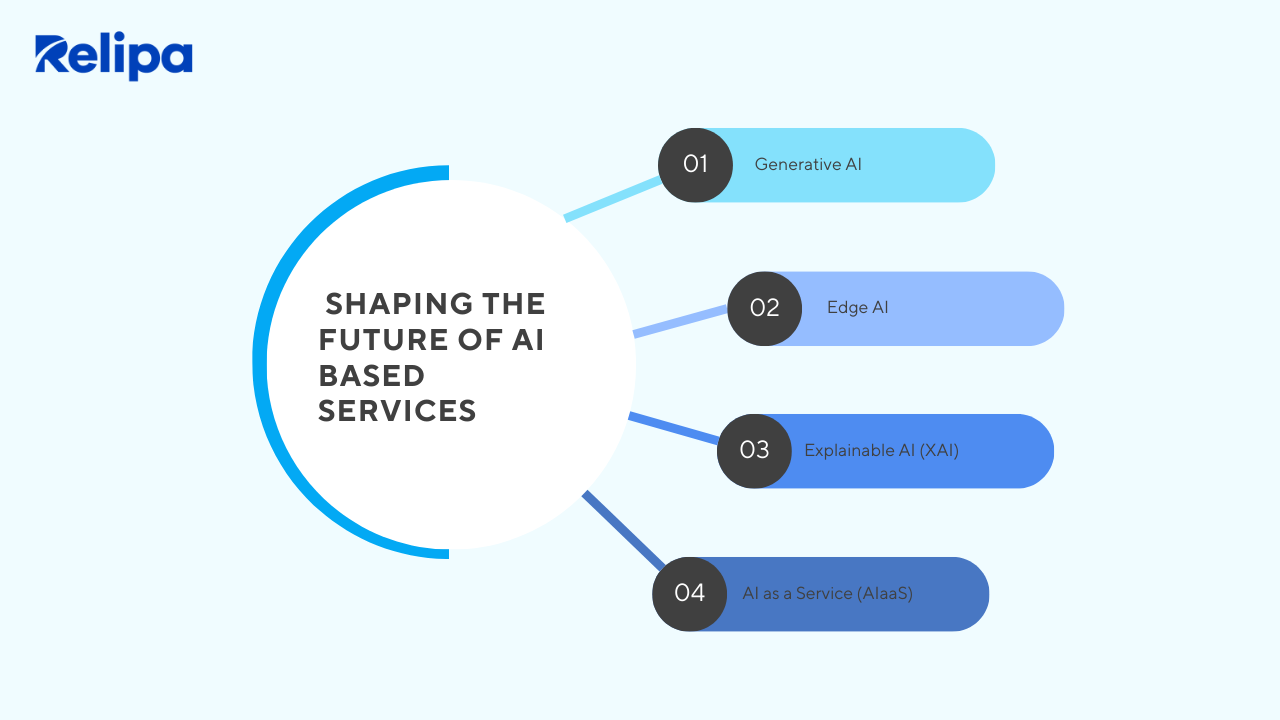
Several key trends are shaping the future of ai based services:
- Generative AI: Beyond analyzing existing data, generative models like GPT-4 can create entirely new content, from text and images to code and music. This has enormous potential for automating content creation, product design, and software development.
- Edge AI: Traditionally, AI processing happens in the cloud. Edge AI involves running algorithms directly on devices like smartphones, factory sensors, or cars. This reduces latency, improves privacy, and allows for real-time decision-making without constant internet connectivity.
- Explainable AI (XAI): As AI models become more complex, their decision-making processes can become “black boxes.” XAI is an emerging field focused on developing techniques to make AI decisions more transparent and understandable to humans, which is crucial for building trust and accountability, especially in regulated industries like finance and healthcare.
- AI as a Service (AIaaS): The growing availability of pre-built AI tools and platforms from major cloud providers (like Google, Amazon, and Microsoft) is democratizing access to artificial intelligence. This allows smaller businesses without large R&D budgets to easily integrate powerful AI capabilities into their applications.
The continuous evolution of these technologies means that the potential applications of AI will only expand. Businesses must foster a culture of lifelong learning and be prepared to experiment with new tools and approaches to unlock future opportunities.
Embrace the Future with Artificial Intelligence Services
Working with the right artificial intelligence development companies allows businesses to reduce risk while accelerating AI adoption.The integration of artificial intelligence services is no longer a luxury reserved for tech giants; it is a strategic imperative for any business aiming to thrive in the digital age. Through expert design, development, and integration, artificial intelligence development companies help organizations turn data into intelligence and intelligence into measurable business outcomes.
For companies seeking to innovate, scale, and compete in a data-driven world, partnering with the right artificial intelligence development company is no longer optional—it is a strategic necessity.