
As Web3 continues to evolve, MetaFi is emerging as a new trend that connects blockchain, DeFi, NFTs, GameFi, SocialFi, and Metaverse into an interconnected digital economy. By combining digital ownership, decentralized finance, and blockchain-based ecosystems, MetaFi creates new opportunities for businesses to develop innovative products, improve user engagement, and build new digital business models.
This article explores MetaFi’s key concepts, real-world applications across industries, and how Blockchain Development Services enable businesses to build secure, scalable, and decentralized MetaFi ecosystems.
What is MetaFi?
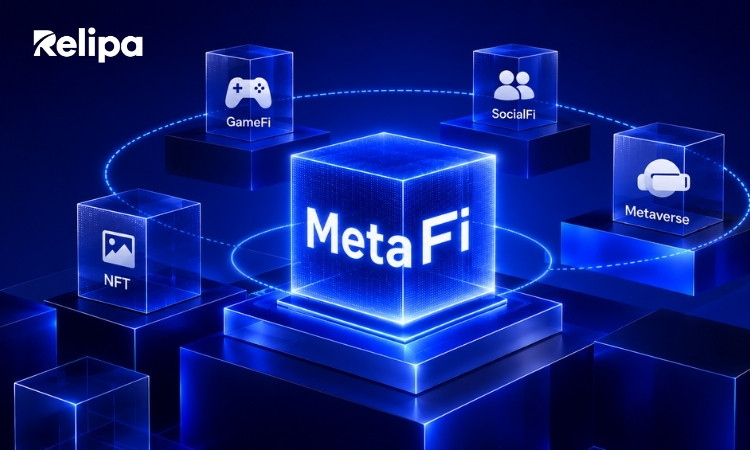
“MetaFi” comes from “Metadata” and “DeFi”, which means trying to tune up blockchain-tradeable content and products developed using all kinds of digital data as productive and profitable entities using (blockchain-based) Decentralized finance (DeFi).
In the world of digital communication, after Web1.0 of the Internet Genesis and Web2.0, which enables interactive communication widely centered on SNS, the world has entered the phase of Web3.0, which is a decentralized service based on blockchain technology. As we all know, the development and spread of blockchain cannot be talked about without crypto assets.
As represented by Bitcoin, the functions of crypto assets were originally only remittance and settlement, and the meaning of their existence was mostly created by the speculators who expected the price would increase. Ethereum made a big splash. With the advent of Ethereum, which enables application development incorporating smart contracts, the landscape of the blockchain economic zone will change completely toward the transition to Web3.0.
Based on the Ethereum blockchain, NFTs have made it possible to grant unique ownership to digital data with irreplaceable tokens. The game that utilizes the NFT has created an epoch-making Game Fi in which profits can be earned by playing and selling characters. In addition, Social Fi, where rewards are generated by the number of followers on SNS and the influence of remarks, Metaverse, which tries to copy all economic activities from real to virtual through avatars in virtual space, and shifts to an innovative approach while arranging. These seemingly separated projects will be connected with Ethereum’s DeFi (decentralized finance) as the key.
DeFi is a next-generation financial platform that does not go through traditional centralized entities such as banks and securities. By providing this DeFi infrastructure, the above-mentioned services and products originating from the Paradigm blockchain can be grown into low-cost, usability-rich, and profitable products, and seamlessly linked and integrated. The concept of MetaFi is to open up a new paradigm.
MetaFi – Some Essential Keywords
MetaFi is just a concept, and there is nothing clear yet. However, let’s introduce the keywords to make it easier to imagine and deepen the understanding of the world that will be created in the future.
Decentralized
The idea of “Decentralized” is indispensable for understanding MetaFi. This term is often used as an acronym for Ethereum-based systems and platforms, such as “DeFi (Decentralized Finance)” and “DAO (Decentralized Autonomous Organization)”, which will be described later.
When it comes to traditional organizations, it was common that there was a centralized manager, such as the government for a country, CEOs and officers for a company, and financial institutions such as banks and securities for a financial system. However, blockchain is characterized by a “decentralized” mechanism in which there is no centralized client-server, servers are distributed to multiple nodes by P2P, and all data is managed by each terminal.
All transactions are recorded on the blockchain and cannot be hacked as they cannot be modified or deleted without the approval of all nodes. Decentralization using blockchain, which has the advantage of robustness, enables individuals to manage and utilize their own information in the absence of an administrator. In that case, since there is no intermediary, there is an advantage that the procedure can be simplified and the fee can be reduced. This is the world of Web3.0.
With the concept of “Decentralization” in mind, it will be easier to get an image of MetaFi if you read the explanations about the following keywords.
DAO (Decentralized Organization)
The idea of decentralization has already become widespread in the Metaverse. A good example is the VR (Virtual Reality) space platform called Decentraland. Decentraland is a Metaverse/ NFT fusion type DAO that operates on the Ethereum blockchain. DAO stands for “Decentralized Autonomous Organization”. There is no specific administrator, and all transactions are automatically operated by Ethereum’s smart contracts.
At Decentraland, once you register, you can use a special ERC-20 token called MANA to have an avatar and purchase Land. Utilizing this, you will be able to carry out various social and economic activities in virtual space. Land can be bought and sold, and there are cases where the price is over 100 million JPY.
It is also possible to build a museum or gallery in Decentraland, where NFT art can be exhibited and sold at auction. There is also an example of holding a virtual live at a live venue and selling the artist’s costumes and goods as NFTs.
Furthermore, by fusing DeFi, it is possible to obtain loans with the above NFT as collateral and increase assets through liquidity mining, staking, buying, and selling, etc. This is an example of “MetaFi”.
Also see: Pros and cons of DAO – Next generation organization
Practical Benefits and Applications of MetaFi
MetaFi is not only a theoretical concept but also provides practical applications across multiple industries. By combining blockchain, NFTs, DeFi, and digital ownership, MetaFi enables businesses to create new ecosystems, improve user engagement, and develop innovative digital business models.
Gaming Industry – GameFi
One of the most notable applications of MetaFi is GameFi (Game Finance), which combines blockchain technology with gaming ecosystems.
Unlike traditional games, where players only purchase and use in-game items without having actual ownership of them, GameFi leverages blockchain technology and smart contracts to introduce the play-to-earn model, allowing players to own digital assets such as characters, items, and virtual assets through NFTs. These assets can be traded or exchanged on blockchain-based marketplaces, enabling players to create value from their digital assets.
For game developers and businesses, GameFi creates opportunities to:
- Build blockchain-based gaming ecosystems
- Develop NFT marketplaces and digital asset management platforms
- Create token-based reward systems
- Increase user engagement through digital ownership
In addition, integrating DeFi further expands the potential of GameFi through financial mechanisms such as token transactions, liquidity systems, and decentralized exchanges (DEX). This allows users to participate more easily in digital economies while helping businesses develop more sustainable Web3 gaming models.
Through the combination of gaming, NFTs, and decentralized finance, GameFi represents a practical example of how MetaFi can transform traditional digital experiences into interactive ecosystems where both users and businesses can create value.
Related article: What is the popular NFT game? You can really make money! ??
Social Media Industry – SocialFi
Another application of MetaFi is SocialFi (Social Finance), which combines social platforms, blockchain technology, and decentralized finance.
In traditional social media platforms, user-generated content and personal data are usually managed and monetized by centralized platforms. Users create valuable content but often have limited control over how their data and influence generate value.
SocialFi introduces a decentralized approach by enabling users to:
- Own and manage their digital identities
- Monetize content and online influence
- Receive rewards through token-based mechanisms
For businesses and social platforms, SocialFi creates new ways to build digital communities, improve user participation, and establish direct relationships between creators, users, and platforms.
Blockchain Development Services of ITO for MetaFi Ecosystems
MetaFi requires advanced blockchain infrastructure to connect different Web3 components such as DeFi, NFTs, GameFi, SocialFi, and Metaverse platforms. Through Blockchain Development Services, businesses can develop customized solutions that support decentralized ownership, digital asset management, and blockchain-based economies.
Key Blockchain Development Services for MetaFi include:
| Blockchain Development Services | How It Supports MetaFi |
|---|---|
| Smart Contract Development | Smart contracts automate transactions and operations within MetaFi ecosystems, supporting NFT ownership, DeFi protocols, staking mechanisms, and token-based systems without relying on intermediaries. |
| Decentralized Application (dApp) Development | dApp development enables businesses to create Web3 applications where users can directly interact with blockchain networks, manage digital assets, and participate in decentralized ecosystems. |
| NFT Development | NFT solutions allow businesses to create, manage, and trade unique digital assets for applications such as GameFi, Metaverse platforms, digital collectibles, and virtual marketplaces. |
| Token Development & Tokenomics Design | Token development helps build sustainable economic models through utility tokens, governance tokens, and reward systems that encourage user participation within MetaFi ecosystems. |
| DeFi Development | DeFi solutions provide financial functions such as lending, staking, liquidity pools, and decentralized exchanges (DEX), enabling digital assets to generate additional value. |
| Blockchain Integration | Blockchain integration connects existing platforms with blockchain networks, allowing businesses to introduce Web3 features such as digital ownership, transparent transactions, and decentralized data management. |
By leveraging Blockchain Development Services, businesses can build secure and scalable MetaFi ecosystems that connect users, creators, and organizations through decentralized technologies. These solutions open new opportunities for digital ownership, virtual economies, and next-generation Web3 experiences.
Key Criteria for Choosing an ITO Partner for MetaFi Development
Building a successful MetaFi ecosystem requires strong blockchain expertise, technical capabilities, and a reliable development partner. Choosing the right ITO (Information Technology Outsourcing) partner helps businesses build secure, scalable, and efficient Web3 solutions.
When selecting an ITO partner for MetaFi development, businesses should consider:
- Blockchain Expertise: Experience with blockchain technologies such as smart contracts, DeFi, NFTs, tokens, and dApps is essential for building effective MetaFi solutions.
- Web3 Development Experience: Understanding of Web3 ecosystems, including GameFi, SocialFi, Metaverse, and digital assets, helps ensure smooth integration between different platforms.
- Smart Contract Security: Strong security practices are important to minimize vulnerabilities and protect digital assets within MetaFi ecosystems.
- Scalable Development Capability: MetaFi platforms need to handle increasing numbers of users, transactions, and digital assets. Choosing a partner without scalability expertise may result in slow performance, higher maintenance costs, and difficulties when expanding the ecosystem.
- Understanding of Tokenomics: Tokenomics plays an important role in creating sustainable MetaFi economies. A partner should understand token models, reward mechanisms, and digital asset flows. Without proper token design, projects may face economic imbalance, low user engagement, or unstable ecosystems.
- End-to-End Blockchain Development Services: A partner with comprehensive services from blockchain consulting to smart contract, dApp, NFT, and DeFi development can simplify the MetaFi development process. This helps businesses reduce technical complexity, improve development efficiency, and ensure consistency across the ecosystem.
MetaFi – Precautions
| Risk | Description |
|---|---|
| Risk of Hacking | DeFi smart contracts may contain security vulnerabilities or coding errors, creating opportunities for hackers to exploit the system. Since MetaFi relies heavily on crypto assets, attacks on crypto exchanges or platforms could result in users losing their digital assets. In addition, regulations for crypto transactions are still developing, meaning users may have limited protection when problems occur. |
| Dependence on Crypto Assets | MetaFi is built mainly on crypto assets, especially Ethereum-based assets. Therefore, any major decline in Ethereum’s value could significantly affect the entire MetaFi ecosystem, including NFTs, GameFi, SocialFi, and Metaverse projects. |
| Market Volatility | The NFT and DeFi markets experienced rapid growth during the 2021 boom, especially after Facebook announced its transition toward the Metaverse and changed its name to Meta. However, external factors such as interest rate increases, changes in monetary policy, and global events can strongly impact crypto markets. |
| Impact on NFTs and Virtual Assets | If Ethereum prices decline significantly, the value of many NFTs and digital assets may also decrease. This could negatively affect Metaverse platforms, GameFi projects, and other blockchain-based ecosystems, potentially creating a negative cycle where falling asset prices further reduce market confidence. |
Summary
MetaFi represents a new approach to combining blockchain technology, digital ownership, decentralized finance, and virtual economies. By connecting concepts such as DeFi, NFTs, GameFi, SocialFi, and Metaverse, MetaFi has the potential to create more interactive and valuable digital ecosystems.
However, turning the MetaFi vision into practical solutions requires strong blockchain infrastructure and technical expertise. Blockchain Development Services play a key role in developing smart contracts, dApps, NFT platforms, token systems, and DeFi solutions that enable secure and scalable Web3 ecosystems.
At Relipa, we help our customers innovate through blockchain development services. If you have any requests for any services, please feel free to contact us. We are sincerely looking forward to hearing from you!
Relipa
Relipa is a Vietnam-based software development company established in April 2016. After two years of growth, our Japanese branch – Relipa Japan – was officially founded in July 2018.
We provide services in MVP development, web and mobile application development, and blockchain solutions. With a team of over 100 professional IT engineers and experienced project managers, Relipa has become a reliable partner for many enterprises and has successfully delivered more than 500 projects for startups and businesses worldwide.
