
Artificial intelligence is often presented as a high-impact investment that can automate operations, unlock insights, and create competitive advantage. As a result, many organizations are turning to AI development services to accelerate innovation and shorten time to market.
However, behind successful AI deployments lies a reality that many companies underestimate: AI projects frequently cost far more than initially planned. According to multiple industry studies and delivery reports, the primary reason is not failed algorithms—but hidden costs that emerge after development begins.
Understanding these hidden costs is essential for organizations that want predictable budgets, sustainable systems, and measurable ROI from AI development services. This article examines the most common cost drivers identified by research and industry experience, explains why they occur, and outlines how businesses can plan more effectively.
Why AI Projects Commonly Exceed Initial Budgets
Unlike traditional software systems, AI solutions are not static. They rely on data quality, model performance, infrastructure scalability, and continuous adaptation. Research consistently shows that organizations often underestimate the full lifecycle cost of AI initiatives.
Industry reports indicate that:
- AI projects frequently exceed their initial budgets by 20–40%
- Total cost of ownership (TCO) over 2–3 years can reach 2–3 times the original development cost
- Post-deployment expenses account for a significant portion of long-term AI spending
These overruns are rarely caused by model training alone. Instead, they arise from overlooked cost areas that are essential to real-world AI deployment.
The Major Hidden Costs in AI Projects
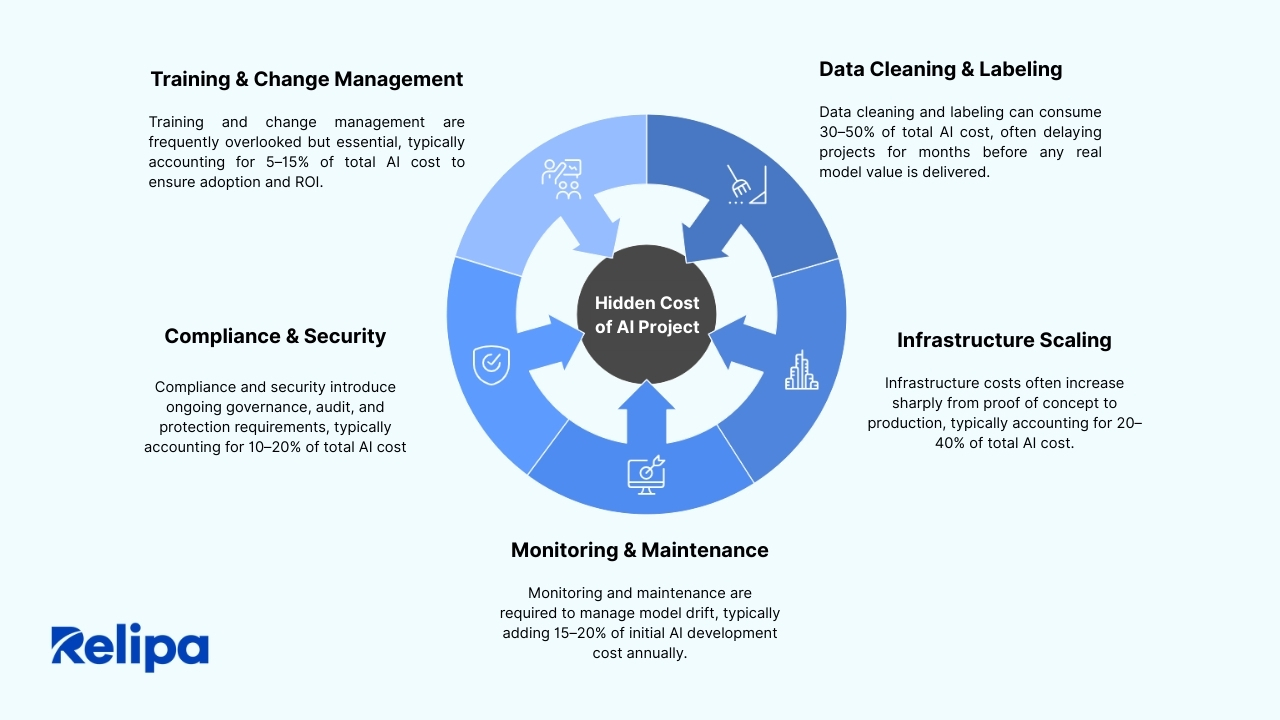
Hidden Cost #1: Data Preparation and Labeling
One of the most well-documented findings across AI research is that data preparation consumes the majority of AI project effort.
Multiple industry studies consistently report that 60–80% of total AI project time and cost is spent on:
- Data collection
- Data cleaning and normalization
- Data labeling and annotation
- Validation and quality control
This is often surprising to organizations that assume data is already “available” within existing systems.
Why This Cost Is Often Underestimated
Enterprise data is rarely AI-ready. It is typically:
- Stored across multiple systems
- Inconsistent in structure
- Incomplete or outdated
- Lacking accurate labels for supervised learning
Even small data quality issues can significantly reduce model accuracy, forcing teams to repeat preparation cycles—each iteration adding cost and delay.
Impact on AI Development Services
Professional AI development services allocate substantial effort to data engineering and governance early in the project. Without this investment, organizations risk:
- Low-quality models
- Delayed deployment
- Rework that multiplies cost
Data preparation is not a one-time task—it continues throughout the AI system’s lifecycle as new data enters production.
Hidden Cost #2: Infrastructure and Compute Scaling
AI prototypes are often built using limited datasets and short-term cloud resources. However, research shows that infrastructure costs increase sharply when AI systems move into production.
Industry benchmarks highlight that:
- Cloud compute costs can increase 10× or more when models scale
- GPU-based workloads may cost thousands of dollars per month per model
- Data storage and transfer costs grow continuously as datasets expand
Where Costs Escalate
Key infrastructure cost drivers include:
- Model training and retraining on large datasets
- Real-time inference workloads
- High-availability requirements
- Secure data storage and backups
A system that costs a few hundred dollars per month during testing can quickly scale into a multi-thousand-dollar operational expense.
Role of AI Development Services
Experienced AI development services help organizations:
- Forecast infrastructure cost growth
- Optimize model architecture for efficiency
- Design scalable, cloud-native deployments
- Avoid over-provisioning resources
Without early infrastructure planning, cost overruns are almost inevitable.
Hidden Cost #3: Monitoring, Retraining, and Maintenance
AI models do not remain accurate indefinitely. Research into production AI systems consistently identifies model drift as a major cost factor.
Studies show that:
- Model accuracy can degrade significantly within months
- Ongoing maintenance costs typically represent 15–20% of the initial development cost per year
- Systems without monitoring frameworks experience higher failure rates
What Drives Ongoing Costs
Post-deployment AI maintenance includes:
- Performance monitoring
- Bias and accuracy evaluation
- Retraining with new data
- Model version management
- Incident response and rollback
Unlike traditional software, AI systems require continuous learning to remain effective.
Why This Matters for AI Development Services
Professional AI development services increasingly include MLOps practices, which automate monitoring and retraining pipelines. While this adds upfront cost, it significantly reduces long-term operational risk and expense. Ignoring maintenance does not eliminate cost—it simply defers it until performance degrades or systems fail.
Hidden Cost #4: Compliance, Security, and Governance
As AI systems become more integrated into business operations, regulatory and ethical oversight becomes unavoidable. Research shows that compliance-related activities can account for 10–20% of total AI project cost, particularly in regulated industries.
Key Compliance Cost Areas
These include:
- Data privacy audits (GDPR, HIPAA, etc.)
- Security testing and access controls
- Explainability and bias assessment
- Documentation for regulatory review
- Governance frameworks for AI decision-making
In many cases, organizations only realize these requirements late in the project—leading to expensive redesigns.
AI Development Services and Risk Mitigation
Experienced AI development services incorporate compliance planning from the start, reducing the likelihood of costly retrofits. This approach is especially critical for finance, healthcare, and enterprise platforms.
Hidden Cost #5: Training, Adoption, and Change Management
Research into AI adoption consistently highlights a non-technical challenge: human adoption.
Studies show that:
- Organizational training and change management typically account for 5–15% of total AI project cost
- Productivity often dips temporarily during AI adoption phases
- Poor adoption significantly reduces ROI, regardless of model accuracy
Why This Cost Is Often Ignored
AI is often treated as a technical initiative rather than a business transformation. Without proper training:
- Users distrust model outputs
- Teams bypass AI-driven workflows
- Systems fail to deliver expected value
How AI Development Services Help
Leading AI development services include:
- User training programs
- Documentation and explainability support
- Change-management planning
- Gradual rollout strategies
These investments ensure AI solutions are actually used—and not abandoned.
Understanding Total Cost of Ownership (TCO)
Industry research consistently shows that the initial build phase represents only a fraction of an AI system’s total cost. When infrastructure, maintenance, and operational requirements are factored in, organizations often spend two to three times the original development budget within two to three years. This gap between expectation and reality is one of the most common reasons AI initiatives exceed budget.
A realistic total cost of ownership (TCO) model for AI development services extends well beyond model training and deployment. Infrastructure costs increase as systems scale, particularly for cloud-based inference and storage. Models also require continuous monitoring and retraining to maintain accuracy as data patterns evolve. In parallel, compliance, security, and governance activities introduce recurring costs, especially for enterprises operating in regulated environments.
From practical delivery experience, these costs are not signs of inefficiency but structural characteristics of production-grade AI systems. Teams that have built and operated AI solutions across multiple industries tend to anticipate these cost drivers early, enabling more accurate forecasting and smoother post-deployment operations. This is why experienced AI development services providers focus not only on development, but also on lifecycle planning and long-term sustainability.
Organizations that budget primarily for development often encounter financial pressure later—not because the AI solution underperforms, but because its long-term operating requirements were underestimated. Factoring TCO into early decision-making leads to more predictable investment outcomes and clearer expectations around ROI.
Common Reasons AI ROI Falls Short
Despite growing investment in AI, research indicates that many projects struggle to deliver expected returns. This challenge is rarely caused by a single issue; rather, it results from a combination of technical, operational, and organizational factors.
One of the most persistent barriers is data quality. AI systems depend on reliable, well-structured data, yet many organizations work with fragmented or inconsistent datasets. Without sufficient attention to data readiness, teams often repeat preparation work, increasing cost while limiting performance gains. Over time, this erodes confidence in AI-driven outputs and reduces perceived value.
Another common issue is weak alignment between AI initiatives and business objectives. When success metrics are unclear or disconnected from operational impact, it becomes difficult to demonstrate ROI—even if the AI model performs well in isolation. Effective AI development services address this by grounding system design in real business workflows and measurable outcomes, rather than abstract technical benchmarks.
Operational cost underestimation also plays a major role. Infrastructure, maintenance, and retraining expenses accumulate steadily after deployment and can significantly reduce net returns if they are not planned for. Organizations with limited experience running AI systems at scale often discover these costs only after solutions go live.
Finally, legacy system constraints frequently introduce hidden complexity. Integrating AI into existing enterprise environments may require additional customization or architectural adjustments, extending timelines and increasing cost. Teams with hands-on experience navigating these constraints are better positioned to design AI systems that integrate smoothly and deliver value sooner.
Taken together, these challenges explain why AI ROI often falls short of expectations. Organizations that work with AI development services providers focused on delivery realism—rather than experimentation alone—are more likely to build solutions that generate sustainable, measurable business value.
How to Plan AI Projects More Effectively
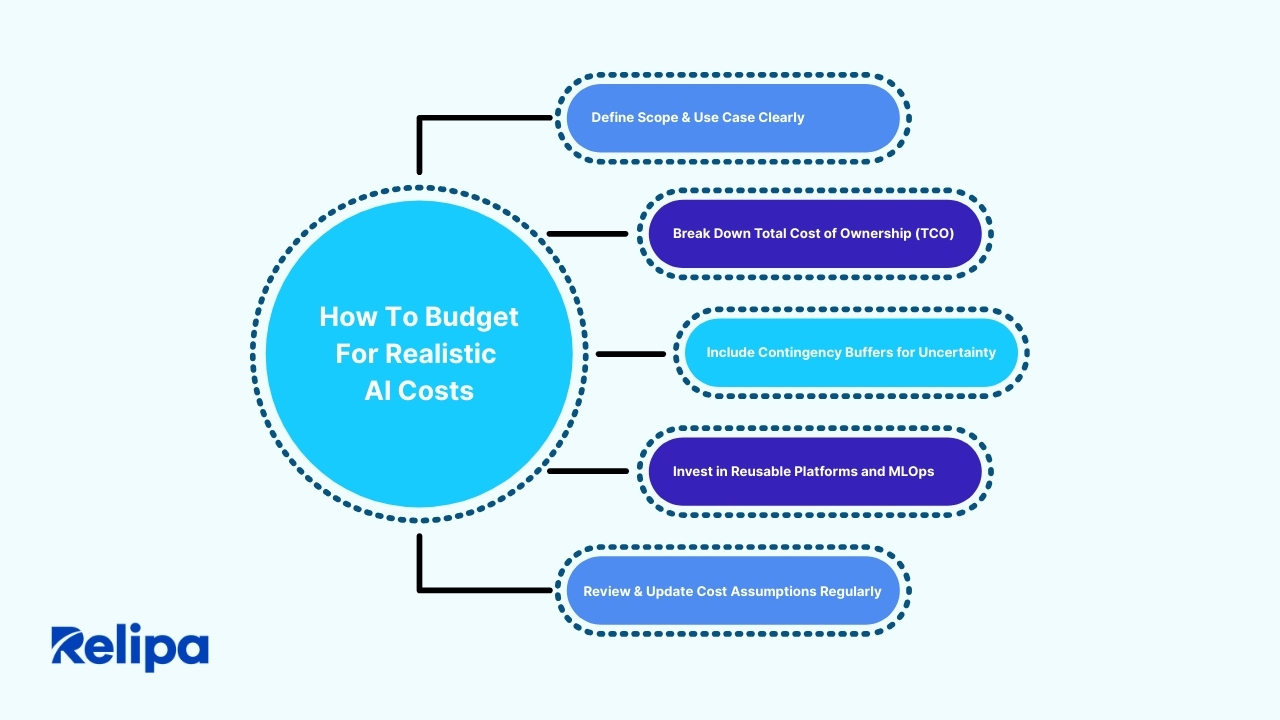
Planning is one of the most decisive factors in determining whether AI initiatives deliver long-term value or become sources of unexpected cost. Research and project experience show that organizations that succeed with AI development services treat AI as a strategic system investment rather than an isolated technical experiment.
- Define Clear, Business-Oriented Use Cases: Many AI projects fail to control cost because they start with vague or overly ambitious goals. Studies indicate that unclear problem definitions often lead to repeated experimentation and scope expansion, significantly increasing development time and budget. Effective planning begins by linking AI initiatives directly to measurable business outcomes, such as cost reduction, accuracy improvement, or process efficiency. When AI development services are guided by concrete objectives, teams can make focused design decisions and avoid unnecessary complexity.
- Allocate Budget for Uncertainty: Unlike traditional software, AI systems depend on data quality and real-world behavior that cannot be fully predicted in advance. Industry research suggests that allocating a 15–30% contingency budget is essential for managing this uncertainty. This buffer helps absorb unexpected costs related to data preparation, model retraining, or infrastructure scaling, without disrupting delivery timelines or compromising system quality.
- Plan for Long-Term Operational Costs: A common misconception is that AI costs end at deployment. In reality, ongoing expenses such as cloud infrastructure, monitoring, retraining, and maintenance typically account for 15–20% of the initial development cost per year. AI development services that incorporate total cost of ownership into early planning help organizations avoid building systems that are expensive to operate or difficult to scale sustainably.
- Invest Early in Data Readiness: Research consistently shows that data preparation accounts for the majority of effort in AI projects, often reaching 60–80% of total workload. Poor data quality or fragmented data sources frequently lead to rework and performance issues later in the project. By prioritizing data readiness from the outset, AI development services reduce hidden costs and create a more stable foundation for model development and long-term performance.
- Address Compliance and Risk Early: As AI systems increasingly influence business decisions, compliance and governance costs become unavoidable. Privacy protection, security controls, and fairness assessments can represent a significant portion of AI budgets if addressed late. Integrating these requirements into system design from the beginning helps prevent costly redesigns and reduces regulatory risk throughout the AI lifecycle.
- Plan for Adoption and Change Management: Even technically successful AI solutions can fail if users do not trust or adopt them. Research shows that training, documentation, and change management typically represent 5–15% of AI project costs, yet they play a critical role in achieving ROI. AI development services that support user adoption ensure that AI systems are effectively integrated into daily operations.
- Work with Experienced AI Development Services Providers: Finally, organizations that partner with experienced AI development services providers are better positioned to anticipate hidden costs and avoid common pitfalls. Beyond technical expertise, the right partner contributes realistic cost modeling, proven delivery frameworks, and long-term operational support, helping businesses build AI solutions that remain effective and economically viable over time.
Conclusion
Research consistently shows that the true cost of AI extends far beyond algorithms and code. Data preparation, infrastructure scaling, ongoing maintenance, compliance, and human adoption all contribute significantly to long-term expense.
Organizations that recognize these hidden costs early—and plan accordingly—are far more likely to achieve sustainable ROI from AI development services.
By approaching AI as a long-term system rather than a short-term experiment, businesses can turn hidden costs into predictable investments and unlock the full value of artificial intelligence.
Relipa Software
Relipa Co., Ltd. is a Vietnam-based software development company established in April 2016. After two years of growth, our Japanese branch – Relipa Japan – was officially founded in July 2018.
We provide services in MVP development, web and mobile application development, and blockchain solutions. With a team of over 100 professional IT engineers and experienced project managers, Relipa has become a reliable partner for many enterprises and has successfully delivered more than 500 projects for startups and businesses worldwide.
