

 Copy link


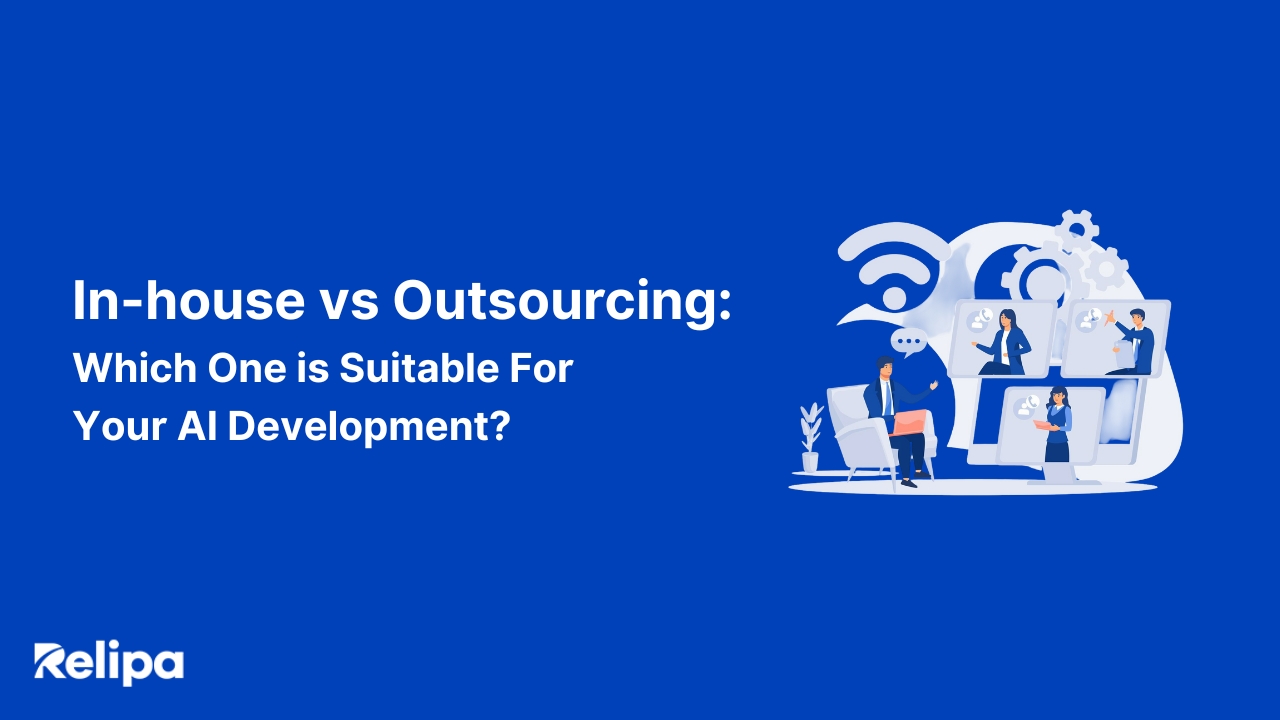
In-House vs Outsourcing: Which One Is Suitable For Your AI Development?
Why do some companies with highly skilled engineering teams struggle to launch meaningful AI products, while others without internal AI departments deploy production-ready systems in months?
At first glance, the answer may appear to lie in better models, stronger technical frameworks, or larger datasets. In reality, the difference is often far more structural. It comes down to how organizations approach building AI automation solutions from the very beginning.
Many companies underestimate that AI is not just a technology layer. It is an operational capability that requires coordination between infrastructure, data pipelines, model development, governance, and product integration. When this ecosystem is not structured correctly, even strong engineering teams can struggle to move beyond prototypes.
This is where the debate between in-house development and outsourcing for AI automation solutions becomes critical.
Organizations today face a fundamental decision:
-
Should they build internal AI capabilities and develop automation solutions themselves, or
-
Should they leverage external expertise to accelerate deployment and reduce risk?
Both models offer advantages and limitations. The right choice depends on multiple factors including strategic importance, cost structure, time-to-market pressure, technical maturity, and long-term scalability.
This article examines the in-house vs outsourcing debate through the lens of real delivery outcomes, focusing specifically on the development of enterprise AI automation solutions. It compares both approaches across cost, speed, technical risk, scalability, security, and talent readiness. It also explores which types of AI projects fit each model, why many enterprises adopt hybrid strategies, and how organizations can make a structured decision for their next AI investment.
What is In-house Development?
In-house development refers to building and operating AI automation solutions entirely within an organization’s internal teams and infrastructure. In this model, companies recruit their own AI engineers, data scientists, and machine learning specialists to design, train, deploy, and maintain AI systems.
To support these teams, organizations must also invest in the technical environment required for AI development. This typically includes cloud computing platforms, GPU infrastructure for model training, scalable data pipelines, and MLOps frameworks that allow AI automation solutions to operate reliably in production environments.
The primary advantage of in-house development lies in control and ownership. Businesses maintain direct authority over their data, models, intellectual property, and development roadmap. This level of control is particularly important when AI automation solutions are deeply integrated into core products or rely heavily on proprietary datasets.
For example, many digital platforms build internal AI automation solutions for recommendation engines, fraud detection, pricing optimization, and customer behavior prediction. These systems evolve continuously and accumulate strategic value over time, making long-term internal ownership beneficial.
However, developing AI internally also requires significant investment. Recruiting experienced AI engineers is expensive, and organizations must compete in a global talent market where skilled specialists are in high demand. In addition to salary costs, companies must invest in infrastructure, tools, model monitoring systems, and continuous training to keep their AI automation solutions accurate and reliable.
As a result, while in-house development offers strong strategic control, it also demands substantial financial and operational commitment before companies begin to see measurable results.
What is Outsourcing Development?
Outsourcing development involves collaborating with external vendors or specialized technology partners to design, build, and deploy AI automation solutions. Instead of assembling a full internal AI team, organizations leverage external expertise to accelerate development and reduce technical risk.
Outsourcing can take several forms depending on business needs. Some companies outsource entire AI projects from strategy to deployment, while others adopt more flexible models such as staff augmentation or collaborative development, where external engineers work alongside internal teams.
Across industries, outsourcing has become a common strategy for organizations implementing AI automation solutions. Many large enterprises rely on external development partners to gain access to specialized expertise that may not exist internally. According to industry reports, nearly 90% of Fortune 500 companies outsource some portion of their software or AI development, particularly when launching new technology initiatives.
One of the main advantages of outsourcing is speed. External teams typically have experience building similar AI automation solutions across multiple projects and industries. Because of this experience, they can implement proven frameworks, avoid common mistakes, and move rapidly from concept to production.
Outsourcing also provides greater scalability. Vendors often maintain large pools of engineers and specialists who can be deployed quickly when project demand increases. This flexibility allows companies to scale their AI automation initiatives without committing to permanent hiring.
However, outsourcing also introduces certain trade-offs. Companies may have less direct control over technical decisions, and they must ensure strong communication and governance processes to maintain alignment. Clear contracts, well-defined ownership structures, and strict security policies are essential to ensure successful collaboration.
Read more: 8 Major Benefits Of IT Outsourcing In Vietnam
In-house vs Outsourcing: A Comparative Analysis
When organizations evaluate how to build AI automation solutions, several practical factors influence the decision between in-house and outsourcing models.
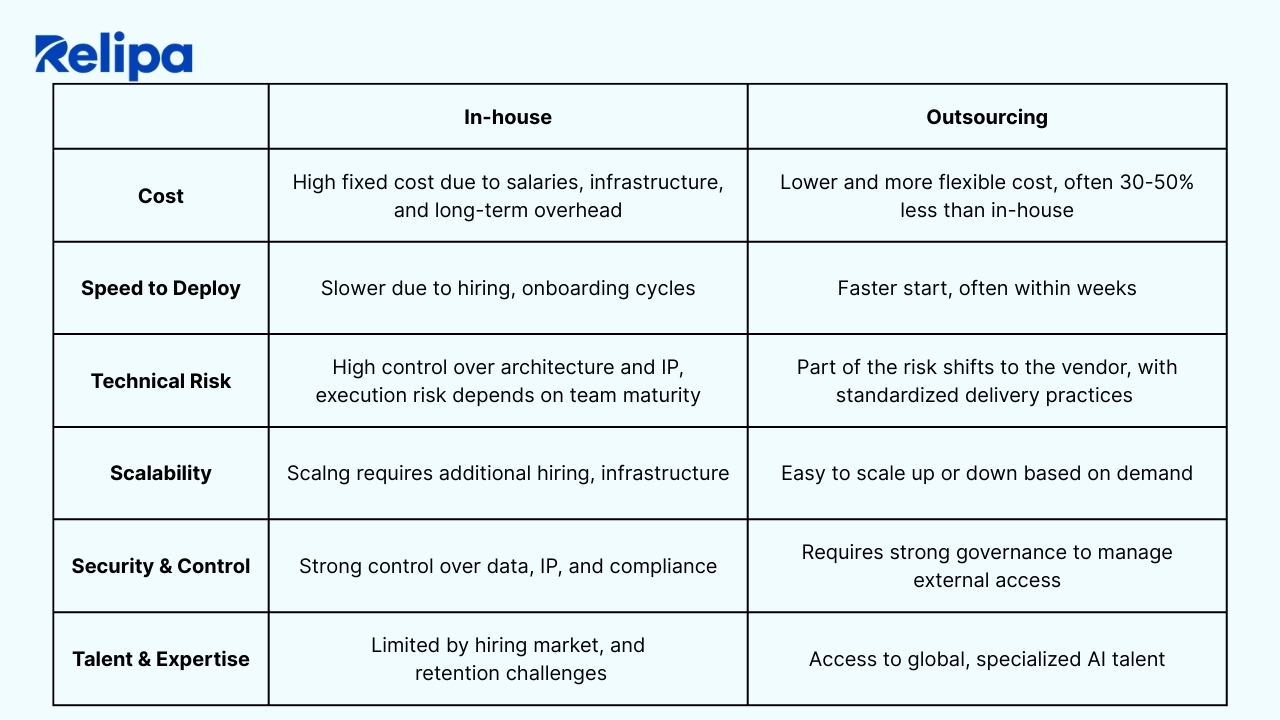
Cost
Cost is often the first factor organizations evaluate when deciding how to build AI automation solutions. Establishing internal AI teams can be extremely expensive, particularly in regions where demand for AI talent far exceeds supply. Experienced machine learning engineers command high salaries, and total operational costs increase further when companies account for infrastructure, benefits, recruitment, and long-term retention efforts.
Building AI automation solutions internally also requires significant investment in computing resources. Training advanced machine learning models often involves GPU clusters, large-scale storage systems, and sophisticated monitoring infrastructure. These costs accumulate quickly, especially for organizations still experimenting with AI capabilities.
Outsourcing can significantly reduce these financial barriers. External vendors distribute operational costs across multiple clients, allowing organizations to access experienced engineers and established infrastructure without building everything from scratch. For companies exploring AI automation solutions for the first time, outsourcing can therefore reduce upfront investment while still enabling rapid innovation.
Technical Risk
Technical risk plays a major role in AI projects because machine learning systems are inherently complex. In-house teams provide organizations with direct oversight of technical decisions, enabling tighter integration between AI models and proprietary data systems. Internal engineers often possess deeper knowledge of the company’s business processes, which can reduce the risk of misalignment during development.
Outsourcing shifts some of this technical responsibility to the vendor. Experienced partners often implement strong quality assurance practices, automated testing pipelines, and model validation frameworks to ensure reliable AI automation solutions. However, outsourcing also requires effective communication and documentation to ensure external engineers fully understand business requirements.
Scalability
Scalability is another area where the two approaches differ significantly. Expanding internal teams requires lengthy recruitment cycles, training programs, and long-term salary commitments. This makes rapid scaling difficult, particularly for companies launching multiple AI automation solutions simultaneously.
Outsourcing provides greater flexibility. Vendors can allocate additional engineers to projects as demand increases, enabling organizations to scale development resources quickly. When workloads decrease, companies can reduce external engagement without maintaining large permanent teams.
Security and Control
Security and data governance remain critical considerations when building AI automation solutions. Internal development offers greater control over data access, compliance procedures, and intellectual property protection. This is especially important for organizations operating in highly regulated sectors such as finance, healthcare, or government.
Outsourcing does not necessarily imply weaker security, as many reputable vendors maintain strict certifications and enterprise-grade security frameworks. However, organizations must carefully manage access controls, data protection policies, and contractual agreements to ensure their AI automation solutions remain secure throughout the development lifecycle.
Talent and Organizational Expertise
Access to skilled AI professionals represents one of the biggest challenges in modern technology development. Recruiting and retaining top AI engineers is both expensive and competitive, particularly for organizations outside major technology hubs.
Outsourcing provides access to a global talent pool, allowing organizations to collaborate with specialists who have experience building diverse AI automation solutions across industries. This external expertise can accelerate development while allowing internal teams to focus on strategic decision-making and product integration.
Read more: Top 10 Recommended System Development Outsourcing Companies in Vietnam
What Types of AI Projects Suit Each Model?
AI Projects Best Suited for In-house Development
Certain categories of AI automation solutions benefit significantly from internal ownership. Projects that form a core component of a company’s competitive differentiation often require long-term internal development. Examples include proprietary recommendation systems, dynamic pricing engines, and personalized customer experience platforms.
These systems rely heavily on proprietary data and continuously improve through long-term iteration. Maintaining internal control ensures that the organization retains ownership of the algorithms and insights generated by these AI automation solutions.
In-house development is also beneficial when AI systems must integrate deeply with internal workflows or legacy enterprise systems. In such environments, internal teams possess the domain knowledge necessary to align AI functionality with operational processes.
AI Projects Best Suited for Outsourcing
Other types of AI initiatives are well suited for outsourcing. Short-term experiments, proof-of-concept projects, and minimum viable products often benefit from the speed and flexibility of external development partners.
Organizations exploring new opportunities with AI automation solutions frequently outsource early-stage experimentation to validate business value before committing to large-scale internal investment.
Outsourcing is also effective for highly specialized AI tasks such as computer vision systems, natural language processing models, or advanced data engineering pipelines. External partners often bring specialized expertise that would take significant time and resources to build internally.
Hybrid Model: When One Approach is Not Enough
In practice, many organizations discover that neither purely in-house development nor full outsourcing provides the ideal solution for building AI automation solutions. As a result, hybrid models have become increasingly common in enterprise AI strategies.
Under a hybrid approach, internal teams maintain strategic control over AI architecture, data governance, and product direction. External partners then provide additional engineering capacity or specialized expertise to accelerate development.
For example, an internal AI lead or center of excellence may define overall strategy and system architecture while external teams assist with model development, infrastructure setup, or scaling workloads during peak demand periods.
This model allows organizations to retain ownership of critical intellectual property while still benefiting from the speed and expertise of external development partners.
A Practical Decision Framework for AI Investment
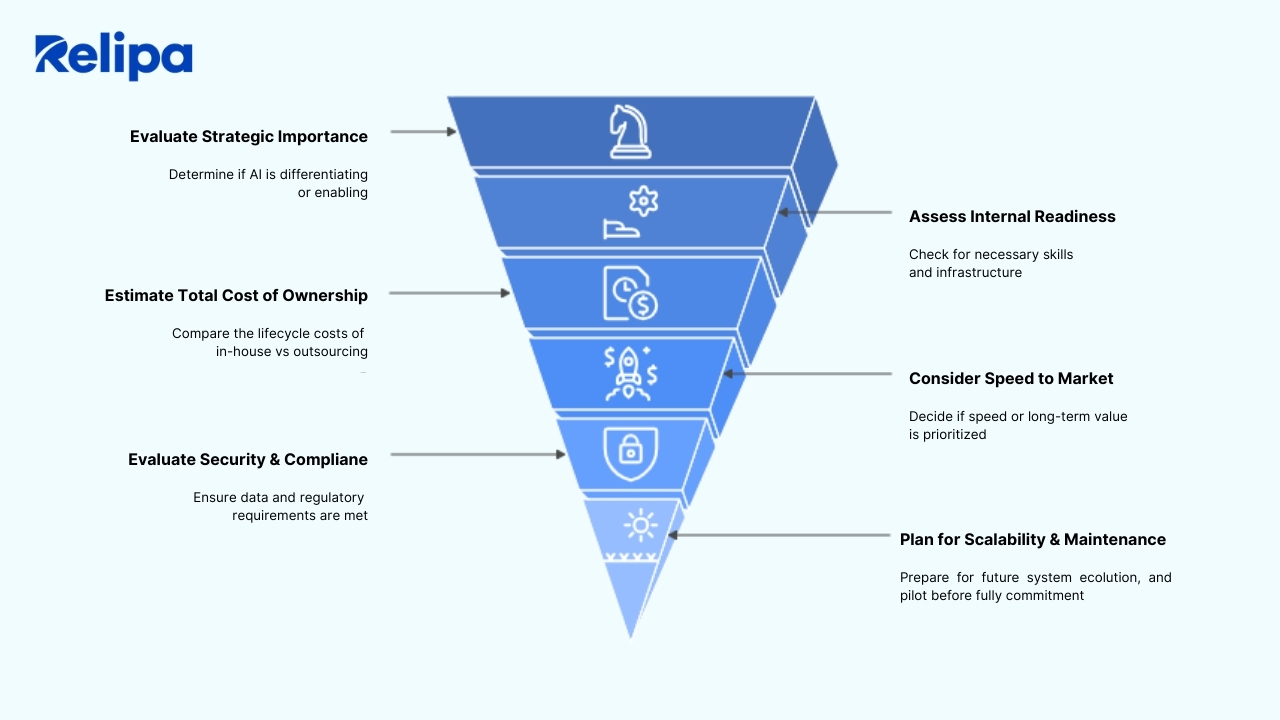
Evaluate Strategic Importance
The first question is whether the AI capability in question is strategically differentiating or primarily enabling.
If AI directly underpins competitive advantage, for example, proprietary algorithms that shape customer experience, pricing, or core product performance, in-house ownership is often justified. Strategic AI capabilities compound in value over time and benefit from tight alignment with business vision.
By contrast, if AI serves a supporting role, such as process automation or analytics enhancement, outsourcing may deliver faster value without diluting strategic control.
Assess Internal Readiness
Internal readiness goes beyond headcount. Organizations must assess whether they have the right mix of skills, tooling, and operational maturity to execute the project. This includes AI engineering capability, data quality, MLOps practices, and cross-functional collaboration between IT and business teams.
If internal teams lack experience deploying AI systems into production, projects often stall after experimentation. In such cases, outsourcing can reduce execution risk while internal capability is still developing.
Estimate Total Cost of Ownership (TCO)
Decision-makers should consider the full lifecycle cost of AI automation solutions rather than focusing solely on initial development budgets. Internal development involves recruitment, infrastructure, and long-term maintenance costs, while outsourcing introduces vendor management expenses.
A comprehensive cost analysis helps organizations choose the most sustainable model.
Read more: Top 5 Hidden Cost of AI Projects Most Companies Ignore
Consider Speed to Market
Speed is often decisive in AI investment. For time-sensitive initiatives, such as market pilots, MVPs, or regulatory-driven deadlines, outsourcing can significantly compress delivery timelines.
In-house teams may deliver higher long-term value, but they rarely offer the fastest path to first production. Organizations must decide whether early market presence or internal capability building is the primary objective.
Evaluate Security and Compliance Requirements
AI Projects involving sensitive data, regulated environments, or strict audit requirements demand careful consideration. In-house development provides greater control over data access, model behavior, and compliance processes.
Outsourcing can still be viable in these contexts, but only with strong contractual safeguards, governance frameworks, and clearly defined responsibility boundaries. The higher the regulatory exposure, the more deliberate the outsourcing model must be.
Plan for Scalability and Long-term Maintenance
AI systems rarely remain static. Models degrade, data distributions shift, and business requirements evolve. Organizations must consider who will maintain, retrain, and scale the system over time.
If long-term evolution and continuous optimization are expected, in-house teams or hybrid models often provide better continuity. For bounded or short-lived initiatives, outsourcing may be sufficient without long-term operational burden.
Pilot Before Full Commitment
Finally, organizations shoul aboid committing fully to either model upfront. Running a limited proof-of-concept, either internally, with a partner, or both, allows teams to validate assumptions around cost, speed, collaboration, and delivery quality.
The pilot-driven approach reduces risk and provides concrete evidence to inform larger investment decisions, rather than relying on theoretical comparisons.
Conclusion
There is no universal answer to the in-house versus outsourcing debate when building AI automation solutions. The most successful organizations treat this decision as a strategic design choice rather than a default operational model.
Companies that succeed with AI recognize that different initiatives require different development approaches. Some AI automation solutions demand deep internal ownership and long-term investment, while others benefit from the speed and flexibility of external development partners.
By carefully evaluating strategic importance, internal readiness, cost structure, and scalability requirements, organizations can choose the development model that best supports their goals.
As AI adoption continues to accelerate across industries, the ability to structure and deliver AI automation solutions effectively will increasingly determine which companies transform AI investment into measurable business outcomes.