
Many businesses today choose to outsource IT support to ensure system stability, cost efficiency, and long-term scalability. While a reliable IT infrastructure is the backbone of modern corporate management, many organizations still struggle to differentiate between Core Systems, Business Systems, and ERP.
Understanding these technical nuances is vital for a successful digital transformation. By leveraging expert IT consultancy services, leaders can gain the clarity needed to make informed decisions and effectively outsource IT support to the right professional partner.
What is the core system?
At its heart, a “core system” is the fundamental IT infrastructure that manages a company’s most essential operations. Think of it as the digital foundation: while the specific functions vary by industry, they typically unify mission-critical tasks like production management, sales, and financial accounting into one cohesive flow.
What truly sets a core system apart is its high-stakes nature. Because these systems ensure the smooth operation of vital business processes, any malfunction isn’t just a minor glitch. In fact, it can cause immediate, severe damage to a company’s performance and overall management.
To put this into perspective, let’s look at two major industries:
- In Manufacturing: “Production control” is a literal lifeline. Without the ability to track what is being produced, where, and by whom, a company’s stability and very existence can be threatened.
- In Logistics: The core system acts as the brain for warehouse flows—overseeing everything from inventory and packing to shipping. A failure here doesn’t just stop a truck; it shatters credibility with partners and customers alike.
The real power of a modern core system lies in integration. By bringing together functions that were once handled in silos, businesses can achieve a new level of operational efficiency, standardization, and significant cost reduction.
However, managing such complex, integrated systems requires deep expertise. This is where IT consultancy services become invaluable, helping enterprises navigate these technical complexities. By choosing to outsource IT support, companies can ensure their “digital backbone” benefits from 24/7 monitoring and rapid issue resolution, maintaining the long-term stability needed to stay competitive.
There are 6 types of main core systems.
- Inventory management system
- Purchasing management system
- Sales management system
- Production management system
- Accounting management system
- HR payroll system
Below is a detailed breakdown of how each core system functions to support your overarching business goals.
| Inventory Management System | This system grasps the inventory quantity and location (storage location) of each product and manages appropriate inventory by integrating it with incoming/outgoing information. In order to maintain proper inventory, there is also a function to notify you with an alert if there is an excess or deficiency in inventory. |
| Purchasing Management System | It manages and inspects the ordering and purchasing of products and raw materials, and cooperates with the inventory system. Some also have features for estimating and billing. |
| Sales Management System | In sales, this system manages the flow of money, such as quotations, sales, invoices, deposits, and payments, and the flow of products, such as ordering, purchasing, shipping, and inventory. |
| Production Management System | In order to efficiently manufacture with the shortest lead time, we perform production planning, ordering, worker management, work instructions, progress management, cost management, etc. |
| Accounting Management System | It automates the creation of the general ledger, income statement, and balance sheet, starting with daily journal entries in accounting operations. If you can understand the basic operations, you can streamline your accounting work without any special knowledge. |
| HR Payroll System | This is a system that unifies personnel management, which manages basic employee information and information related to careers and skills, and payroll management, such as payroll calculation, payment, and payslip management. By integrating the two, it is possible to promote the accuracy and efficiency of personnel assessment and payroll operations. |
Read more: [2023] Top 10 recommended system development outsourcing companies in Vietnam
What is a business system?
A business system supports specific departments and improves operational efficiency. Unlike core systems, failure does not immediately stop company-wide operations.
Examples include:
-
Attendance management system
-
Quotation management system
-
Quality control system
-
Customer management system
Take an attendance management system, for example: it does more than just track time; it eliminates the friction of manual payroll errors by automating the entire workflow. Similarly, a robust customer management system transforms scattered data into a centralized powerhouse, fortifying security while ensuring every customer follow-up is timely and impactful.
For many SMEs, the challenge lies in maintaining these specialized tools without the overhead of an expanding internal tech department. This is where strategic IT consultancy services provide the most value. By choosing to outsource IT support, businesses can secure professional maintenance and seamless upgrades, ensuring their systems remain cost-effective assets rather than technical bottlenecks.
Type of business system
Depending on the industry or type of business, some companies opt to develop their own system to support special operations unique to their organization. This type of system is also known as a business system. Examples of Business Systems include:
- Purchasing management system
- Attendance management system
- Quotation management system
- Quality control system
- Customer management system
Business system usage example
To better understand the tangible impact on your operations, let’s explore how a business system functions in a real-world scenario.
Attendance management system
The Attendance Management System’s primary purpose is to manage employee attendance and track working hours for payroll calculation accurately. This involves capturing data on ‘when,’ ‘where,’ ‘who,’ and ‘how long’ employees are working.
Traditionally, many workplaces use manual methods like printing time cards on paper and collecting them with the responsible person. This process requires additional effort to calculate working hours, overtime, and other payroll-related figures for each employee. It becomes more complex when employees work at multiple branches or stores, requiring frequent check-ins and check-outs from various locations. This can lead to significant time and effort expenditure and poses a risk of human error.
By implementing an attendance management system, companies can manage the attendance of all employees in real time, irrespective of their location or work hours. Additionally, the system can automatically record the required data for payroll calculation, including irregular patterns like overtime, late-night work, and holiday shifts. This automation significantly improves work efficiency and reduces the chances of errors, leading to a more streamlined and standardized process.
Purchase management system
In the manufacturing industry, efficient procurement is the lifeblood of operational excellence, where securing raw materials at the optimal price and volume is essential for cost reduction. Similarly, for non-manufacturing sectors, cost-effective purchasing remains a cornerstone of lean management.
However, a significant challenge arises when procurement is handled in silos; without a unified history, organizations often face “fragmented purchasing,” leading to duplicate orders, inconsistent pricing, and a lack of transparency. These ad-hoc methods not only drain financial resources but also hinder the ability to build stable, long-term relationships with business partners.
Implementing a centralized purchasing management system addresses these pain points by creating a “single source of truth” across all departments. This ensures that high-quality materials are procured at the right time and cost, effectively eliminating the risks of inventory imbalances.
By leveraging expert IT consultancy services to deploy these systems, companies can transform chaotic workflows into streamlined, data-driven processes. Ultimately, this strategic shift empowers leaders to make well-informed decisions that secure significant cost savings and bolster the overall stability of the organization’s supply chain.
Customer management system
In order to build good relationships with customers and have them continue to use our products and services, it has become common practice to use communication tools via the Internet, such as SNS and email.
However, for customer management, there are still many cases that rely on Excel or in-house formats. Then, there is a lot of risk that manpower will be needed unnecessarily, oversights will occur due to the huge amount of customer information, and thorough follow-up will not be possible. Above all, the security aspect is weak, and the risk of important customer information being leaked cannot be denied.
By introducing a customer management system, it is possible not only to provide comprehensive service and care to existing customers by status, but also to discover new customer targets based on purchase history and access history, etc., and take appropriate approaches. increase. The security level will also be significantly improved, which will greatly contribute to increasing the trust of stakeholders.
Read more: Ultimate guideline of appropriate system development flow
Differences between the core system and the business system
Let’s clarify the difference between a core system and a business system based on the information provided:
- Core System: A core system is a mission-critical IT system that supports a company’s fundamental business operations. These systems are of utmost importance for the organization’s overall functioning and success. They directly manage core business processes, such as production management, sales management, and financial accounting. The primary focus of core systems is to ensure the stability and reliability of essential operations, and any malfunction can have an immediate and significant impact on the company’s management.
- Business System: On the other hand, a business system is a supporting system that aims to improve efficiency, save labor, and reduce costs for specific operations within the organization. Business systems are often targeted at individual departments or functions, such as customer relationship management, inventory management, and human resource management. While they play a crucial role in enhancing productivity and streamlining specific operations, their malfunction typically does not directly affect the core operations of the company.
In practice, the line between these two categories often blurs. Depending on the specific operation or product being supported, a business system can evolve to serve a role just as vital as a mission-critical system. This overlap suggests that systems shouldn’t just be viewed as static labels, but as dynamic components of a company’s unique infrastructure.
When it comes to development, many organizations choose to partner with a specialized firm to build custom systems tailored to their exact needs. While this bespoke approach may require a larger initial investment in time and budget compared to off-the-shelf products, the long-term rewards are significant. Custom development offers unparalleled flexibility, allowing for the seamless integration of both core and business functions into one unified platform. This is where strategic IT consultancy services prove their worth, helping leaders navigate the choice between “buying” vs “building” to ensure their tech stack delivers a true competitive advantage in efficiency and productivity.
In summary, while core systems manage fundamental processes and business systems drive departmental efficiencies, the most successful enterprises are those that bridge the gap. Custom-built solutions provide the unique opportunity to merge these functionalities into a tailored ecosystem, fostering innovation and long-term business value.
ERP is an integration of the core system and business system
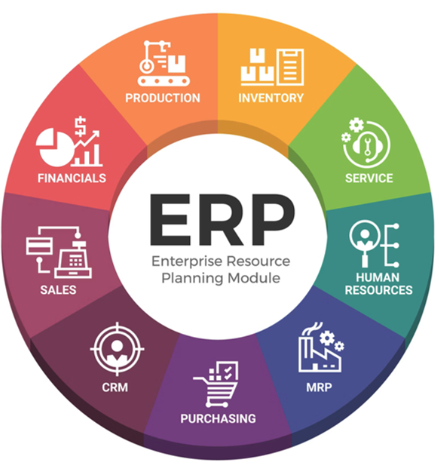
In addition to core systems and business systems, there is also a system called “ERP (Enterprise Resource Planning Module”. As we mentioned earlier, this refers to integrating multiple core systems and business systems that are outsourced to development companies and systematizing them so that they can be centrally managed (there are also ready-made products).
- ERP integration and centralized management: ERP systems are designed to integrate multiple core systems and business systems, whether developed in-house or outsourced to development companies. According to Gartner, ERP integration plays a critical role in enterprise digital transformation strategy. The goal is to centralize the management of various departmental information and data. This includes functions such as inventory management, purchase management, sales management, production management, accounting management, personnel and payroll, and more.
- Real-time data linkage: One of the primary purposes of ERP is to link data in real-time, allowing for quick and accurate decision-making. This real-time data linkage enhances the ability to respond promptly to changing business conditions and provides a comprehensive view of the organization’s operations.
- Strengthening business: The ultimate purpose of implementing an ERP system is to strengthen the organization. By effectively utilizing resources such as people, goods, money, information, and intellectual property, ERP enhances core business processes that form the foundation of the company.
- Essential for corporate value: The concept of ERP is essential for increasing corporate value. Through the streamlined integration and management of various systems and data, ERP enhances operational efficiency, reduces redundancy, and fosters better decision-making, ultimately contributing to the organization’s overall growth and success.
In summary, ERP systems serve as the ultimate connective tissue, centralizing and integrating fragmented data across the entire organization. By facilitating real-time data linkage and enhancing core processes, they act as a vital catalyst for increasing corporate value and long-term competitiveness. For modern businesses, realizing this potential often requires the guidance of expert IT consultancy services to ensure the ERP environment is strategically aligned with their unique operational goals
Main core systems and business systems integrated with ERP
ERP systems are sold as products in various forms, such as cloud, on-premise, and packaged. In addition, when pursuing originality, it is often the case that development is outsourced to a developer.
In any case, ERP includes the following systems:
- Production control
- Sales management
- Development management
- purchase management
- Purchasing management
- Labor management
- HR management
- Adoption management
- Payroll accounting management
- Financial Management
- Customer management
- Asset management
- Receivables management
- Debt management
- Inventory control
- Warehouse management
And so on.
There are also systems that are not included in the product, so when introducing it, it is necessary to carefully examine the necessary functions and select the most suitable one for your company.
How to choose the core system and business system/ERP
Finally, let’s explain the key points when choosing a core system, business system, and ERP, and how to choose a contractor when outsourcing these.
Choosing the right core system, business system, or ERP, and selecting the right contractor when outsourcing these projects are critical decisions for a company’s success. Here are key points to consider when making these choices:
Points to consider when choosing a service
There are six points to consider when choosing a service.
- Clarify the purpose of the introduction within the company
- Check if it has the features you need
- Make sure it’s extensible and customizable
- Conduct a simulation to see if the company’s personnel can master it
- Check your support system
- Don’t choose based on budget alone
Offshore destinations such as Vietnam have become popular for companies seeking reliable and cost-effective IT consultancy services.
Clarify the purpose of the introduction within the company
Whether you are implementing a Core System, a Business System, or an ERP, one truth remains: if the vision is vague, the project is likely to fail, no matter how advanced the technology. It is vital to remember that systems don’t drive success; people do. From top management to frontline employees, it is the human element that steers an organization, while the system merely serves as an enabler. Technology is not a magic wand that solves operational friction overnight; it is a tool that requires a clear, strategic direction to be effective.
When partnering with a development firm, the process always begins with “Requirement Definition.” This is the critical phase where the what, why, how, and when of your digital roadmap are meticulously dissected. If your objectives are ambiguous, even the most skilled developers will struggle to deliver a solution that fits. This is precisely where professional IT consultancy services prove invaluable, bridging the gap between your business vision and technical execution.
By setting concrete goals, such as “integrating production with sales to enable real-time CRM and automated marketing”, you provide the clarity needed to avoid costly detours and ensure your investment delivers genuine, measurable value.
Check if it has the features you need
After clarifying the necessary functions and systems within the company, the next step is to find a service that meets those needs. If there is something that seems to be applicable, let’s investigate in detail by requesting materials or making inquiries.
Costs can vary greatly depending on which service provider you use. Therefore, it will be necessary to carefully examine whether the effect commensurate with the cost can be obtained.
Make sure it’s extensible and customizable
Whether it is a core system or a business system, scalability is often required according to business flow and strategy rather than using it alone. It should also be customizable to fit your own style. Don’t forget to choose not only for the immediate purpose but also for how far the flexibility in that area will work, looking ahead to the future.
Conduct a simulation to see if the company’s personnel can master it
In many organizations, the decision to implement a new system is made solely at the executive level. While leadership holds the decision-making power, it is the frontline employees – the ones using the system every day, who often have the least say. However, even the most advanced technology is worthless if it creates friction for those who rely on it. A system forced from the top down without considering the end-user’s experience is a recipe for low adoption and operational failure.
True success comes from bridging the gap between management’s vision and the operational realities of the field. This is a core focus of strategic IT consultancy services: ensuring that a system isn’t just an “ideal” on paper, but a functional tool that empowers your team. By listening carefully to the feedback of those in charge of daily tasks, leaders can select a solution that fits the company’s comprehensive needs. Ultimately, a system should serve the people using it, not the other way around.
Check your support system
No service is perfect the first time. It is almost certain that there will be situations where a problem occurs, or you do not know how to deal with it, or how to operate it. Support and maintenance are what you can count on.
In the case of mission-critical systems in particular, if recovery takes a long time, there is a great possibility that the customer will be greatly damaged, and the company’s credibility will be greatly damaged. Therefore, be sure to check in advance what conditions you can receive support and maintenance after the introduction, including costs.
Don’t choose based on budget alone
When introducing a new system, there is a strong tendency to focus too much on the budget. To some extent, it may be unavoidable. However, it still costs money, so in the long run, it will be a loss if it is cheap or not. If you can introduce an optimal system that hits the mark in the true sense, you may gain many times in the future, so let’s value the idea of emphasizing functionality.
How to choose a subcontractor with prolific IT consultancy services
Next, we will explain the important points to consider when outsourcing your system development to a third-party development company. There are five key factors to keep in mind:
- Check the subcontractor’s achievements
- Ensure Relevant Experience
- Assess Their Financial Standing
- Request Multiple Quotes
- Stay Involved in the Development Process
Check the subcontractor’s achievements
Review their past projects carefully. Some vendors claim experience without a solid track record.
Consider referrals from trusted partners. Offshore development (for example, Southeast Asia, such as Vietnam) can be a cost-effective option, once you seek professional IT consultancy services, offering skilled engineers at competitive rates.
The laboratory-type (dedicated team) model is particularly effective. It allows you to build a long-term team that works like an internal department while maintaining flexibility.
Ensure relevant experience
When evaluating development achievements, it is essential to verify if the development company has experience in creating systems within the same genre as the one you are planning to develop. Keep in mind that core systems may be more complex than business systems, and ERP systems can be even more intricate. If possible, consider having the development company build a prototype or a small-scale version of the system. This way, you can see firsthand how well it aligns with your company’s image and meets your specific needs. This hands-on approach will help you make an informed decision about choosing the right development partner for your project.
Assess their financial standing
When embarking on a system development project from scratch, it is crucial to recognize that the timeline can often span from several months to a full year. Even with a management structure in place, there are instances where projects are abandoned midway due to unforeseen challenges – a situation that becomes particularly concerning if you have already paid a portion of the development costs with no guarantee of a refund.
Beyond the direct financial hit, a significant delay in launching the system can result in substantial operational losses for the management. Therefore, it is essential to exercise extreme caution by thoroughly vetting the financial stability and credibility of a development company before the project begins. Ensuring your chosen contractor has a proven track record is the most effective way to mitigate these risks and avoid potential setbacks.
Managing such a complex project requires vigilant oversight and constant communication with the development team. Being proactive in addressing issues and staying deeply engaged throughout the build is the only way to avoid unexpected delays. This is where professional IT consultancy services prove invaluable—acting as a bridge to ensure the process remains transparent, expectations are met, and the final result delivers the exact value your business needs.
Get multiple quotes
Don’t limit yourself to one company from the beginning; ask for quotes from multiple companies at the same time. Even with the same development project, the method of proceeding with the project, the way of thinking, and, of course, the amount of money vary depending on the company. You can learn by comparing them, and you can also refer to one company’s quote and haggle with another company. And finally, make sure to choose the company with the best cost performance.
Stay involved in the development process
Beyond just selecting a partner, one common pitfall is the “hands-off” approach. Leaving everything entirely to a contractor, no matter how professional they are, carries a significant risk. Because developers bring their own technical expertise, they may naturally prioritize their own assumptions or “industry standards” if they sense a lack of clear, active direction from the client. This information gap can lead to architectural choices that are either impossible to undo or prohibitively expensive to fix once the project is finalized.
To protect your investment, frequent progress monitoring and active engagement are non-negotiable. This is precisely where specialized IT consultancy services act as your strategic eyes and ears. They bridge the knowledge gap, ensuring that the development process remains transparent and stays strictly aligned with your actual business needs rather than just technical convenience. Constant communication isn’t about micromanagement; it’s about safeguarding your vision from being “lost in translation” during the build.
Why choose Relipa?
With a 7-year legacy of delivering high-stakes enterprise software and resilient IT maintenance, Relipa is the trusted engine behind your digital transformation. We believe that your technology should be a springboard for growth, not a barrier.
In today’s fast-moving market, having a fluid Core system or an integrated ERP is about more than just operational efficiency. In fact, it’s about being ready for the next big opportunity.
Through our specialized IT consultancy services, we partner with you to turn complex technical challenges into clear, scalable advantages that align perfectly with your long-term vision. Don’t let your infrastructure settle for “good enough” when it can be a powerhouse for innovation. Contact Relipa today to discuss how we can strengthen your digital foundation and accelerate your journey toward excellence.
Summary
In the fast-evolving landscape of Digital Transformation, the choice between Core Systems, Business Systems, and ERP is more than a technical decision. In fact, it is a strategic move to secure your company’s future. While Core Systems provide the mission-critical foundation and Business Systems drive departmental efficiency, an ERP acts as the ultimate integrator, breaking down data silos and unifying your entire operation. Success in this journey doesn’t come from technology alone, but from a human-centric approach that prioritizes clear objectives and end-user experience over complex software.
By leveraging professional IT consultancy services, Relipa definitely has the capacity to help you navigate these complexities to ensure your technical roadmap translates into a powerful, long-term competitive advantage.
