
Is your business struggling with a rigid monolithic system? If so, you’re definitely not alone, as many organisations find their growth held back by outdated codebases. That’s why in the world of modern offshore software development, microservices have emerged as the gold standard for building truly scalable, multi-platform applications. By decoupling your services, you can ensure a seamless user experience across Web, Mobile, and IoT, all while avoiding the messy bugs that often plague a single codebase. Ultimately, following the path of giants like Netflix and Amazon is about more than just tech; it’s about giving your architecture the ultimate flexibility it needs to thrive.
What is a Microservice?
A microservice or microservices architecture is a cloud-native architectural approach in which an application is composed of many small, independently deployable components (services). The characteristics of microservices are as follows:
- Each microservice has its own technology stack, including databases and data management models.
- Microservices use REST APIs, event streaming, and message brokers to communicate with each other.
- The boundaries between services are often referred to as context boundaries.
- While much of the discussion about microservices revolves around architectural definitions and characteristics, their value can be understood more generally through the simplest business and organisational benefits.
These benefits include:
- Easier Code Updates: You can update your code more easily, and new functions and features can be added without affecting the entire application.
- Flexibility in Technology Stacks: Teams can use different stacks and programming languages for each component.
- Independent Scaling: Components can be scaled independently of each other, reducing waste and costs associated with scaling the entire application due to one overloaded function.

What is a Monolithic Service?

Essentially, a monolithic system is constructed as a single unit or block. This is the traditional approach taken in building monolithic applications, where components like APIs, databases, and services act as a unified entity within a single framework. In contrast, microservices – an architecture frequently utilised in modern offshore software development – separate each aspect of an application into independent services that communicate via APIs. Furthermore, this modular structure allows individual teams to take full responsibility for specific services, significantly enhancing both project agility and accountability.
Have you ever worked on a project with the following characteristics?
- Released every few months.
- Encompassing a wide range of features and functions.
- Involving a large team size.
- Posed challenges in debugging.
- Faced difficulties in adopting new technologies.
These characteristics align with those of monolithic applications. Monolith applications are usually quite extensive, often exceeding 100,000 lines of code, and sometimes even surpassing 1 million lines.
If you construct your software using a monolithic architecture (single block), all modules (such as views, business logic, databases, and reports) are consolidated into a single, extensive project. During deployment, this code block is deployed to the server and configured to run.
While the monolithic architecture is straightforward, it facilitates coding and works well for small systems; its limitations become evident when dealing with complex software. Modules are tightly bundled together, meaning that upgrading a single module necessitates redeploying the entire codebase. Consequently, end users might experience a loss of system functionality during deployment. Additionally, if your system serves a substantial number of users, server upgrades might become necessary.
Challenges posed by monolithic applications include:
- Limited application scalability and adaptability to change.
- Complex interdependencies between applications lead to intricate updates.
- Tight coupling of applications impacts the entire system.
- The requirement to redeploy the entire application after each update.
Comparing Microservices and Monolithic Architectures
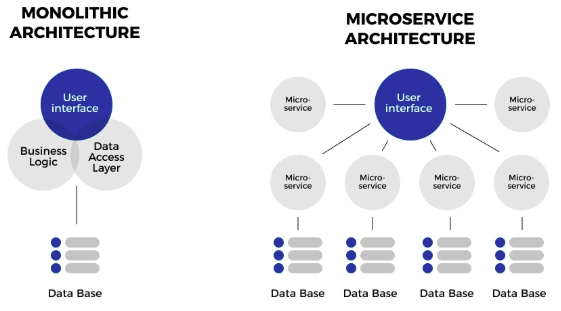
When comparing monolithic architectures and microservices, it’s easy to assume that the newer option is always superior. However, the reality of offshore software development is far more nuanced than a simple “old versus new” debate.
Ultimately, depending on your specific business requirements, choosing the right architecture, whether monolithic or microservices, is the strategic key to unlocking your organisation’s full potential.
Let’s take a closer look at the advantages and disadvantages of each.
|
Microservices |
Monolithic |
|
| Introduction | The simple and fast development of the entire system | Requires separate resources, complicating deployment coordination |
| Scalability | New changes are difficult to maintain and process. Need to redeploy the whole system | Each element can be scaled independently with no downtime |
| Agility | Lack of flexibility and inability to adopt new technologies, languages, and frameworks | Integrate with new technologies to solve business objectives |
| Resilience | One bug or issue can affect the entire system | Failure of one microservice does not affect other services |
| Test | End-to-end testing | Independent components should be tested separately |
| Safety | Communication within the unit makes data processing safe | Interprocess communication requires API circumvention and raises security concerns |
| Developer | Large, indivisible databases make it impossible to distribute team efforts | Teams of developers can work independently with no downtime |
Essential Technology for Microservices
Any modern tool or language can be used in a microservices architecture, but there are some core tools that are essential and close to the definition of microservices.
Containers, Docker, Kubernetes
To understand Docker, it is essential to first explore the concept of containers and how they address a primary challenge in the development lifecycle. In the context of offshore software development, maintaining environment consistency is vital for seamless project delivery. Historically, a major hurdle arises during deployment: code that performs flawlessly in a developer’s local environment may encounter unexpected issues in production. This predicament typically stems from discrepancies in operating systems, library versions, and diverse dependencies across different environments.
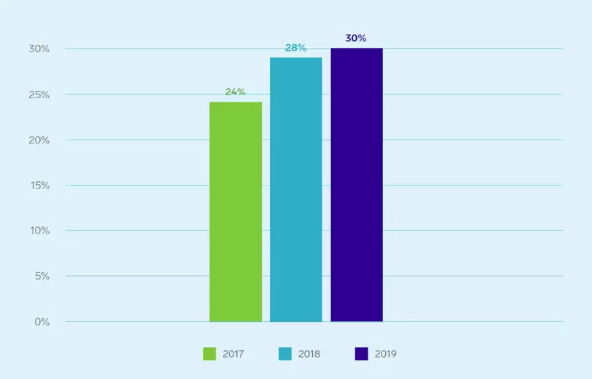
Docker stands out as the predominant container platform at present. It emerged in the market at an opportune moment and was open source right from the outset, establishing its dominance in the current landscape. As of now, approximately 30% of companies incorporate Docker within their AWS environments, and this figure continues to rise.
Docker provides an open standard for packaging and distributing container applications, but it introduces new problems. How are all these containers coordinated and scheduled? How can you upgrade your app seamlessly without interrupting service? How do I know what I’ve done and restart at the right time?

A solution swiftly emerged to organise containers: Kubernetes, Mesos, and Docker Swarm are among the prominent solutions that offer an abstract approach to crafting clusters of machines that simulate larger entities, a crucial aspect in expansive environments.
However, managing containers in a production setting is far from easy; containers necessitate a dispatch system. So, what should this dispatch system accomplish?
- Handling High Container and User Loads: A single application might involve numerous containers and users interacting simultaneously. Managing and monitoring these interactions requires a purpose-built system capable of managing large volumes of containers and users effectively.
- Managing, Monitoring, and Communication: Establishing communication between containers and users while managing monitoring services is a challenge. Embedding each microservice with its own monitoring functionality can be redundant and inefficient, potentially leading to performance degradation and congestion.
- Efficient Load Distribution: In an unregulated environment, container load can skew due to user requests, resulting in server-level imbalances and inefficient resource allocation. Load balancing mitigates this by ensuring efficient resource distribution.
- Authentication and Security: Orchestration systems like Kubernetes offer infrastructure-level management of authentication and security, enforcing consistent policies across platforms rather than within applications.
- Cross-Platform Deployment: Orchestrators effectively oversee complex tasks such as container operations coordination, microservice availability, and synchronisation in multi-cloud, cross-platform environments.
An orchestration system acts as a dynamic, comprehensive infrastructure for container-based applications. It governs external interactions while creating a secure and highly organised environment for its operation.
Kubernetes is well-suited for this role, contributing significantly to its widespread adoption.
API gateway
Microservices typically communicate via APIs, which is fundamental to establishing and maintaining system state. While this allows for direct interaction between clients and services, an intermediary layer becomes indispensable as the architecture expands over time. In the realm of offshore software development, where project scalability and security are top priorities, an API Gateway serves as a vital component.
Specifically, it acts as a reverse proxy that efficiently routes and distributes client requests across multiple services. Furthermore, it provides a centralised layer for enhanced security and authentication, ensuring that the entire application ecosystem remains both protected and highly efficient.
There are multiple technologies that can be used to implement API gateways, including API management platforms, but microservice architectures can be implemented using containers and Kubernetes. Gateways are usually implemented using Ingress or, more recently, Istio.
Advantages of Microservices
Reducing Costs and Increasing Efficiency
Microservices are generally simpler and more efficient than monolithic applications, leading to overall cost savings. In addition, microservices are self-contained and do not require the level of coordination and communication that monolithic applications require. By enabling organisations to use the right technology for the task at hand, microservices can improve efficiency and reduce the number of errors. For example, choosing a different technology stack for each microservice can improve performance and scalability.
Increasing Agility and Scalability
Microservices can scale horizontally very easily, making them ideal for situations where scalability is required. Additionally, because microservices are small and modular, they can be deployed much faster than traditional monolithic applications. This increased agility will be of great benefit to organisations that need to respond quickly to market changes.
Easy to Maintain and Update
Microservices are inherently easier to update than monolithic systems due to their modular, self-contained design. Since each service handles a specific functional task, developers can implement changes with a much lower risk of system-wide errors. Offshore software development projects benefit significantly from this, as it minimises the time and costs typically associated with long-term maintenance and complex system updates.
Reducing Time to Market
Microservices also help companies get their products to market faster. By breaking your application into smaller, more manageable pieces, you can develop and release feature-by-feature. Products can often be brought to market faster than with a monolithic approach.
Expanding Independently
Microservices are independently deployable, giving organisations more control over their applications. This increased control is a great advantage for organisations that need to react quickly to market changes. Additionally, using microservices will help organisations avoid the “monolithic blue” that can occur when a monolithic application becomes too large and unwieldy.
Read more: What is the difference between a core system and a business system and the relationship with ERP?
Disadvantages of Microservices
High Complexity
Microservices have many advantages, but they also come with complexity. This complexity can pose significant challenges for organisations unfamiliar with microservices. Additionally, microservices are so independent that it can be difficult to track down and resolve errors.
Increasing Network Traffic
Because microservices are designed to be self-contained, they rely heavily on the network to communicate with each other. This can result in slow response times (network latency) and increased network traffic. Additionally, it would be difficult to track down errors that occur when multiple microservices are communicating with each other.
Code Reuse Restrictions
Microservices are typically written in multiple programming languages and use different technology stacks, which limits code reuse. Sharing code between microservices increases development time and costs. is difficult.
Dependence on DevOps
To be successful with microservices, an organisation must have a strong DevOps team. Because DevOps is responsible for deploying and managing microservices. Without a strong DevOps team, it can be difficult to successfully implement and manage microservices-based applications.
Global Testing and Debugging Difficulties
Testing and debugging microservices-based applications can be quite complex, as components are typically distributed across multiple servers and devices. Achieving full visibility into every part of the system is essential for effective troubleshooting, yet this remains a significant hurdle for large-scale architectures. Offshore software development strategies, therefore, must prioritise advanced monitoring and centralised logging to ensure that these distributed environments are managed effectively and errors are resolved promptly.
Consider Microservices Carefully
As you can imagine, moving from a monolithic architecture to microservices is not for everyone. When you have a lot of important considerations to make and weigh some pros and cons, you need professional help from a trusted partner.
Relipa enables microservices for even the most complex monolithic application architectures. We can alleviate many of the inconveniences you may encounter when shifting.
Real-world Use Cases

If we raise four cases where microservices are suitable, we can think of the following.
- A system with a large scale and a wide range of functions
Microservices can be developed and operated by subdividing functions, making it easier to change and expand than monolithic systems.
- Systems with frequently changing business requirements and market conditions
Microservices let you deploy individual services independently, allowing you to quickly release new features and improvements.
- Systems that want to leverage different technologies and teams
With microservices, you can choose the most suitable technology and development language for each service, so you have a high degree of technical freedom. Also, since it can be developed in a small team, it is easy to communicate and manage progress.
- Systems that emphasise load balancing and availability
Microservices can distribute load according to each service, improving performance and cost efficiency. In addition, availability is also high because other services are less likely to be affected even if a failure occurs.
Real-life Microservice Use Cases
Amazon
Like many startups, Amazon was built as a monolith because it’s easier to create and launch apps in a monolithic architecture. However, as the company began to grow rapidly, it needed to develop many new features and quickly expand its online platform.
“This allowed us to create a very highly microservice architecture.”
Rob Brigham
AWS developer tools products
Back in 2001, Amazon’s codebase grew so massive and complex that it became a major bottleneck. Because hundreds of software engineers were constantly pushing changes, developers had to spend a significant amount of time simply resolving merge conflicts and consolidating code into a single version.
Consequently, the need to rebuild and retest the entire system for every update led to an unacceptable product delivery schedule. To solve this, Amazon’s engineers sought to simplify their pipeline – a challenge that remains highly relevant for modern businesses managing offshore software development. Their strategic solution was to take the monolith apart.
Specifically, the team thoroughly analysed the codebase to identify functional units that served a single purpose. By transforming these units into independent microservices and connecting them via API integration, they achieved the modularity required for rapid, decentralised growth.
Following this shift, the focus turned toward optimising the entire development lifecycle. Amazon’s engineers began developing automated solutions to eliminate idle time in their CI/CD pipelines, ensuring that their new architecture could deliver value faster and more reliably than ever before.
Netflix
Netflix stands as a premier business case for the successful adoption of microservices. While the company initially relied on a monolithic architecture for its debut web application, this model quickly reached its limits as the service’s popularity skyrocketed.
To adapt, Netflix engineered a robust microservices system on the AWS platform. This shift effectively segregated their engineering teams, allowing them to build and deploy a multitude of services independently – a level of agility that high-quality offshore software development partners strive to deliver for their clients.
However, this transition was not without its hurdles. As the volume of customer requests surged, Netflix struggled with processing efficiency, which initially led to several database failures.
To resolve these bottlenecks, the company transitioned from on-premises databases to a cloud-based solution on AWS. The inherent horizontal scalability of the cloud allowed Netflix to allocate resources on demand, effortlessly managing the massive inflow of user requests.
Ultimately, the entire architectural shift took two years to complete. This transformation was fueled by a clear recognition of the operational advantages a decoupled system offers, proving that microservices are essential for modernising complex business operations in today’s digital landscape.
Uber
At its inception, Uber utilised a monolithic architecture where a single codebase managed every operational facet, from connecting drivers with passengers to processing payments and trip management. While this worked initially, the model quickly became a bottleneck as the company’s growth accelerated.
Specifically, the monolithic setup required developers to redeploy the entire codebase for even the most minor updates. This meant that every slight modification reverberated throughout the system, necessitating exhaustive testing cycles before any new feature could go live.
Faced with this drain on time and resources, Uber embarked on a transformative path to fragment its application into independent microservices. This strategic pivot is a core expertise in modern offshore software development, where agility and rapid deployment are essential for scaling global platforms.
As a result, the shift to microservices granted various teams within the organisation much-needed autonomy and significantly augmented system flexibility. Uber achieved the capability to scale distinct domains, such as billing, notifications, and driver administration, independently, without the burden of updating the entire system for every small tweak.
Ultimately, Uber’s evolution underscores how a strategic architectural shift can drive efficiency and agility. It serves as a powerful reminder that for technology-driven enterprises, the right architecture is the foundation for staying competitive in a fast-paced digital market.
Cases Not Suitable for Microservices
If I had to raise three cases where microservices are not suitable, I would consider the following:
- The small system with simple functions
Microservices increase the cost and complexity of designing and managing them, reducing the benefits of the system as a whole.
- Systems with stable business requirements and market environment
Microservices are easy to adapt to changes and extensions, but you need to pay attention to data consistency and security. Since the services are loosely coupled and independent, it is easy to add new functions individually. If changes are small, a monolithic system may be sufficient.
- Systems you want to develop with the same technology or team
Microservices have the advantage of being able to select the most suitable technology and development language for each service, but at the same time, it also increases technical diversity and learning costs. Organisational changes may also be required, as small teams are encouraged to develop.
Read more: What is MVP development? Introducing the Detailed Development Process, Noted Points, and Use Cases
Conclusion
In summary, transitioning to a microservices architecture offers distinct advantages over traditional monolithic systems, specifically accelerated performance, seamless scalability, and efficient code reuse. However, these benefits are accompanied by inherent challenges, including greater deployment complexity and higher initial implementation costs.
Consequently, the decision to modernise should not be viewed as a mere trend but as a calculated strategic move. For organisations utilising offshore software development, a comprehensive evaluation of these trade-offs is essential to ensure that the chosen architecture effectively supports their long-term operational objectives and technical capacity.
Relipa Software
Relipa Co., Ltd. is a Vietnam-based software development company established in April 2016. After two years of growth, our Japanese branch – Relipa Japan – was officially founded in July 2018.
We provide services in MVP development, web and mobile application development, and blockchain solutions. With a team of over 100 professional IT engineers and experienced project managers, Relipa has become a reliable partner for many enterprises and has successfully delivered more than 500 projects for startups and businesses worldwide.
