
As businesses accelerate their digital transformation initiatives, the demand for efficient and scalable app development software continues to grow. Organizations across industries are investing in mobile applications, web platforms, internal business systems, and customer-facing digital solutions to improve operational efficiency and customer experiences.
One of the most important decisions companies face during this journey is choosing between low-code development and custom app development.
Low-code platforms promise rapid delivery, reduced development costs, and easier maintenance. On the other hand, custom application development provides maximum flexibility, scalability, and control over business-critical software solutions.
So which approach is right for your business?
The answer depends on your goals, technical requirements, budget, timeline, and long-term growth strategy.In this guide, we’ll compare low-code and custom app development in depth, examining their advantages, limitations, costs, scalability, security considerations, and ideal use cases to help you make an informed decision.
Understanding Low-Code Development
According to Gartner, low-code platforms are helping organizations accelerate digital transformation by enabling faster application delivery and reducing development complexity. Low-code development is a software development approach that allows applications to be built using visual modeling tools, drag-and-drop interfaces, pre-configured components, and reusable workflows instead of extensive manual coding.
Modern low-code app development software enables both professional developers and citizen developers to create applications quickly. By reducing the amount of hand-written code required, organizations can accelerate project delivery while minimizing development complexity.
Popular low-code platforms include Microsoft Power Apps, OutSystems, Mendix, Appian, and Zoho Creator. These solutions typically provide built-in functionality for user management, workflow automation, reporting dashboards, API connectivity, database management, and application deployment.
One major advantage of low-code app development software is its ability to reduce IT backlogs. Business departments can develop internal applications without waiting months for traditional development resources. This enables faster innovation and quicker responses to operational challenges.
Common low-code use cases include:
- Internal workflow automation
- Employee self-service portals
- Approval management systems
- Customer onboarding applications
- Reporting dashboards
- Rapid proof-of-concept development
For businesses seeking fast deployment and cost-effective digital transformation, low-code app development software offers a compelling solution.
What Is Custom App Development?
Custom app development is the process of designing, building, and deploying software applications specifically tailored to an organization’s unique business requirements. Unlike low-code platforms that rely heavily on pre-built templates and standardized components, custom development allows businesses to create solutions from the ground up with complete control over features, functionality, and user experience.
Using modern technologies such as Java, .NET, Python, Node.js, React, Angular, Vue.js, Flutter, Kotlin, and Swift, development teams can build highly specialized applications that align with both current operational needs and future business goals. This level of flexibility makes custom app development software a preferred choice for organizations that require more than what off-the-shelf solutions can offer.
Businesses often invest in custom app development software when they need unique business functionality, advanced third-party integrations, complex workflows, enhanced security controls, or applications capable of supporting large-scale growth. Unlike many low-code platforms, custom-built solutions can be optimized for specific performance requirements and integrated seamlessly with existing enterprise systems.
Another major advantage of custom app development software is full ownership of the source code and underlying architecture. This gives organizations complete control over future enhancements, security updates, and technology decisions without being dependent on a specific platform vendor.
For companies developing customer-facing products, enterprise platforms, or mission-critical systems, custom app development software provides the flexibility, scalability, and long-term value needed to support sustainable business growth and digital transformation.
Low-Code vs Custom App Development: Understanding the Key Differences
When evaluating modern app development software, businesses often compare low-code platforms with traditional custom app development. While both approaches can help organizations build digital solutions, they differ significantly in terms of speed, flexibility, scalability, cost, and long-term business value.
Development Speed: Fast Delivery vs Tailored Solutions
One of the biggest advantages of low-code development is speed. By using visual interfaces, drag-and-drop components, and pre-built modules, development teams can create applications much faster than with traditional coding methods.
For businesses that need internal tools, workflow automation systems, or proof-of-concept applications, low-code platforms can reduce development timelines from months to just a few weeks. This accelerated delivery allows organizations to respond quickly to market demands and launch digital initiatives faster.
Custom app development, however, follows a more comprehensive software development process. Teams must handle requirements analysis, architecture planning, coding, testing, security validation, and deployment. Although this approach requires more time, it results in a solution specifically designed around unique business requirements rather than platform limitations.
For organizations prioritizing rapid deployment, low-code development offers a clear advantage. Businesses seeking highly customized solutions may find the additional development time worthwhile.
Flexibility and Customization: Standardized vs Fully Tailored Applications
Flexibility is often where the gap between low-code and custom development becomes most apparent.
Most low-code app development software provides predefined templates, components, and workflows that simplify application creation. While these tools offer some customization capabilities, businesses may eventually encounter restrictions when attempting to implement unique processes or advanced functionality.
As organizations grow and operational requirements become more complex, these limitations can impact innovation and user experience.
Custom software development removes these constraints entirely. Development teams can build applications that align precisely with business goals, customer expectations, and industry requirements. Whether creating proprietary workflows, advanced integrations, or highly customized interfaces, custom development provides complete freedom over how the application functions and evolves.
For companies seeking long-term differentiation and competitive advantage, custom app development often delivers greater strategic value.
Scalability: Supporting Future Business Growth
Scalability is a critical consideration when selecting an app development software strategy.
Low-code platforms perform well for departmental applications, workflow automation tools, and internal business systems with moderate user volumes. However, as applications become more complex and user demand increases, organizations may encounter performance limitations imposed by the platform architecture.
Custom applications can be designed specifically for growth from the beginning. Modern enterprise app development often incorporates cloud-native technologies, microservices architectures, distributed infrastructure, and high-performance databases that support increasing workloads.
This level of architectural flexibility allows businesses to scale applications efficiently as user bases, transaction volumes, and operational complexity expand over time.
For organizations expecting significant growth, custom software development typically provides a stronger foundation for long-term scalability.
Cost Considerations: Upfront Savings vs Long-Term Value
Budget is often a major factor when deciding between low-code and custom app development.
Low-code platforms generally require lower initial investment because they reduce coding effort, shorten development cycles, and minimize resource requirements. This makes them particularly attractive for startups and businesses seeking cost-effective application development solutions.
However, evaluating costs solely based on initial development expenses can be misleading.
Most low-code platforms operate on subscription-based pricing models that include licensing fees, user-based charges, premium integrations, and additional platform services. As application usage grows, these recurring costs can increase substantially.
Custom development requires a larger upfront investment due to planning, design, engineering, and quality assurance activities. Yet businesses gain full ownership of their software and avoid ongoing platform licensing costs.
When assessing total cost of ownership, organizations should consider both immediate development expenses and long-term operational costs.
Security and Compliance: Balancing Convenience and Control
Security remains a top priority for businesses handling sensitive customer, financial, or operational data.
Leading low-code development platforms offer built-in security capabilities such as role-based access control, encryption, compliance certifications, and user authentication features. These tools help organizations implement standard security practices without extensive technical expertise.
Despite these advantages, businesses remain dependent on the platform provider’s security infrastructure and update policies.
Custom software development offers a greater level of control. Organizations can design security architectures tailored to their specific risk profile, regulatory requirements, and industry standards. Features such as advanced authentication systems, zero-trust security frameworks, and specialized compliance controls can be integrated directly into the application.
Industries such as healthcare, finance, government, and enterprise technology often prefer custom application development because of these enhanced security capabilities.
Integration Capabilities: Connecting Modern and Legacy Systems
Modern businesses rarely operate with a single software platform. Instead, they rely on interconnected ecosystems that include CRM systems, ERP solutions, marketing platforms, accounting software, analytics tools, and payment gateways.
Most low-code app development software includes pre-built connectors that simplify integration with popular cloud services. These capabilities can significantly reduce development effort for common business scenarios.
However, challenges may arise when organizations need to connect legacy systems, proprietary databases, or highly specialized industry applications.
Custom development provides virtually unlimited integration flexibility. Developers can create APIs, middleware solutions, custom connectors, and data pipelines that facilitate seamless communication between diverse systems.
For enterprises managing complex technology environments, custom software development often provides the integration capabilities necessary to support digital transformation initiatives.
Comparing Low-Code and Custom Development Side by Side
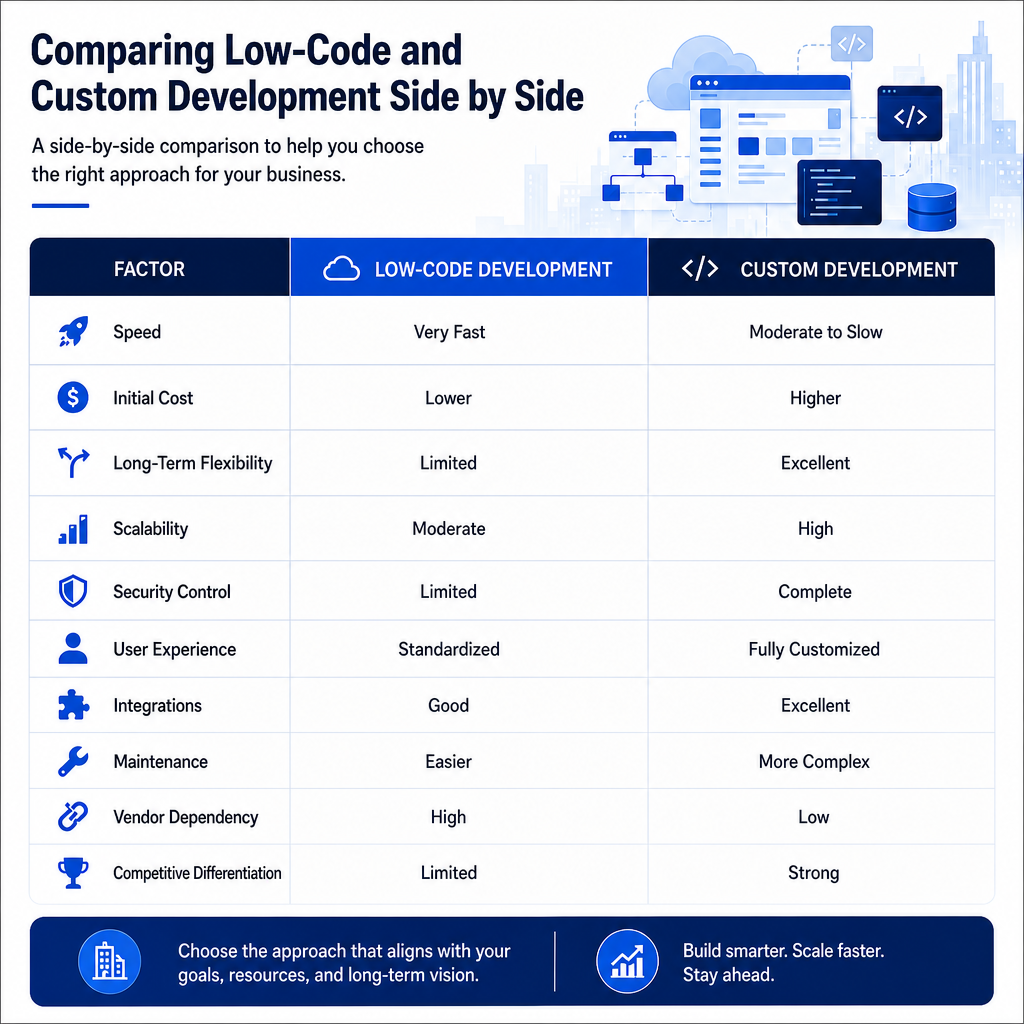
How to Choose the Right Approach
Before selecting an app development software strategy, businesses should evaluate both their current needs and long-term objectives. While low-code and custom development can both deliver successful outcomes, the right choice depends on factors such as complexity, speed, scalability, security, and business value.
What Business Problem Are You Solving?
Start by identifying the purpose of the application. If you need to automate simple workflows, manage internal processes, or quickly digitize manual tasks, low-code app development software may provide a fast and cost-effective solution. However, applications that require unique functionality, complex business logic, or customer-facing experiences often benefit from custom development.
How Fast Do You Need the Solution?
Project timelines play a major role in the decision-making process. Low-code development enables faster deployment by using pre-built components and visual development tools, making it ideal for organizations that need to launch quickly. Custom development takes more time but provides greater flexibility and control over the final product.
Will the Application Scale Significantly?
Consider where the application will be in three to five years. If you expect rapid growth, increasing user volumes, or evolving business requirements, scalability should be a priority. While many low-code platforms support moderate growth, custom applications can be designed specifically to accommodate future expansion and higher performance demands.
What Are Your Security Requirements?
Organizations handling sensitive customer data, financial information, or regulated workloads should carefully assess security requirements. Low-code platforms often provide built-in security features, but custom development allows businesses to implement specialized security controls, compliance measures, and governance policies tailored to their industry standards.
Is the Application Core to Your Business?
Applications that directly support revenue generation, customer engagement, or competitive differentiation often justify the investment in custom development. For business-critical systems, the ability to fully control functionality, integrations, and future enhancements can provide significant long-term value. Internal tools or non-core applications, on the other hand, may be well suited to low-code app development software.
By answering these questions, organizations can choose an app development software approach that balances speed, cost, flexibility, and long-term business goals.
Conclusion
The debate between low-code and custom app development is not about determining a universal winner. Instead, it is about selecting the right approach based on your business objectives.
Low-code app development software delivers speed, cost efficiency, and ease of maintenance, making it ideal for internal tools, workflow automation, and rapid deployment projects.
Custom app development offers unmatched flexibility, scalability, security, and competitive differentiation, making it the preferred choice for enterprise platforms, customer-facing applications, and mission-critical systems.
For many organizations, the most effective strategy combines both approaches—leveraging low-code solutions where speed matters and custom development where innovation and long-term growth are priorities.
By carefully evaluating your business needs, technical requirements, and future goals, you can choose the development approach that maximizes value and supports sustainable digital transformation.
Relipa Software
Relipa Co., Ltd. is a Vietnam-based software development company established in April 2016. After two years of growth, our Japanese branch – Relipa Japan – was officially founded in July 2018.
We provide services in MVP development, web and mobile application development, and blockchain solutions. With a team of over 100 professional IT engineers and experienced project managers, Relipa has become a reliable partner for many enterprises and has successfully delivered more than 500 projects for startups and businesses worldwide.
