
A digital product rarely fails because a team cannot write code. More often, it fails because the business idea behind the product is still unclear. The target users may be too broad, the value proposition vague, or the revenue model unvalidated. This is why Business Model Canvas (BMC) can be useful before starting software and application development.
Instead of treating BMC as a simple planning template, businesses can use it as a decision-making framework. It connects customer needs, product value, channels, revenue, resources, partners, activities, and costs in one view. For teams preparing for software and application development, this creates a clearer foundation for deciding what should be built, why it matters, and which assumptions need to be tested first., this creates a clearer foundation for deciding what should be built, why it matters, and which assumptions need to be tested first.
What is BMC?
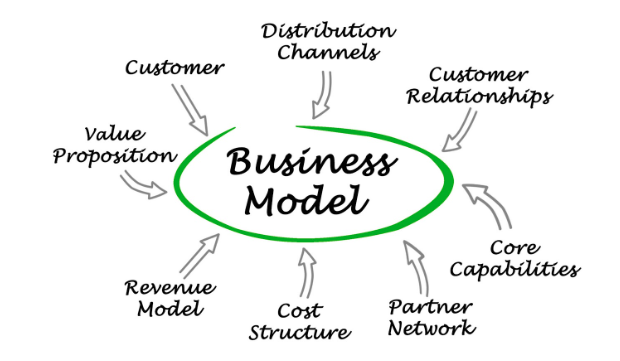
Business Model Canvas (BMC) is an essential thing for a new business. How each part means will be explained later, but let’s slightly go through the general canvas. BMC contains 9 main elements:
- Customer Segment
- Value Propositions
- Channels
- Customer Relationships
- Revenue Streams
- Key Resources
- Key Activities
- Key Partner
- Cost Structure
The main axis of a new business is “what to provide to what target”. If the business cannot decide what they provide and who the target consumers are, nothing will start. However, it’s not always easy to instantly create a sustainable and potentially new business.
It is said that each person in charge of the business repeats trial and error in their head while exploring all possibilities, which is a series of crude work. However, even if you keep thinking, without specific keywords, concepts, and numerical values that can be used as a guide, you will not be able to determine a business plan. Therefore, in order to find ideas for developing new services and solving problems, we will fill in the above BMC one by one.
The specific procedure for creating Business Model Canvas (BMC) will be described later, but these nine items are not in independent relationships, but related to each other while being derived in order from the elements that are close to each other. By linking them, we create the whole picture and finally incorporate it into the business plan.
For example, you are presenting a prestigious new business for your company. The points required at that time and the minimum factors that will be pointed out by the CEO and management are “What”, “When”, “Who”, “Where”, “Why”, and “How”, or the “5W1H” model.
It’s a kind of important framework, but it’s still not enough if you want to succeed in a new business. You add the three elements of “Whom”, “How many”, and “How much” or “6W3H”, then it will be more strategically seen. In the other way, filling in the 9 elements BMC is naturally answering to “6W3H”.
Why BMC matters before product development
Business Model Canvas includes nine elements: customer segments, value propositions, channels, customer relationships, revenue streams, key resources, key activities, key partners, and cost structure.
Its real value is showing how each decision affects the others. For example, before building a booking platform, a company needs to know who will use it, what problem it solves, how customers will find it, how revenue will be generated, and what resources are required.
These questions directly influence software and application development. A different customer segment may require a different user journey. A subscription model may need recurring billing. A marketplace may need payment processing, user roles, transaction tracking, and partner integrations.
BMC helps businesses identify these connections before they become expensive changes during implementation.
Validate the business before defining the product

One common mistake in digital projects is moving too quickly from “we have an idea” to “we need an app.”
An app is not a business model, and a long feature list does not automatically create customer value.
BMC helps teams define the assumptions behind a product before committing significant time and budget. Unclear assumptions often turn into changing requirements, unnecessary features, delayed releases, and higher costs.
Instead of starting with functions, teams can first clarify who the product is for, what problem it solves, what value users receive, how users discover it, and how the business earns revenue. These answers can then shape the MVP, roadmap, and development scope.
The 9 BMC elements through a digital product lens
Customer segments
Customer segments define who the business intends to serve. This sounds simple, but the answer can change almost every product decision.
A product for individual consumers will not have the same onboarding, permissions, payment flow, or support process as an enterprise platform. Customer segmentation is therefore also a product requirement.
Value propositions
Value propositions connect customer needs with what the business actually offers.
Before development begins, the team needs to understand why users would choose the product. Is the goal to save time, reduce costs, simplify a process, improve convenience, or create a new experience?
When the value proposition is clear, the team can focus on functions that directly support it. When it is unclear, software and application development can easily become a process of adding features without a strong reason for users to adopt them.
Channels
Channels describe how a business reaches customers and delivers value. For digital businesses, this may include websites, mobile apps, social platforms, marketplaces, partner systems, or direct sales.
The selected channels can affect architecture, integrations, authentication, analytics, and user experience. A product operating across web, mobile, and partner platforms may require centralized data and APIs.
Customer relationships
Getting users into a product is only one part of the model. The business also needs to decide how it will maintain the relationship after acquisition.
Some products depend on self-service, while others require onboarding, support, account management, communities, or after-sales services. These choices can lead to CRM integration, notification systems, support tools, and member accounts.
Revenue streams
A digital product may generate revenue through subscriptions, commissions, transaction fees, licenses, memberships, or advertising.
Each model creates different technical requirements.
A subscription service needs billing cycles and account management. A marketplace may need payment processing, settlements, and transaction tracking. A membership product may require tier management and access control.
Defining the revenue model early allows software and application development to support monetization from the beginning instead of adding it later.
Key resources
Key resources include people, capital, information, infrastructure, intellectual property, and technical capabilities.
For a digital product, this may include product managers, designers, engineers, cloud infrastructure, databases, APIs, security expertise, or specialists in AI and blockchain. This part of BMC reveals the gap between what a company wants to build and what it can support sustainably.
Key activities
Key activities cover the work required to deliver the value proposition, including development, system operations, sales, marketing, customer support, data analysis, security, and continuous improvement.
After launch, the product still requires monitoring, maintenance, updates, infrastructure management, security, and customer support. These activities should be considered early rather than treated as post-launch concerns.
Key partners
Not every capability needs to exist inside the company.
Businesses may work with cloud providers, payment providers, technology vendors, data partners, consultants, or external development teams.
The important decision is identifying which capabilities are strategic enough to keep in-house and which can be supported by partners.
This becomes especially relevant when software and application development requires skills that are difficult, expensive, or slow to build internally.
A clear partner strategy can reduce resource pressure while allowing the business to stay focused on its core value proposition.
Cost structure
Cost structure brings the business model back to feasibility.
Digital products require more than an initial development budget. Businesses also need to consider infrastructure, maintenance, licenses, third-party services, integrations, customer support, security, marketing, and future upgrades.
A product may be technically possible but commercially unsustainable. Mapping these costs early helps the team decide whether the scope is realistic before development begins.
Reviewing the business model before adding new features
Business Model Canvas is often associated with startups and new products, but it can also help businesses review existing products.
A product may reach a point where growth slows, acquisition becomes more expensive, expectations change, or competitors enter the market. Adding more features may not solve the real problem. Low conversion can come from weak positioning, while high churn may reflect a mismatch between customer expectations and the value delivered.
Revisiting BMC allows teams to review the full business model before deciding what needs to change. This gives software and application development teams more context for deciding whether the next step should be a new feature, redesigned workflow, integration, or broader business adjustment.
How to build a BMC that can guide development
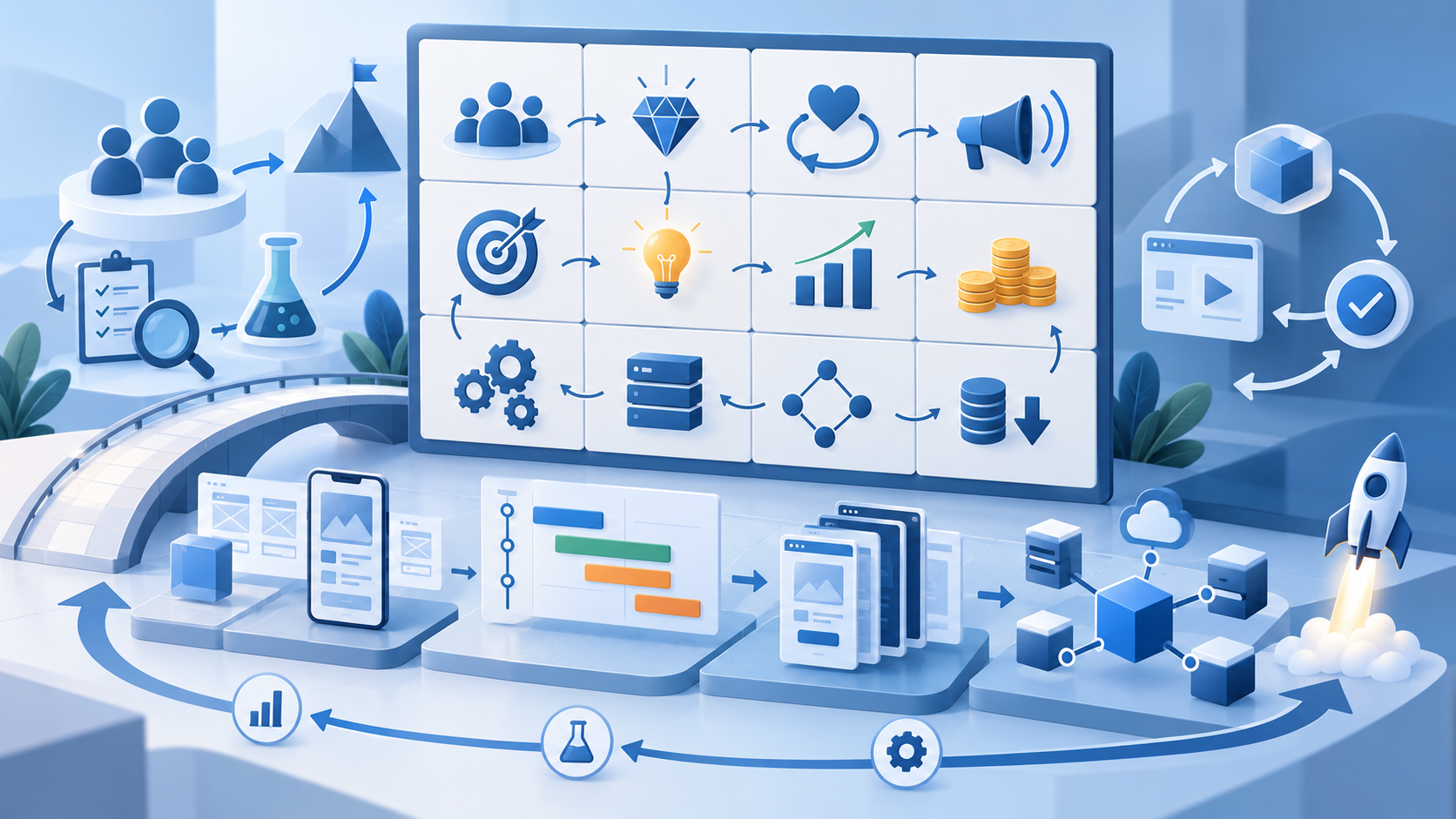
There is no single mandatory order for completing a Business Model Canvas. However, for a new digital product, customer segments and value propositions are usually the strongest starting points.
First, define who the product is for and what problem it solves. Then clarify how the product will reach users, how the business will maintain customer relationships, and how revenue will be generated. After that, identify the resources, activities, partners, and costs required to make the model work.
The goal is not to fill every box perfectly on the first attempt.
BMC works best as an iterative tool. Businesses can revise assumptions as they interview users, test prototypes, compare alternatives, evaluate costs, and gather feedback.
This approach also fits software and application development because products can be validated and improved through successive releases instead of trying to build everything at once.
The strongest use of BMC is converting business logic into priorities. Once the canvas is clear, a company can identify assumptions to validate, MVP capabilities, required integrations, key partners, and costs that need tighter control.
That makes BMC a practical bridge between strategy and execution.
Instead of asking developers to simply “build the idea,” businesses can give the product team a structured view of the customer, value proposition, revenue model, operating requirements, and constraints.
This gives software and application development a clearer direction while reducing the risk of investing in functions that do not contribute to the business model.
Conclusion
Business Model Canvas helps businesses connect software and application development with real customer needs, business value, and long-term goals. Instead of moving directly from an idea to technical implementation, BMC gives teams a clearer view of what should be built and why.
Before investing heavily in technology, businesses can use BMC to define their target customers, value proposition, revenue model, required resources, key partners, and overall costs. These factors provide a stronger foundation for making practical product decisions.
By connecting business strategy with development priorities, companies can reduce unnecessary features, control costs, and focus resources on functions that create measurable value.
At Relipa, we help businesses turn product ideas into practical digital solutions. By aligning business priorities with the right development approach, teams can build products with clearer direction, lower complexity, and stronger potential for sustainable growth.
Relipa
Relipa is a Vietnam-based software development company established in April 2016. After two years of growth, our Japanese branch – Relipa Japan – was officially founded in July 2018.
We provide services in MVP development, web and mobile application development, and blockchain solutions. With a team of over 100 professional IT engineers and experienced project managers, Relipa has become a reliable partner for many enterprises and has successfully delivered more than 500 projects for startups and businesses worldwide.
