

 Copy link


Top Tech Trends In 2026: How AI Is Powering The Future
The year 2026 will mark a turning point in tech trends, as AI, advanced computing, and human-machine collaboration evolve from experimental concepts into business enablers. Organizations across every industry are beginning to rethink their digital strategies, recognizing that future competitiveness will depend on how effectively they adopt and integrate these emerging capabilities.
In this blog, we break down the key technology trends shaping the next wave of digital transformation, spanning AI foundations, new computing paradigms, and intelligent systems that enhance human performance. Combining Gartner’s latest prediction with real-world use cases, this overview provides a clear roadmap for companies seeking to strengthen their technological foundation and seize new opportunities in a rapidly chaningoaveđ
Global Technology Market Overview
The Global technology sector is continuously expanding. Worldwide IT spending is projected to reach USD 5.43 trillion in 2025, which marks a 7.9% increase from the previous year. AI investment is expected to grow in 2026, supported by hyperscaler infrastructure and enterprise adoption.
The industry maintains steady momentum despite inflation and geopolitical tensions. Cloud computing remains a key driver, with the global market reaching USD 738.2 billion in 2025 and projected to grow to USD 1.6 trillion by 2030. This shift is reshaping enterprise operations and consumer experiences across regions such as the US, India, and Africa.
(Source: StartUs Insights)
Market Expansion and Investment Insights
Precedence Research estimates the global agentic AI market will reach USD 4.35 billion in 2025 and grow to USD 103.28 billion by 2034, with a compound annual growth rate above 40%.
Deloitte’s Global 2025 Predictions Report notes that 25% of enterprises using generative AI plan to deploy AI agents by 2025. This figure may rise to 50% by 2027.
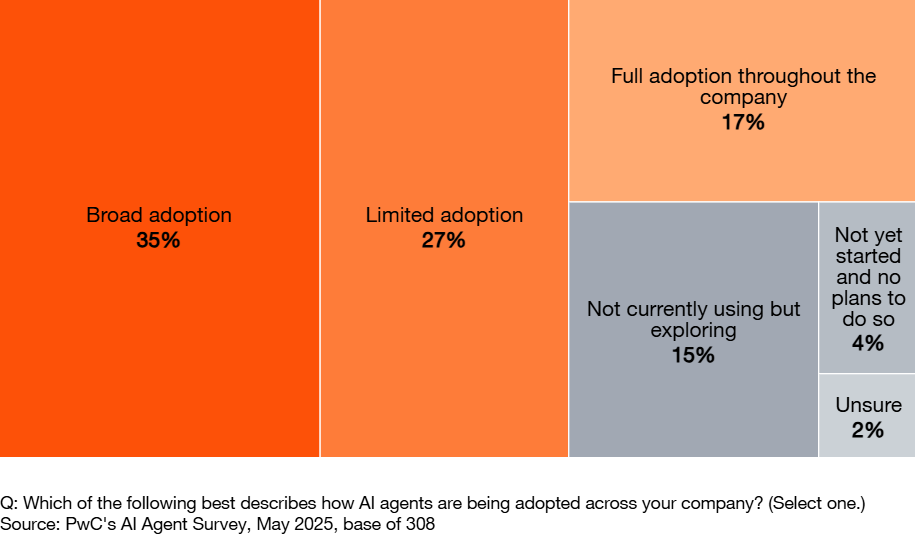
Source: PwC’s 2025 Survey
According to PwC’s 2025 survey, most organizations report some level of AI agent adoption. Among them, 19% deploy agents at scale, 35% run pilots, and 25% use agents in limited applications.
Venture capital investment continues to grow. In 2024, generative AI startups raised USD 56 billion across 885 deals, up from 29.1 billion across 691 deals in 2023. The first half of 2025 alone saw USD 49.2 billion in funding, which already exceeds the previous year’s total.
Measurable Business Impact
McKinsey research shows AI is able to automate 60-70% of work activities. This shift allows teams to prioritize strategic tasks over routine operations. Further, programmers report a 55.8% productivity increase, whereas customer service teams see a 14% improvement. Organizations using AI agents note faster order processing and lower compliance costs, driven by autonomous workflow management.
“73% of survey respondents agree that how they use AI agents will give them a significant competitive advantage in the coming 12 months, and 75% say they are confident in their company’s AI agent strategy.” – Credit: PwC AI Agent Survey
Top 10 Tech Trends in 2026
In line with the 3 themes advocated by Gartner and McKinsey, we will provide a thorough explanation of the top 10 tech trends that companies should prioritize, examples, and an image of return on investment.
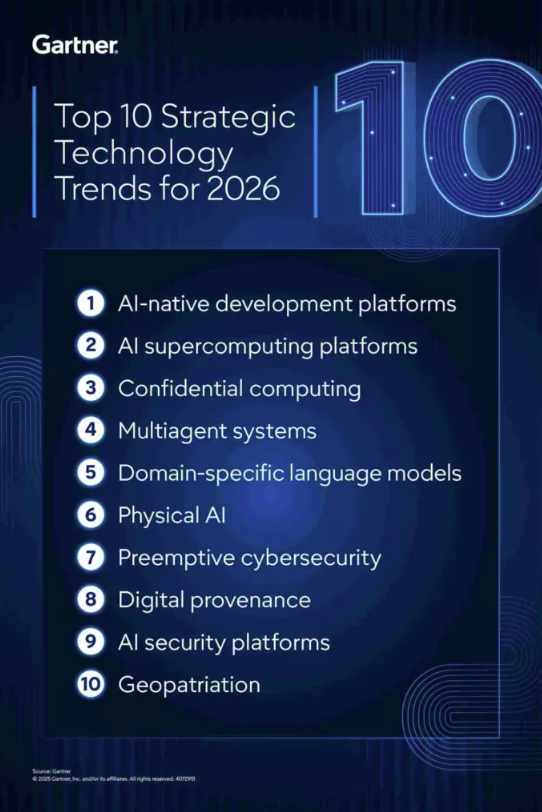
Category 1: Essential Elements of AI
AI Native Development Platform
The AI Native Development Platform is a next-generation development environment centered around generative AI. With the rise of no-code/low-code development, it offers an environment where even non-engineers can quickly create in-house tools through rapid development and citizen development. It also comes standard with the latest technologies, such as API integration, microservices, and RAG (Search Augmented and Generated Analytics).
Key Roles:
- Dramatically streamlined application development
- Establishing a standardized AI workflow
- Securing integration with internal data
- Promoting Citizen Development to fill the IT human resource shortage
Risks to Consider:
- Inadequate data quality and access management can lead to incorrect answers and incorrect processing
- Governance, quality assurance, and auditing mechanisms are essential
Gartner predicts that by 2030, 80% of organizations will restructure their large software engineering teams due to the proliferation of AI-native development platforms, especially towards smaller, more agile teams augmented by AI.
AI Supercomputing Platform
With the rapid surge in AI demand, supercomputing infrastructures leveraging high-performance GPU clusters and hybrid cloud environments have become critically important. They enable large-scale model training, real-time inference, and advanced simulations, tasks that were difficult or even impossible with traditional systems.
Key Roles:
- Enables high-speed training and real-time inference for large-scale LLMs
- Optimizes distributed processing, including edge environments
- Eliminates bottlenecks in legacy systems and supports the transition to a modern AI-ready infrastructure
Risks to Consider:
- Infrastructure costs, including initial investment and ongoing operations, and power consumption, tend to remain high
- Potential vendor lock-in with specific cloud providers or GPU vendors
- Strengthening security and access control for models and data is essential
Gartner predicts that by 2028, more than 40% of major enterprises will adopt hybrid computing paradigms for their critical business workflows. This indicates that architecture combining on-premises systems, cloud, and edge computing is becoming the standard infrastructure model in the AI era.
Domain-Specific Language Models
Domain-specific language models are large-scale models trained on industry-specific data such as finance, manufacturing, and healthcare. They deliver levels of accuracy, expertise, and nuanced Japanese honorific expressions that general-purpose models cannot fully achieve.
Key Roles:
- Strong understanding of language context and honorific expressions, providing accuracy suitable for real-world business use
- Significantly reduces incorrect responses (hallucinations) by leveraging industry-specific knowledge
- Enables safe integration and utilization of internal data through RAG (Retrieval-Augmented Generation)
Risks to Consider:
- Excessive specialization may reduce generality and flexibility
- Model updates and retaining can incur substantial costs
- Strengthening data governance and privacy protection is essential
Gartner predicts that by 2028, the majority of generative AI models used by enterprises will be domain-specific rather than general-purpose. The reason is that specialized models deliver greater business value from the perspective of accuracy, safety, and compliance.
AI Security Platform
As generative AI becomes more widespread, new threats such as data leakage, prompt injection, and model theft are rapidly increasing. To address these risks, AI-dedicated security platforms have become essential for enterprises.
Key Roles:
- Strengthening access control, encryption, and authorization management
- Ensuring secure management of training data and generated data
- Providing AI log auditing, anomaly detection, and automated alerting
- Supporting various compliance requirements
Risks to Consider:
- Enterprise-wide AI literacy must be improved in parallel
- Excessive security controls may slow down development
- Maintaining a balance between security and usability is crucial
Gartner predicts that by 2028, more than 50% of companies will use AI security platforms to protect their AI investments.
Category 2: The New Frontier of Computing
Quantum Technology
Quantum technology is a next-generation computing paradigm that uses quantum bits (qubits) to perform calculations that are difficult or impossible for conventional computers, with far greater speed and efficiency. It holds significant promise in areas such as complex chemical simulations, cryptanalysis, and optimization problems.
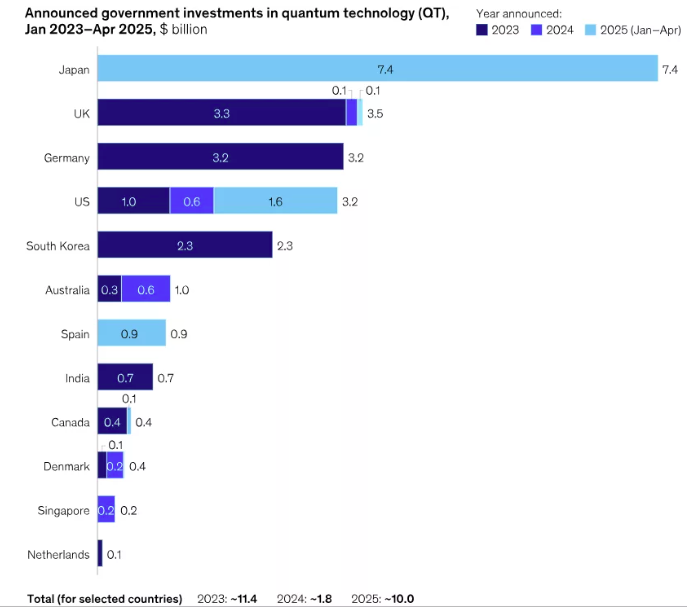
Source: Quantum Technology Monitor 2025 | McKinsey
Key Roles:
- Rapidly solving highly complex problems
- Supporting the design of new materials and pharmaceuticals
- Enabling quantum cryptography to enhance security
Risks to Consider:
- Hardware stability and error correction remain major challenges
- Technological maturity is still limited for widespread practical use
- Concerns over high costs and a shortage of specialized talent
Use Cases:
- New drug development projects at major pharmaceutical companies
- Portfolio optimization support for financial institutions
Gartner predicts that commercial applications of quantum computing technologies wll accelerate by 2028.
Next-Generation Connectivity
Next-generation connectivity refers to ultra-high-speed, low-latency communication technologies such as 5G/6G, Wi-Fi 7, and satellite communication. These technologies serve as the foundation for advanced services, including IoT, smart cities, and remote healthcare.
Key Roles:
- Enabling real-time data transmission with ultra-low latency
- Supporting simultaneous connections for massive numbers of devices through networking slicing
- Incorporating advanced security features
Risks to Consider:
- High costs associated with infrastructure development
- Need to address increasingly complex security risks
- Requirement to adapt flexibility to changing regulations and standards
Use Cases:
- Real-time production management in manufacturing
- Remote surgical support in the medical field
- Smart tracking in the logistics industry
Gartner predicts that by 2026, more than 50% of major enterprises will leverage next-generation networks to accelerate business transformation.
Confidential Computing
Confidential computing is a technology that keeps data encrypted even while it is being processed, significantly enhancing privacy and security. It is particularly essential for secure data sharing in cloud and multi-tenant environments.
Key Roles:
- Secure data processing through Trusted Execution Environments (TEE)
- Maintaining encryption of sensitive data during computation
- Supporting secure collaborative analytics across multiple organizations
Risk to Consider:
- Operational complexity due to hardware dependencies
- Limited availability of compatible software and services
- Higher cost burdens for early adopters
Use Cases:
- Risk management through secure computation in financial institutions
- Safe sharing of patient data among medical organizations
- Strengthened confidentiality within supply chain operations
Gartner predicts that by 2029, more than 75% of operations running on untrusted infrastructure will be protected by confidential computing, ensuring security even when data is in use. This reflects a broader shift in cloud and hybrid environments from protecting data at rest and in transit to protecting data during processing.
Category 3: Synergy Between Humans and Machines
Preventive cybersecurity
Preventive cybersecurity is a next-generation security strategy designed to detect and stop threats before attacks occur. By leveraging AI and machine learning, it identifies unknown attack patterns early and minimizes potential damage.
Key Roles:
- Real-time threat detection and automated response
- Predicting unknown attacks through behavioral analysis
- Reducing risks before incidents occur
Risks to Consider:
- Excessive automation may lead to false positives or operational disruptions
- Advanced technologies can increase operational costs
- Need for continuous development of skilled security personnel
Use Cases:
- Major financial institutions are reducing incidents by 30% through preventive security systems
- Preventing supply chain attacks in the manufacturing industry
Gartner predicts that by 2026, more than 60% of enterprises will adopt preventive security approaches
Digital Provenance
Digital provenance refers to technologies that track and record the origin and history of data and digital assets, ensuring their authenticity and reliability. Integrated with blockchain and distributed ledger technologies, it is widely used to prevent tampering and combat fake information
Key Roles:
- Comprehensive tracking and management of data history
- Enhancing transparency and providing reliability
- Building trust in supply chains and media ecosystems
Risks to Consider:
- Increased costs for data management
- Need to balance transparency with privacy protection
- Challenges related to standardization and interoperability
Use Cases:
- Strengthening traceability in the food industry
- Fact-checking and anti-fake news measures in media companies
Gartner predicts that by 2027, more than 40% of enterprises will adopt digital provenance technologies.
Physical AI
Physical AI refers to technologies that embed AI into robots, sensors, and IoT devices operating in the physical world, enhancing and augmenting human perception and actions. It is increasingly being adopted in manufacturing, logistics, and healthcare settings.
Key Roles:
- Automation and human task support through robotics
- Environmental awareness and real-time feedback
- Improved safety and increased productivity
Risks to Consider:
- Risk management related to equipment failures or malfunctions
- Privacy and ethical concerns
- High implementation and maintenance costs
Use Cases:
- Efficiency improvements through collaborative robots on manufacturing lines
- Patient care support robots in hospitals
Gartner predicts that by 2026, systems powered by physical AI will be deployed in more than 50% of enterprises.
Conclusion
2026 will mark a period of explosive adoption of advanced technologies, accelerating digital transformation across enterprises. However, alongside tremendous opportunities come challenges such as skill shortages, security concerns, and governance issues. Companies must develop clear strategies and prepare thoroughly.
To keep pace with rapidly evolving technologies beyond 2026, it is essential to have an experienced partner capable of adapting flexibly to change. With over nine years of experience in AI and blockchain, Relipa offers deep expertise in the global market. Our specialized team continuously tracks the latest technological developments and fully supports your digital transformation initiatives.
Contact us for more information.