
Medical artificial intelligence (AI) is becoming an essential component of modern healthcare systems. From assisting clinicians in diagnosis to improving operational efficiency, medical AI is increasingly applied in real-world settings. For healthcare organizations and technology leaders alike, understanding how these systems work — and how AI development companies support their implementation — is key to adopting AI responsibly and effectively.
What Is Medical AI?
Medical AI refers to the application of artificial intelligence technologies — including machine learning, deep learning, and data analytics — to healthcare-related tasks such as diagnosis, treatment planning, and operational management. Unlike traditional healthcare software, medical AI systems are designed to learn from data and improve their performance over time.
These systems analyze large volumes of medical data, including imaging files, clinical records, and operational datasets, to support decision-making and automation. In practice, medical AI is rarely deployed as a standalone tool. Instead, it is embedded into existing healthcare platforms and workflows, which is why collaboration with experienced AI development companies is often necessary.
Why Medical AI Is Important for Healthcare Systems
Healthcare organizations face growing pressure to deliver better outcomes while managing limited resources. Medical AI helps address this challenge in two primary ways.
First, it enables more efficient use of data. Modern healthcare environments generate vast amounts of information that are difficult to process manually. AI systems can analyze this data quickly and consistently, supporting clinicians and administrators alike.
Second, medical AI supports accuracy and scalability. When properly implemented, AI tools can perform repetitive or data-intensive tasks with a stable level of performance, reducing human workload and variability.
However, realizing these benefits requires careful system design, validation, and integration — areas where AI development companies contribute technical and domain expertise.
Top 4 Medical AI Use Cases
1. Medical Imaging and Image Recognition
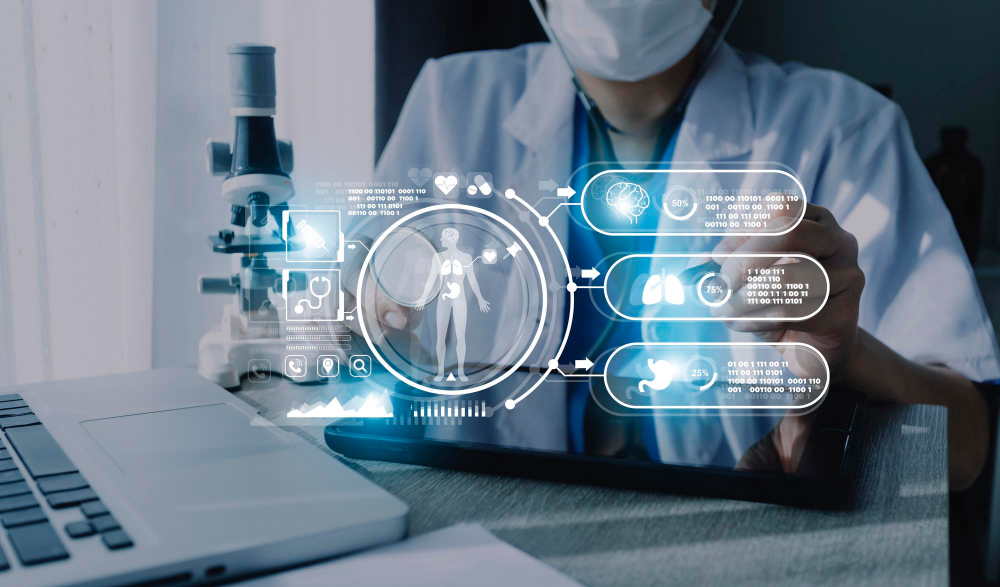
Medical imaging is one of the most established application areas for medical AI. AI-based image recognition systems are trained on large datasets of labeled medical images, enabling them to identify patterns associated with specific conditions.
Medical image recognition technology has demonstrated an accuracy rate of 93.4% for positive predictions and 83.6% for negative predictions in diagnostic support scenarios. These figures illustrate how AI can assist clinicians by highlighting potential abnormalities that warrant closer review.
In practice, these systems are used as decision-support tools rather than replacements for medical professionals. AI development companies play a key role in training models, validating performance, and integrating image recognition solutions into hospital imaging systems in a way that supports clinical workflows.
2. Disease Diagnosis and Early Detection
Beyond imaging, medical AI is used to support disease diagnosis by analyzing patient data such as symptoms, test results, and historical records. AI systems can help identify patterns that may not be immediately obvious through manual review alone.
These diagnostic support systems are particularly valuable in environments with high patient volumes, where clinicians must make timely decisions. AI can assist by prioritizing cases or flagging potential risks for further evaluation.
Developing such systems requires careful handling of medical data and close alignment with clinical processes. AI development companies are often responsible for ensuring that diagnostic tools are accurate, interpretable, and integrated safely into healthcare IT systems.
3. Medical Data Management and Analysis
Healthcare organizations manage large volumes of structured and unstructured data, including electronic health records, lab results, and clinical notes. Medical AI is increasingly used to organize, analyze, and extract insights from this data.
AI-based data analysis supports tasks such as identifying trends in patient outcomes, improving reporting accuracy, and reducing manual data entry. By automating data processing, healthcare providers can focus more on patient care rather than administrative work.
From a development perspective, this use case emphasizes system integration, data security, and scalability. AI development companies contribute by building data pipelines and analytics platforms that can operate reliably within complex healthcare environments.
4. Smart Healthcare Operations and Workflow Optimization

Medical AI is also applied to operational processes such as appointment scheduling, resource allocation, and internal workflow management. These applications aim to improve efficiency rather than clinical decision-making directly.
AI systems can analyze historical operational data to identify bottlenecks or inefficiencies and support better planning. While these use cases are less visible to patients, they play a critical role in improving overall healthcare service quality.
Implementing operational AI requires coordination across multiple systems and departments. AI development companies help design solutions that align with existing infrastructure while meeting healthcare-specific requirements for reliability and compliance.
Key Considerations When Working With AI Development Companies
Medical AI solutions must meet higher standards than typical enterprise software. Accuracy, reliability, and safety are essential, particularly when systems support clinical decisions.
Data quality is a foundational concern. AI models depend on consistent and well-structured data, and poor data quality can significantly affect performance. AI development companies often assist with data preparation and validation to address this issue.
System integration is another major factor. Medical AI solutions must work seamlessly with electronic health records, imaging systems, and operational platforms. Without proper integration, even accurate AI models may fail to deliver practical value.
Finally, transparency and maintainability are important. Healthcare organizations need to understand how AI systems function and how they can be updated or monitored over time — responsibilities that often fall to development partners.
The Role of AI Development Companies in Medical AI Adoption
As medical AI continues to evolve, healthcare organizations increasingly rely on AI development companies to bridge the gap between conceptual use cases and deployable systems. These companies provide expertise in model development, system architecture, integration, and long-term support.
Rather than focusing solely on algorithms, effective AI development partners consider the full lifecycle of medical AI solutions — from data preparation and testing to deployment and maintenance within regulated environments.
Conclusion
Medical AI is already playing a meaningful role in healthcare, particularly in areas such as medical imaging, diagnostic support, data analysis, and operational optimization. While the technology continues to evolve, proven performance figures — such as the image recognition accuracy rates cited in the original Relipa article — demonstrate that AI can deliver practical value when applied appropriately.
For healthcare organizations, successful adoption depends not only on the technology itself but also on how it is designed, integrated, and maintained. By working with experienced AI development companies, organizations can implement medical AI solutions that are reliable, scalable, and aligned with real-world healthcare needs.
Relipa Software
Relipa Co., Ltd. is a Vietnam-based software development company established in April 2016. After two years of growth, our Japanese branch – Relipa Japan – was officially founded in July 2018.
We provide services in MVP development, web and mobile application development, and blockchain solutions. With a team of over 100 professional IT engineers and experienced project managers, Relipa has become a reliable partner for many enterprises and has successfully delivered more than 500 projects for startups and businesses worldwide.
